 English
 Le français
 Türkçe

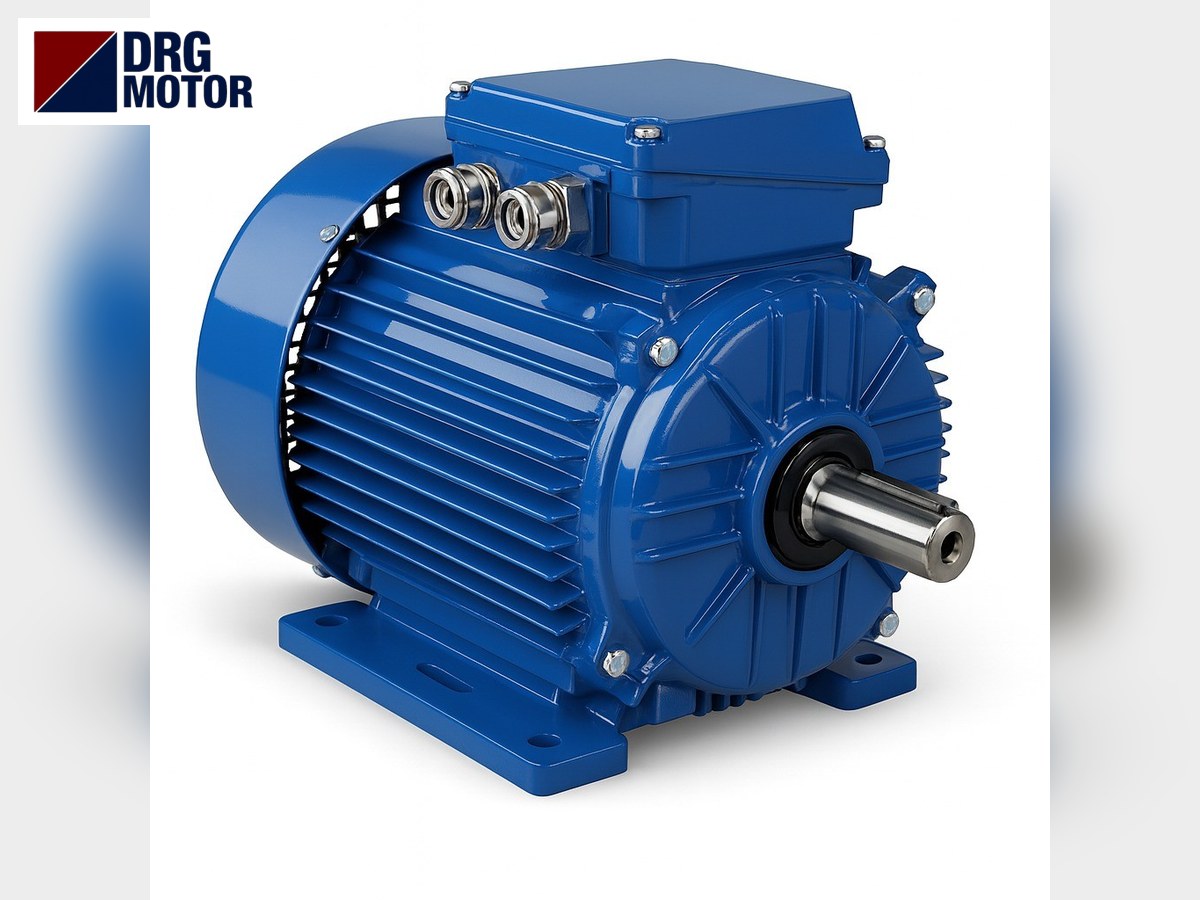
On a hydraulic log splitter the electric motor does not split the wood itself: it turns a hydraulic pump, the oil from the pump drives a cylinder, and the wedge on the cylinder splits the log along its grain. Maker catalogues give 2.2 to 5.5 kW motors for electric log splitters; on firewood processors, which first cut the log to length and then split it, the figure climbs to 11–22 kW. Motor power sets how fast the wedge moves, not how many tonnes the machine pushes.
DRG Motor is a manufacturer, supplier and seller of electric motors. We do not sell log splitters, wedges, cylinders, hydraulic pumps, valves or hydraulic units, nor gearboxes, inverters, electro-spindles or servo motors. We supply the three-phase induction motor at the pump end; suitable models are on Buy Electric Motors Online.
How does power flow in a log splitter?
The chain is short: motor → coupling → gear pump → directional valve → cylinder → wedge. With the valve in neutral the oil returns to the tank and the motor runs almost unloaded; when the operator presses the two-hand control, oil goes to the cylinder and pressure rises with the log’s resistance. The load is therefore intermittent: a short splitting stroke, then the return stroke and idling while the next log is placed. Through most of that cycle the motor is not at full load.
Horizontal and vertical splitters
On horizontal machines a short log lies in a trough and the wedge pushes from the side; this is the small, low-power class close to home and garden use. On vertical machines a metre-long log stands upright and the wedge comes down from above; most professional machines in the 13–30 t class are built this way and carry extras such as log lifters and winches.
Firewood processor
A firewood processor feeds the log forward on an infeed belt, cuts it to length with a chain bar or a large circular blade, pushes the cut piece through a multi-way wedge and carries the firewood to a pile on a conveyor. In electric versions a single motor powers all of this; catalogues show 11 kW and 22 kW. Whether the conveyor has its own motor and which movements are hydraulic varies by model.
How it differs from stone splitters and wood chippers
Stone splitters are hydraulic too, but there the stone is cracked between two toothed blades at a very high cycle rate; in log splitting the wedge travels along the grain and resistance changes with species, moisture and knots. Chippers that turn wood into chips are a completely different design with the motor driving a disc directly; for those see our wood chipper and chip mill article.
Motor power from pump flow and pressure
Motor power comes from pump pressure times flow: P (kW) = p (bar) × Q (l/min) / (600 × η), where η is the overall pump efficiency. Cylinder thrust is pressure times cylinder area; it is set by the circuit’s maximum pressure and the cylinder bore, not by motor power. Our hydraulic pump motor kW calculation article goes through the formula and its tables step by step.
Example: a 16-tonne vertical log splitter
Take a machine with an 8 cm³/rev gear pump, 200 bar maximum pressure and a 100 mm bore cylinder. Let a DRG-132S-4 (5.5 kW, 1,460 rpm) drive the pump; volumetric efficiency 0.95 and overall efficiency 0.85 are assumed:
| Step | Calculation | Result | Note |
|---|---|---|---|
| Pump flow | 8 cm³/rev × 1,460 rpm × 0.95 | ≈ 11.1 l/min | motor: DRG-132S-4 |
| Power in the splitting stage | 200 bar × 11.1 / (600 × 0.85) | ≈ 4.35 kW | next standard size: 5.5 kW |
| Cylinder force, Ø100 mm | 200 bar × 78.5 cm² | ≈ 15,700 daN (about 16 t) | independent of motor power |
| Splitting speed | 11,100 cm³/min ÷ 78.5 cm² | ≈ 2.35 cm/s | more flow means more speed |
| Fast approach stage | 40 bar × 22 l/min / 510 | ≈ 1.7 kW | with a two-stage pump |
With 4.35 kW needed, the splitter gets the 5.5 kW frame. Fitting a 7.5 kW motor to the same machine does not change its tonnage; only with a larger pump would the wedge move faster. That is why the pump displacement and relief valve setting matter when you replace the motor.
Two-stage pump and two speeds
The “two splitting speeds” mentioned in catalogues usually come from a two-stage pump: until the wedge meets the log, high flow at low pressure gives a fast approach; once resistance rises, the pump shifts to low flow at high pressure. The last row of the table shows it: 1.7 kW is enough for the approach, and the splitting stage decides the motor size. One maker quotes 12.5 and 3.7 cm/s on motor drive for its 30 t machine, another 10.5 and 4.3 cm/s for a 22 t model.
Click to see current electric motor prices and order nowSEE PRICES →
How many kW is a log splitter motor? Catalogue values
A) Motor ratings published for electric log splitters and firewood processors:
| Machine | Electric motor | Single / total | Note |
|---|---|---|---|
| Short-log splitter, 5.5–6 t | 2.2 kW, 400 V or 230 V | single motor driving the pump | maker catalogue, two models |
| Vertical log splitter, 14 t | 3.5 kW, 400 V | single motor | maker catalogue, mid-size model |
| Vertical log splitter, 13 t | 5.5 kW, 400 V | single motor; tractor version needs 14 kW at the PTO | second maker |
| Log splitter, 22 t, two speeds | 5.1 kW, 400 V | single motor | third maker |
| Vertical log splitter, 30 t | 5.5 kW, 400 V + PTO | single motor; second drive by tractor | catalogues of two makers |
| Firewood processor, 38 cm log | 11 kW, 2,910 rpm | the only electric motor on the machine | fourth maker |
| Firewood processor, 37 cm log, 15 t | 22 kW, 400 V | the only electric motor on the machine | second maker |
| Electric power unit replacing the tractor | 11 / 15 kW, 1,500 rpm | unit motor turning the PTO input | fourth maker |
Across these makers, electric splitters use about 2.2–5.5 kW and processors 11–22 kW. A 30 t machine running on a motor hardly larger than a 14 t one shows that tonnage comes from cylinder and pressure, not from the motor; the difference shows up mainly as ram speed. The tractor power needed by PTO-driven versions must not be confused with electric motor power.
B) Where DRG fits: for 2.2 kW the DRG-100L1-4 or the 2-pole DRG-90L-2, for 5.5 kW the DRG-132S-4, for 11 kW the DRG-160M-4 and the 2-pole DRG-160M1-2, for 15 kW the DRG-160L-4 and for 22 kW the DRG-180L-4. For non-standard values such as 3.5 and 5.1 kW, an equal or next standard size (4 or 5.5 kW) is chosen and the pump coupling and fuse are checked again. Some small machines in the catalogues are 230 V single-phase; single-phase motors are not in the DRG range. Tractor PTO drives and petrol power units are outside our scope as well; they are not electric motors.
Connecting the motor to the pump and commissioning
Flange, bell housing and coupling
The gear pump is usually joined through a bell housing and a flexible coupling between motor and pump, with a B5 flange or B35 foot-and-flange motor. On small machines the pump may sit directly on the motor flange with a special coupling. On the new motor, shaft diameter, shaft length and flange spigot must match the bell housing; otherwise the bell housing or coupling hub is changed.
Direction of rotation and starting
A gear pump runs in one direction only. If the motor turns backwards the pump delivers no oil and can soon be damaged; at first start, jog the motor and compare with the arrow on the pump, and if it is wrong swap two phases. Some makers fit a phase inverter to their machines for this reason. Motors up to 5.5 kW usually start direct-on-line: for the DRG-132S-4 the starting current is about 10.7 × 7.9 ≈ 85 A, and it is brief because the pump starts unloaded. The 22 kW processor class is normally started in star-delta or through a soft starter, and it needs a heavier plug and socket; see our star-delta starting page.
Outdoor use, bark and oil temperature
Log splitters often work outdoors, in the woodyard or under a roof. Our motors are IP55; even so, they should not stand in direct rain, the terminal box cable entry should face down, and bark and chips must not fill the fan cowl. During long sessions the tank oil warms up; very hot oil lowers pump efficiency and keeps the motor loaded longer for the same work. In winter, cold thick oil makes starting harder; a few minutes of idling warms it.
DRG motors for log splitters
Our models matching log splitter, processor and electric power unit ratings (current at 400 V):
| Model | Power / speed | Frame · shaft D×E | Current 400 V |
|---|---|---|---|
| DRG-90L-2 | 2.2 kW / 2895 rpm | 90L cast iron · 24×50 | 4.35 A |
| DRG-100L1-4 | 2.2 kW / 1450 rpm | 100L cast iron · 28×60 | 4.52 A |
| DRG-112M-4 | 4 kW / 1450 rpm | 112M cast iron · 28×60 | 7.95 A |
| DRG-132S-4 | 5.5 kW / 1460 rpm | 132S cast iron · 38×80 | 10.7 A |
| DRG-160M1-2 | 11 kW / 2945 rpm | 160M cast iron · 42×110 | 19.6 A |
| DRG-160M-4 | 11 kW / 1465 rpm | 160M cast iron · 42×110 | 20.4 A |
| DRG-160L-4 | 15 kW / 1465 rpm | 160L cast iron · 42×110 | 27.3 A |
| DRG-180L-4 | 22 kW / 1470 rpm | 180L cast iron · 48×110 | 39.7 A |
Gear pumps are mostly sized for 1,500 rpm, so the 4-pole motor is common; 3,000 rpm (2-pole) also appears where a small pump must give speed. Small splitters take aluminium motors up to 11 kW, processors and power units cast iron ones; our motors are three-phase IEC induction motors, and a 1,000 rpm option is available. Mounting is usually B5 or B35; B3, B14 and B34 can be ordered too. Before replacing, note power, speed and voltage on the old plate, shaft diameter and key, flange size, pump rotation and bell housing dimensions. With these figures and the splitter’s manual side by side, we propose a motor and settle it with you, without promising an exact fit. Flange dimensions are on our technical drawings page.
Live price table
Prices of motors in log splitter and processor ratings come live from the shop:
| Model | Power / speed | Frame · current 400 V | Price |
|---|---|---|---|
| DRG-100L1-43 HP | 2.2 kW · 1500 rpm | Cast iron 100L · 4.52 A | $188.32 (€168.18) Details & buy → |
| DRG-112M-45.5 HP | 4 kW · 1500 rpm | Cast iron 112M · 7.95 A | $254.38 (€227.18) Details & buy → |
| DRG-132S-47.5 HP | 5.5 kW · 1500 rpm | Cast iron 132S · 10.7 A | $342.01 (€305.44) Details & buy → |
| DRG-132M-410 HP | 7.5 kW · 1500 rpm | Cast iron 132M · 14.3 A | $394.89 (€352.66) Details & buy → |
| DRG-160M-415 HP | 11 kW · 1500 rpm | Cast iron 160M · 20.4 A | $568.76 (€507.94) Details & buy → |
| DRG-160M1-215 HP | 11 kW · 3000 rpm | Cast iron 160M · 19.6 A | $527.95 (€471.49) Details & buy → |
| DRG-160L-420 HP | 15 kW · 1500 rpm | Cast iron 160L · 27.3 A | $678.13 (€605.61) Details & buy → |
| DRG-180L-430 HP | 22 kW · 1500 rpm | Cast iron 180L · 39.7 A | $919.45 (€821.13) Details & buy → |
DRG MOTOR motors are guaranteed against material and manufacturing defects for 2 years from the delivery date (warranty certificate).
Motors in this power range
- DRG-112M-4 – 4 kW – 1450 rpm – 112M cast iron
- DRG-132S-4 – 5.5 kW – 1460 rpm – 132S cast iron
- DRG-160M-4 – 11 kW – 1465 rpm – 160M cast iron
- DRG-160L-4 – 15 kW – 1465 rpm – 160L cast iron
- DRG-180L-4 – 22 kW – 1470 rpm – 180L cast iron
Click to see current prices and order these motors nowSEE PRICES →
Browse the products, ask for a quote: the full choice of motors for your log splitter is on Buy Electric Motors Online. Pictures of plate, pump and bell housing over WhatsApp get us started; on +90 (542) 666 11 11 give us the tonnage and pump displacement.
Frequently asked questions
Will a stronger motor let my log splitter split thicker logs?
No. Splitting force is limited by cylinder bore and relief valve pressure. A stronger motor only speeds up the wedge, and only together with a larger pump; raising the pressure depends on what the cylinder and hoses can take and is the machine maker’s call.
Can I convert a tractor-driven log splitter to electric?
The PTO pump can be coupled to an electric motor through a bell housing and coupling, or an electric power unit that turns the PTO input can be used. Pump speed and direction, the power needed and the mounting position are the basis of the conversion; talk the details through with us.
The motor runs but the wedge does not move. Why?
The usual causes are reverse rotation, low oil level, a broken coupling or a worn pump. If the motor draws normal current and turns, the fault is most likely on the hydraulic side.
Got a splitter that needs a new motor? Phone +90 (542) 666 11 11, e-mail info@drgmotor.com or use our contact page.


