 English
 Le français
 Türkçe

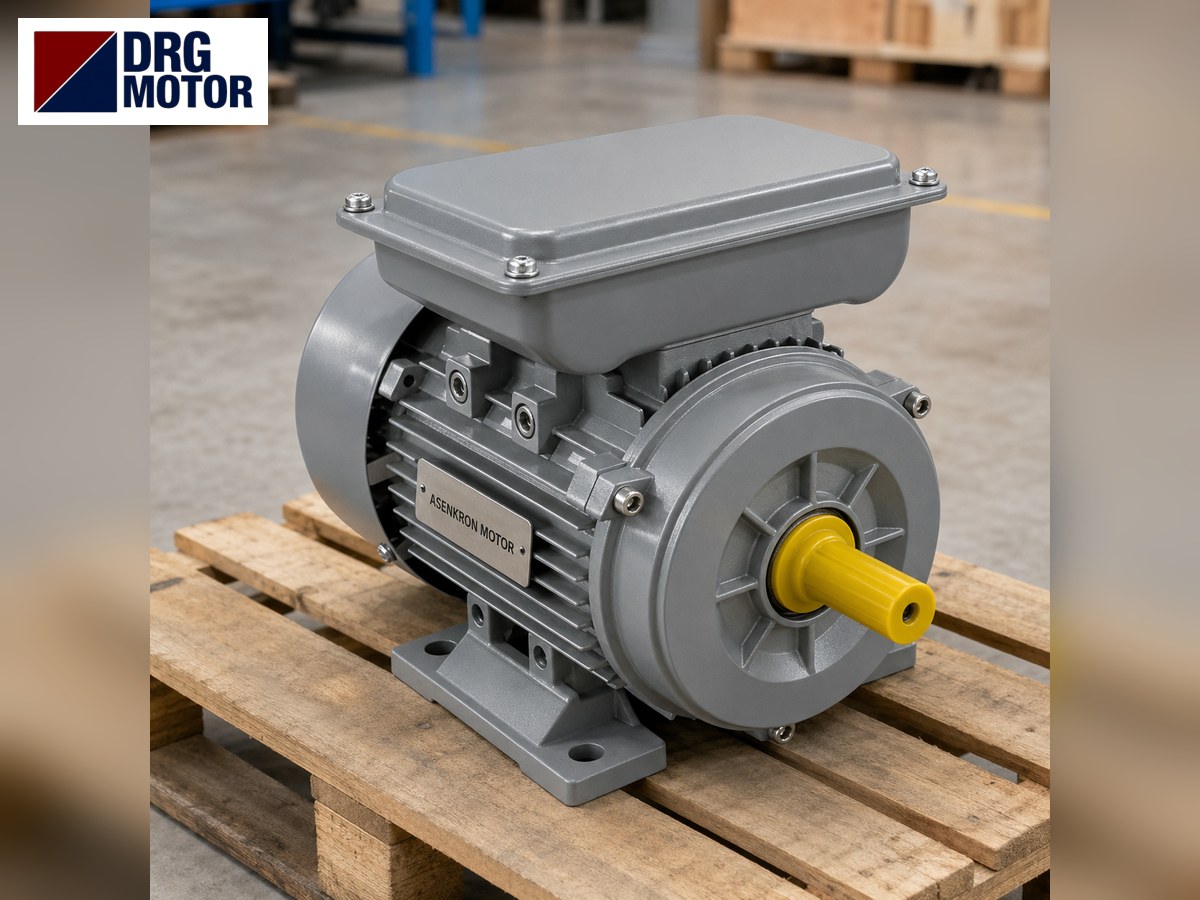
On the wide belt sander used in furniture and wood panel production, the main electric motor drives the contact roller that carries the abrasive belt, through V-belts; the feed belt that carries the panel through the machine and the table lift each have their own small motor. Maker catalogues list 7.5–37 kW per sanding unit, 1.1–4.5 kW for the feed belt and 0.37–0.55 kW for the table lift. This page covers the motors of industrial machines sanding panels and solid wood; for belt speed on a workshop belt sander, see our belt sander motor article.
DRG Motor is a manufacturer, supplier and seller of electric motors. We do not sell the sanding machine, its abrasive belts or brushes; gearboxes, hydraulic or pneumatic units, inverters, electro-spindles and servo motors are likewise outside our offer. Our supply is the motor itself, three-phase, for the sanding units and the feed; models are on Buy Electric Motors Online.
Where do the motors work on a wide belt sander?
The panel is laid on a rubber-coated feed belt, pressure rollers hold it down and the belt carries it under the sanding units. In each unit an endless abrasive belt is tensioned between a contact roller and one or two return rollers. The main motor turns the contact roller; the abrasive belt, squeezed between roller and panel, grinds the surface down. The first unit is usually for calibrating or coarse sanding and carries the largest motor; the following units do fine sanding and pad sanding.
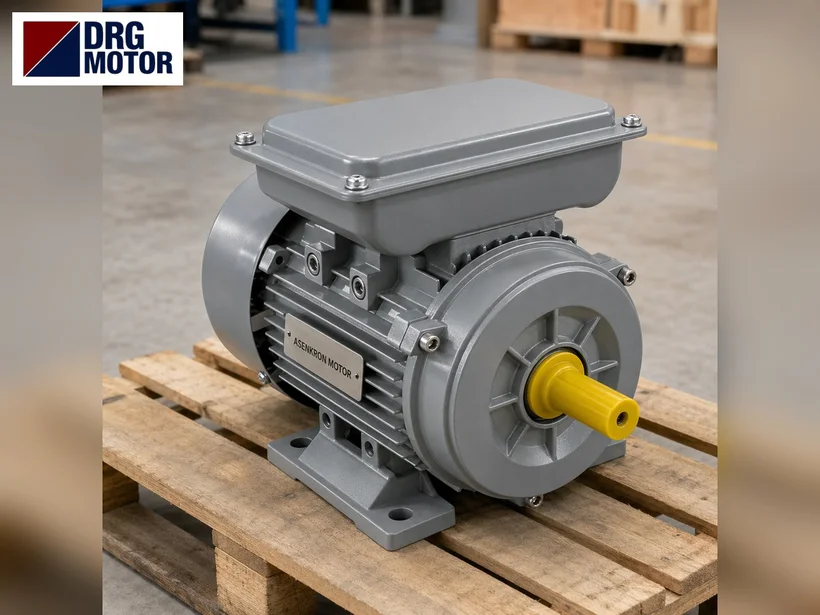
Main motor of the sanding unit
The main motor is a foot-mounted (B3) motor standing beside the machine frame and belted to the contact roller; data sheets show a separate motor for each unit. Belt speed comes from contact roller diameter and pulley ratio. The second maker’s data sheet gives 23 m/s on the first unit and 17 m/s on the second, each matched with a different rating (15 kW and 7.5 kW). One catalogue lists automatic star-delta starting as standard for the larger motors.
Feed belt and table lift
The feed belt motor turns the drive roller through a gearbox; catalogues show two-step (4.5/9 m/min) or inverter-adjusted 3–15 m/min feed. The table lift motor raises and lowers the table on screw spindles to suit panel thickness; it is small but switches on often during setting.
Belt oscillation, brush sanding and orbital sanding
While running, the abrasive belt swings slowly from side to side so that it does not wear along a single line or mark the panel. One catalogue states that oscillation is controlled by an infrared sensor. On many machines the oscillating movement comes from an air cylinder and needs no separate electric motor; if your machine has a motor for oscillation, read its plate and give its rating and speed separately.
Brush sanding and brushing units
Brush machines use rotating brushes or abrasive flap drums instead of a flat belt: on profiled doors, distressed surfaces and between lacquer coats they reach places a flat belt cannot. On the fourth maker’s brushing machine two brush units run with 4 kW motors turning against the feed; the second unit has electrical height adjustment and the brushes can be given optional oscillation. Brush motors, too, are mostly standard 4-pole motors with belt or direct drive.
Orbital sanding units
Some lines add orbital or vibrating pad units behind the belt units. We could not find a reliable catalogue value for the motor rating and speed of these units, so we give no figure. The motor is chosen from application data: send us the old motor’s plate rating and speed, the type of eccentric or cam mechanism, whether the motor stands vertical or horizontal, and the width of the unit.
How many kW is a sanding machine motor? Catalogue values
A) Motor ratings published by makers of wide belt and brush sanding machines:
| Machine / unit | Motor power | Single / total | Note |
|---|---|---|---|
| One- to three-unit wide belt, 650–1300 mm | 11 kW; options 15 and 18.5 kW | per sanding unit | first maker’s catalogue |
| Same series, two-speed belt (9/18 m/s) | max. 11 kW | per sanding unit | first maker, option |
| Two units, 950 mm: 1st unit | 15 kW | single motor, belt 23 m/s | second maker’s data sheet |
| Two units, 950 mm: 2nd unit | 7.5 kW | single motor, belt 17 m/s | second maker’s data sheet |
| Three units, 1000–1300 mm: 1st unit | 15/22–37 kW | single motor | third maker |
| Three units: 2nd and 3rd unit | 11–22 kW | per unit | third maker |
| Feed belt motor | 1.1–4.5 kW | single motor | second and third maker |
| Table lift motor | 0.37–0.55 kW | single motor | second and third maker |
| Brushing unit (steel brush) | 4 kW | per brush; two units total 8 kW | fourth maker |
| Total of the two-unit machine | 23.97 kW | machine total | second maker’s data sheet |
Depending on model, working width and unit position, each sanding unit takes roughly 7.5–37 kW, the feed 1.1–4.5 kW and the table 0.37–0.55 kW. Machine total grows with the number of units; the 23.97 kW in the table is the sum of two units plus feed and table motors, not one motor. Main motor rating climbs with working width and when the first unit calibrates.
B) Where DRG fits: 7.5–37 kW sanding unit motors match our 4-pole cast iron 132M to 225S frames, 1.1–4.5 kW feed motors the 90S to 112M frames, and 0.37–0.55 kW table motors the 71 and 80 frames; 2-pole versions of the same ratings are in the range too. The whole span lies inside our range.
Click to see current electric motor prices and order nowSEE PRICES →
Worked example: pulley ratio and sequential starting
The second maker’s data sheet gives a 190 mm contact roller and 23 m/s belt speed for the first unit. From these we can find the roller speed needed and the pulley ratio with two different motors:
| Option | Operation | Result | Comment |
|---|---|---|---|
| Required roller speed | 23 × 60 / (π × 0.19) | about 2,312 rpm | 190 mm contact roller, 23 m/s |
| 4-pole motor, DRG-160L-4 | 2,312 / 1,465 | about 1.58 step-up | large motor pulley, small roller pulley |
| 2-pole motor, DRG-160M2-2 | 2,945 / 2,312 | about 1.27 step-down | small motor pulley, large roller pulley |
| Direct drive, 4 poles | π × 0.19 × 1,465 / 60 | about 14.6 m/s | below the belt speed in the data sheet |
The table shows that changing motor speed changes belt speed directly: replace a 2-pole motor with a 4-pole one and keep the pulleys, and belt speed halves. Try pulley diameters with our pulley and belt calculator.
Starting current on a two-unit machine
Take the motors of the same data sheet with their equivalents in our range: DRG-160L-4 for 15 kW, DRG-132M-4 for 7.5 kW, DRG-90S-4 for the 1.1 kW feed, DRG-712-4 for the 0.37 kW table (rated torque: DRG-160L-4, 97.8 Nm).
| Case | Operation | Current (400 V) | Note |
|---|---|---|---|
| All four motors running | 27.3 + 14.3 + 2.48 + 0.92 | about 45 A | sum of rated currents |
| 15 kW unit, direct-on-line start | 27.3 × 7.8 | about 213 A | Is/In = 7.8 |
| Both units started DOL together | 212.9 + 14.3 × 7.5 | about 320 A | case to avoid |
| 15 kW unit, star-delta | 212.9 / 3 | about 71 A | star step |
| 2nd unit star-delta while 1st runs | 27.3 + 107.3 / 3 | about 63 A | sequential switching |
Even if the abrasive belt starts unloaded, the inertia of the large contact roller and pulleys lengthens the start. Bringing the units in a few seconds apart and in star-delta noticeably reduces the shock on the supply. See our star-delta tool for details.
Braking, dust and items outside our range
After switching off, the abrasive belt and heavy contact roller keep turning for a long time. One catalogue shows a pneumatic disc brake for the main motor as standard; that brake belongs to the machine. Brake motors are not in our range; where quick stopping is needed, the machine’s mechanical brake or DC-injection electronic braking in the panel is used. The single-phase motors common on small workshop sanders, high-frequency motors and drives are also outside our range.
Fine sanding dust and motor cooling
Sanding produces the finest dust in woodworking. It sticks to the motor’s fan cowl and fins; clogged fins mean a hotter motor for the same work. Our IP55 motors are dust protected, yet the machine’s extraction outlets (150 mm on one data sheet) should always be connected to the workshop dust system. For the extraction fan motor see the Fan Motors category, and for motor choice in dusty rooms our dust and extraction article. A filter or silo rated as an explosive dust area calls for an Ex motor and paperwork; our standard motor is not sold with that documentation.
DRG motors for sanding machines
Four-pole DRG motors sized for sanding heads, feed belts and table lifts, with 400 V current:
| Model | Power / speed | Frame · shaft D×E | Current 400 V |
|---|---|---|---|
| DRG-712-4 | 0.37 kW / 1340 rpm | 71 aluminium · 14×30 | 0.92 A |
| DRG-90S-4 | 1.1 kW / 1445 rpm | 90S cast iron · 24×50 | 2.48 A |
| DRG-112M-4 | 4 kW / 1450 rpm | 112M cast iron · 28×60 | 7.95 A |
| DRG-132M-4 | 7.5 kW / 1460 rpm | 132M cast iron · 38×80 | 14.3 A |
| DRG-160M-4 | 11 kW / 1465 rpm | 160M cast iron · 42×110 | 20.4 A |
| DRG-160L-4 | 15 kW / 1465 rpm | 160L cast iron · 42×110 | 27.3 A |
| DRG-180L-4 | 22 kW / 1470 rpm | 180L cast iron · 48×110 | 39.7 A |
| DRG-225S-4 | 37 kW / 1485 rpm | 225S cast iron · 60×140 | 66.1 A |
The main motor is usually a foot-mounted (B3) cast iron frame, the feed gearbox motor a small flange-mounted (B5 or B14) one. Aluminium versions stop at 11 kW, while the cast iron line continues to 355 kW; all are three-phase IEC induction motors with 2, 4 or 6 poles. Before removing the old motor, note its plate power, speed, voltage and star/delta connection, shaft diameter and key, foot or flange size and pulley diameter. Those figures are compared with the sander’s manual before we confirm; we give no fit guarantee without seeing the dimensions.
B5 dimensions for the feed motor
B5 flange values of the small frames used on feed and table drives, mm:
| Frame | Shaft D×E | Flange P / M / N | Hole S |
|---|---|---|---|
| 71 | 14×30 | 160 / 130 / 110 | 10 |
| 90S/90L | 24×50 | 200 / 165 / 130 | 12 |
| 132S/132M | 38×80 | 300 / 265 / 230 | 14.5 |
On a geared feed the motor shaft enters the gearbox input, so D and E and the spigot diameter N must match exactly. For main motor foot dimensions see the technical drawings page.
Live price table
Prices of our models in sanding unit, feed and table motor sizes are pulled live from the shop:
| Model | Power / speed | Frame · current 400 V | Price |
|---|---|---|---|
| DRG-712-40.5 HP | 0.37 kW · 1500 rpm | Aluminium 71 · 0.92 A | $76.76 (€68.55) Details & buy → |
| DRG-90S-41.5 HP | 1.1 kW · 1500 rpm | Cast iron 90S · 2.48 A | $124.09 (€110.82) Details & buy → |
| DRG-132M-410 HP | 7.5 kW · 1500 rpm | Cast iron 132M · 14.3 A | $394.89 (€352.66) Details & buy → |
| DRG-160M-415 HP | 11 kW · 1500 rpm | Cast iron 160M · 20.4 A | $568.76 (€507.94) Details & buy → |
| DRG-160L-420 HP | 15 kW · 1500 rpm | Cast iron 160L · 27.3 A | $678.13 (€605.61) Details & buy → |
| DRG-180M-425 HP | 18.5 kW · 1500 rpm | Cast iron 180M · 33.5 A | $873.49 (€780.08) Details & buy → |
| DRG-180L-430 HP | 22 kW · 1500 rpm | Cast iron 180L · 39.7 A | $919.45 (€821.13) Details & buy → |
| DRG-225S-450 HP | 37 kW · 1500 rpm | Cast iron 225S · 66.1 A | $1,527.18 (€1,363.87) Details & buy → |
DRG MOTOR motors are guaranteed against material and manufacturing defects for 2 years from the delivery date (warranty certificate).
Motors in this power range
- DRG-90S-4 – 1.1 kW – 1445 rpm – 90S cast iron
- DRG-132M-4 – 7.5 kW – 1460 rpm – 132M cast iron
- DRG-160M-4 – 11 kW – 1465 rpm – 160M cast iron
- DRG-160L-4 – 15 kW – 1465 rpm – 160L cast iron
- DRG-180M-4 – 18.5 kW – 1470 rpm – 180M cast iron
Click to see current prices and order these motors nowSEE PRICES →
Browse the products, ask for a quote: suitable motors for your sander are on Buy Electric Motors Online. A photo of the main motor plate and its pulley side on WhatsApp is enough; by phone (+90 (542) 666 11 11), the number of sanding heads and the working width are a good start.
Frequently asked questions
Is the main motor of a wide belt sander 2-pole or 4-pole?
Both are used; motor speed and pulley ratio together set belt speed. If the replacement has the same pole count as the old motor, the pulleys need no change.
What happens if I fit a stronger motor to a sanding unit?
Panel, cable and protection must suit the new rating, and the machine maker must say whether contact roller, bearings and belts can carry the torque. A stronger motor alone does not mean faster sanding; feed speed and grit matter as much.
What does the price of a sanding machine motor depend on?
Rating, poles and frame; the table above is refreshed from the shop.
For questions about your sanding line, reach us at +90 (542) 666 11 11, info@drgmotor.com or via our contact page. For wood machines in general, our woodworking machine motor guide is also useful.


