 English
 Le français
 Türkçe

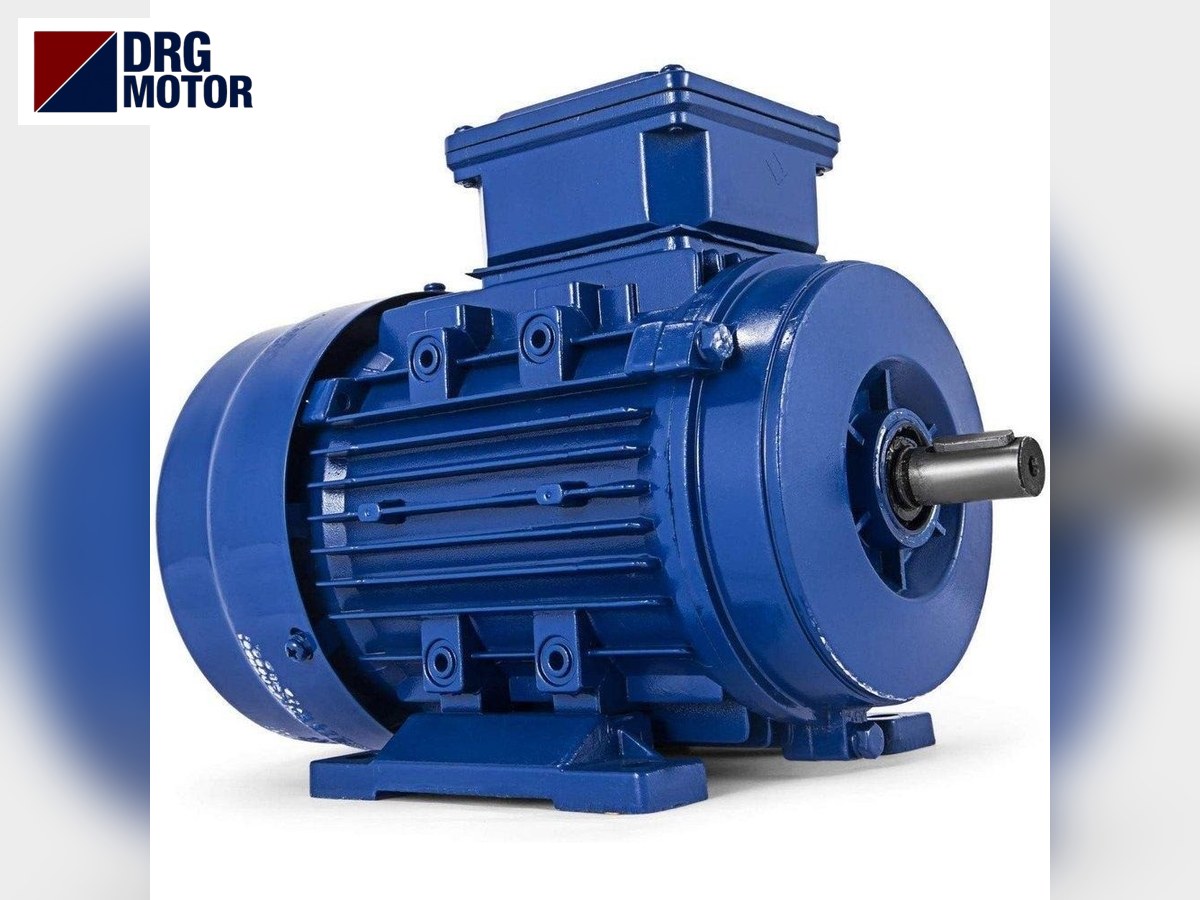
In a dust extraction or chip collection system the electric motor turns the fan that draws air from the machine hoods and carries it to the filter or cyclone. Larger systems add small motors for the rotary valve, the screw conveyor and filter cleaning. Manufacturer catalogues show 0.75–2.2 kW for mobile single-machine chip collectors, 1.1–15 kW for bag and filter units sized for a workshop, and 30–37 kW per fan in central filter systems. Two quantities set the power: the airflow the system needs and the total pressure the fan has to overcome.
DRG Motor is a manufacturer, supplier and seller of electric motors. This page is about the electric motor of the system. We do not sell servo motors, spindles, inverters, hydraulic units or gearboxes, nor the filter housing, bags, cartridges, cyclone, fan impeller and scroll or the body of the rotary valve. The three-phase induction motors that turn the fan or the valve are listed on the Buy Electric Motors Online page.
Chip collection layouts: from mobile unit to central system
Woodshops collect chips and dust in three common ways. The motor sits in a different place, has a different size and works differently in each, so the first step when replacing it is to know which group your system belongs to.
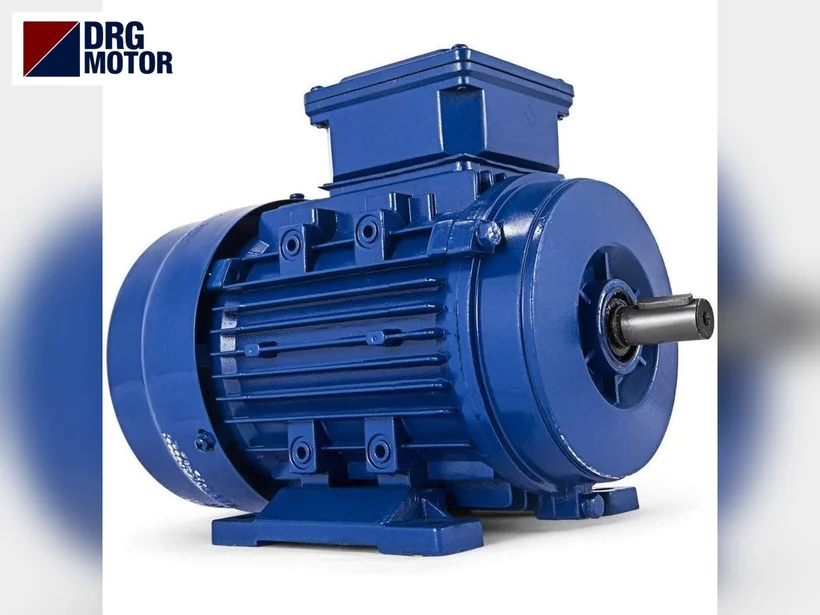
Mobile bag-type chip collector
A small wheeled unit placed next to one machine such as a planer, a circular saw or a band saw. The impeller is usually fitted straight on the motor shaft and blows air into the bags. Motors in this class are 2-pole: one manufacturer lists every model at 3450 rpm on 60 Hz, which corresponds to the 3000 rpm class on a 50 Hz grid. Some of the small models are sold with single-phase motors.
Workshop filter unit and compact filter
These units serve several machines at once, use cartridge or bag filters and often have their own pre-separator. Some designs place the fan after the filter, where the air is already clean, keeping impeller and motor away from the dust.
Central dust extraction system
At factory scale every machine is connected through a duct network to a large filter outside the building. The number and size of fans follow the total airflow of the hoods that may be open at the same time; large plants run several fans in parallel. Chips leaving the filter go to the silo through a rotary valve and screw or by air.
Airflow and pressure decide the fan power
The fan motor power comes from the volume of air moved multiplied by the resistance that air meets. Airflow (m³/h) depends on the number and diameter of the hoods and on the air velocity in the duct; the velocity is kept above a certain value so that wood chips do not settle inside the duct. Pressure (Pa) is the sum of duct length, bends, filter loading and hood losses.
Formula and coefficients
Fan shaft power is roughly P = Q × Δp / η_fan, where Q is airflow (m³/s), Δp is total pressure (Pa) and η_fan is the fan’s own coefficient read from the manufacturer’s curve. Belt-driven fans get an extra factor for belt losses. A margin for start-up and filter loading is added to the result, then the next standard motor rating is chosen.
How many kW for a dust extraction motor? Catalogue values
A) What manufacturers list as motor power for chip collection and dust extraction equipment:
| Equipment | Motor power | Single / total | Note |
|---|---|---|---|
| Mobile chip collector, single machine | 0.75–2.2 kW | single motor (fan) | manufacturer catalogue; some small models are single-phase |
| Bag-type chip collector, 2–4 bags | 1.5–7.5 kW | single motor (fan) | second manufacturer; 2-pole class |
| Filter unit for workshops, with pre-separator | 1.1–15 kW | single motor (fan) | first manufacturer; about 10,000 m³/h in the largest model |
| Compact filter system | 3–18.5 kW; twin-fan type 2 × 11–2 × 18.5 kW | per fan | same catalogue |
| Central filter system, large size | 30–37 kW | per fan; 111 kW in total with 3 fans, 180 kW with 6 fans | same catalogue |
| Separate chip transport fan | 7.5 kW | single motor | third manufacturer; about 2,500 Pa |
| Rotary valve (airlock) for wood chips | 0.75–3 kW | single motor, rotor at 20–30 rpm | fourth manufacturer |
Depending on the model and airflow, this equipment group shows roughly 0.75–37 kW per fan and 0.75–3 kW for auxiliary drives such as rotary valves. In multi-fan central systems the totals in the table add up fans running in parallel; they are not the rating of one motor.
B) Where DRG motors fit: the whole 0.75–37 kW band is met by our three-phase IEC motors; fans mostly use 2 or 4 poles and rotary valve gearboxes 4 poles. Motors for single-phase mobile chip collectors are not in our range. Dust zones that call for Ex-certified motors are also outside our range; see the section below.
Click to see current electric motor prices and order nowSEE PRICES →
Worked example: central extraction for a six-machine shop
Assume a shop where six machines run together, the hoods need 9,000 m³/h in total and duct plus filter losses add up to 3,000 Pa. The fan coefficient at the duty point, read from the fan maker’s curve, is 0.70, and the impeller sits directly on the motor shaft. The values are for illustration only.
| Step | Calculation | Result | Comment |
|---|---|---|---|
| Airflow | 9,000 / 3,600 | 2.5 m³/s | hourly value converted to seconds |
| Fan shaft power | 2.5 × 3,000 / 0.7 | 10.7 kW | P = Q × Δp / η_fan |
| Power with margin | 10.7 × 1.15 | 12.3 kW | for start-up and a loaded filter |
| Motor choice | next standard rating | 15 kW | DRG-160M2-2 or DRG-160L-4 |
| Rated current | DRG-160M2-2, 400 V | 26.5 A | catalogue value |
| Direct-on-line start | 26.5 × 8.1 | about 215 A | Is/In = 8.1 |
| Star-delta start | 214.6 / 3 | about 72 A | in the star step |
The design speed of the impeller decides the number of poles; the same impeller does not deliver the same airflow at two different speeds. A heavy, large-diameter impeller takes a long time to run up. One manufacturer offers two control options for its filter unit: star-delta starting or a frequency converter. Torque falls in the star step, so run-up takes longer and the motor protection has to be set for that time. You can compare the methods with our star-delta starting tool.
Speed and pulleys on a belt-driven fan
On a belt-driven fan the motor speed and fan speed differ; the ratio of pulley diameters gives the speed the fan needs. Enlarging the pulley for more air raises the absorbed power with the cube of speed: ten per cent more speed adds close to a third more power. You can check the ratio with our pulley and belt calculator.
Wood dust, explosion risk and the Ex rule
Wood dust burns, and a cloud of it in air can ignite explosively. Parts of a dust extraction system are therefore classified into dust zones in the plant’s explosion protection document: zone 20 where a dust cloud is present continuously or for long periods, zone 21 where it may form occasionally in normal operation, zone 22 where it forms only in a fault and briefly. The dirty side of the filter, the inside of the silo and chip discharge points often fall into one of these zones.
Where Ex certification is needed
A motor placed in a classified zone must carry the Ex marking for that zone and be certified under ATEX. A standard motor cannot be fitted at such a point and an Ex-certified motor is required, because DRG Motor’s standard motors are not sold with this certificate. The plant or its safety consultant sets the zone.
If the motor is outside the zone
In many systems the fan motor stands downstream of the filter or outside the building, in a place not counted as a dust zone. If the explosion protection document treats that point as unclassified, a standard motor can be used; our motors are IP55. Even where no certificate is needed, fine dust settling on the frame fins heats the motor: clean the fins regularly and keep the terminal box cover and cable gland tight.
Rotary valve, screw and filter cleaning motors
The rotary valve (airlock) under the filter lets the collected chips out without losing the system’s air. In a rotary valve catalogue prepared for wood chips the rotor turns at 20–30 rpm and uses 0.75–3 kW motors depending on cell volume; the drive unit sits directly on the rotor shaft without a coupling. That low speed comes from a 4-pole motor and a high-ratio gearbox, which you source from the machine or gearbox maker.
Screw conveyor and briquetting press
Chips travel to the silo by screw or sometimes by air; small systems put a briquetting press right under the filter. The screw motor starts loaded; set the thermal relay to the nameplate current. In a briquetting press the motor usually drives a hydraulic pump; the pump and the unit are not part of our sales, we supply the motor only.
DRG motors for dust extraction systems
Example models from our range for fans and auxiliary drives (current at 400 V):
| Model | Power / speed | Frame · shaft D×E | Current 400 V |
|---|---|---|---|
| DRG-100L-2 | 3 kW / 2895 rpm | 100L cast iron · 28×60 | 5.71 A |
| DRG-132S2-2 | 7.5 kW / 2930 rpm | 132S cast iron · 38×80 | 13.7 A |
| DRG-160M2-2 | 15 kW / 2945 rpm | 160M cast iron · 42×110 | 26.5 A |
| DRG-160L-4 | 15 kW / 1465 rpm | 160L cast iron · 42×110 | 27.3 A |
| DRG-200L2-2 | 37 kW / 2960 rpm | 200L cast iron · 55×110 | 64 A |
| DRG-802-4 | 0.75 kW / 1420 rpm | 80 cast iron · 19×40 | 1.75 A |
For the fan side, pick from aluminium frames (0.25 to 11 kW) or cast iron frames (0.55 to 355 kW); fan speeds of 3000, 1500 or 1000 rpm are covered. Fans use foot-mounted B3 or flange-mounted B5 and B35 versions. To check the fit, read power, speed, voltage and connection off the old plate, measure frame, shaft and key, check the flange, and note whether the impeller is on the shaft or belt-driven. We review this with the documents of the fan or filter maker and confirm the fit with you; we give no blanket compatibility guarantee.
Live price table
Current shop prices for motors in fan and rotary valve ratings:
| Model | Power / speed | Frame · current 400 V | Price |
|---|---|---|---|
| DRG-802-41 HP | 0.75 kW · 1500 rpm | Cast iron 80 · 1.75 A | $101.93 (€91.03) Details & buy → |
| DRG-100L1-43 HP | 2.2 kW · 1500 rpm | Cast iron 100L · 4.52 A | $188.32 (€168.18) Details & buy → |
| DRG-90L-23 HP | 2.2 kW · 3000 rpm | Cast iron 90L · 4.35 A | $154.45 (€137.93) Details & buy → |
| DRG-100L-24 HP | 3 kW · 3000 rpm | Cast iron 100L · 5.71 A | $177.89 (€158.87) Details & buy → |
| DRG-132S2-210 HP | 7.5 kW · 3000 rpm | Cast iron 132S · 13.7 A | $369.43 (€329.92) Details & buy → |
| DRG-160L-420 HP | 15 kW · 1500 rpm | Cast iron 160L · 27.3 A | $678.13 (€605.61) Details & buy → |
| DRG-160M2-220 HP | 15 kW · 3000 rpm | Cast iron 160M · 26.5 A | $570.23 (€509.25) Details & buy → |
| DRG-180M-230 HP | 22 kW · 3000 rpm | Cast iron 180M · 38.5 A | $857.53 (€765.83) Details & buy → |
| DRG-200L2-250 HP | 37 kW · 3000 rpm | Cast iron 200L · 64 A | $1,484.05 (€1,325.35) Details & buy → |
DRG MOTOR motors are guaranteed against material and manufacturing defects for 2 years from the delivery date (warranty certificate).
Motors in this power range
- DRG-100L-2 – 3 kW – 2895 rpm – 100L cast iron
- DRG-132S2-2 – 7.5 kW – 2930 rpm – 132S cast iron
- DRG-160M2-2 – 15 kW – 2945 rpm – 160M cast iron
- DRG-180M-2 – 22 kW – 2955 rpm – 180M cast iron
- DRG-200L2-2 – 37 kW – 2960 rpm – 200L cast iron
Click to see current prices and order these motors nowSEE PRICES →
Browse the products, ask for a quote: all motor options for your extraction fan and rotary valve are on the Buy Electric Motors Online page. Send a photo of the fan motor nameplate and tell us whether the fan is belt-driven or direct via WhatsApp, or call +90 (542) 666 11 11 and start with the fan airflow.
Frequently asked questions
What motor rating does a chip collector need?
Catalogues show 0.75–2.2 kW for mobile single-machine units; for units serving several machines the rating grows with airflow. The right value is calculated from the total airflow of the hoods open at the same time and the system pressure.
Can the single-phase motor of a mobile chip collector be replaced with a three-phase one?
Yes, if the shop has a three-phase supply, but the switch, cable and protection change as well. The new motor’s speed and shaft diameter must match the impeller. Our range has no single-phase motors, which is why we propose a three-phase one here.
What is needed for a motor next to the filter silo?
First find out from the explosion protection document whether that point is a dust zone. Inside a zone an Ex-certified motor is required and we cannot supply it from our standard range; outside a zone a standard motor can be chosen.
Any motor on the extraction line can be discussed by phone on +90 (542) 666 11 11, by email at info@drgmotor.com or via our contact form. Motor supply for dusty woodworking shops is covered in Woodworking Machine Motor Supply, wood chipping and chip milling motors in Wood Chipper Motor Selection; for fan types see our Fan Motors category.


