 English
 Le français
 Türkçe

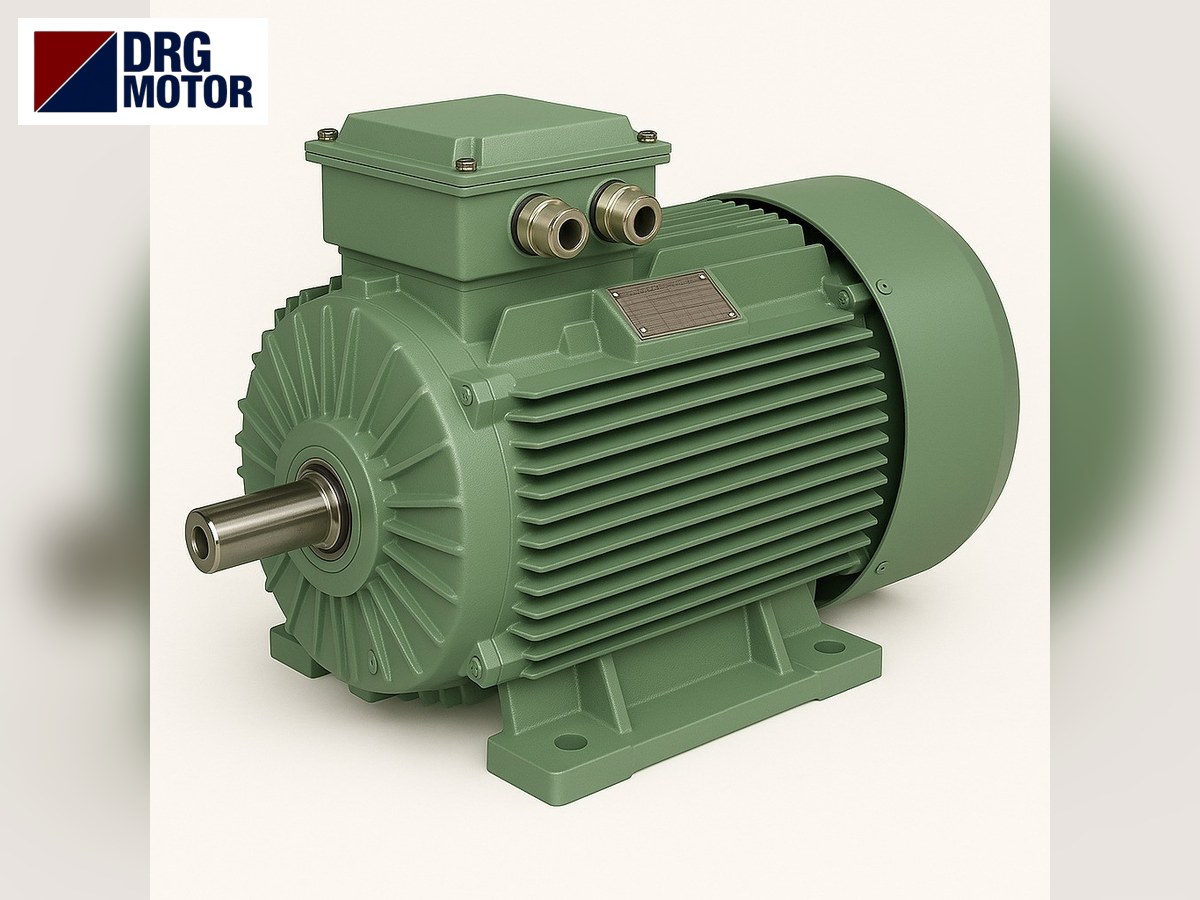
On a planetary mixer one motor turns the tool (whisk, beater or hook), which spins on its own axis while travelling round the bowl; on a spiral mixer the spiral arm and the bowl are usually turned by two separate motors. Maker data sheets list 0.37–5.5 kW for planetary mixers, 1.5–12.5 kW for the spiral motor of spiral mixers, 0.37–1.5 kW for the bowl motor and 37–55 kW per motor for large horizontal mixers. This page compares the three mixer families from the motor’s point of view; for torque sizing, single-phase supply and motor replacement on a spiral kneader read our dough kneading machine motor article.
DRG Motor is a manufacturer, supplier and seller of electric motors. We do not sell the mixer, bowl, tools, gear head or inverter; two-speed pole-changing motors are not among our products either. What we cover is the single-speed three-phase IEC motor used on the mixer. Models are on Buy Electric Motors Online.
Planetary, spiral and horizontal mixers: how the motor layout changes
All three mix dough or cream, but they pass the load to the motor in different ways. Pastry kitchens and hotels choose the planetary mixer; bakeries use the spiral mixer for bread dough; biscuit, cracker and large bread plants move to the horizontal mixer.
Planetary mixer: one motor, many jobs
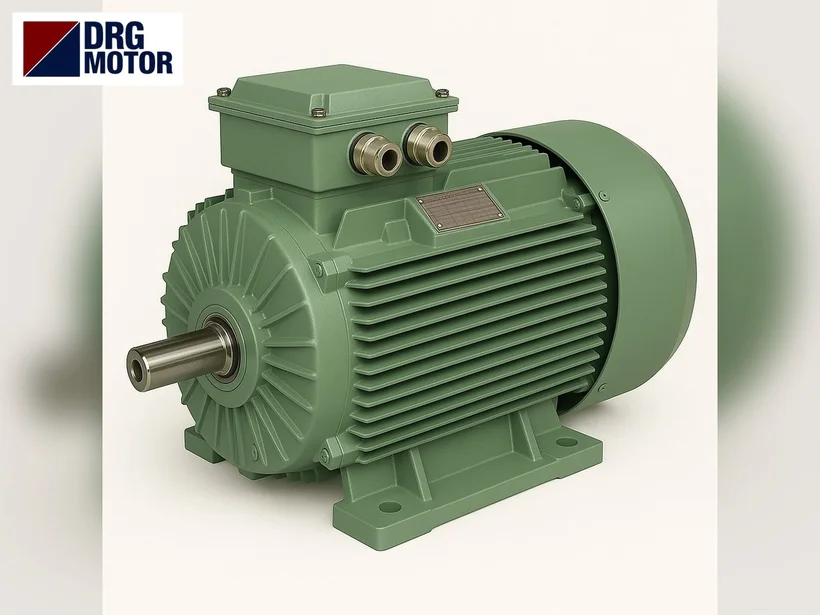
The motor in the head drives, through a gear head, both the planetary motion and the tool’s own rotation. Whipping cream wants high speed, stiff dough low speed and high torque. Small models use a 3-speed gear head, larger ones a belt and an inverter; on the third maker’s 60–160 litre series the inverter gives 6 steps plus stepless adjustment, and the bowl is lifted by motor.
Spiral mixer: spiral motor and bowl motor
The spiral arm pulls the dough while the bowl turns slowly. The fourth and sixth makers list the two motors separately. The spiral motor is given with two figures (for example 1.5/3.0 kW): the power at first and second speed. On the sixth maker’s 120 kg machine the spiral runs at 110/220 rpm; on the 200 kg model at 98/196 rpm.
Horizontal (twin-arm) mixer
In a horizontal mixer the arms turn inside a horizontal trough that tilts to discharge. The seventh maker’s twin-arm series lists 2 × 37 kW maximum power for the 600 litre trough and 2 × 55 kW for the 1100 and 1500 litre troughs. In this power class the motor is mostly started through an inverter or soft starter; tilting comes from a separate small motor.
How many kW for a planetary or spiral mixer motor?
A) Values given in maker catalogues and data sheets:
| Machine / section | Motor power | Single / total | Note |
|---|---|---|---|
| Planetary mixer 20 qt, 3 fixed speeds | 0.37 kW, single-phase | single motor, gears | first maker’s sheet |
| Planetary mixer 15–30 L | 0.55–1.5 kW, 220 V | single motor | second maker |
| Planetary mixer 40–80 L | from 1.5 to 4 kW, 380 V | single motor, by speed | second maker |
| Planetary mixer 60–160 L, inverter | 2.2 / 4 / 5.5 kW | single motor, belt | third maker |
| Spiral mixer 60–200 kg: spiral | 1.5/3.0 … 7.5/12.5 kW | 1st / 2nd speed | fourth maker |
| Spiral mixer 60–200 kg: bowl | 0.55–0.75 kW | separate motor | fourth maker |
| Spiral mixer 30–300 kg: spiral | 1.5–0.75 … 10.3–7 kW | two speed values | fifth maker |
| Spiral mixer 120 / 200 kg | spiral 6 / 12 kW, bowl 0.55 / 1.5 kW | two motors | sixth maker |
| Horizontal twin-arm mixer 600–1500 L | 2 × 37 … 2 × 55 kW | maximum power, two motors | seventh maker |
Depending on model and bowl size, this group shows roughly 0.37–5.5 kW on planetary mixers, 1.5–12.5 kW on the spiral motor, 0.37–1.5 kW on the bowl motor and 37–55 kW per motor on horizontal mixers. A spiral mixer’s machine power is the sum of its two motors; on a horizontal mixer the sum of two motors must not be read as one motor.
B) Where DRG fits: a planetary head of 0.37–5.5 kW takes one of our 4-pole frames from 71 up to 132; a bowl drive of 0.37–1.5 kW stays within frames 71–90; a horizontal mixer arm of 37–55 kW calls for cast iron 225S, 225M or 250M. Where the spiral motor is single-speed or the machine runs on an inverter, its single-speed equivalent of 1.5–15 kW is in the range. A two-speed spiral motor carrying two separate ratings is outside our range.
Click to see current electric motor prices and order nowSEE PRICES →
Two-speed spiral motor: what replaces a pole-changing motor?
If the catalogue gives the spiral motor a double figure such as “1.5/3.0 kW” or “7.5–4.8 kW”, it is most likely a pole-changing motor: one frame, two winding arrangements, two speeds and two plate ratings. Our range has no such motor. There are two ways to replace it.
Finding the same type
The control circuit and the two speed contactors stay as they are; the new motor must have the same two ratings, two currents and connection diagram as the old one. In that case the motor comes from the mixer maker or from a supplier of two-speed motors.
Single-speed motor plus inverter
A single-speed motor chosen for the second-speed rating gives both speeds through an inverter. In the fourth maker’s data the ratio between the two speed ratings lies between 1.7 and 2.3, so at second speed the motor delivers about twice the power. The single-speed motor has to be sized on that second-speed figure: 3 kW for a 1.5/3.0 kW spiral, while a 7.5/12.5 kW spiral needs the next standard step, the 15 kW cast iron model, since 12.5 kW is not a standard rating. The control panel, inverter and pulley ratio are reworked for this conversion; an electrician who knows the machine should carry it out.
Worked example: low speed on an inverter planetary mixer
The third maker lists a 4 kW motor and 35–150 rpm tool speed for its 80–120 litre planetary mixers. Assuming the top speed is reached at 50 Hz, here is the table with a DRG-112M-4:
| Step | Operation | Result | Explanation |
|---|---|---|---|
| Highest tool speed | catalogue | 150 rpm | we assume it is reached at 50 Hz |
| Lowest tool speed | catalogue | 35 rpm | same ratio |
| Frequency at the lowest speed | 50 × 35 / 150 | about 11.7 Hz | the motor fan slows in proportion |
| Upper limit of tool torque at 150 rpm | 4 × 9550 / 150 | about 255 Nm | losses ignored |
| DRG-112M-4 rated torque | data | 26.3 Nm | at 1,450 rpm |
| Total ratio needed | 1450 / 150 | about 9.7 | belt + gears |
Two things follow. First, even with no losses there is at most about 255 Nm at the tool shaft; the real value is lower by the belt and gear losses. Second, at the lowest speed the motor drops to around 12 Hz and its own fan turns very slowly. Recipes that knead stiff dough at the bottom speed for a long time can make the motor warm; a separately driven cooling fan or a slightly higher recipe speed is then worth considering. Try the frequency–speed relation in our gearbox output speed tool.
Where the mixer motor sits in a bakery, and small single-phase mixers
On a planetary mixer the motor is inside the head; on a spiral mixer it sits in the lower or rear compartment. Either way the motor lies outside the product-contact zone; flour dust and water must not get into the motor compartment. Bowl and tools come off for washing, the body is wiped down, and no hose is aimed at the motor compartment. Stainless-bodied washdown motors are a different product that we do not carry; talk to us before ordering for such a room.
Single-phase planetary mixers
Most small planetary mixers (20–30 litres) are delivered with a single-phase motor; the first maker’s 20 qt model has 0.37 kW on a single-phase supply. We have no single-phase motors; switching to a three-phase motor means new switchgear and control as well. See our three-phase vs single-phase article for detail.
Brake motor and safety guard
The mixer stopping when the guard opens is down to the machine’s safety circuit. A brake motor is not part of our range; where stopping time is limited, the brake belongs to the machine’s own design.
Replacing a mixer motor with DRG
Our 4-pole models suited to planetary, spiral and horizontal mixers; currents are for 400 V:
| Model | Power / speed | Frame · shaft D×E | Current 400 V |
|---|---|---|---|
| DRG-801-4 | 0.55 kW / 1400 rpm | 80 cast iron · 19×40 | 1.31 A |
| DRG-90L-4 | 1.5 kW / 1445 rpm | 90L cast iron · 24×50 | 3.3 A |
| DRG-100L1-4 | 2.2 kW / 1450 rpm | 100L cast iron · 28×60 | 4.52 A |
| DRG-112M-4 | 4 kW / 1450 rpm | 112M cast iron · 28×60 | 7.95 A |
| DRG-132S-4 | 5.5 kW / 1460 rpm | 132S cast iron · 38×80 | 10.7 A |
| DRG-160M-4 | 11 kW / 1465 rpm | 160M cast iron · 42×110 | 20.4 A |
| DRG-225S-4 | 37 kW / 1485 rpm | 225S cast iron · 60×140 | 66.1 A |
| DRG-250M-4 | 55 kW / 1485 rpm | 250M cast iron · 65×140 | 97.6 A |
Aluminium-bodied motors from DRG stop at 11 kW; cast iron frames go from 0.55 to 355 kW. All are three-phase, IEC-dimensioned and IP55, with 2, 4 and 6 pole versions. Before removing a mixer motor, write down plate power and speed (single or double figure), voltage and star/delta link, shaft diameter and key, whether it is foot or flange mounted, and the pulley diameter. These go next to the mixer manual; we do not finalise the fit before seeing the dimensions.
B5 dimensions for motors flanged to the head
B5 values of the frames that bolt onto a planetary mixer head or gear unit, mm:
| Frame | Shaft D×E | Flange P / M / N | Hole S |
|---|---|---|---|
| 80 | 19×40 | 200 / 165 / 130 | 12 |
| 90S/90L | 24×50 | 200 / 165 / 130 | 12 |
| 100L/112M | 28×60 | 250 / 215 / 180 | 14.5 |
At the gear input, shaft diameter and spigot diameter N must be identical or the motor will not seat. For foot-mounting dimensions, browse our technical drawing page.
Live price table
From bowl motor to horizontal mixer motor, prices of models in mixer ratings are pulled from the shop:
| Model | Power / speed | Frame · current 400 V | Price |
|---|---|---|---|
| DRG-712-40.5 HP | 0.37 kW · 1500 rpm | Aluminium 71 · 0.92 A | $76.76 (€68.55) Details & buy → |
| DRG-801-40.75 HP | 0.55 kW · 1500 rpm | Cast iron 80 · 1.31 A | $91.72 (€81.91) Details & buy → |
| DRG-90S-41.5 HP | 1.1 kW · 1500 rpm | Cast iron 90S · 2.48 A | $124.09 (€110.82) Details & buy → |
| DRG-100L1-43 HP | 2.2 kW · 1500 rpm | Cast iron 100L · 4.52 A | $188.32 (€168.18) Details & buy → |
| DRG-112M-45.5 HP | 4 kW · 1500 rpm | Cast iron 112M · 7.95 A | $254.38 (€227.18) Details & buy → |
| DRG-132S-47.5 HP | 5.5 kW · 1500 rpm | Cast iron 132S · 10.7 A | $342.01 (€305.44) Details & buy → |
| DRG-160M-415 HP | 11 kW · 1500 rpm | Cast iron 160M · 20.4 A | $568.76 (€507.94) Details & buy → |
| DRG-160L-420 HP | 15 kW · 1500 rpm | Cast iron 160L · 27.3 A | $678.13 (€605.61) Details & buy → |
| DRG-225S-450 HP | 37 kW · 1500 rpm | Cast iron 225S · 66.1 A | $1,527.18 (€1,363.87) Details & buy → |
DRG MOTOR motors are guaranteed against material and manufacturing defects for 2 years from the delivery date (warranty certificate).
Motors in this power range
- DRG-90S-4 – 1.1 kW – 1445 rpm – 90S cast iron
- DRG-100L1-4 – 2.2 kW – 1450 rpm – 100L cast iron
- DRG-112M-4 – 4 kW – 1450 rpm – 112M cast iron
- DRG-132S-4 – 5.5 kW – 1460 rpm – 132S cast iron
- DRG-160M-4 – 11 kW – 1465 rpm – 160M cast iron
Click to see current prices and order these motors nowSEE PRICES →
Browse the products, ask for a quote: motors for your mixer are on Buy Electric Motors Online. Photograph the plates of both motors of a spiral mixer separately and pass them on by WhatsApp; for a planetary mixer, bowl size and number of speeds given on +90 (542) 666 11 11 are enough.
Frequently asked questions
How many kW should a planetary mixer motor be?
Catalogues show 0.37 to 5.5 kW depending on bowl size; on your own machine the plate value is what counts.
If the bowl motor of a spiral mixer fails, is it replaced like the spiral motor?
No; the bowl motor is much smaller and usually geared. Only the failed motor is replaced, with its rating read from its own plate.
Does a mixer motor price change with speed?
Power, pole count and frame decide it; current values for our single-speed models are in the table above.
Questions: +90 (542) 666 11 11 · info@drgmotor.com · contact. For kettle mixers, our mixing kettle motor article also helps.


