 English
 Le français
 Türkçe

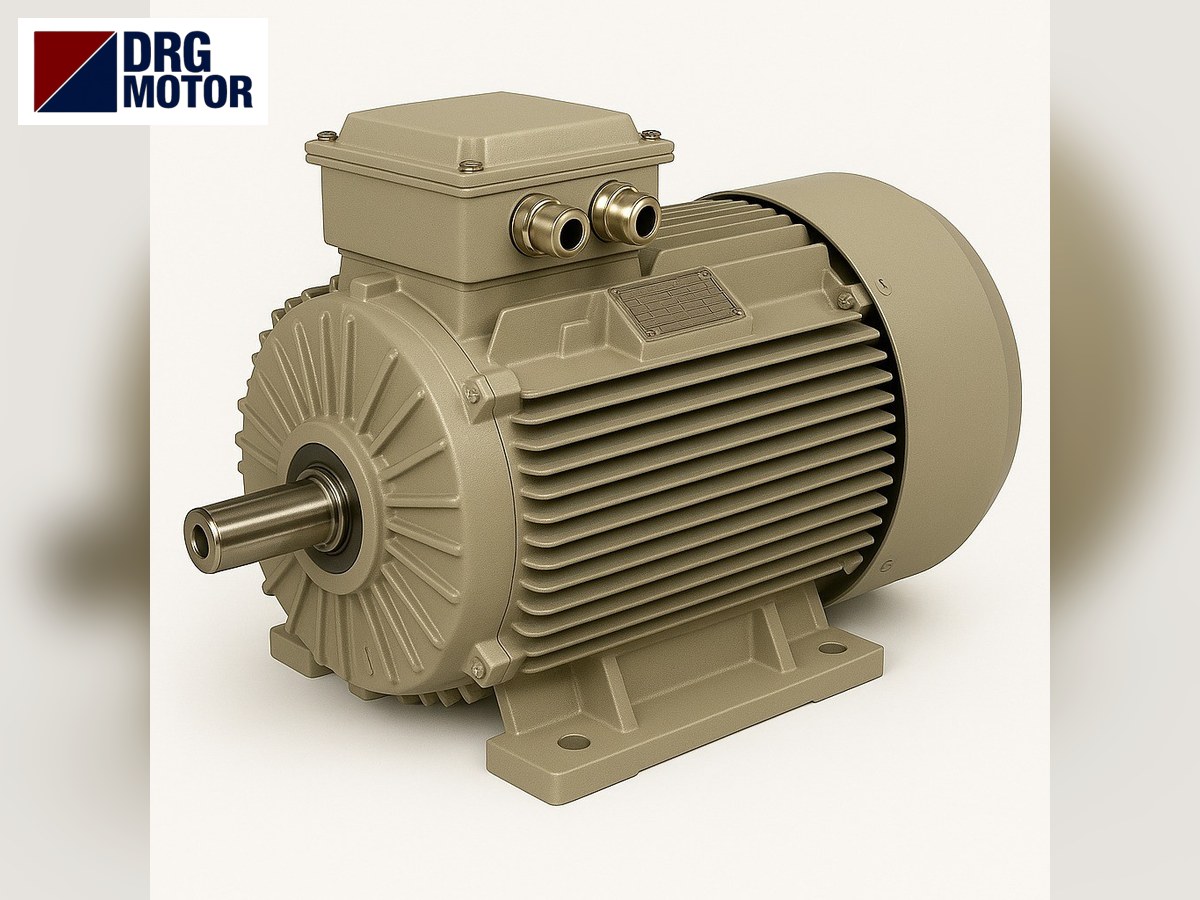
In an asphalt plant the electric motors draw aggregate from the bins, rotate the dryer drum, supply air to the burner and the baghouse, lift hot aggregate to the screen decks, blend it with bitumen in the mixer and push bitumen from the tank to the weigh bucket. Manufacturer catalogues show 2.2–3 kW per bin for cold feed belts, 22–30 kW for single-motor dryer drums or 15–22 kW per motor on four-motor drums, 11–22 kW for the hot elevator, 2 × 11 to 2 × 55 kW for the mixer and 110–185 kW for the exhaust fan. A general discussion of dust, heat and protection is in our asphalt plant motor selection article; this page goes through the plant motor points one by one with sourced power values.
DRG Motor is a manufacturer, supplier and seller of electric motors. We do not sell the plant itself, the burner, the fan impeller, the drum, the gearbox, the bitumen pump casing or the drive; we supply the three-phase cage induction motor behind each of these machines. Models are listed on the Buy Electric Motors Online page.
From cold aggregate to hot mix: where are the motors?
In a batch plant the material runs cold bins → collecting belt → dryer drum → hot elevator → screen and hot bins → weighing → mixer. Gas leaving the burner end of the drum passes the dust separator and the baghouse and is blown to the stack by the exhaust fan. A continuous drum mix plant has no elevator or screen; bitumen is sprayed straight into the drum.
Cold feed bins and collecting belt
Each bin sits over a short belt feeder. Because the aggregate recipe is set by the speed of these belts, the motors are often driven by a VFD. The collecting belt that carries their output to the drum is longer. A vibrator fitted to a wet sand bin to keep material flowing is a vibration motor, not a standard motor.
Dryer drum drive
The drum rests on friction wheels that run on tyres fixed to its shell; motor-gearbox sets turn the wheels. Small plants turn the drum with one motor through a chain sprocket, while large plants drive four wheels with four separate motors. In the four-motor layout all plates are kept identical; one motor at a different speed makes its wheel slip and wear.
Burner air fan, exhaust and baghouse fan
The burner combustion air fan and the exhaust fan that pulls gas through the drum are separate machines. The largest motor in the plant is usually on the exhaust fan, which overcomes the resistance of the whole air path from drum to baghouse. Airflow is often set by fan speed or by a damper.
Hot elevator, screen and mixer
Aggregate leaving the drum rides a bucket elevator to the screen at the top of the tower; the screen splits it into size fractions and drops it into the hot bins. The elevator motor sits at the head of the elevator, outside the casing that carries hot material. The mixer is a twin-shaft paddle type driven by two motors. The general method for bucket and speed sizing is in our bucket elevator motor article.
Bitumen pump and filler screw
Bitumen is pumped from the tank to the weigh bucket by a jacketed gear or screw pump. The pump handles hot bitumen while the motor stays beside it, separated by a coupling. Filler (mineral dust) comes down from its silo by screw; that screw motor is among the small motors of the plant.
The hot zone rule: where does the motor go?
The dryer drum, the hot elevator casing, the screen tower and the bitumen line all heat the space around a motor. Our motors are catalogued for −15 to +40 °C surroundings at sites no higher than 1000 m; they carry class F (155) insulation and IC411 cooling, so the shaft-mounted fan blows air over the finned frame. That is why the motor is placed in a ventilated, shaded spot rather than where heat from the drum, burner or bitumen tank strikes it directly; the shaft, coupling or belt reaches into the hot zone.
Dust and the fan cover
When dry aggregate dust packs the fins, the motor cannot cool properly with its own fan. Frames near the baghouse and on the screen tower need periodic cleaning. Our motors are IP55. If the site needs a special temperature class for high ambient heat, an Ex motor because the tank area is classified as explosive, or a brake motor to stop an elevator running back, those are not in our range; ask us in that case. For asphalt plants we also steer clear of single-phase motors.
Click to see current electric motor prices and order nowSEE PRICES →
How many kW are asphalt plant motors? Catalogue values
A) Motor ratings read from asphalt plant makers’ data sheets:
| Plant / equipment | Motor power | Single / total | Note |
|---|---|---|---|
| Cold feed belt feeder, 80–200 t/h | 2.2–3 kW | per bin | first maker |
| Collecting belt, 80–200 t/h | 4–5.5 kW | single motor | first maker |
| Dryer drum, 80 / 120 t/h | 22 / 30 kW | single motor | first maker |
| Dryer drum, 160 / 200 t/h | 4 × 15 / 4 × 22 kW | four motors; 60 / 88 kW total | first maker |
| Hot aggregate elevator, 90–220 t/h | 11–22 kW | single motor | first maker |
| Hot screen, 2 / 3.5 decks | 7.5–18.5 kW | single motor | first maker |
| Paddle mixer, 1250–2750 kg batch | 2 × 11 … 2 × 37 kW | two motors | first maker |
| 160 t/h plant: mixer / exhaust fan | 2 × 30 kW / 110 kW | separate motors; plant total 380 kW | second maker |
| 320 t/h plant: mixer / exhaust fan | 2 × 55 kW / 185 kW | separate motors; plant total 730 kW | second maker |
| 240 t/h plant exhaust fan | 160 kW | single motor | third maker |
| Drum mix plant 40–120 t/h: exhaust / burner air blower | 20–40 HP / 7.5–15 HP | separate motors | fourth maker; 1 HP ≈ 0.746 kW |
| Drum mix plant: bitumen pump drive | 5 HP | single motor | fourth maker |
Depending on model and capacity, this plant group shows roughly these motor options: 2.2–3 kW on cold feed belts, 4–5.5 kW on the collecting belt, 22–30 kW for a single-motor drum or 60–88 kW total for a four-motor drum, 11–22 kW for the hot elevator, 7.5–18.5 kW for the screen, 2 × 11 to 2 × 55 kW for the mixer and 110–185 kW for the exhaust fan. As capacity (t/h) and aggregate moisture rise, drum, fan and elevator power grow. Figures such as 380 and 730 kW are the installed power of the whole plant, not of one motor.
B) Overlap with the DRG range: no individual motor listed is larger than what our cast iron line covers, 0.55 up to 355 kW. A 110 kW exhaust motor matches frame 315S, a 22 kW drum or mixer motor frame 180L; for belts and screws at 11 kW or less an aluminium housing is an option too. What stays outside is the motor type, not the power: the brake, Ex and special temperature class motors listed above, plus imported plants that need 60 Hz, where the plate data must be checked separately.
Exhaust fan: speed, power and starting
A fan’s power demand follows speed cubed. When a 110 kW exhaust fan is slowed by a drive to eight tenths of rated speed, the shaft power needed is roughly 110 × 0.8³ ≈ 56.3 kW. When the plant runs at low output or in hot weather, the difference shows at once in current and temperature. Whether the fan runs on a 2-pole or 4-pole motor depends on impeller diameter and the fan maker’s curve; the existing pole number is kept.
Starting current of a 110 kW motor
The DRG-315S-4 model draws 187 A at 400 V, and its starting current is 7 times that, about 1309 A direct-on-line. A large impeller has high inertia, so acceleration takes a long time. Most plants therefore start the exhaust motor with a drive or a soft starter; the differences are explained on our motor starting page. For motor choice by fan type see the Fan Motors category.
Example: motor current budget of a 160 t/h batch plant
Starting from the 160 t/h column of the table, we assign one DRG motor to every drive. This is an assumption; the burner fan, bitumen pump, filler screw and compressor are not included.
| Drive | DRG match | Current 400 V | Qty × current |
|---|---|---|---|
| Cold feed belts, 2.2 kW | DRG-100L1-4 | 4.52 A | 4 × 4.52 = 18.08 A |
| Collecting belt, 5.5 kW | DRG-132S-4 | 10.7 A | 1 × 10.7 = 10.7 A |
| Drum drive, 4 × 15 kW | DRG-160L-4 | 27.3 A | 4 × 27.3 = 109.2 A |
| Hot elevator, 15 kW | DRG-160L-4 | 27.3 A | 1 × 27.3 = 27.3 A |
| Hot screen, 11 kW | DRG-160M-4 | 20.4 A | 1 × 20.4 = 20.4 A |
| Mixer, 2 × 22 kW | DRG-180L-4 | 39.7 A | 2 × 39.7 = 79.4 A |
| Exhaust fan, 110 kW | DRG-315S-4 | 187 A | 1 × 187 = 187 A |
| Total (rated load) | — | — | 452.08 A |
With all seven groups at rated load the line draws about 452.1 A, of which 187 A comes from the exhaust motor alone. The four drum motors start together, fed from a common drive or separate starters. Transformer and main breaker sizing must add the exhaust fan start and the burner fan current to this budget.
Asphalt plants with DRG motors
Models that match the plant power steps from belt feeder to exhaust fan:
| Model | Power / speed | Frame · shaft D×E | Current 400 V |
|---|---|---|---|
| DRG-100L1-4 | 2.2 kW / 1450 rpm | 100L cast iron · 28×60 | 4.52 A |
| DRG-132S-4 | 5.5 kW / 1460 rpm | 132S cast iron · 38×80 | 10.7 A |
| DRG-160M-4 | 11 kW / 1465 rpm | 160M cast iron · 42×110 | 20.4 A |
| DRG-160L-4 | 15 kW / 1465 rpm | 160L cast iron · 42×110 | 27.3 A |
| DRG-180L-4 | 22 kW / 1470 rpm | 180L cast iron · 48×110 | 39.7 A |
| DRG-200L-4 | 30 kW / 1475 rpm | 200L cast iron · 55×110 | 53.8 A |
| DRG-280S-4 | 75 kW / 1486 rpm | 280S cast iron · 75×140 | 129 A |
| DRG-315S-4 | 110 kW / 1488 rpm | 315S cast iron · 85×170 | 187 A |
For a replacement order, send the plate photo, the 400 V connection, shaft and key size, foot or flange fixing and how the motor is coupled to the gearbox, belt or coupling. Our mounting options are foot B3, flange B5 and B14, the combined B34/B35 and vertical variants; on drum and elevator sets the motor is usually flanged to the gearbox. Until those figures reach us, we do not confirm interchangeability.
Live price table
Prices of the models matching the power steps of an asphalt plant are read live from the store:
| Model | Power / speed | Frame · current 400 V | Price |
|---|---|---|---|
| DRG-100L1-43 HP | 2.2 kW · 1500 rpm | Cast iron 100L · 4.52 A | $188.32 (€168.18) Details & buy → |
| DRG-132S-47.5 HP | 5.5 kW · 1500 rpm | Cast iron 132S · 10.7 A | $342.01 (€305.44) Details & buy → |
| DRG-160M-415 HP | 11 kW · 1500 rpm | Cast iron 160M · 20.4 A | $568.76 (€507.94) Details & buy → |
| DRG-160L-420 HP | 15 kW · 1500 rpm | Cast iron 160L · 27.3 A | $678.13 (€605.61) Details & buy → |
| DRG-180L-430 HP | 22 kW · 1500 rpm | Cast iron 180L · 39.7 A | $919.45 (€821.13) Details & buy → |
| DRG-200L-440 HP | 30 kW · 1500 rpm | Cast iron 200L · 53.8 A | $1,235.00 (€1,102.93) Details & buy → |
| DRG-280S-4100 HP | 75 kW · 1500 rpm | Cast iron 280S · 129 A | $2,916.93 (€2,605.00) Details & buy → |
| DRG-315S-4150 HP | 110 kW · 1500 rpm | Cast iron 315S · 187 A | $4,863.00 (€4,342.97) Details & buy → |
DRG MOTOR motors are guaranteed against material and manufacturing defects for 2 years from the delivery date (warranty certificate).
Motors in this power range
- DRG-100L1-4 – 2.2 kW – 1450 rpm – 100L cast iron
- DRG-160L-4 – 15 kW – 1465 rpm – 160L cast iron
- DRG-180L-4 – 22 kW – 1470 rpm – 180L cast iron
- DRG-280S-4 – 75 kW – 1486 rpm – 280S cast iron
- DRG-315S-4 – 110 kW – 1488 rpm – 315S cast iron
Click to see current prices and order these motors nowSEE PRICES →
Browse the products, ask for a quote: plant motors are on the Buy Electric Motors Online page. Send the plant capacity (t/h), the motor position and the old plate photo on WhatsApp; you can also call +90 (542) 666 11 11.
Frequently asked questions
If one of the four drum motors burns out, is replacing only that one enough?
The new motor must match the other three in power, pole number and rated speed. A motor at another speed turns its wheel at a different rate, which adds tyre and wheel wear.
How is the bitumen pump motor protected from heat?
A coupling spaces the motor from the pump, so it stays clear of the heated jacket; if the ambient exceeds 40 °C, state it in the order.
Where can I see the exhaust motor price?
The live table above shows current prices for models in plant power steps, 110 kW included.
For questions: +90 (542) 666 11 11 · info@drgmotor.com · contact.


