 English
 Le français
 Türkçe

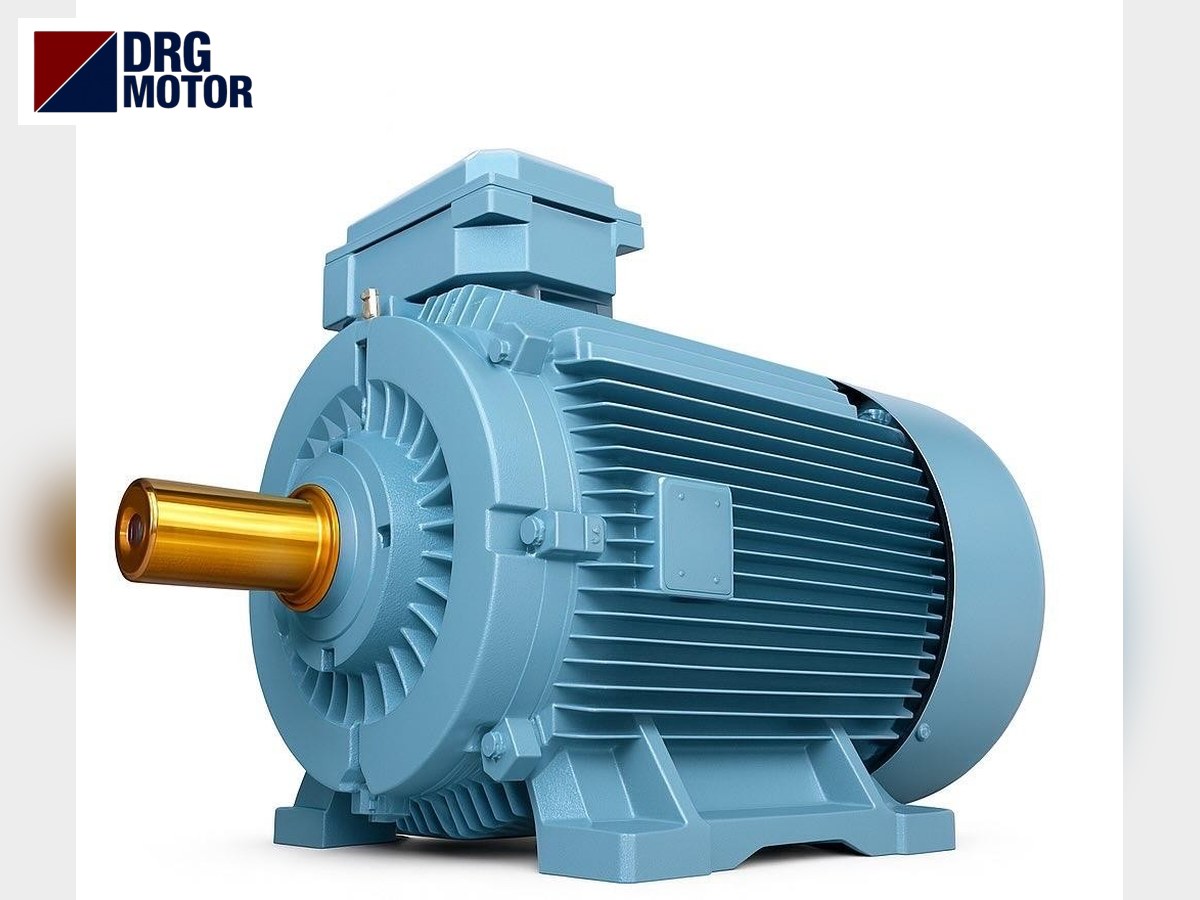
On a wood lathe the electric motor turns the headstock spindle by belt, spinning the workpiece between centres or in a chuck; the shape comes from the turner’s gouge or, on a copy lathe, from a template-guided knife. Table legs, newel posts, balusters, bowls and handles are made this way. Manufacturer catalogues list motors of roughly 0.55–2.2 kW for manual and copy wood lathes and a main motor around 5.5 kW for automatic CNC wood lathes. Part of the hobby and small-workshop lathes come with a single-phase motor; there is no single-phase motor in the DRG range, and we come back to this point separately below.
DRG Motor is a manufacturer, supplier and seller of electric motors. We do not sell the lathe itself, the headstock unit, the copying device, chucks, gearboxes, inverters, or the electrospindle and servo motors of CNC lathes; the part we deliver is the three-phase IEC induction motor under the headstock. Models are on the Buy Electric Motors Online page.
Types of wood lathe and the job of the motor
On a manual lathe the turner rests the tool on a tool rest and feeds it into the piece by hand; the motor only has to spin the work smoothly at the chosen speed. On a copy lathe a carriage following a template carries the knife along the piece, so one profile is repeated in series. On an automatic (CNC) wood lathe the carriages move on axis motors, several pieces can be machined at once, and some models add a high-speed spindle for carving.
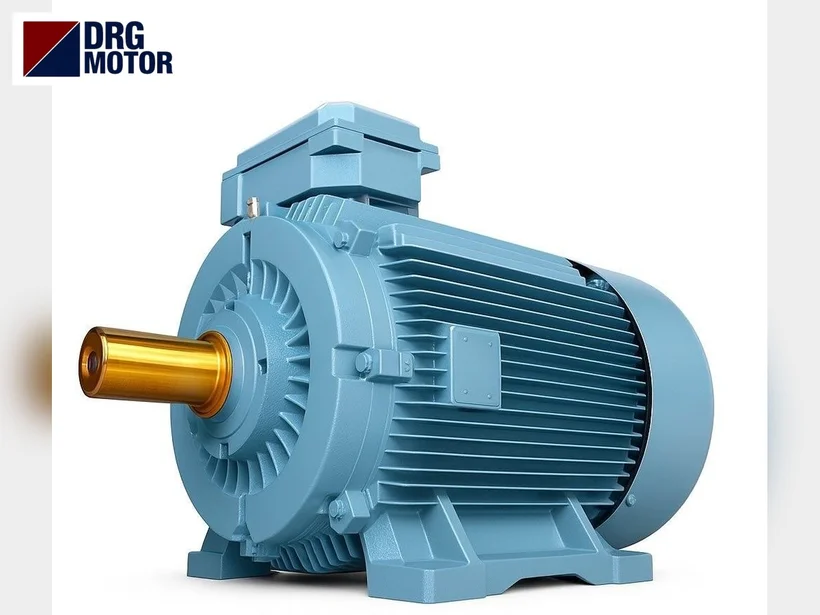
Manual lathe and bowl turning
Bowls and platters are fixed to a chuck without a tailstock. Imbalance is large here: an uncut blank from a log shakes the machine as it turns. Strong torque at low speed and a soft start therefore matter. On some lathes the headstock swivels so work can be turned outboard of the bed; the diameter grows and so does the motor load.
Copy and automatic lathes
On a copy lathe the diameter is usually small but the length is great, and the knife removes chips continuously. Production automatic lathes add axis drives, a pneumatic tailstock and sometimes a carving spindle to the main motor. That carving spindle is an electrospindle of the 18,000 rpm class and, together with the axis motors, lies outside the DRG range.
Variable speed: step pulleys or an inverter?
Wood lathe speed follows the diameter of the work: a large, unbalanced piece turns slowly and a slender spindle turns fast. Catalogues show two solutions. One is the step pulley, where moving the belt by hand across four to six grooves gives fixed speeds. The other is the inverter, which feeds the motor and sets the speed steplessly; most models still keep two or three pulley steps so enough torque remains at low speed.
Choosing the motor for inverter use
With an inverter the motor is three-phase and fed by the drive. If long periods at low speed are expected, the fan on the motor’s own shaft slows and cooling falls; dropping the pulley step and keeping the motor at a higher frequency is a good answer. DRG does not supply drives; we provide the motor, the panel side provides the drive. The inverter’s acceleration and deceleration ramps soften the start with heavy blanks.
Quick stopping
Some catalogues fit a self-braking motor as standard on EU-compliant versions. A mechanical brake motor is not something DRG offers. On an inverter lathe the drive’s deceleration ramp or a braking resistor, and on a lathe without inverter a DC injection brake module added to the panel, can stop the spindle quickly. These modules are not part of what we sell either.
Single-phase lathes in small workshops: an honest note
Most hobby and small-workshop lathes carry a 230 V single-phase motor or offer one as an option. We do not sell single-phase motors and cannot supply a like-for-like replacement for a failed one. Where the workshop has a three-phase supply, motor, switch and protection can be converted together. Where it does not, another route is a three-phase motor fed by an inverter with single-phase input and three-phase output; one manufacturer catalogue lists lathe versions whose three-phase motor runs from a 230 V supply through an inverter. Since the drive output is then usually 230 V three-phase, a 230/400 V motor is connected in delta. Our motors up to 3 kW have 230/400 V windings. An electrician should carry out this conversion.
Click to see current electric motor prices and order nowSEE PRICES →
How many kW for a wood lathe? Catalogue values
A) Motor ratings stated in manufacturer catalogues for wood lathes:
| Lathe type | Motor power | Single / total | Note |
|---|---|---|---|
| Small bench-top lathe | 0.55 kW (option 0.75 kW), 400 V | single motor | manufacturer catalogue; six steps or inverter |
| Manual and copy lathe, 4 steps | 1.5 kW three-phase | single motor | second manufacturer; 1.5 kW single-phase option |
| Copy lathe, 1,500 mm | 3 HP (about 2.2 kW), 400 V | single motor | third manufacturer; single-phase option, braked version |
| Copy lathe, inverter 0–3,000 rpm | 1.1–1.5 kW, 400 V | single motor | fourth manufacturer; two values by duty rating |
| Heavy professional lathe | 1.5 kW and 2.2 kW | single motor | larger models of the first manufacturer; stronger motors on request |
| Automatic CNC wood lathe | 5.5 kW main motor | main motor; carving spindle separate | fifth manufacturer; carving spindle 3.5 kW, 0–18,000 rpm |
So hand and copy lathes in these catalogues stay at about 0.55–2.2 kW, depending on size and length between centres, while the automatic CNC wood lathe reaches a 5.5 kW main motor. On an automatic lathe the carving spindle and axis motors add to the main motor; adding them up gives the lathe total, not the rating of the headstock motor.
B) Overlap with the DRG range: three-phase lathe motors between 0.55 and 3 kW are covered by our four-pole models in frames 80, 90S, 90L and 100L, and a 5.5 kW main motor by the 132S model. For a value given in horsepower, such as 3 HP, the nearest standard kW (2.2 kW) is chosen and checked against the old nameplate. Single-phase motors, the carving electrospindle of a CNC lathe and its servo/stepper axis motors are outside our range.
Worked example: torque and rim speed on step pulleys
Our lathe example uses a 1.5 kW four-pole motor (DRG-90L-4, 1,445 rpm; rated torque DRG-90L-4, 9.91 Nm) and the catalogue steps of 570 / 1,000 / 1,850 / 2,500 rpm. Rim speed is calculated for a 400 mm bowl blank, belt losses ignored:
| Spindle speed | Pulley ratio (motor / spindle) | Spindle torque | Rim speed of a 400 mm piece |
|---|---|---|---|
| 570 rpm | 1,445 / 570 ≈ 2.54 (reduction) | 9,550 × 1.5 / 570 ≈ 25.1 Nm | about 11.9 m/s |
| 1,000 rpm | about 1.45 (reduction) | about 14.3 Nm | about 20.9 m/s |
| 1,850 rpm | about 0.78 (step-up) | about 7.7 Nm | about 38.7 m/s |
| 2,500 rpm | about 0.58 (step-up) | about 5.7 Nm | about 52.4 m/s |
The table shows two things. The lowest step delivers two and a half times the motor’s rated torque to the spindle; that is the step for roughing a wide bowl. Turning the same 400 mm piece on the top step is both dangerous and pointless, as the rim speed quadruples. High steps are for thin, balanced work. To try pulley diameters for your own machine, use the pulley and belt calculator.
DRG motors for wood lathes
Four-pole models from our range for manual, copy and automatic lathe main motors (current at 400 V):
| Model | Power / speed | Frame · shaft D×E | Current 400 V |
|---|---|---|---|
| DRG-801-4 | 0.55 kW / 1400 rpm | 80 cast iron · 19×40 | 1.31 A |
| DRG-802-4 | 0.75 kW / 1420 rpm | 80 cast iron · 19×40 | 1.75 A |
| DRG-90S-4 | 1.1 kW / 1445 rpm | 90S cast iron · 24×50 | 2.48 A |
| DRG-90L-4 | 1.5 kW / 1445 rpm | 90L cast iron · 24×50 | 3.3 A |
| DRG-100L1-4 | 2.2 kW / 1450 rpm | 100L cast iron · 28×60 | 4.52 A |
| DRG-100L2-4 | 3 kW / 1450 rpm | 100L cast iron · 28×60 | 6.02 A |
| DRG-132S-4 | 5.5 kW / 1460 rpm | 132S cast iron · 38×80 | 10.7 A |
On a wood lathe the motor usually sits under or behind the bed, foot mounted (B3) on a hinged plate that lets the belt be tensioned. For a lathe the useful part of our IEC range is small: four-pole aluminium or cast iron frames from 0.55 kW upward, while the full range reaches 355 kW; foot, flange or vertical form is stated on the order. When the old lathe motor comes out, a phone photo of its plate plus four measurements (shaft, key, pulley bore, foot spacing) tells us almost everything; the lathe manual fills the gaps, and only then do we name a model. Without those numbers there is no fit promise.
Live price table
Current shop prices for four-pole motors in wood lathe power ratings:
| Model | Power / speed | Frame · current 400 V | Price |
|---|---|---|---|
| DRG-801-40.75 HP | 0.55 kW · 1500 rpm | Cast iron 80 · 1.31 A | $91.72 (€81.91) Details & buy → |
| DRG-802-41 HP | 0.75 kW · 1500 rpm | Cast iron 80 · 1.75 A | $101.93 (€91.03) Details & buy → |
| DRG-90S-41.5 HP | 1.1 kW · 1500 rpm | Cast iron 90S · 2.48 A | $124.09 (€110.82) Details & buy → |
| DRG-90L-42 HP | 1.5 kW · 1500 rpm | Cast iron 90L · 3.3 A | $144.14 (€128.73) Details & buy → |
| DRG-100L1-43 HP | 2.2 kW · 1500 rpm | Cast iron 100L · 4.52 A | $188.32 (€168.18) Details & buy → |
| DRG-100L2-44 HP | 3 kW · 1500 rpm | Cast iron 100L · 6.02 A | $203.84 (€182.05) Details & buy → |
| DRG-132S-47.5 HP | 5.5 kW · 1500 rpm | Cast iron 132S · 10.7 A | $342.01 (€305.44) Details & buy → |
DRG MOTOR motors are guaranteed against material and manufacturing defects for 2 years from the delivery date (warranty certificate).
Motors in this power range
- DRG-802-4 – 0.75 kW – 1420 rpm – 80 cast iron
- DRG-90L-4 – 1.5 kW – 1445 rpm – 90L cast iron
- DRG-100L1-4 – 2.2 kW – 1450 rpm – 100L cast iron
- DRG-132S-4 – 5.5 kW – 1460 rpm – 132S cast iron
Click to see current prices and order these motors nowSEE PRICES →
Browse the products, ask for a quote: lathe motor options are on the Buy Electric Motors Online page. Send the old nameplate and the pulley end through WhatsApp, or call +90 (542) 666 11 11 and begin by telling us whether your workshop has a three-phase supply.
Frequently asked questions
Which motor speed suits a wood lathe?
Most catalogue lathes use a four-pole motor of about 1,450 rpm with step pulleys. That speed is a convenient midpoint for both reducing and raising speed through the pulleys. The final choice follows the old nameplate and the lathe’s pulley diameters.
Can a lathe motor run in reverse?
A three-phase motor reverses when two phases are swapped; on inverter lathes this is done from the drive. Work screwed onto a threaded chuck can loosen in reverse, so reverse is only used where the chuck is locked or flange mounted.
What does the price of a wood lathe motor depend on?
Output, frame material and mounting determine it; the table is read live from the shop.
Questions about your lathe can reach us via the contact form, at info@drgmotor.com or on +90 (542) 666 11 11. For the general framework of motor choice on woodworking machines, our article woodworking machine electric motor may also help.


