 English
 Le français
 Türkçe

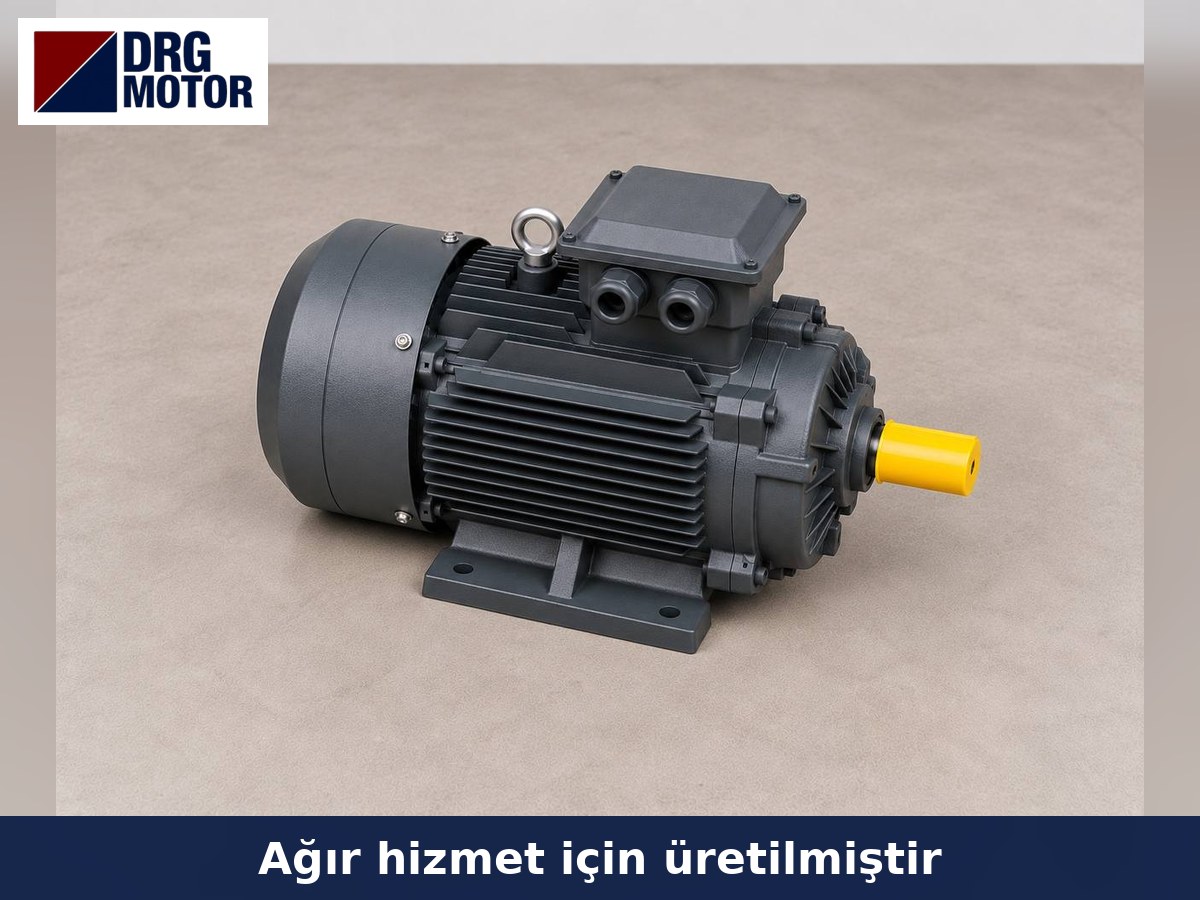
A ball mill turns a horizontal shell filled with steel balls slowly, reducing crushed ore, clinker, lime or chemical raw material to powder. The electric motor does not turn this shell directly: it drives a gearbox, the gearbox drives a small pinion and the pinion meshes with a large girth gear bolted around the shell. Manufacturer catalogues start at 0.75 kW for laboratory mills and at 18.5 kW for industrial mills; on the largest mining and cement models the main motor reaches several thousand kW.
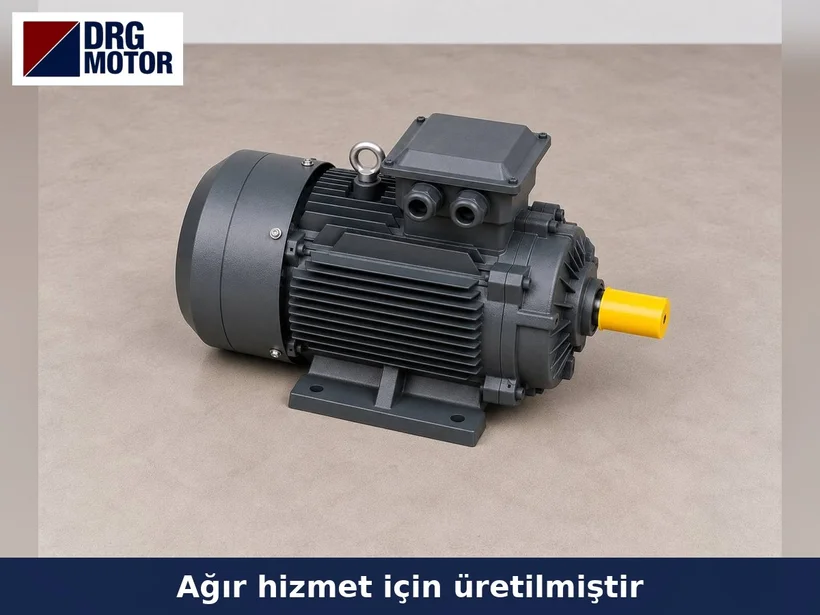
DRG Motor is a manufacturer, supplier and seller of electric motors. We do not sell the mill, the girth gear, the pinion, the gearbox, the coupling, the liner plates or the drive; we deliver only the three-phase squirrel-cage motor sitting at the head of that gear train. Rubber-lined mills that prepare slip in ceramic plants are covered separately on the Ceramic Slip Mill Motors page; this page deals with steel-ball mills running dry or wet in mining, cement, lime and chemical plants. All our models are on the Buy Electric Motors Online page.
Where are ball mills used and how do they differ from ceramic mills?
In a mineral processing plant, ore below 25 mm leaving the jaw and cone crushers is ground fine in the ball mill, then split by cyclones or a classifier, and the coarse fraction returns to the mill. In a cement plant the same machine grinds raw meal and clinker; in lime and gypsum plants it refines the hydrated product; in the chemical and paint industry it grinds pigments and fillers. Crushing machines belong to another category: see Stone Crushing Plant Motors.
Steel balls and continuous feed
In ore and cement mills the grinding media are cast steel or chrome-alloy balls, and the inside is protected by steel or manganese liners. Such mills are usually flow-fed: material enters at one end and discharges at the other through an overflow or a grate. A ceramic slip mill uses alumina balls, a rubber lining and batch operation. This changes the load on the motor: a steel ball charge is far heavier for the same volume, and the drive is mostly a gear train instead of belts.
Batch and laboratory mills
Batch mills used for chemicals, pigments and sample preparation, and laboratory jar mills, run on small motors. The data sheet of a two-station laboratory mill lists 0.75 kW and a 220 V single-phase supply; single-phase motors are outside our range. Where the site has a three-phase supply, a small-frame model of the same power such as DRG-802-4 can be considered with the machine builder’s approval.
Drive train: girth gear, pinion, gearbox and coupling
The mill shell turns at only 18–38 rpm, so a 1500 rpm motor needs a 40 to 80-fold reduction. It is taken in two steps: the gearbox lowers the motor speed and the tooth ratio between pinion and girth gear does the rest.
Girth gear drive and central drive
Manufacturer documents list three layouts: induction motor + gearbox + pinion + girth gear; synchronous motor + air clutch + pinion + girth gear; and a central drive in which an induction motor and gearbox connect to the shell axis through a diaphragm coupling. Our motors can be used in the first and third layouts. The synchronous layout and the medium-voltage motors of large mills are outside our range.
Loaded start and inching
When the mill stops, balls and material settle at the bottom, and at start-up the motor has to deliver enough torque to lift this heap. Hence the start-up arrangement weighs as much as the motor choice: small mills start direct on line, medium mills use a soft starter, a fluid coupling or a drive. A small auxiliary drive that turns the shell slowly for liner changes and maintenance (inching) is on the option lists of the makers; this auxiliary motor is selected separately from the main motor and needs its own starting check.
Ball mill motor kW: catalogue values
A) Main motor power given in manufacturer catalogues by ball mill size:
| Mill size (diameter × length) | Motor power | Single / total | Note |
|---|---|---|---|
| Laboratory jar mill, 2 stations | 0.75 kW | single motor, 220 V single-phase | laboratory equipment maker |
| Ø900×1800 mm, 36–38 rpm | 18.5 kW | main motor | same value in two catalogues |
| Ø1200×3000 mm | 37–45 kW | main motor | two makers; depends on model and discharge type |
| Ø1500×4500 mm | 110 kW | main motor | two catalogues |
| Ø1830×7000 mm, 24.1 rpm | 245 kW | main motor | two catalogues |
| Ø2100×4500 – Ø2200×7500 mm | 245–380 kW | main motor | first maker |
| Ø2700×4500 mm | 430 kW | main motor | two catalogues |
| Ø3200×4500 – Ø3600×6000 mm | 800–1250 kW | main motor | large ore and cement mill |
| Ø4500×6400 – Ø6000×9500 mm | 2000–6000 kW | main motor | largest overflow models |
Read side by side, ball mills show motors from about 0.75 kW (laboratory) to 18.5–6000 kW (industrial). Two catalogues can give different power for the same diameter and length: a grate-discharge mill takes more balls than an overflow mill of the same size and needs a stronger motor. The quantity that really sets the power is the ball charge together with shell speed; capacity in t/h varies with ore hardness and target fineness.
B) Overlap with the DRG range: mills from a 0.75 kW three-phase laboratory drive up to 315 kW, that is the first six rows of the table, are covered by our cast iron frames. Mills of 380–430 kW and large ore and cement mills above 800 kW, most of which run on medium-voltage and synchronous motors, are outside our range; in that class the feed belt, classifier, lubrication pump and inching drives still fall within our range.
Click to see current electric motor prices and order nowSEE PRICES →
Worked example: Ø1830×7000 mm mill with a 250 kW motor
Take the mill listed at 24.1 rpm and 245 kW. The first model above it in our range is DRG-355M-4: 250 kW, 1490 rpm, 418 A at 400 V, rated torque 1602 Nm, starting current 7.1 times rated. We computed the figures with python; because the catalogue shell diameter is used instead of the inner diameter, the critical speed is approximate:
| Quantity | Working | Result | Comment |
|---|---|---|---|
| Critical speed | 42.3 / √1.83 | about 31.3 rpm | speed at which balls cling to the shell |
| Operating ratio | 24.1 / 31.3 | about 0.77 | catalogue speed is below critical |
| Motor-to-shell overall ratio | 1490 / 24.1 | about 61.8 | gearbox × pinion/girth gear |
| Torque needed at the shell | 9550 × 245 / 24.1 | about 97,100 Nm | loss-free, at catalogue power |
| Torque delivered by the motor | 1602 Nm × 61.8 | about 99,000 Nm | DRG-355M-4 rated torque |
| Direct-on-line starting current | 418 A × 7.1 | about 2,968 A | very high for the supply |
The torque rows agree: rated motor torque multiplied by the overall ratio covers the shell requirement with a small margin. The last row shows why large mills are never started direct on line; that current would strain most plant transformers. Compare starting methods on the star-delta and starting methods page and gearbox ratios with the gearbox output speed calculator.
What if the speed changes?
The operating ratio sits near 0.77 of critical speed. Replacing the motor with a faster one raises this ratio; the balls move towards the shell, impact grinding weakens and liners wear sooner. So a replacement keeps the old pole count; if a 1000 rpm motor is to be replaced by a 1500 rpm model, the gearbox ratio has to be selected again.
Mill-specific motor selection checklist
- Rated power and speed from the plate, plus whether the winding runs in 400 V delta or 690 V star.
- Girth gear or central drive; diameter and key of the gearbox input shaft.
- Starting arrangement: direct, soft starter, fluid coupling or drive.
- Dust in dry grinding; in wet grinding the motor kept away from slurry splash.
- Separate motor of the inching drive, lubrication and jacking pump motors.
- Ambient temperature and altitude; if the mill building is close to the hot clinker line, the ambient temperature is stated.
A dry cement or lime mill classified as an explosive dust zone calls for an Ex (ATEX) motor, which we do not offer. If a brake motor is needed to hold the mill at standstill, it is not in our range either; the brake is usually on the gearbox or auxiliary drive side. For a general look at mills see motor selection in mills and grinding plants, and for the whole cement line motor selection in cement plants.
Ball mill drives with DRG motors
Candidate models from the laboratory mill up to a 315 kW main drive:
| Model | Power / speed | Frame · shaft D×E | Current 400 V |
|---|---|---|---|
| DRG-802-4 | 0.75 kW / 1420 rpm | 80 cast iron · 19×40 | 1.75 A |
| DRG-180M-4 | 18.5 kW / 1470 rpm | 180M cast iron · 48×110 | 33.5 A |
| DRG-200L1-6 | 18.5 kW / 980 rpm | 200L cast iron · 55×110 | 35.9 A |
| DRG-250M-4 | 55 kW / 1485 rpm | 250M cast iron · 65×140 | 97.6 A |
| DRG-315S-4 | 110 kW / 1488 rpm | 315S cast iron · 85×170 | 187 A |
| DRG-315L1-4 | 160 kW / 1488 rpm | 315L cast iron · 85×170 | 271 A |
| DRG-355M-4 | 250 kW / 1490 rpm | 355M cast iron · 100×170 | 418 A |
| DRG-355L-4 | 315 kW / 1490 rpm | 355L cast iron · 100×170 | 526 A |
Mill gearboxes are mostly sized for a 4-pole motor; some older plants that need a lower output speed use 6-pole (1000 rpm) motors, and the same pole number is kept on replacement. Main motors are foot-mounted B3; flange B5 or B35 may suit the auxiliary drive group. No fit is promised before shaft diameter, foot hole spacing and shaft height have been compared with the gearbox base.
Live price table
Prices of the models matching ball mill power steps come live from the shop:
| Model | Power / speed | Frame · current 400 V | Price |
|---|---|---|---|
| DRG-802-41 HP | 0.75 kW · 1500 rpm | Cast iron 80 · 1.75 A | $101.93 (€91.03) Details & buy → |
| DRG-180M-425 HP | 18.5 kW · 1500 rpm | Cast iron 180M · 33.5 A | $873.49 (€780.08) Details & buy → |
| DRG-180L-430 HP | 22 kW · 1500 rpm | Cast iron 180L · 39.7 A | $919.45 (€821.13) Details & buy → |
| DRG-250M-475 HP | 55 kW · 1500 rpm | Cast iron 250M · 97.6 A | $2,065.73 (€1,844.82) Details & buy → |
| DRG-280S-4100 HP | 75 kW · 1500 rpm | Cast iron 280S · 129 A | $2,916.93 (€2,605.00) Details & buy → |
| DRG-315S-4150 HP | 110 kW · 1500 rpm | Cast iron 315S · 187 A | $4,863.00 (€4,342.97) Details & buy → |
| DRG-315L1-4200 HP | 160 kW · 1500 rpm | Cast iron 315L · 271 A | $6,135.24 (€5,479.15) Details & buy → |
| DRG-355M-4340 HP | 250 kW · 1500 rpm | Cast iron 355M · 418 A | $9,826.77 (€8,775.92) Details & buy → |
| DRG-355L-4430 HP | 315 kW · 1500 rpm | Cast iron 355L · 526 A | $11,417.31 (€10,196.37) Details & buy → |
DRG MOTOR motors are guaranteed against material and manufacturing defects for 2 years from the delivery date (warranty certificate).
Motors in this power range
- DRG-180M-4 – 18.5 kW – 1470 rpm – 180M cast iron
- DRG-250M-4 – 55 kW – 1485 rpm – 250M cast iron
- DRG-315L1-4 – 160 kW – 1488 rpm – 315L cast iron
- DRG-355M-4 – 250 kW – 1490 rpm – 355M cast iron
- DRG-355L-4 – 315 kW – 1490 rpm – 355L cast iron
Click to see current prices and order these motors nowSEE PRICES →
Browse the products and ask for a quote: models for mill main and auxiliary drives are on the Buy Electric Motors Online page. Share the shell diameter, its length, its speed in rpm and a nameplate photo over WhatsApp, or phone +90 (542) 666 11 11; those figures are checked together with the gearbox input dimensions.
Frequently asked questions
What speed should a ball mill motor have?
Motor speed sets the gearbox input, not the shell speed. 1500 rpm is common on industrial mills; if the plant was built with a 1000 rpm motor, the new one is chosen at the same speed.
Does a stronger motor raise capacity?
Capacity is set by the ball charge, the liners and the classification circuit. If the motor is upsized, the mill builder must confirm that gearbox, pinion and girth gear can carry the torque.
How do I check today’s price of a ball mill drive motor?
Our shop feeds that live grid, so each mill-sized model appears with its present-day price.
Contact: +90 (542) 666 11 11 · info@drgmotor.com · contact page.


