 English
 Le français
 Türkçe

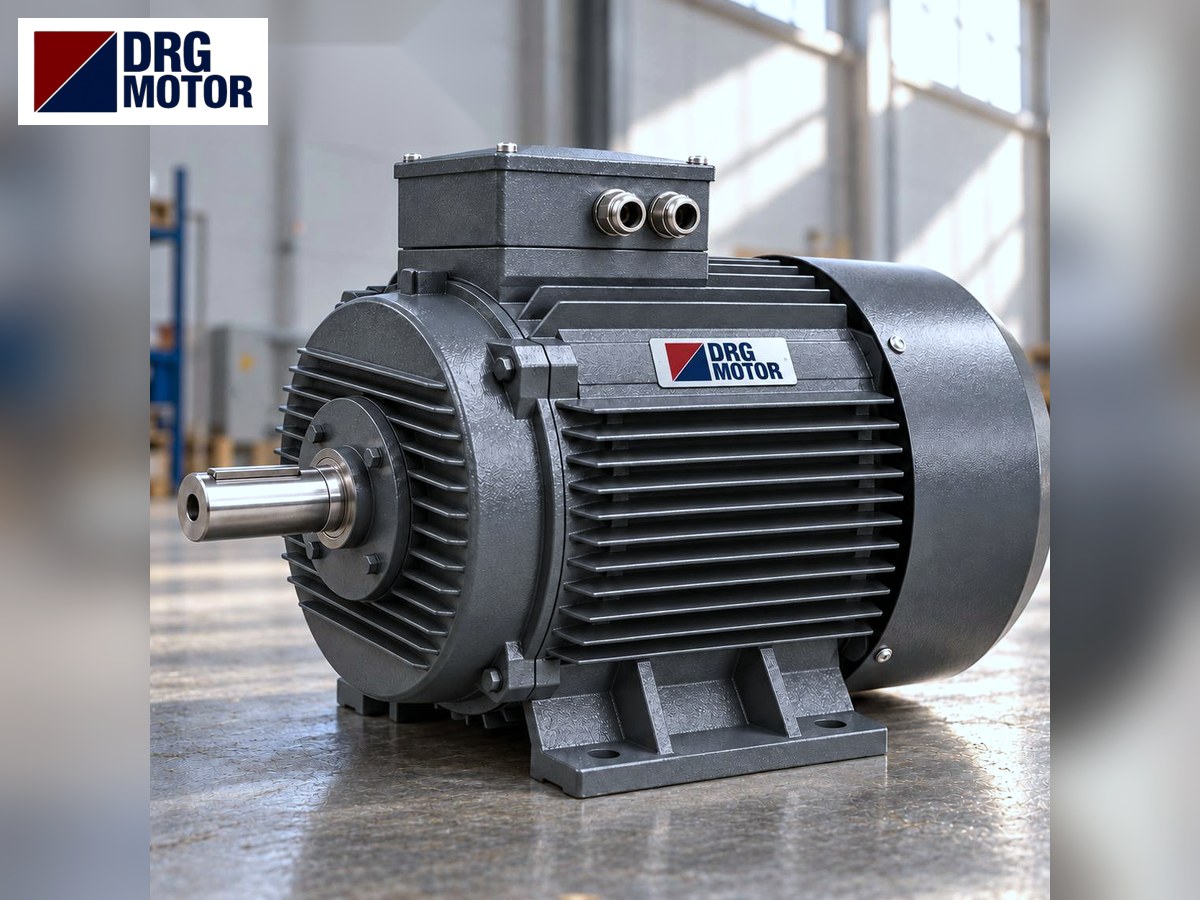
On a PET bottle recycling line, electric motors turn the drums that open the bales, the knife rotor that tears off labels, the wet granulator that turns bottles into flakes, the shafts stirring hot caustic water, the paddles of the tank that floats off caps and the centrifuge that dries the flakes. On a PET line the real test for the motor comes at the three stages that decide flake quality: label stripping, cap separation and hot caustic washing. Motor selection has to follow the load, temperature and chemistry of these stages.
DRG Motor does not sell PET washing machines, gearboxes or drives; it supplies the electric motors that turn in these machines. See our Buy Electric Motors Online page for the models in our store.
Stages of a PET bottle line and where the motor sits
Collected bottles arrive as compressed bales; the output is clean PET flake heading for fibre, sheet or new bottles. Each stage in between is built to hand cleaner material to the next one. Compared with a general plastic washing line, PET buyers want almost zero PVC, cap plastic, adhesive and label residue in the flake.
Bale breaker
A vertical or horizontal drum bale breaker separates a de-wired bale into single bottles and feeds the line evenly. The catalogues we reviewed show two motors: a main motor turning the drums and a small one for the discharge belt or a second shaft. The drums turn slowly, so the motors work through gearboxes; feed rate is usually set with an inverter. The moment the bale first breaks apart is the heaviest load the drums see.
Pre-wash and label remover
Whole bottles are tumbled with hot water in a perforated drum before crushing; then a knife rotor in the label remover tears off PVC, OPS or paper labels without breaking the bottle. The label remover is one of the most power-hungry dry machines on a PET line: the models we reviewed carry motors from 7.5 kW up to 37 kW, and a suction fan with its own motor carries the torn labels away. With heavily compressed bottles the rotor works harder, and motor current shows it directly.
Cap and label separation (flotation)
Crushed flakes enter a water-filled tank. PET is denser than water and sinks; PP and PE caps and ring fragments float. Surface paddles push the caps into a separate channel and the bottom screw carries PET flakes to the next stage. These motors are small, but if one paddle stops, cap plastic ends up in the PET; the reliability of a small motor therefore matters a lot for flake quality.
Wet grinding
De-labelled bottles are cut into small flakes in a knife granulator sprayed with water. On a PET line this is also usually the largest single-motor machine. Details on the granulator motor and pulley choice are in our plastic granulator motor article; the point to watch with PET is that its hard, abrasive nature raises motor current as the knives get blunt.
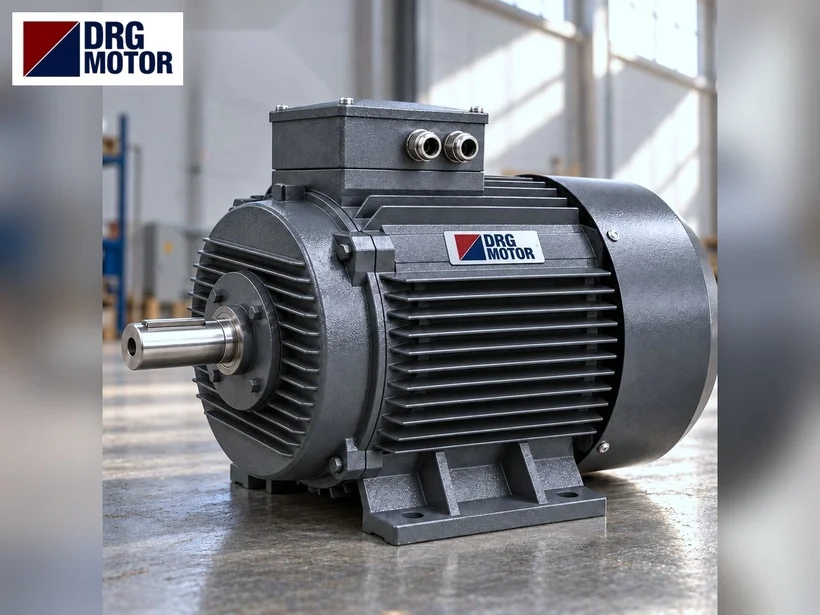
Hot caustic washing: heat, chemicals and the motor
Label glue, drink residue and oil do not come off in cold water. European PET lines typically wash flakes in several steps at about 85 °C in water with caustic soda and surfactant. In one line catalogue we reviewed, the hot washer holds about 4 m³, caustic concentration is 1–2 % and water temperature 70–90 °C; a 5.5 kW motor turns the agitator.
Where does the motor sit on the tank?
The agitator motor is usually mounted on a gearbox on top of the tank or on its side wall. Even the insulated outer skin warms the surroundings, and steam rises when the lid opens. If the motor's cooling fan draws in that steam, condensation forms inside the frame. Keeping the motor away from the steam outlet, leaving the fan cowl unobstructed and running with the tank lid closed are the simplest precautions.
Caustic splashes and paint
Caustic solution gradually attacks painted surfaces and aluminium. A cast iron frame and regular cleaning are therefore preferred in the hot wash area; a dried caustic crust on the motor also spoils cooling. DRG motors are IP55 and are not suitable for placement inside the tank or in direct contact with the solution.
Rinsing and the effect of temperature
After hot washing, flakes pass through one or two rinse tanks and another friction stage where caustic residue is removed. Pump and screw motors on the rinse section run at normal temperature, but those near the first tank work in warm, humid air. In a hot motor compartment a motor may warm up even when its current stays below the nameplate value, so ventilation matters.
Centrifugal drying and flake sorting
Centrifugal dryer
Rinsed PET flakes are separated from water in a high-speed centrifuge. In the line catalogue this machine comes with a 22 kW main motor and a separate 0.75 kW motor for opening the lid; moisture at the outlet drops to about 2 %. Because the heavy rotor takes a long time to reach speed, the starting method and overload setting directly decide the life of the dryer motor. Our plastic drying machine motor article, which looks at dryer and squeezer motors, may also help.
Zigzag air classifier and colour sorting
Label fragments and dust left in dried flakes are removed by a zigzag air classifier: an aspirator fan lifts light particles, and a rotary valve feeds flakes evenly into the column. Optical sorters then reject coloured and PVC flakes; their motors are small belt and fan motors. At this stage, keeping the fan's suction duct clean matters as much as motor choice.
Vibrating dryers and screens
Some lines remove fine dust from flakes on a vibrating screen or dryer. These machines generally use vibration motors; vibration motors form their own product family and cannot simply replace, or be replaced by, a standard induction motor. Let us know the machine data; background is in our vibration motors article.
Click to see current electric motor prices and order nowSEE PRICES →
Motor power of PET line machines
The values below are compiled from catalogues of companies building PET bottle line equipment and are per machine. The total installed power of the same line is much larger: one line catalogue gives 150 kW installed for 500 kg per hour and 750 kW for 3000 kg per hour. That total is not the rating of a single motor.
| PET line machine | Motor power | Single motor or total | Note |
|---|---|---|---|
| Bale breaker, vertical | 7.5 kW + 2.2 kW | two motors (9.7 kW total) | maker catalogue; inverter speed |
| Bale breaker + discharge conveyor | 5.5 kW main + 7.5 kW conveyor | two separate motors | second maker |
| Dry label remover | 7.5–22 kW | single main motor | maker catalogue, model range |
| Label remover drum Ø1000 × 4500 mm | 37 kW | single motor; drum 500 rpm | third maker, large model |
| Label remover + suction fan (line list) | 15 kW + 5.5 kW | two separate motors | line catalogue |
| Drum pre-washer Ø1500 × 6000 mm | 7.5 kW + 2.2 kW screw | two separate motors | same line catalogue |
| Hot caustic washer (~4 m³) | 5.5 kW | single motor | same line catalogue; 1–2 % caustic, 70–90 °C |
| Cap separation tank | 5.5 kW screw + 3 × 0.55 kW paddles | four motors (7.15 kW total) | same line catalogue |
| Centrifugal dryer | 22 kW + 0.75 kW lid | two separate motors | same line catalogue |
| Zigzag label separator | 7.5 kW aspirator + 1.5 kW rotary valve | two separate motors | maker catalogue, 1500–2000 kg/h |
Machine by machine, a PET bottle line therefore runs single motors of about 0.55–37 kW; the wet granulator can exceed this range and reaches 55–90 kW on large models. Hourly capacity, how tightly the bottles are compressed and label type all change the power needed.
Worked example: label remover drum
In the large catalogue model, a Ø1000 mm drum turns at 500 rpm with a 37 kW motor. Our 4-pole DRG-225S-4 of the same power runs at 1485 rpm.
- Required speed ratio: 1485 / 500 ≈ 2.97. With a 180 mm motor pulley, the drum pulley is about 535 mm.
- Torque at the drum shaft (losses ignored): 37 × 9550 / 500 ≈ 707 Nm.
- Drum peripheral speed: π × 1.0 × 500 / 60 ≈ 26.2 m/s. Bottles from compressed bales hit the knives at this speed; as the knives wear, more current is drawn for the same speed.
- The motor's rated current is 66.1 A at 400 V. If clamp-meter readings stay close to this value during operation, check knife maintenance and feed rate.
Exact pulley diameters and the number of belts come from the machine maker's drawing; the aim here is to see the relation between motor speed and drum speed.
Matching DRG motors to a PET line
DRG Motor is a manufacturer, supplier and seller of electric motors. Almost every machine on a PET line falls inside our range: for a bottle line that means light aluminium motors on paddles, valves and conveyors (to 11 kW), cast iron on the label remover, granulator and dryer (to 355 kW), with 1000, 1500 or 3000 rpm windings. Foot (B3), flange (B5, B14) and foot-and-flange (B34, B35) mounting as well as vertical versions are set in the order note. If dry plastic dust from the label remover area is classified as a hazardous zone, a certified motor is required; standard DRG motors do not carry that certificate.
| Model | Power / speed | Frame · shaft D×E | Current 400 V |
|---|---|---|---|
| DRG-801-4 | 0.55 kW / 1400 rpm | 80 cast iron · 19×40 | 1.31 A |
| DRG-100L1-4 | 2.2 kW / 1450 rpm | 100L cast iron · 28×60 | 4.52 A |
| DRG-132S-4 | 5.5 kW / 1460 rpm | 132S cast iron · 38×80 | 10.7 A |
| DRG-132M-4 | 7.5 kW / 1460 rpm | 132M cast iron · 38×80 | 14.3 A |
| DRG-180L-4 | 22 kW / 1470 rpm | 180L cast iron · 48×110 | 39.7 A |
| DRG-225S-4 | 37 kW / 1485 rpm | 225S cast iron · 60×140 | 66.1 A |
For a replacement order, a photo of the old nameplate is enough to confirm the match: kW, speed, voltage and connection, frame number, shaft diameter and key, flange size if any, and how the pulley or coupling is fitted. We compare these with the machine maker's document and suggest a suitable model; no exact-fit guarantee is given before dimensions are confirmed.
Live price table
Current prices of our motors in the ratings most often found on PET lines:
| Model | Power / speed | Frame · current 400 V | Price |
|---|---|---|---|
| DRG-90L-42 HP | 1.5 kW · 1500 rpm | Cast iron 90L · 3.3 A | $144.14 (€128.73) Details & buy → |
| DRG-100L1-43 HP | 2.2 kW · 1500 rpm | Cast iron 100L · 4.52 A | $188.32 (€168.18) Details & buy → |
| DRG-132S-47.5 HP | 5.5 kW · 1500 rpm | Cast iron 132S · 10.7 A | $342.01 (€305.44) Details & buy → |
| DRG-132M-410 HP | 7.5 kW · 1500 rpm | Cast iron 132M · 14.3 A | $394.89 (€352.66) Details & buy → |
| DRG-160M-415 HP | 11 kW · 1500 rpm | Cast iron 160M · 20.4 A | $568.76 (€507.94) Details & buy → |
| DRG-160L-420 HP | 15 kW · 1500 rpm | Cast iron 160L · 27.3 A | $678.13 (€605.61) Details & buy → |
| DRG-180L-430 HP | 22 kW · 1500 rpm | Cast iron 180L · 39.7 A | $919.45 (€821.13) Details & buy → |
| DRG-225S-450 HP | 37 kW · 1500 rpm | Cast iron 225S · 66.1 A | $1,527.18 (€1,363.87) Details & buy → |
| DRG-250M-475 HP | 55 kW · 1500 rpm | Cast iron 250M · 97.6 A | $2,065.73 (€1,844.82) Details & buy → |
DRG MOTOR motors are guaranteed against material and manufacturing defects for 2 years from the delivery date (warranty certificate).
Motors in this power range
- DRG-100L1-4 – 2.2 kW – 1450 rpm – 100L cast iron
- DRG-132S-4 – 5.5 kW – 1460 rpm – 132S cast iron
- DRG-132M-4 – 7.5 kW – 1460 rpm – 132M cast iron
- DRG-180L-4 – 22 kW – 1470 rpm – 180L cast iron
- DRG-225S-4 – 37 kW – 1485 rpm – 225S cast iron
Click to see current prices and order these motors nowSEE PRICES →
Browse products and get a quote: all models are on the Buy Electric Motors Online page. Send your PET line's motor list via WhatsApp and we will quote matching motors stage by stage.
Frequently asked questions
Is a PET washing line motor different from a general washing line motor?
The motor type is the same; the machines differ. A PET line has a label remover, a cap separation tank and a hot caustic washer, and their load, temperature and chemicals affect motor placement and frame choice.
Why does the label remover motor overheat?
The most common causes are blunt knives, over-compressed bottles, overfeeding and a loose belt. Measure current and check these four points before moving up a size.
What do you recommend for the motor next to the hot wash tank?
A cast iron frame, a position away from the steam outlet, free fan airflow and regular removal of caustic deposits. Never expose the motor to the inside of the tank or to the solution.
What does a PET processing machine motor cost?
Each rating's current price appears in the live table further up, and again on its own product page.
If you want to select motors for your PET bottle line or replace a failed one, write to us: phone +90 (542) 666 11 11, e-mail [email protected], contact page. Our recycling plant motor supply article covers crusher and conveyor motors as well.


