 English
 Le français
 Türkçe

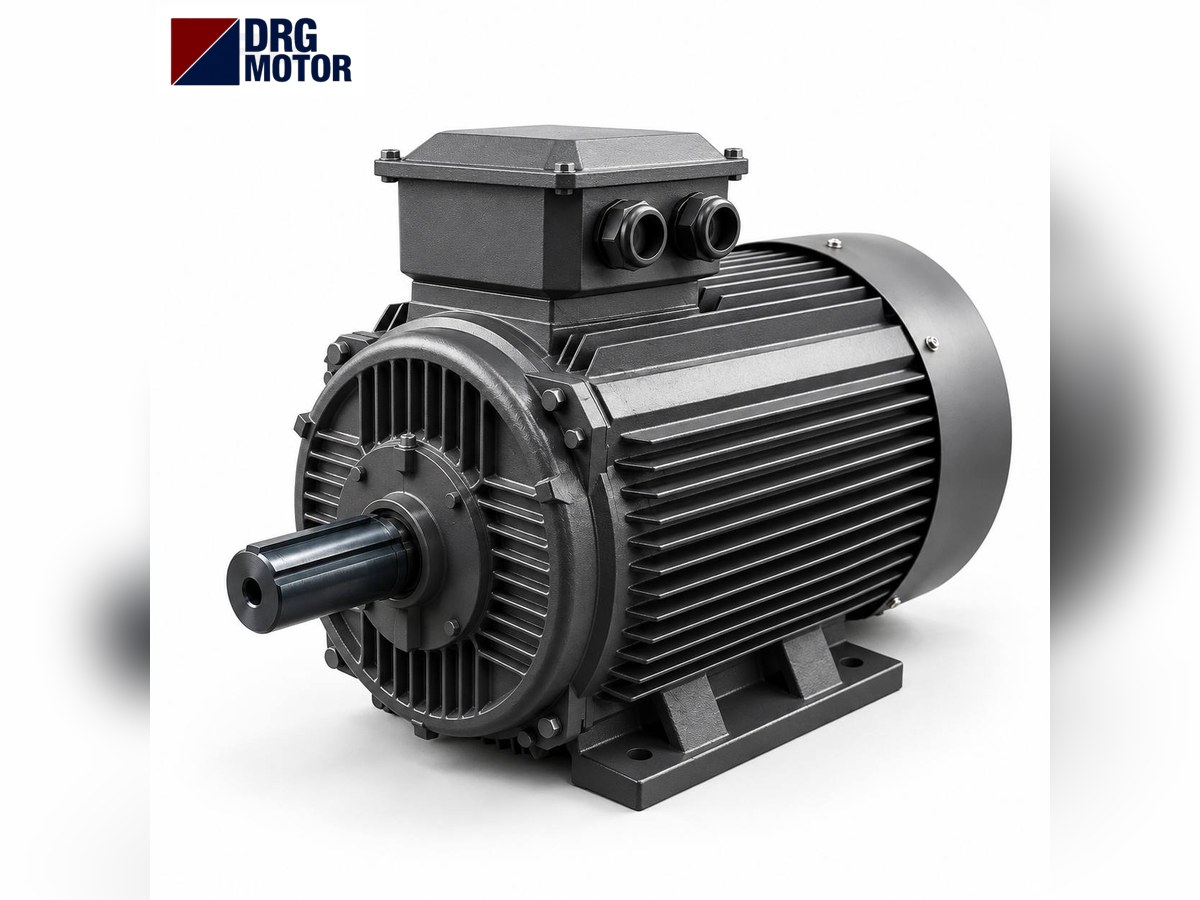
On a cone crusher, the drive is a standard three-phase induction motor coupled, usually by V-belts, to the horizontal pinion shaft; the pinion drives the eccentric and, with it, the mantle. For cone crushers used in secondary and tertiary crushing, manufacturer catalogues give main motor ratings of 75–90 kW on small models, 200–315 kW on medium models and 500–750 kW on large mining types [1][2][4]. On top of that, every cone crusher has separate, small auxiliary motors in its lubrication and hydraulic setting units.
Here you will find what a cone crusher does in the plant, why its main and auxiliary motors are treated separately, what the catalogues list and which DRG motors fit. The current price list is reached via Buy Electric Motors Online; for the other machines of the crushing and screening line see Stone Crushing Plant Motors.
What is a cone crusher and what does it do in secondary and tertiary crushing?
A cone crusher has a concave liner fixed to the frame and a cone-shaped part, the mantle, turning inside it. The mantle sits on an eccentric bushing, so it does not turn exactly on centre: one side approaches the concave while the other moves away. Rock is squeezed on the closing side, slides down on the opening side and finally leaves through the bottom setting (CSS). Like a jaw crusher it works by compression, but continuously and all the way round.
It sits after the primary. A coarse cone taking 150–250 mm rock from the jaw works at the secondary stage; a fine cone reducing that product to chippings and aggregate sizes works at the tertiary (or even quaternary) stage. In one manufacturer’s series this split shows in the model name: models with an “S” are secondary units, the others are for tertiary duty and beyond [2].
Cone crushers are preferred for hard, abrasive rock: basalt, granite, diabase, quartz-rich gravel and metal ores. In these rocks the hammers and plates of an impact crusher wear fast; a cone crusher crushes rock against rock and keeps wear cost low.
How it differs from other crushers
- Jaw crusher: takes the largest blocks, but its product is not as fine or even as a cone’s.
- Secondary impact crusher: in limestone it yields cubical grains and a high reduction ratio; in hard rock its wear climbs.
- Vertical shaft impactor (VSI): used for sand making and particle shape; it is the stage after the cone.
How does the motor turn the mantle?
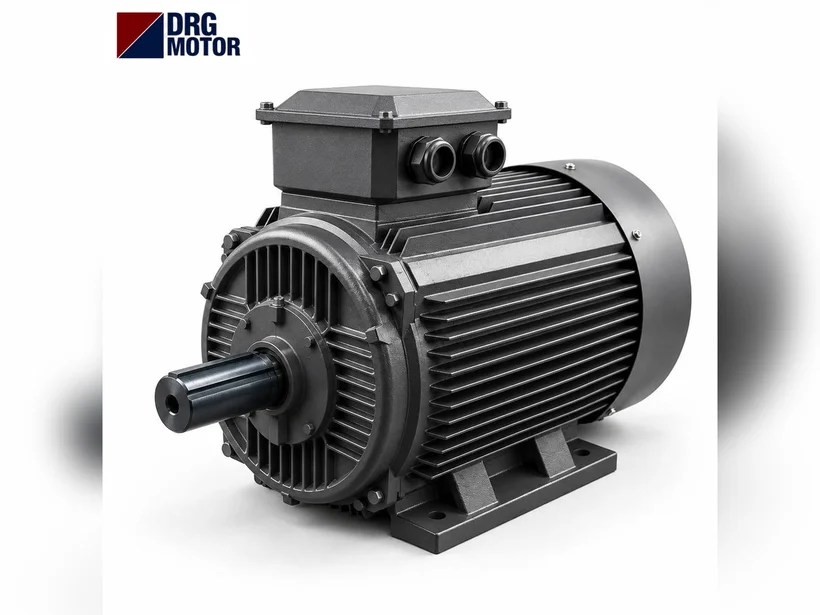
The main motor stands on a separate base beside the crusher. V-belts from the motor pulley turn the pulley on the crusher’s horizontal countershaft. A bevel pinion at the end of this shaft drives the gear of the eccentric bushing, and the eccentric gives the mantle its gyrating motion. One medium-size model’s sheet gives an input shaft speed of 750–900 rpm [5]; the motor speed is brought down to this by the belt ratio.
Some very large mining types have no belts: on a 750 kW model the motor is coupled directly to the pinion shaft, which turns at 993 rpm at 50 Hz [4]. Motors of this size are special designs and are not in the DRG range.
Auxiliary motors are a separate list
The cone crusher’s moving parts are lubricated and cooled by pressurised oil, so the main motor is not started until the lubrication unit runs. Setting adjustment and tramp-iron clearing are hydraulic too. Catalogue examples:
- On a medium model (149 kW main motor), lube pump 1.1 kW and hydraulic setting module 3.7 kW [5].
- On the 750 kW mining model, lube pump motor 11 kW at 2,950 rpm and hydraulic setting pump 7.5 kW at 970 rpm [4].
These motors are fed and protected from the panel separately from the main motor. They should be listed on separate lines in the order so they are not confused with the main drive.
Motor power of cone crushers on the market
A cone crusher has a single main drive motor. The main motor values in the table refer to that one motor; the auxiliary motors are shown separately in the last row.
| Model group / capacity | Motor power | Single / total | Source |
|---|---|---|---|
| Maker A, small model (23–132 t/h) | 90 kW | Single main motor | [3] |
| Maker B, 1,120 mm head (up to 440 t/h) | 220 kW | Single main motor | [1] |
| Maker B, large secondary-range model | 200–355 kW | Single main motor | [2] |
| Maker B, 1,400 mm head (up to 790 t/h) | 500 kW | Single main motor | [1] |
| Maker A, largest mining model | 750 kW | Single main motor | [4] |
| Same mining model: lube + hydraulic setting | 11 kW + 7.5 kW | Auxiliary, separate | [4] |
In this machine group, motor options of roughly 75–750 kW are seen depending on the manufacturer’s model and capacity [2][4].
The first factor setting power is the head (mantle) diameter: a 735 mm head is given 90 kW and a 1,400 mm head 500 kW [1]. For one and the same crusher, stroke, CSS, chamber profile and feed rate all shift the power drawn. A longer stroke and a choke-fed crusher raise capacity and power together. That is why manufacturers give a motor range such as 132–250 kW for the same crusher rather than a single value [2].
The part that overlaps the DRG range
The 75–355 kW catalogue models can be covered by DRG cast iron motors. The large 370 kW, 500 kW, 700 kW and 750 kW models are above the 355 kW limit and outside the DRG range. The auxiliary motors in the catalogues (1.1–11 kW) are within the DRG range [4][5].
Click to see current electric motor prices and order nowSEE PRICES →
Reading the selection table: from power draw to motor size
Cone crusher motor power is not calculated with a formula; it is read from the manufacturer’s operating-point table. One manufacturer’s brochure compares two strokes for the same crusher, same chamber and the same 25 mm CSS [2]:
- 40 mm stroke: about 350 t/h, 280 kW power draw; suggested motor 315 kW.
- 22 mm stroke: about 220 t/h, 140 kW power draw; suggested motor 200 kW.
From these two points you get the following ratios: about 0.80 kWh per tonne in the first case and 0.64 kWh in the second. The motor runs at about 89 % load in the first case and 70 % in the second. The reading order is: choose the target capacity and CSS, then the suitable stroke and chamber, read the power draw from the table and take the next standard motor size. The crusher motor is not chosen above the upper catalogue limit, because the crusher’s mechanical parts are designed for that limit.
On the DRG side, the two motors of the example are DRG-355L-4 for 315 kW (1490 rpm, 526 A at 400 V) and DRG-315L2-4 for 200 kW (1490 rpm, 334 A at 400 V).
Cone crusher motor checklist
- Crusher model, head diameter, chamber type and stroke; the motor power given by the manufacturer for that combination.
- Countershaft (input shaft) speed and direction of rotation; motor pulley diameter and number of belts.
- kW, speed and voltage of the lubrication and hydraulic unit motors (as separate lines).
- Interlock preventing the main motor from starting before lube pressure is established (panel side).
- Starting method: does the crusher start empty, could material remain in the chamber; star-delta, soft starter or VFD.
- Whether an oil heater is needed in cold climates or an oil cooler fan motor in hot regions.
Speed, starting and mounting
An input shaft speed such as 750–900 rpm [5] allows either a 4-pole (1500 rpm) or a 6-pole (1000 rpm) motor with belts; the choice follows the pulley ratio and the manufacturer’s base dimensions. When replacing an existing motor, the safest path is to keep the same number of poles; if the poles change, the pulley must be recalculated (pulley and belt calculator).
A cone crusher is started empty and feed opens once the motor is up to speed. With no flywheel its inertia is lower than a jaw crusher’s, but starting gets harder with cold oil and leftover material in the chamber. Every DRG motor of 4 kW or more has a 400/690 V winding, which is what a star-delta panel needs; where a heavily loaded start is likely, a soft starter or VFD is preferred. Watching current during sudden load increases is part of protection; some crusher automation systems adjust feed to the power the motor draws [2]. Why starting current is high is explained in this article. Wiring is a job for a qualified electrician.
The main motor is foot-mounted (B3) on a belt-tensioning slide. Lube pump motors are usually flange-mounted to the pump (B5 or B35). Take the exact mounting from the crusher maker’s drawing and compare it with our technical drawings.
| Model | Power / speed | Frame · current 400 V | Price |
|---|---|---|---|
| DRG-280M-4125 HP | 90 kW · 1500 rpm | Cast iron 280M · 155 A | $3,268.56 (€2,919.03) Details & buy → |
| DRG-315S-4150 HP | 110 kW · 1500 rpm | Cast iron 315S · 187 A | $4,863.00 (€4,342.97) Details & buy → |
| DRG-315M-4180 HP | 132 kW · 1500 rpm | Cast iron 315M · 224 A | $5,621.72 (€5,020.55) Details & buy → |
| DRG-315L1-4200 HP | 160 kW · 1500 rpm | Cast iron 315L · 271 A | $6,135.24 (€5,479.15) Details & buy → |
| DRG-315L2-4270 HP | 200 kW · 1500 rpm | Cast iron 315L · 334 A | $7,115.64 (€6,354.71) Details & buy → |
| DRG-355M-4340 HP | 250 kW · 1500 rpm | Cast iron 355M · 418 A | $9,826.77 (€8,775.92) Details & buy → |
| DRG-355L-4430 HP | 315 kW · 1500 rpm | Cast iron 355L · 526 A | $11,417.31 (€10,196.37) Details & buy → |
| DRG-400M-4480 HP | 355 kW · 1500 rpm | Cast iron 400M · 593 A | $11,803.58 (€10,541.33) Details & buy → |
Matching DRG motors
DRG Motor is a manufacturer, supplier and seller of electric motors. Product range: cast iron three-phase motors of 0.55–355 kW and aluminium ones of 0.25–11 kW, 1000/1500/3000 rpm, 230/400 V or 400/690 V; B3, B5, B14 or B35 mounting is stated in an order note. For cone crushers we cover main motors of 75–355 kW plus lubrication and hydraulic unit motors. In our 4-pole series the starting torque ratio is 2.0 from 90 to 355 kW. The last two rows of the table match the auxiliary motors in the 750 kW model’s sheet (11 kW 2-pole, 7.5 kW 6-pole).
| Model | Power / speed | Frame | Current 400 V |
|---|---|---|---|
| DRG-280M-4 | 90 kW / 1486 rpm | 280M cast iron | 155 A |
| DRG-315M-4 | 132 kW / 1488 rpm | 315M cast iron | 224 A |
| DRG-315L2-4 | 200 kW / 1490 rpm | 315L cast iron | 334 A |
| DRG-355L-4 | 315 kW / 1490 rpm | 355L cast iron | 526 A |
| DRG-400M-4 | 355 kW / 1490 rpm | 400M cast iron | 593 A |
| DRG-160M1-2 | 11 kW / 2945 rpm | 160M cast iron | 19.6 A |
| DRG-160M-6 | 7.5 kW / 970 rpm | 160M cast iron | 15.4 A |
DRG MOTOR motors are guaranteed against material and manufacturing defects for 2 years from the delivery date (warranty certificate). The supply process for high-power crusher motors is covered in our article on crusher motor supply.
Motors in this power range for cone crushers
- DRG-280M-4 – 90 kW – 1486 rpm – 280M cast iron
- DRG-315M-4 – 132 kW – 1488 rpm – 315M cast iron
- DRG-315L2-4 – 200 kW – 1490 rpm – 315L cast iron
- DRG-355M-4 – 250 kW – 1490 rpm – 355M cast iron
- DRG-355L-4 – 315 kW – 1490 rpm – 355L cast iron
- DRG-400M-4 – 355 kW – 1490 rpm – 400M cast iron
Click to see current prices and order these motors nowSEE PRICES →
Frequently Asked Questions
How many kW is a cone crusher motor?
Catalogues show 75–90 kW on small models, 200–315 kW on medium models and 500–750 kW on large mining types. For one crusher the manufacturer usually gives a range; the exact value is read by stroke and chamber.
Is the lube pump motor replaced together with the main motor?
No, they are separate motors. Lubrication and hydraulic unit motors are chosen separately by their own nameplates; in catalogue examples their power is between 1.1 kW and 11 kW.
Does DRG offer cone crusher motors above 355 kW?
No. The DRG range ends at 355 kW; cone crushers needing 370 kW or more are outside it. Their auxiliary motors, however, are within the range.
Why will a cone crusher not run without oil pressure?
The eccentric bushing and bearings are lubricated and cooled by pressurised oil. Turning without oil flow can damage the bearings within minutes, so the panel is interlocked to block the main motor until oil pressure is established.
With the crusher’s model plate, the main and auxiliary motor nameplates and the pulley size in hand, we can work out the matching DRG motors with you. Reach us on +90 (542) 666 11 11, at [email protected] or through the contact form; the store models are listed on Buy Electric Motors Online.
Sources
- Metso – Nordberg HP Series cone crushers (broşür) – HP100–HP6: motor power 90–700 kW, head diameter, feed opening and capacity; hydraulic setting motor.
- Metso – Nordberg GP Series cone crushers (broşür) – GP series 75–400 kW; power draw by stroke and CSS with suggested motor (280 kW → 315 kW, 140 kW → 200 kW).
- Sandvik – Cone crusher range CH/CS 400-600 (broşür, bayi kopyası) – CH420–CH660 and CS420–CS660: motors 90–315 kW, capacity and CSS ranges; lube tank standard.
- Sandvik – CH890i & CH895i technical specification – 750 kW main motor (6/8-pole, direct drive, pinion 993 rpm); lube pump 11 kW 2,950 rpm; hydraulic setting pump 7.5 kW 970 rpm.
- Terex Cedarapids – RC45III cone crusher specification – 149 kW main motor, input shaft 750–900 rpm, V-belts; lube pump 1.1 kW, hydraulic module 3.7 kW.


