 English
 Le français
 Türkçe

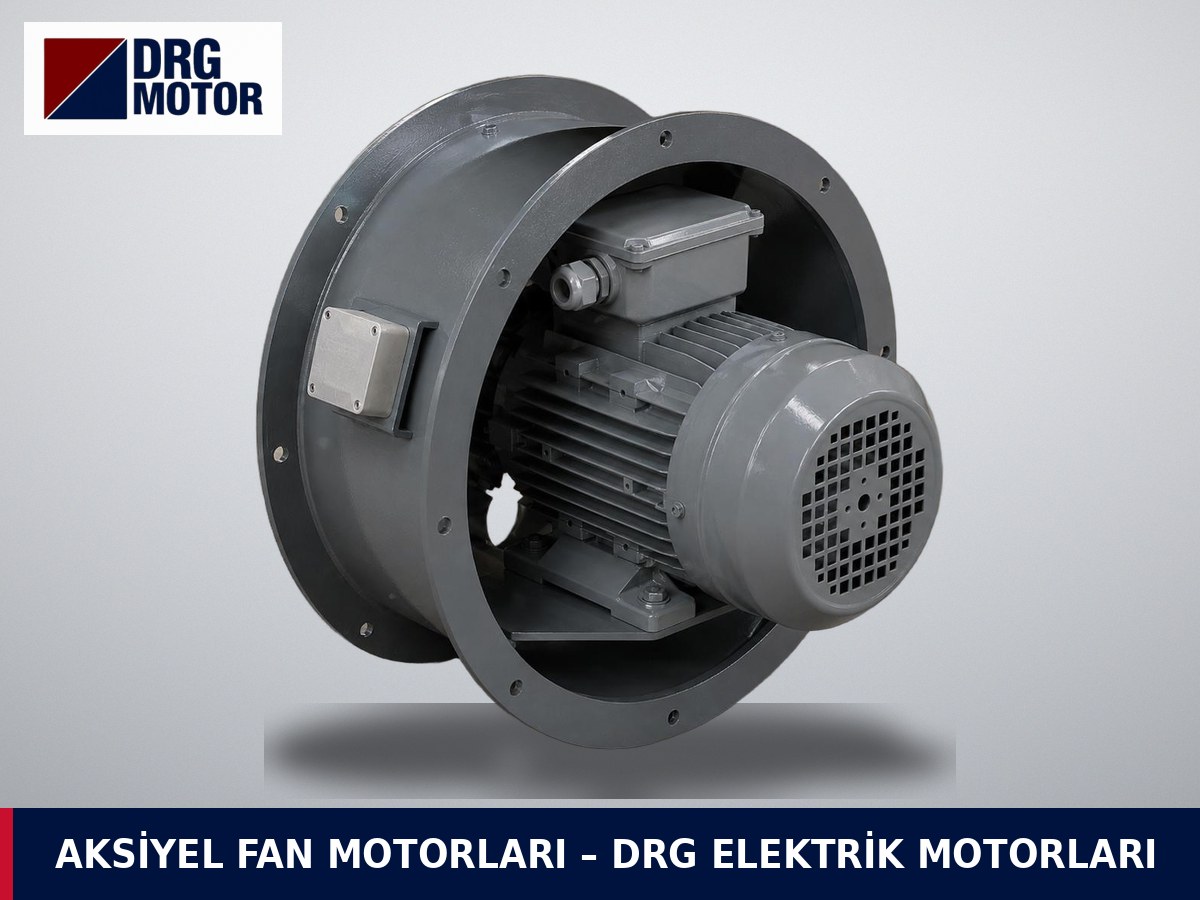
An axial fan motor is not a special type of motor: it is a standard three-phase induction motor that drives the axial impeller and is chosen according to the fan’s shaft power, speed and mounting arrangement. The choice rests on three pieces of data: the shaft power calculated from airflow and pressure at the duty point, a speed (number of poles) suited to the impeller diameter, and the way the motor is fixed to the fan casing. For example, a direct-drive axial fan moving 6 m³/s against 220 Pa needs a 3 kW, 4-pole motor; you will find models in this class among the 120 listed on our Buy Electric Motors Online page.
In most axial fans the motor sits right in the airstream and the impeller is mounted directly on the motor shaft. This layout cools the motor, but it also exposes it to the temperature, humidity and dust of the air being moved. That is why a kW figure alone does not describe the right motor; speed, environment and mounting are part of the choice. Keep the existing motor’s nameplate and the fan label at hand; the steps below show how to use them. In Turkish the axial fan is also called “aksiyal” or “eksenel” fan, and people even search for it under the misspelling “aksiyoner”; all of these describe the same operating principle.
What is an axial fan and which group does it belong to?
In an axial fan, air enters the impeller parallel to the shaft axis and leaves parallel to it as well. The blades push the air like a propeller; because the air does not change direction, the fan delivers high airflow for its diameter, while the pressure it builds is lower than that of a centrifugal fan. The word “axial” describes an operating principle; it says nothing about where the fan is installed or what job it does.
| Term group | What it describes | Example |
|---|---|---|
| Operating principle | Path of air through the impeller | Axial, centrifugal, mixed flow |
| Casing / installation | Where the fan is fitted | Wall, duct, roof type |
| Purpose | The job the fan does | Jet fan, smoke extraction |
Sub-types of axial fan
- Wall type: mounted on a plate or ring, without ductwork, blowing freely.
- Duct / tube type: runs inside a cylindrical casing flanged to the duct at both ends.
- Vane-axial: fixed vanes after the impeller turn the swirl of the air into pressure.
- Jet fan: a cased axial that moves air by thrust in spaces without ducts.
- Roof type: an exhaust arrangement with the axial impeller inside a roof cowl.
- Reversible: an axial with a symmetrical blade profile giving similar performance in both directions.
Where is it used, and what sets it apart?
Warehouse and workshop ventilation, livestock buildings, greenhouses, cooling towers, condenser and heat-exchanger cooling, car-park and tunnel ventilation are typical axial fan applications. What they share is moving a large volume of air against low resistance. What sets the axial apart from other fans is that the motor sits in the middle of the airflow, immediately behind or in front of the impeller; in centrifugal fans the motor usually stays outside the air path.
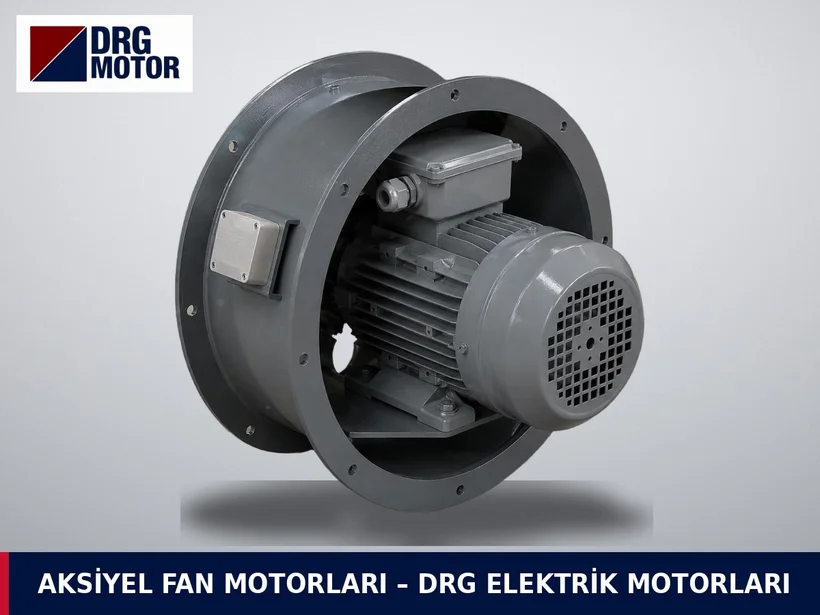
The motor’s role in an axial fan: impeller on the shaft, motor in the airstream
In most industrial axial fans the impeller is fitted directly to the motor shaft end with a key and a retaining bolt. There is no belt, pulley or coupling in between; fan speed equals motor speed. This has two consequences: speed cannot be changed by swapping pulleys, only by the number of poles or a frequency inverter; and the motor shaft and bearings carry the weight of the impeller and the reaction force of the air directly.
Sitting in the airstream helps the motor stay cool, but if the air is hot, humid, or carries oil mist, dust or abrasive particles, the motor is exposed to all of it. In one manufacturer’s catalogue, the air temperature for a cased axial series is limited to 55 °C, and a special motor version is offered for hotter air [1]. If very hot or dirty air must be moved, a belt-driven axial with the motor outside the flow, or another fan type, comes into play; that decision belongs to the fan side.
The split of responsibility is clear: fan selection, the fan curve, impeller and casing design are the job of the fan manufacturer or the project engineer. The motor supplier’s job is to provide a motor that matches the shaft power, speed, mounting and ambient conditions resulting from that work. Motor selection does not change the fan curve; but a motor with the wrong speed or too little power can stop even the best-designed fan from working.
Click to see current electric motor prices and order nowSEE PRICES →
What information do you need to select the motor?
Collecting the list below in full is the quickest way to reach the right model in a single phone call or e-mail:
- Fan label: airflow (m³/h or m³/s), static pressure (Pa), impeller diameter and fan speed.
- Old motor nameplate: kW, rpm, voltage (230/400 V or 400/690 V), current, IEC frame code.
- Shaft diameter and length (D × E): the impeller hub is machined to this size.
- Mounting: foot (B3) or flange (B5 / B14), and does the fan run horizontally or vertically?
- Airflow direction: does air pass from motor to impeller or from impeller to motor?
- Temperature and humidity of the air; is there dust, oil or chemical vapour?
- Is the fan started direct on line, star-delta, or by an inverter?
- Does the fan run in both directions, and does it have a certified duty such as smoke extraction?
The last point matters: fans with a smoke-extraction or explosive-atmosphere duty require the fan and motor set to hold the relevant certificate. DRG’s standard motors are not sold with these certificates; the recommendations in this article apply to axial fans used for normal ventilation.
How many kW does an axial fan need?
No fixed kW can be assigned to an axial fan. Power depends on impeller diameter, airflow, static pressure, blade profile and pitch angle, speed, system resistance, and air density and temperature. The calculation starts with the fan shaft power: Pshaft = Q × Δp / ηfan (Q in m³/s, Δp in Pa, P in W). Motor power is found by dividing the shaft power by the drive losses and adding a margin.
Example: take a ducted axial fan extracting 21,600 m³/h from a production hall against 220 Pa static pressure. 21,600 m³/h = 6 m³/s. Assuming a fan efficiency of 0.62, Pshaft = 6 × 220 / 0.62 ≈ 2,130 W, i.e. about 2.13 kW. With the impeller on the motor shaft, drive losses are ignored. Adding a 15% margin for filter fouling and air density changes gives ≈ 2.45 kW; the next standard rating is 3 kW. If the fan manufacturer’s curve shows around 1450 rpm for this impeller, the matching model is DRG-100L2-4: 3 kW, 1450 rpm, 6.02 A at 400 V, cos φ 0.82. You can run the same calculation with your own data in the Pump & Fan Motor Power calculator.
Looking at products on the market shows the scale too. In one manufacturer’s catalogue, a cased axial series with 400, 500 and 630 mm diameters is offered with motors up to 11 kW [1]. The same manufacturer’s 315–800 mm cased axial series goes up to 15 kW, but uses an EC motor integrated into the fan [2]. EC motors are part of the fan and DRG does not sell this type of motor; DRG’s match is fans that use IEC-dimension induction motors.
DRG’s range should be stated separately: aluminium frame 0.25–11 kW, cast iron 0.55–355 kW; 1000, 1500 and 3000 rpm; 3-phase, 230/400 V or 400/690 V; B3, B5, B14 and B35 mounting with an order note. The table below shows models selected from the power and speed range commonly used in axial fans.
| Model | Power / speed | Frame · current 400 V | Price |
|---|---|---|---|
| DRG-711-40.37 HP | 0.25 kW · 1500 rpm | Aluminium 71 · 0.66 A | $73.16 (€65.33) Details & buy → |
| DRG-802-41 HP | 0.75 kW · 1500 rpm | Cast iron 80 · 1.75 A | $101.93 (€91.03) Details & buy → |
| DRG-90L-42 HP | 1.5 kW · 1500 rpm | Cast iron 90L · 3.3 A | $144.14 (€128.73) Details & buy → |
| DRG-132S-64 HP | 3 kW · 1000 rpm | Cast iron 132S · 6.84 A | $295.59 (€263.98) Details & buy → |
| DRG-100L2-44 HP | 3 kW · 1500 rpm | Cast iron 100L · 6.02 A | $203.84 (€182.05) Details & buy → |
| DRG-100L-24 HP | 3 kW · 3000 rpm | Cast iron 100L · 5.71 A | $177.89 (€158.87) Details & buy → |
| DRG-132M-410 HP | 7.5 kW · 1500 rpm | Cast iron 132M · 14.3 A | $394.89 (€352.66) Details & buy → |
| DRG-160M-415 HP | 11 kW · 1500 rpm | Cast iron 160M · 20.4 A | $568.76 (€507.94) Details & buy → |
Speed and poles: why tip speed decides
On an axial impeller, pole selection must be considered together with diameter. Blade tip speed is v = π × D × n / 60 (D in metres, n in rpm, v in m/s). As tip speed rises, noise and the centrifugal load on blades and hub increase; every impeller has a speed limit set by its manufacturer. The values below are calculated with the rated speeds of DRG motors: DRG-100L-2 for 2 poles (2895 rpm), DRG-100L2-4 for 4 poles (1450 rpm), DRG-132S-6 for 6 poles (968 rpm).
| Impeller diameter | 2 poles | 4 poles | 6 poles |
|---|---|---|---|
| 560 mm | 84.9 m/s | 42.5 m/s | 28.4 m/s |
| 710 mm | 107.6 m/s | 53.9 m/s | 36.0 m/s |
| 900 mm | 136.4 m/s | 68.3 m/s | 45.6 m/s |
The table explains why a 900 mm impeller driven by a 2-pole motor is practically never seen: tip speed reaches 136 m/s. Two poles are common on small-diameter cased axials; as the diameter grows, 4 and 6 poles take over. Remember one rule: as speed rises, airflow grows with speed, pressure with the square of speed and shaft power with the cube of speed. Fitting a faster motor to the same fan multiplies the power and may exceed the impeller’s mechanical limit. Keep the speed at the value given by the fan manufacturer; if adjustment is needed, use an inverter.
Mounting and connection: fan mounting and IEC mounting are different things
Fixing the fan to a wall, duct or roof is one thing; the way the motor is fixed to the fan casing is another. In cased axials the motor usually sits on a support plate or arms inside the casing, by its feet (B3) or flange (B5 / B14). The required type is taken from the fan manufacturer’s drawing; with a flange, the spigot diameter and bolt circle must match the old motor. You can compare flange and shaft dimensions on our technical drawings page.
If the fan runs on a vertical axis or the airflow direction differs from the one the fan was designed for, the bearings carry a higher load. One manufacturer’s catalogue asks that fans to be installed with a different airflow direction be specified in the order from IEC frame 160 and 11 kW upwards, because the motor bearings are then under additional stress [3]. The terminal box is placed outside the casing, or the cable is led out through a gland; the cable must be secured so it cannot touch the impeller. Wiring and the direction-of-rotation check must be done by a qualified electrician; check the motor current for the overload setting in our motor current chart. Our ventilation fan motor article, which compares the motor side of axial and radial fans, and our roof extractor article complete the topic from other angles; for all fan applications, see the Fan Motors page.
DRG Motor is a manufacturer, supplier and seller of electric motors. DRG MOTOR motors are guaranteed against material and manufacturing defects for 2 years from the delivery date (warranty certificate).
DRG motors suited to axial fans
- DRG-90L-4 – 1.5 kW – 1445 rpm – 90L aluminium
- DRG-100L-2 – 3 kW – 2895 rpm – 100L aluminium
- DRG-100L2-4 – 3 kW – 1450 rpm – 100L aluminium
- DRG-132S-6 – 3 kW – 968 rpm – 132S aluminium
- DRG-112M-4 – 4 kW – 1450 rpm – 112M aluminium
- DRG-132M-4 – 7.5 kW – 1460 rpm – 132M cast iron
Click to see current prices and order these motors nowSEE PRICES →
Axial fan motor: frequently asked questions
What speed should an axial fan motor have?
Speed is set by the impeller diameter and the fan’s design point; there is no fixed value. Small cased fans commonly use 2 poles (about 2900 rpm), larger diameters 4 or 6 poles (around 1450 or 970 rpm). Do not deviate from the speed on the fan label.
What is the difference between an axial and a centrifugal fan?
In an axial fan, air enters and leaves parallel to the axis, airflow is high, pressure is low and the motor is usually in the air. In a centrifugal fan, air enters along the axis and leaves after turning 90°; it builds higher pressure and the motor usually sits outside the air path.
Will a more powerful motor increase the airflow of my axial fan?
No. At the same speed the motor only draws the power the fan demands; airflow does not change. Airflow is set by speed or blade pitch. Fitting a faster motor, on the other hand, raises power with the cube of speed and can push the impeller beyond its mechanical limit.
Can an axial fan motor run on an inverter?
Yes, a three-phase induction motor runs well on an inverter, and this is the best way to adjust airflow. Because fan power falls with the cube of speed, motor load also drops at low speed; with the motor in the airstream, its cooling is supported by the fan’s own air.
Send us the fan label, the old motor’s nameplate and the mounting arrangement, and we will pin down the right DRG model together. Phone +90 (542) 666 11 11, e-mail [email protected], contact page. For all models and current prices, visit Buy Electric Motors Online.
Sources
- Systemair – AXC-E axial fans – 400/500/630 mm, motors up to 11 kW; air up to 55 °C.
- Systemair – AXC-EC axial fans – 315–800 mm, EC motors up to 15 kW.
- Systemair – AXC(A) Axial Fans catalogue (2023) – bearing load note for other airflow directions above IEC 160 / 11 kW.


