 English
 Le français
 Türkçe

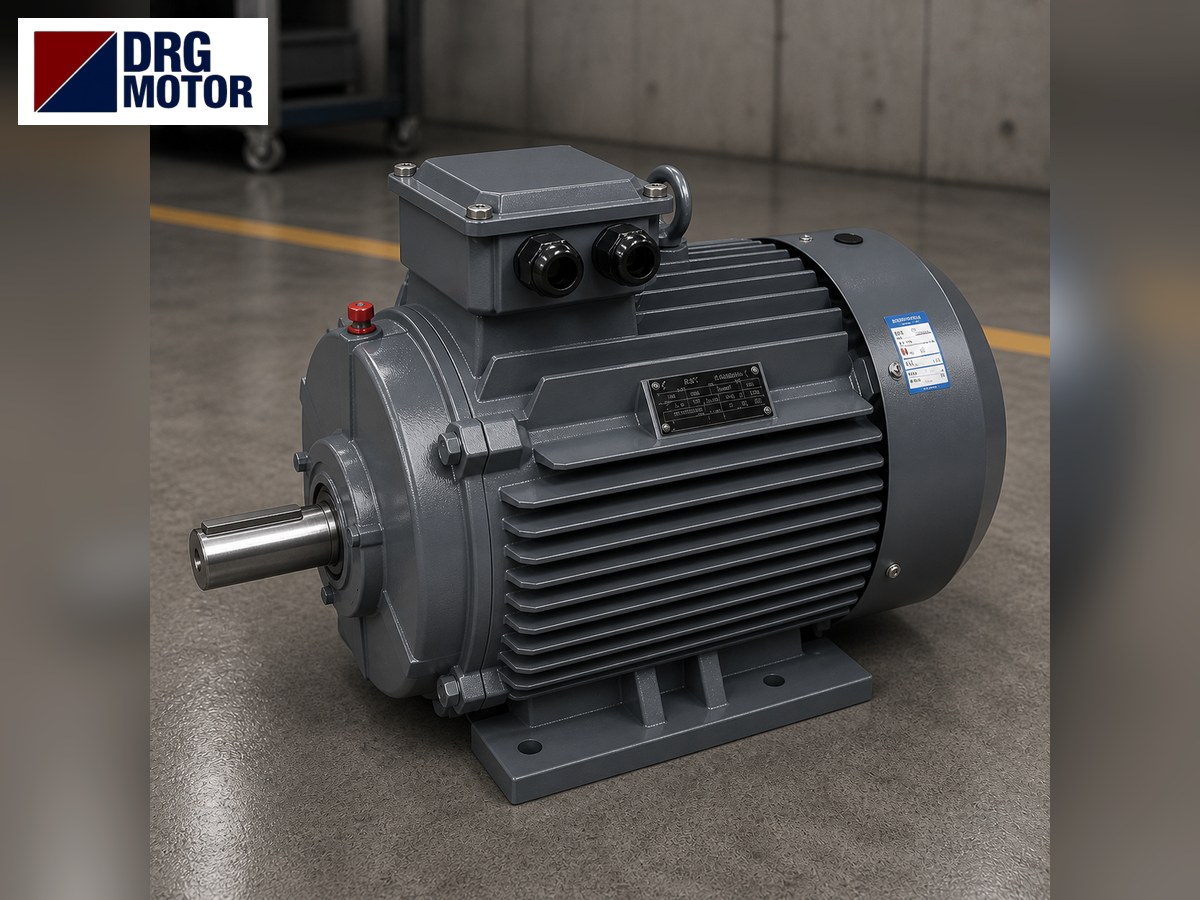
On a band saw machine the electric motor turns the lower wheel; the wheel pulls the endless blade stretched between two wheels, and cutting is done by that straight-line movement of the blade. Maker catalogues list 2.2–4 kW main motors for joinery band saws, while log band mills start at 15 kW and continuous multi-head lines reach up to 90 kW per head. Which value fits your machine depends on wheel diameter, cutting height and the machine nameplate.
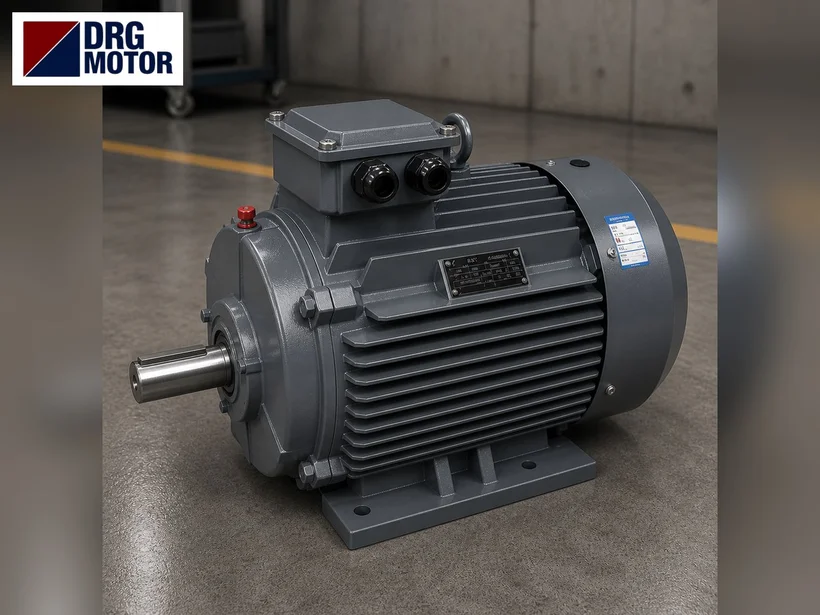
DRG Motor is a manufacturer, supplier and seller of electric motors. We do not sell band saw machines, blades, wheels, pulleys or gearboxes, nor hydraulic units, inverters, electro-spindles or servo motors. Our part is the three-phase induction motor turning the lower wheel, belt-driven or direct; suitable ratings are on Buy Electric Motors Online.
What does the motor do on a band saw?
Blade cutting speed equals the rim speed of the wheel. The motor drives the lower wheel; the upper wheel runs free, keeps the blade tensioned and tracks it. Because a single thin blade removes the chips, the kerf is narrow: less waste from the timber, but a long and steady load for the motor. The load hardly changes while the blade is in the wood; once it leaves the cut, the motor only turns wheels and belts.
Joinery band saw
In the workshop it is used for curved cuts, ripping thick boards and resawing veneer. Wheels range from 400 to 900 mm and the work is fed by hand. The motor usually sits under the frame, foot mounted (B3) on a motor plate, and drives the lower wheel through one belt. With a cutting height extension or an automatic feeder the same machine needs a stronger motor; one maker offers up to 11 kW for this use on its 800 mm model.
Log band mill
This is the large machine that breaks logs into planks and boards. On horizontal mills the band head travels over the log on a rail carriage; on vertical mills the log is clamped on a carriage and driven into a fixed blade. Besides the main motor there are auxiliary drives for carriage travel, head lift and log turning. For general rules on saw and band saw motors see our sawmill and band saw motor article; this page concentrates on how power is spread across machine classes and on the motor issues specific to the band saw family.
How it differs from a multi-rip saw
The other big family in timber breakdown is the multi-rip saw, which splits a board into several pieces in one pass with many circular blades stacked on one arbor. There the motor spins a heavy blade pack at around 3,000–4,000 rpm and every blade opens its own kerf, whereas a band saw has one thin blade and large wheels turning far more slowly. So the band mill cuts the same timber with less waste, the multi-rip faster and into many pieces, and motor rating and speed are chosen differently.
Wheel diameter, blade speed and motor speed
Blade speed is the product of wheel diameter and wheel speed. One maker gives two cutting speeds, 725 and 1,450 m/min, for its 600 mm joinery saw. For 1,450 m/min the wheel must turn at about 769 rpm; with a 4-pole motor at 1,450 rpm such as the DRG-100L1-4, that is a reduction of roughly 1.88 between motor and wheel pulleys. With your machine’s real pulley sizes, the pulley and belt calculator gives the same answer in seconds.
Two-speed and variable-speed drives
Machines that also cut plastics, foam or insulation boards need two speeds or variable speed. Catalogues solve this with a pole-changing two-speed motor (for example 1.5/2.2 kW) or with a single-speed motor adjusted 1:5 by an inverter. Pole-changing two-speed motors are not in the DRG range; our single-speed motor can run on an inverter, but we do not supply the inverter. If the motor is to run slowly for long periods its own fan may not cool it enough, which should be discussed before ordering.
How many kW is a band saw motor? Catalogue values
A) Main motor ratings published by band saw and band mill makers:
| Machine class | Main motor power | Single / total | Note |
|---|---|---|---|
| Joinery band saw, 600 mm wheel | 2.2 kW (option 3.0 kW) | single motor | catalogues of two makers |
| Joinery band saw, 630 / 800 mm wheel | 3.0 / 4.0 kW | single motor | maker catalogue, two models |
| 800 mm wheel used with a power feeder | up to 11 kW | single motor | same maker, uprated option |
| Horizontal band sawmill, 700–1,600 mm log | 15–30 kW | one main motor; head lift separate | maker catalogue, four models |
| Vertical log band mill, 800 / 900 / 1,000 mm wheel | 15 / 18.5 / 22 kW | one main motor | maker catalogue |
| Vertical log band mill, 1,250 mm wheel | 30–45 kW | one main motor | maker catalogue |
| Continuous twin/quad vertical band line | 22–37 kW / 75–90 kW | one motor per band head | maker catalogue, small and large series |
Read across the makers, joinery saws carry roughly 2.2–4 kW (up to 11 kW with a feeder), log band mills 15–45 kW, and continuous multi-head lines up to 90 kW per head. On multi-head lines the table value is the motor of one head; total installed power is the sum of the heads plus carriage, roller and chip drives. As cutting height, wood hardness and feed rate rise, a stronger motor is needed for the same wheel size.
B) Where DRG fits: 2.2–4 kW joinery saw motors match our 4-pole 100L and 112M frames, 15–45 kW mill main motors our cast iron frames from 160L to 225M, and 75–90 kW large head motors the 280S and 280M frames. The whole range in the table sits inside our 0.25–355 kW span; what falls outside is not power but purpose-built machine motors, since a motor with the machine maker’s own flange or long shaft does not follow standard IEC dimensions.
Click to see current electric motor prices and order nowSEE PRICES →
Starting inertia, star-delta and braking
Starting a heavy wheel
Log mill wheels are large cast iron parts, and at start-up the motor must first accelerate that mass. Run-up takes several seconds, during which the motor draws a multiple of rated current. One joinery saw maker uses direct starting on its 400–600 mm models and star-delta on 700–900 mm models, offering a star-delta switch from 3.0 kW. On log band mills star-delta or a soft starter is almost always fitted.
Example: starting current of an 18.5 kW vertical mill
Take a vertical log mill with 900 mm wheels and an 18.5 kW main motor. The figures use DRG-180M-4 catalogue data (rated torque: DRG-180M-4, 120.2 Nm):
| Step | Value | Basis | What it means |
|---|---|---|---|
| Rated current of the 18.5 kW mill motor | 33.5 A | DRG-180M-4, 400 V | the overload relay is set to this |
| Starting current, direct-on-line | ≈ 261 A | 33.5 × 7.8 | a heavy wheel draws it for several seconds |
| Line current in the star step | ≈ 87 A | 261.3 / 3 | the supply shock falls to one third |
| Starting torque in star | about one third | rated 120.2 Nm | the blade must start out of the cut |
| Comparison: 4 kW joinery saw | ≈ 62 A direct | 7.95 × 7.8 | small machines usually start direct |
Torque also drops to a third in star, so the mill should be started with the blade clear of the log and the carriage pulled back. Try changeover time and switchgear with your own values in our star-delta starting tool.
Run-down time and electronic braking
After switch-off a heavy wheel keeps turning for a long time, and an exposed moving blade is a serious hazard during maintenance and blade changes. Machine safety rules therefore require a limited run-down time. Woodworking machines normally meet it with DC injection braking: for a few seconds after switch-off the panel sends direct current through the winding, and the brake module lives in the panel rather than in the motor. The self-braking (mechanical brake) motors mentioned in some catalogues are not in the DRG range; if your machine needs that type, ask us and we will look at the alternatives together.
Chips, resin dust and motor cooling
A band saw produces fine dry chips, and with resinous species the dust is sticky. On most machines the motor sits under the frame, right where the chips fall. Dust packed between the cooling fins and behind the fan cowl grille raises winding temperature even while the cutting load stays the same. Our motors are IP55; even so, the motor compartment should be cleaned regularly, the fan cowl kept clear and the dust extraction port kept running. For fan motors on the extraction side see our Fan Motors category.
DRG motors for band saw machines
4-pole models in joinery saw and band mill ratings (current at 400 V):
| Model | Power / speed | Frame · shaft D×E | Current 400 V |
|---|---|---|---|
| DRG-100L1-4 | 2.2 kW / 1450 rpm | 100L cast iron · 28×60 | 4.52 A |
| DRG-100L2-4 | 3 kW / 1450 rpm | 100L cast iron · 28×60 | 6.02 A |
| DRG-112M-4 | 4 kW / 1450 rpm | 112M cast iron · 28×60 | 7.95 A |
| DRG-160M-4 | 11 kW / 1465 rpm | 160M cast iron · 42×110 | 20.4 A |
| DRG-180M-4 | 18.5 kW / 1470 rpm | 180M cast iron · 48×110 | 33.5 A |
| DRG-180L-4 | 22 kW / 1470 rpm | 180L cast iron · 48×110 | 39.7 A |
| DRG-200L-4 | 30 kW / 1475 rpm | 200L cast iron · 55×110 | 53.8 A |
Band saws use 4-pole motors (1,500 rpm class); a 2-pole motor on the same pulleys would double blade speed and exceed what the machine allows. Aluminium frames (0.25–11 kW) suit small saws, cast iron frames (0.55–355 kW) the mills; each is a three-phase IEC induction motor; band saws mostly take the foot-mounted B3 form, and B5, B14, B34 or B35 can be ordered. Before removing the old motor, note the kW, speed and voltage/connection on its plate, shaft diameter and key, frame and foot dimensions and where the pulley hub sits on the shaft. We compare this with the machine documents and confirm the right model with you; we give no blanket compatibility guarantee. Dimensions are on our technical drawings page.
Live price table
Current prices of models in band saw and band mill main motor ratings come live from the shop:
| Model | Power / speed | Frame · current 400 V | Price |
|---|---|---|---|
| DRG-100L1-43 HP | 2.2 kW · 1500 rpm | Cast iron 100L · 4.52 A | $188.32 (€168.18) Details & buy → |
| DRG-100L2-44 HP | 3 kW · 1500 rpm | Cast iron 100L · 6.02 A | $203.84 (€182.05) Details & buy → |
| DRG-112M-45.5 HP | 4 kW · 1500 rpm | Cast iron 112M · 7.95 A | $254.38 (€227.18) Details & buy → |
| DRG-132M-410 HP | 7.5 kW · 1500 rpm | Cast iron 132M · 14.3 A | $394.89 (€352.66) Details & buy → |
| DRG-160L-420 HP | 15 kW · 1500 rpm | Cast iron 160L · 27.3 A | $678.13 (€605.61) Details & buy → |
| DRG-180M-425 HP | 18.5 kW · 1500 rpm | Cast iron 180M · 33.5 A | $873.49 (€780.08) Details & buy → |
| DRG-180L-430 HP | 22 kW · 1500 rpm | Cast iron 180L · 39.7 A | $919.45 (€821.13) Details & buy → |
| DRG-225S-450 HP | 37 kW · 1500 rpm | Cast iron 225S · 66.1 A | $1,527.18 (€1,363.87) Details & buy → |
DRG MOTOR motors are guaranteed against material and manufacturing defects for 2 years from the delivery date (warranty certificate).
Motors in this power range
- DRG-100L1-4 – 2.2 kW – 1450 rpm – 100L cast iron
- DRG-112M-4 – 4 kW – 1450 rpm – 112M cast iron
- DRG-160L-4 – 15 kW – 1465 rpm – 160L cast iron
- DRG-180M-4 – 18.5 kW – 1470 rpm – 180M cast iron
- DRG-180L-4 – 22 kW – 1470 rpm – 180L cast iron
Click to see current prices and order these motors nowSEE PRICES →
Browse the products, ask for a quote: every motor option for your band saw or band mill is on Buy Electric Motors Online. Send a picture of the old motor plate and the wheel diameter on WhatsApp or call +90 (542) 666 11 11, and we will pick the frame together.
Frequently asked questions
What speed should a band saw motor have?
A 4-pole motor turning at 1,450–1,490 rpm is the usual choice; the pulley pair then fixes blade speed. The blade speed is given on the machine plate or in the manual; if you change motor speed, the pulleys must be recalculated.
Can a three-phase motor replace a single-phase band saw motor?
Most hobby and small workshop saws run on 230 V single phase. Our range has no single-phase motors. A workshop fed with three phases can make the change, provided the on/off switch and overload device are swapped as well; otherwise, call us before buying.
The mill motor trips the breaker when starting: what should I check?
First make sure the blade is out of the wood at start, the belts are not over-tensioned and the star-delta changeover is not set too short. A large-wheel machine started direct-on-line needs star-delta or a soft starter, and the breaker and fuses must suit the run-up time.
For questions about band saw and band mill motors, reach us at +90 (542) 666 11 11, info@drgmotor.com or through our contact page.


