 English
 Le français
 Türkçe

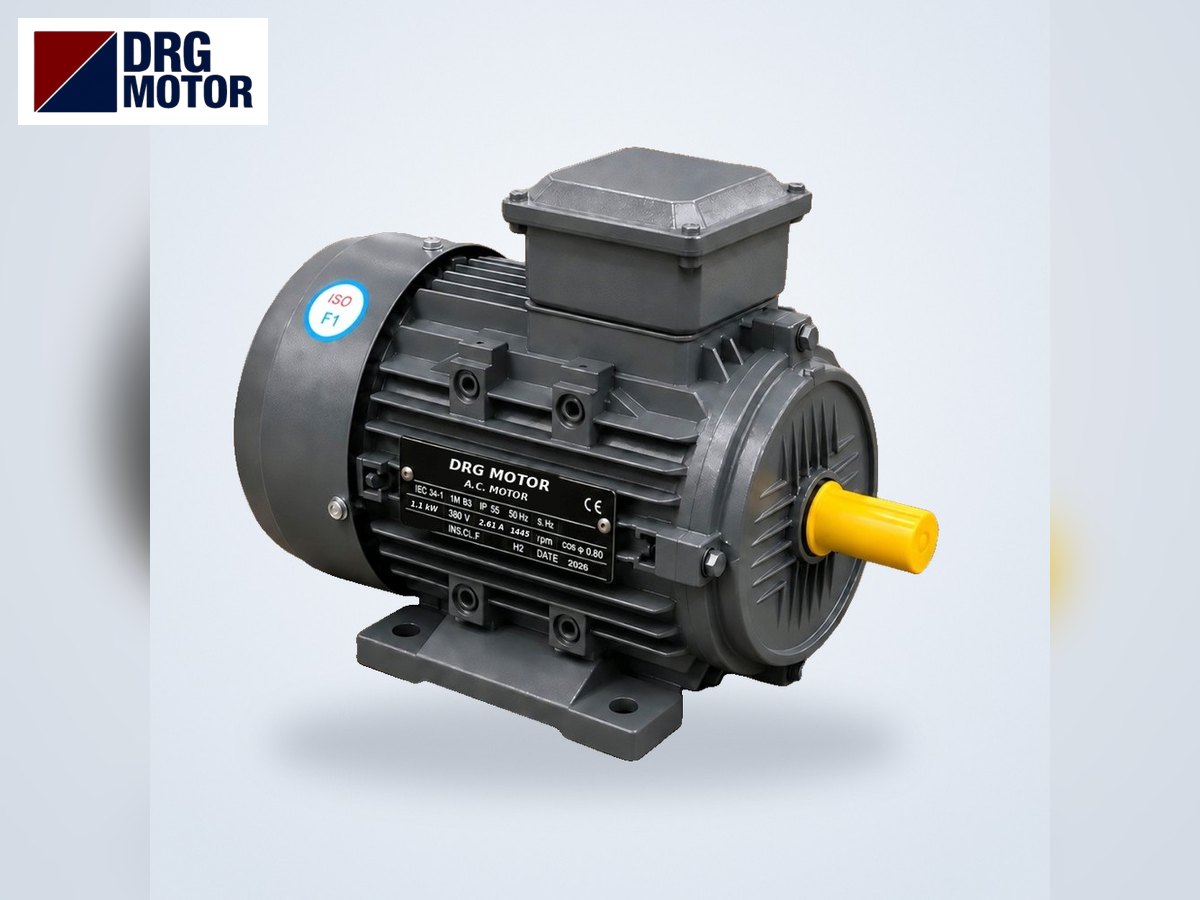
In a barn manure scraper the electric motor sits in the drive unit at the end of the alley and turns a chain or rope wheel through a gearbox. The wheel makes only a few turns a minute; the scraper blade tied to the chain walks along the alley at 3–4 metres a minute, pushes manure into a cross channel or pit, then comes back. For this slow but long journey, aluminium housing electric motors are a natural choice in the small power range. This page covers the barn interior; motors for factory machines that granulate, mix and bag manure are the subject of our article on fertilizer mixing and granulating machine motors.
DRG Motor is a manufacturer, supplier and seller of electric motors. We do not sell the scraper blade, chain, corner pulleys, gearbox, control panel, slurry pump or speed drive; we supply the three-phase asynchronous motor at the head of this arrangement. You will find each of these scraper motors, priced, under Buy Electric Motors Online.
Where do motors work in a scraper system?
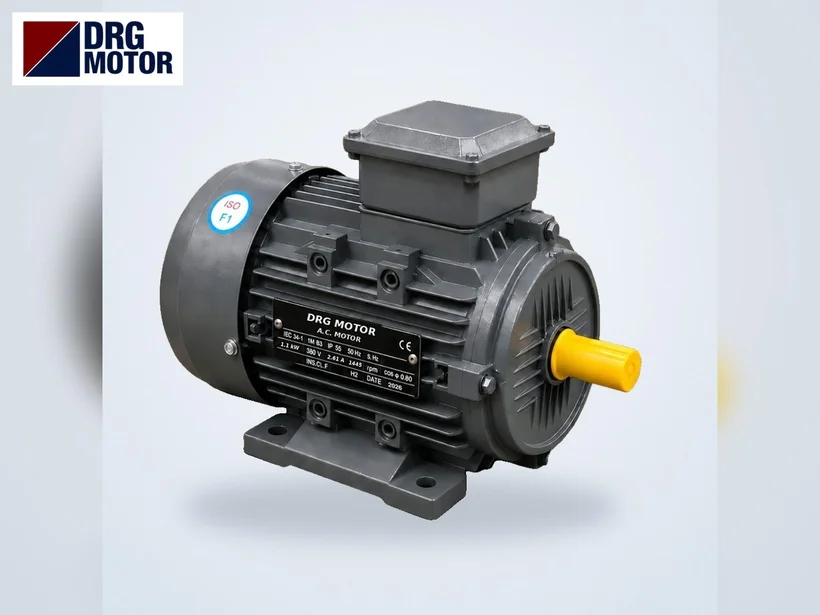
Drive unit: motor, gearbox, chain wheel
One drive unit often pulls two parallel alleys together: while the chain pushes the blade in one alley, the blade in the other comes back empty. At the alley end a limit switch or force sensor reverses direction. Runs follow a timer, a few rounds a day, set to hours with little cow traffic.
Chain, rope and channel scrapers
In the chain type a calibrated steel chain runs in a groove sunk into the alley floor; wear is on the chain and motor load changes little along the way. In the rope type a stainless steel or polyethylene rope winds on and off a drum. In narrow channels under slatted floors a small scraper travels the channel; its motor is smaller than an alley system’s and usually sits on the barn’s outer wall.
Manure pit: mixer and pump
Manure pushed by the scraper flows from the cross channel into the pit. The pit has two more motors: the mixer that breaks up the sediment and the pump that delivers slurry to a tanker or separator. They need far more power than the scraper; submersible types lowered into the pit are outside our range. Where the shaft comes down from above and the motor stands outside, a standard motor can be used.
Motor power on systems on the market
A) Values given in scraper makers’ sheets and a university bulletin:
| System / alley | Motor power | Single motor? | Note |
|---|---|---|---|
| Chain scraper, barns up to 50 m | 0.38 kW | one drive, two alleys | first chain system sheet; 380 V, 2.8–3 m/min |
| Same sheet, up to 100 m / longer | 0.55 / 0.75 kW | one drive | one size up as the barn gets longer |
| Chain length 120 / 240 / 350 m | 0.55 / 0.75 / 1.5 kW | one drive per alley | second maker’s brochure |
| Chain system, by barn length | 0.37–1.1 kW | one drive | 3 × 400 V 50 Hz; 2.8–3 m/min |
| Chain system, gear output 5.4 rpm | 0.55 / 0.75 / 1.5 kW | one drive | 220 V or 380 V; 4 m/min |
| Rope scraper | 0.75 kW | one drive | 380 V three-phase |
| Pig barn, twin rope scrapers | 0.6 kW | one unit per gutter | reversible motor; university bulletin |
| Slatted-floor slurry mixer | 7.5 / 11 kW | per mixer | 1450 rpm, left-right rotation, star-delta |
In this system group, depending on alley length, motors of about 0.37–1.5 kW per drive are found; pit mixers show 7.5 and 11 kW. Even when one drive pulls two alleys there is one motor; a large barn has as many drive units as alleys, and installed power is their sum.
B) Overlap with the DRG range: for scraper drives of 0.37–1.5 kW the aluminium 71, 80 and 90 frame sizes fit, while 7.5 and 11 kW pit mixer motors find their match in 132M and 160M aluminium. Pit mixers or slurry pumps that need more than 11 kW belong to the cast iron models listed on our general purpose page. Outside our range: small units running on single-phase motors, special drives with motor and gearing cast in one piece, layouts that need a brake motor, submersible pumps and mixers, and Ex motors for explosive gas zones. A scraper has no servo or position-controlled axis.
Click to see current electric motor prices and order nowSEE PRICES →
Why choose an aluminium housing for a scraper?
Light weight on the wall bracket and drive frame
In most barns the drive unit hangs on a wall or a steel frame; the motor is flanged to the gearbox and overhangs it like a bracket. A light housing reduces that overhung load and vibration, and makes it easier to slide the unit when tensioning the chain or to lower the motor single-handed during service. We do not quote a weight; our product records have no such field.
Realistic expectations on corrosion
An aluminium housing does not show red rust, but it is not immune to corrosion in ammonia-laden, damp barn air either. The weak points are the bolts, cable gland, shaft end and fan cover. A cast iron housing rusts where its paint is damaged; aluminium does not look like that. With either housing the motor belongs on the dry side, away from the pit mouth and manure splashes.
Where cast iron has the edge
A scraper drive sees no shocks, but for heavy, vibrating jobs such as a pit mixer, and above 11 kW, a cast iron housing takes the lead. A sturdy housing also makes sense for a motor placed where a tractor or loader could hit it.
Dimensions checked during selection
Power, speed and voltage
Because chain speed is very low, the gear ratio is large and most makers use a 4-pole motor. Keeping the old motor’s power and pole count leaves gearbox and chain speed unchanged. The 0.37–1.5 kW aluminium models in our records are wound for 230/400 V and go in star on a 400 V line; the 7.5 and 11 kW models are wound for 400/690 V and run in delta at 400 V.
Gearbox, flange and shaft
Scraper gearboxes are usually worm or multi-stage gear units and take the motor through a B5 flange; couplings and belts are rare. Measure the old scraper motor’s flange rim, spigot, shaft and key and copy them exactly. The gearbox side of the connection is explained on our electric motors for gearboxes page.
Torque at the sprocket and chain force
A rough sum shows how much force a motor can put into the chain. Assumption: drive sprocket at 5.4 rpm, chain speed 3 m/min, a 0.4 allowance for gearbox and chain losses; the figures are an example:
| Motor | Ratio (5.4 rpm output) | Torque at drive sprocket | Chain pull at 3 m/min |
|---|---|---|---|
| DRG-712-4 · 0.37 kW | i ≈ 248 | ≈ 390 Nm | ≈ 4.4 kN |
| DRG-801-4 · 0.55 kW | i ≈ 259 | ≈ 580 Nm | ≈ 6.6 kN |
| DRG-802-4 · 0.75 kW | i ≈ 263 | ≈ 800 Nm | ≈ 9.0 kN |
| DRG-90L-4 · 1.5 kW | i ≈ 268 | ≈ 1590 Nm | ≈ 18.0 kN |
As chain force grows with a long alley or heavy manure, step up one size. Work out the ratio with your own figures in the gearbox output speed and torque tool.
Reversing, moisture and ammonia
Back-and-forth running and starting
A scraper changes direction at least twice per round. On a three-phase motor the panel’s reversing contactor swaps two phases; reverse current should not be applied before the motor has stopped. On starting, the blade moves loaded with manure; direct-on-line starting is enough for these small motors. For speed setting or a soft start an inverter is used; DRG does not supply drives.
Mounting in a wet barn
With IP55, a DRG motor shrugs off barn dust and a low-pressure hose spray from any side. Cleaning the barn with a pressure washer, steam cleaning or the motor sitting in manure are beyond that protection. Hang the drive motor clear of the floor, terminal box and gland pointing at the ground; tighten the gland and blank off unused entries. A small roof or sheet cover over the unit stops water and manure splash; do not block the fan inlet.
Closed-barn air and pit gases
Ammonia and moisture come together in a closed barn, and the motor draws this air in all the time for cooling. Keep the drive unit on the barn’s end wall, on the ventilated side where possible. The inside of a covered manure pit may count as an explosive gas zone; such a place needs an Ex motor, which is outside our range.
Farms with a single-phase supply
Scraper drives running on 220 V are also sold for small barns. For scraper drives we offer no single-phase motor; a DRG unit runs only from a three-phase barn supply.
Suitable DRG aluminium models and prices
4-pole aluminium housing models for scraper drives and pit mixers (values from our product records):
| Model | Power · synchronous / rated speed | Aluminium frame · torque | Current 400 V |
|---|---|---|---|
| DRG-712-4 | 0.37 kW · 1500 / 1340 rpm | IEC 71 · 2.64 Nm | 0.92 A |
| DRG-801-4 | 0.55 kW · 1500 / 1400 rpm | IEC 80 · 3.75 Nm | 1.31 A |
| DRG-802-4 | 0.75 kW · 1500 / 1420 rpm | IEC 80 · 5.04 Nm | 1.75 A |
| DRG-90S-4 | 1.1 kW · 1500 / 1445 rpm | IEC 90S · 7.27 Nm | 2.48 A |
| DRG-90L-4 | 1.5 kW · 1500 / 1445 rpm | IEC 90L · 9.91 Nm | 3.3 A |
| DRG-132M-4 | 7.5 kW · 1500 / 1460 rpm | IEC 132M · 49.1 Nm | 14.3 A |
| DRG-160M-4 | 11 kW · 1500 / 1465 rpm | IEC 160M · 71.7 Nm | 20.4 A |
The current price of these models is read live from the shop below:
| Model | Power / speed | Frame · current 400 V | Price |
|---|---|---|---|
| DRG-712-40.5 HP | 0.37 kW · 1500 rpm | Aluminium 71 · 0.92 A | $76.76 (€68.55) Details & buy → |
| DRG-801-40.75 HP | 0.55 kW · 1500 rpm | Aluminium 80 · 1.31 A | $87.55 (€78.19) Details & buy → |
| DRG-802-41 HP | 0.75 kW · 1500 rpm | Aluminium 80 · 1.75 A | $97.30 (€86.90) Details & buy → |
| DRG-90S-41.5 HP | 1.1 kW · 1500 rpm | Aluminium 90S · 2.48 A | $118.44 (€105.78) Details & buy → |
| DRG-90L-42 HP | 1.5 kW · 1500 rpm | Aluminium 90L · 3.3 A | $137.59 (€122.88) Details & buy → |
| DRG-132M-410 HP | 7.5 kW · 1500 rpm | Aluminium 132M · 14.3 A | $376.94 (€336.63) Details & buy → |
| DRG-160M-415 HP | 11 kW · 1500 rpm | Aluminium 160M · 20.4 A | $542.91 (€484.85) Details & buy → |
DRG MOTOR motors are guaranteed against material and manufacturing defects for 2 years from the delivery date (warranty certificate).
Motors in this power range
- DRG-801-4 – 0.55 kW – 1400 rpm – 80 aluminium
- DRG-802-4 – 0.75 kW – 1420 rpm – 80 aluminium
- DRG-90L-4 – 1.5 kW – 1445 rpm – 90L aluminium
- DRG-160M-4 – 11 kW – 1465 rpm – 160M aluminium
Click to see current prices and order these motors nowSEE PRICES →
Browse the products, ask for a quote. All models are on the Buy Electric Motors Online page. For a quote, write us the old motor’s plate photo, alley length and number of alleys, chain or rope type, gearbox label, flange and shaft size, supply type and how many rounds the scraper makes a day. Send photos via WhatsApp or call +90 (542) 666 11 11.
Frequently asked questions
The scraper motor reverses every round; does that wear it out?
On a programme of a few rounds a day it is no problem for a small motor. A short pause before reversing protects the contactor and gearbox.
Which motor is replaced on a hydraulic scraper?
In a hydraulic system the electric motor only turns the hydraulic pump. If it is joined to the pump by a coupling and bell housing, a standard motor can replace it; pump and cylinder are a separate matter.
The pit mixer is 15 kW; is there an aluminium model?
No, our aluminium housing range ends at 11 kW. At this power we point you to cast iron models.
For questions: +90 (542) 666 11 11 · info@drgmotor.com · contact.


