 English
 Le français
 Türkçe

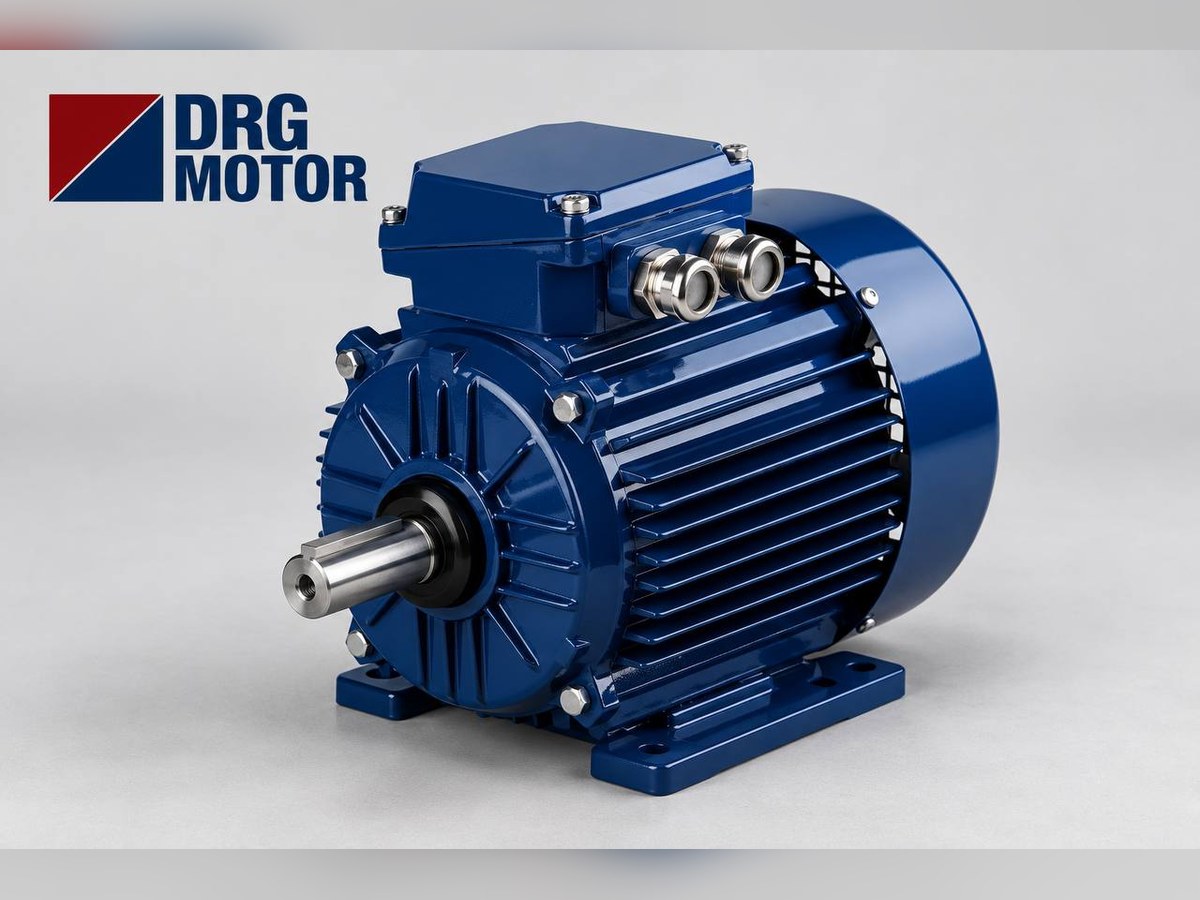
Edge cutting, chamfering and profiling machines do not have one large motor; every processing head turns on its own electric motor. These head motors, which spin diamond or resin wheels, are usually a few kilowatts each, some standing upright and some tilted at 45°. The belt that carries the slab past the heads and the small adjusting motors that position them are part of the same machine. To find the right motor you first need to know which head does which job.
A short word on who we are and what we cover: DRG Motor is a manufacturer, supplier and seller of electric motors. We do not sell the edge machine itself, head housings, pneumatic pressure units, gearboxes, hydraulic units, water pump bodies, drives (inverters), electrospindles or servo motors; we supply the three-phase induction motor behind the heads, the belt and the pumps. The models are listed on Buy Electric Motors Online.
Where do the motors work on an edge line?
A slab entering the edge machine travels at a steady speed on a rubber-covered belt. Pressure rollers above hold the stone in place, and the heads are lined up along the edge. The first heads grind coarsely, the middle ones finely, the last ones polish. For bevelled or profiled work, angled and shaped heads join the sequence. Each head motor turns only its own wheel, so when one motor fails the rest of the machine often keeps running, but edge quality suffers.
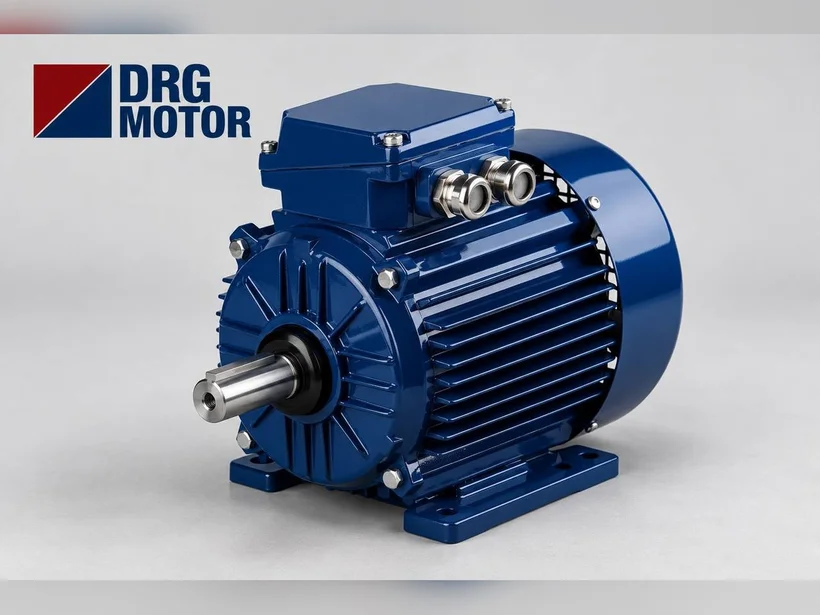
Straight edge and polishing heads
On heads that grind the face of the edge, the motor shaft either points horizontally at the edge or the motor stands upright and turns the wheel from below or above. These heads are the largest group; six, seven or eight of them can sit side by side on one machine. Their powers are similar, and the first coarse head is usually chosen slightly stronger.
Bevel and bottom-cut heads
Upper and lower bevel heads are mounted at 45°. On some machines a blade motor at the start or end of the line makes a 45° cut from beneath the slab; since this head cuts rather than grinds, it is stronger than the polishing heads. A tilted motor sees different bearing loads and water paths than an upright one, so the mounting angle must always be stated in the order.
Belt and adjusting motors
The belt motor, with its gearbox, moves the slab at a few metres per minute; feed speed is usually set by an inverter. Head height and in-out adjustment is done on some machines by a hand-turned geared screw and on others by a small adjusting motor. These are low-power motors, yet machine accuracy depends on them.
Profiling machines: bullnose, ogee and drip groove
Half-round (bullnose), S-curved (ogee) or full-round edges are formed with a shaped diamond profile wheel. Because the profile wheel grips the whole edge at once, it removes far more material than a flat polishing wheel. The difference shows on thick parts such as pool copings, stair treads and window sills. The small blade that opens the drip groove usually runs on a separate motor too.
Why a profile head and a polishing head differ in power
A polishing head smooths the surface; its contact area is small and it removes little material. A profile head gives the edge a new geometry, and the full width of the wheel works at once. That is why maker data sheets show profile head motors at two to three times the power of the polishing heads on the same machine. Hard stone such as granite, or a thick slab, needs slower feed for the same profile; motor power and belt speed are considered together.
How many kW for edge and profiling machine motors?
A) Head and auxiliary motor powers stated in maker data sheets:
| Machine / head | Motor power | Single / total | Note |
|---|---|---|---|
| 10–12 head angular edge polisher, straight and bevel heads | 1.7 kW, 1420 rpm | Per head | first maker; mains connection 25 kVA |
| 11 head flat edge and bevel machine, polishing heads | 2.2–4.5 kW | Per head | second maker |
| Same machine, 45° bottom cut blade | 5.5 kW | Single motor | second maker; machine total 38 kW |
| 11 head vertical edge machine, shaping and polishing heads | 3–5.5 kW | Per head | third maker; machine total 45 kW |
| 23 head automatic edge line, straight polishing heads | 1.1 kW | Per head | third maker, large model; head speed 900 rpm |
| Same line, bevel and profile heads | 3.5 kW | Per head | same model |
| Bullnose profiling machine, two profile heads | 11 kW and 7.5 kW | Two separate motors | fourth maker; belt 0.75 kW |
| 4 head bullnose line | 7.5 kW | Per head | fifth maker; head lift 0.55 kW, belt 0.75 kW, total 33 kW |
Depending on the model and the job of the head, these machines carry roughly 1.1–11 kW per head and 0.55–0.75 kW on belt and adjusting motors, while machine totals of 33–45 kW are quoted. The total is not the power of one motor: a machine rated at 45 kW may have 5.5 kW as its largest motor. More heads mean a larger total; power per head follows the task of that head.
B) Where DRG fits: the 0.55–11 kW band lies within our aluminium frame (0.25–11 kW) and cast iron frame (from 0.55 kW) models; the dominant choice on head motors is 4-pole, the 1500 rpm class. On many edge machines, however, the motor is part of a unit built into the head housing, with an extended shaft or pneumatic feed. If shaft length and flange are not standard IEC dimensions, that motor is not in our range; send us the old motor’s dimensions and we will compare them with the catalogue and tell you plainly. Synchronous speeds below 1000 rpm are outside our range as well.
Click to see current electric motor prices and order nowSEE PRICES →
Head motor mounting, shaft and water
Upright and angled operation
An upright motor with the shaft pointing down is ordered as V1; for flanged vertical mounting we offer V1, V3, V5 and V6 variants depending on frame. A head tilted at 45° has no standard mounting code; the angle, the axial load and the water path are read from the edge machine maker’s drawing and passed on to us.
Shaft, flange and head connection
Head motors usually sit on the head housing with a large flange (B5). Frames found on edge machines, from the B5 page of the DRG catalogue (mm):
| Frame | Shaft D×E | Flange P / M / N | Hole S |
|---|---|---|---|
| 80 | 19×40 | 200 / 165 / 130 | 12 |
| 90S/90L | 24×50 | 200 / 165 / 130 | 12 |
| 100L/112M | 28×60 | 250 / 215 / 180 | 14.5 |
| 132S/132M | 38×80 | 300 / 265 / 230 | 14.5 |
| 160M/160L | 42×110 | 350 / 300 / 250 | 18.5 |
The shaft end that takes the wheel holder differs from machine to machine: a threaded end, a long shaft or a special sleeve is not part of a standard IEC shaft. Should D (shaft diameter), E (shaft length) or N (spigot) differ from the old motor, a new head adaptor is needed before fitting. We do not publish B14 small flange dimensions in the catalogue; in that case we confirm the dimension together.
Water spray and slurry
An edge machine runs fully wet; stone slurry splashes around the heads and can creep up along the flange and shaft seal. Our motors are IP55; even so, water must not be aimed straight at the shaft entry, guards must stay in place and the terminal box gland must be tight. On a shaft-down motor, check that the condensation drain hole remains on the correct side.
Starting current on a multi-head machine: an example
Assume a ten-head edge machine with a 1.5 kW DRG-90L-4 (9.91 Nm, 3.3 A at 400 V) on each head. If all heads start together, the panel briefly sees a very high current:
| Step | Operation | Result | Meaning |
|---|---|---|---|
| 1 | 10 × 3.3 A | 33 A | DRG-90L-4 on ten heads, sum of rated currents |
| 2 | 7.0 × 3.3 A | 23.1 A | starting current of one head (Is/In = 7.0) |
| 3 | 10 × 23.1 A | 231 A | if all ten heads start together |
| 4 | 9 × 3.3 A + 23.1 A | 52.8 A | highest moment with staggered starting |
That is why heads on multi-head machines are usually switched on a few seconds apart. The ten motors in the example total 15 kW; the first maker’s 25 kVA supply requirement in the table shows that room is also left for the belt, pump and adjusting motors. Where belt and head speed are set by inverter, our catalogue reminds that motor and drive rated currents and carrier frequency must be matched, and that the shaft fan may not cool enough at low speed. Drives are not in our range.
DRG motors: models for edge and profiling machines
4-pole models at powers often met as head and belt motors (current at 400 V):
| Model | Power / speed | Frame · shaft D×E | Current 400 V |
|---|---|---|---|
| DRG-90S-4 | 1.1 kW / 1445 rpm | 90S cast iron · 24×50 | 2.48 A |
| DRG-90L-4 | 1.5 kW / 1445 rpm | 90L cast iron · 24×50 | 3.3 A |
| DRG-100L2-4 | 3 kW / 1450 rpm | 100L cast iron · 28×60 | 6.02 A |
| DRG-112M-4 | 4 kW / 1450 rpm | 112M cast iron · 28×60 | 7.95 A |
| DRG-132M-4 | 7.5 kW / 1460 rpm | 132M cast iron · 38×80 | 14.3 A |
| DRG-160M-4 | 11 kW / 1465 rpm | 160M cast iron · 42×110 | 20.4 A |
We give a replacement proposal once the removed motor’s nameplate, the edge machine manual and our data sheet are laid side by side. We compare output and speed, the winding voltage pair (400/690 V or 230/400 V), frame size, B5 or V1 mounting, keyed shaft diameter and length, flange spigot dimension, wheel holder adaptor and the face exposed to water. If one of them does not match we say so and look for an alternative; we do not give a general fit promise.
Live price table
Prices of our motors in the power sizes used on edge and profiling machines are read live from the shop:
| Model | Power / speed | Frame · current 400 V | Price |
|---|---|---|---|
| DRG-802-41 HP | 0.75 kW · 1500 rpm | Cast iron 80 · 1.75 A | $101.93 (€91.03) Details & buy → |
| DRG-90S-41.5 HP | 1.1 kW · 1500 rpm | Cast iron 90S · 2.48 A | $124.09 (€110.82) Details & buy → |
| DRG-90L-42 HP | 1.5 kW · 1500 rpm | Cast iron 90L · 3.3 A | $144.14 (€128.73) Details & buy → |
| DRG-100L1-43 HP | 2.2 kW · 1500 rpm | Cast iron 100L · 4.52 A | $188.32 (€168.18) Details & buy → |
| DRG-100L2-44 HP | 3 kW · 1500 rpm | Cast iron 100L · 6.02 A | $203.84 (€182.05) Details & buy → |
| DRG-112M-45.5 HP | 4 kW · 1500 rpm | Cast iron 112M · 7.95 A | $254.38 (€227.18) Details & buy → |
| DRG-132S-47.5 HP | 5.5 kW · 1500 rpm | Cast iron 132S · 10.7 A | $342.01 (€305.44) Details & buy → |
| DRG-132M-410 HP | 7.5 kW · 1500 rpm | Cast iron 132M · 14.3 A | $394.89 (€352.66) Details & buy → |
| DRG-160M-415 HP | 11 kW · 1500 rpm | Cast iron 160M · 20.4 A | $568.76 (€507.94) Details & buy → |
DRG MOTOR motors are guaranteed against material and manufacturing defects for 2 years from the delivery date (warranty certificate).
Motors in this power range
- DRG-802-4 – 0.75 kW – 1420 rpm – 80 cast iron
- DRG-90L-4 – 1.5 kW – 1445 rpm – 90L cast iron
- DRG-100L1-4 – 2.2 kW – 1450 rpm – 100L cast iron
- DRG-132S-4 – 5.5 kW – 1460 rpm – 132S cast iron
- DRG-160M-4 – 11 kW – 1465 rpm – 160M cast iron
Click to see current prices and order these motors nowSEE PRICES →
Browse the products, ask for a quote: all models suitable as head or belt motors are on Buy Electric Motors Online. Send the old head motor’s nameplate and a photo of its flange and shaft via WhatsApp or call +90 (542) 666 11 11.
Frequently asked questions
The head motor of my edge polisher burnt out; can I find the same one?
If the motor has a standard IEC frame and flange, we look for its match in our range by power, speed and flange size. If it is built in one piece with the head housing or has a special long shaft, there may be no direct match; we tell you plainly once we see the dimensions.
Does changing head speed with an inverter harm the motor?
With a properly selected and set drive, an induction motor can run at variable speed. At very low speed its own fan may not cool enough; for heads running slowly for long periods, discuss with the machine maker whether a separate fan is needed.
What does the price of a chamfering machine motor depend on?
On power, frame material and mounting form; see the live table above for the figure today.
Got a technical question? Phone +90 (542) 666 11 11, email info@drgmotor.com, or fill in our contact form. For edge, chamfer and profile machine motor options, see Buy Electric Motors Online.


