 English
 Le français
 Türkçe

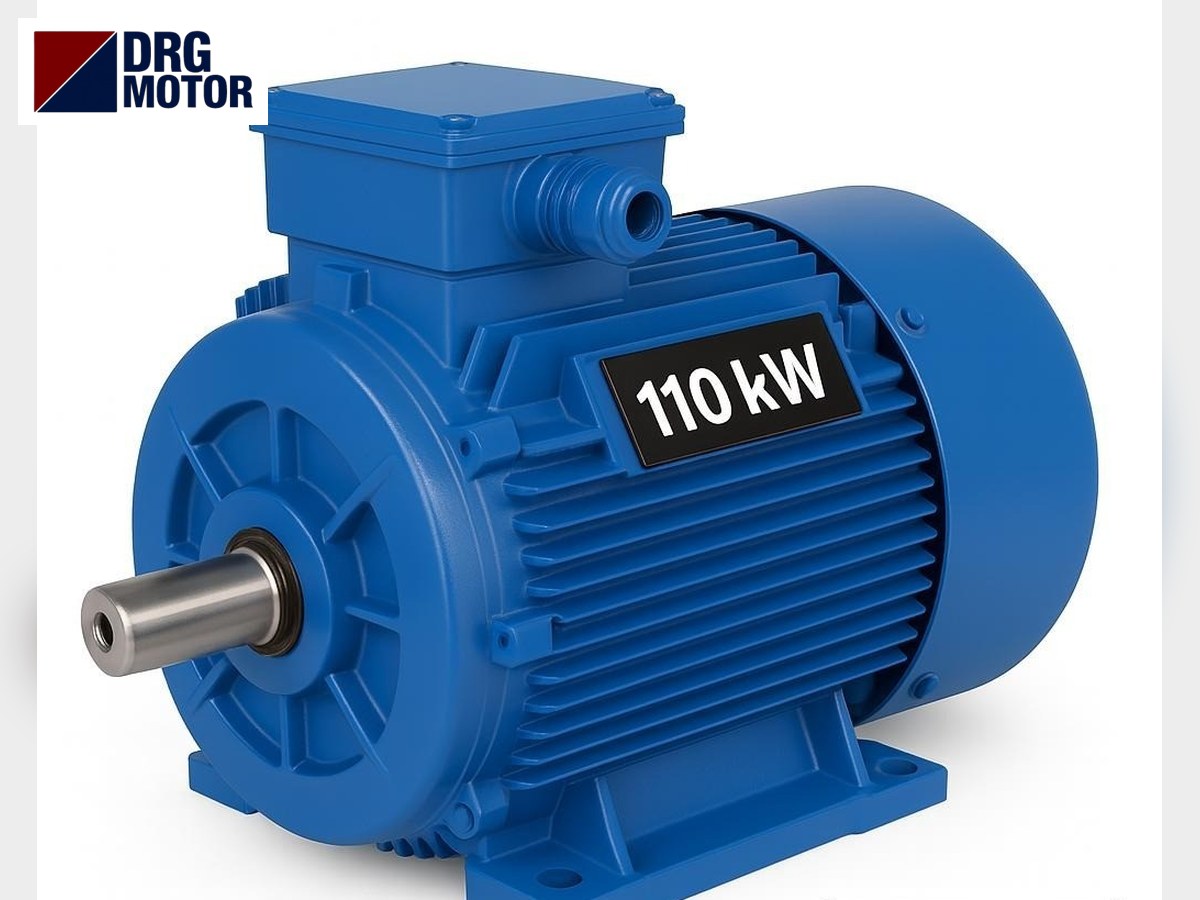
In a cement plant electric motors crush the quarried limestone, grind the raw meal, run the rotary kiln and the clinker cooler, grind cement and sort it by fineness in the separator, carry material on elevators and screws and finally fill the bags. The power spread is very wide: manufacturer catalogues give 2570–9560 kW for cement ball mills, 800–11,000 kW for vertical roller mills, from 55 kW up to two 950 kW motors for kiln main drives, 25–525 kW for separators, 1.5–160 kW for bucket elevators and 4 kW per spout on packers. The large main drives are medium-voltage machines above 355 kW and sit outside our range. What we address are the auxiliary and mid-power drives.
DRG Motor is a manufacturer, supplier and seller of electric motors. We do not sell mills, kilns, separators, elevator casings, gearboxes, couplings, fan impellers or drives; what we supply is the low-voltage (400 V class) three-phase induction motor. General plant conditions are covered in our cement plant motor selection article and high-power supply in our cement and aggregate plant motor supply article. Models are on the Buy Electric Motors Online page.
From quarry to bag: the motor map of a cement plant
A dry-process line runs: quarry and crushing → pre-blending → raw mill → preheater cyclones → rotary kiln → clinker cooler → clinker store → cement mill and separator → cement silos → packing and bulk loading. Below we say what the motor does in each section and where it meets the DRG range.
Quarry and crushing
Limestone and clay come from the quarry to the crusher. Crusher motor power, starting and belt layout are covered on separate pages in the Stone Crushing Plant Motors category; for the type often used on cement raw material see the hammer crusher motor page. The belt conveyor motor page covers the belts that carry crushed material.
Raw mill and cement mill
The mill main motor is the largest consumer in the plant and is fed at medium voltage such as 6, 10 or 11 kV. These motors are not in our range. The auxiliaries around the mill run on low-voltage motors: lubrication pumps, feed belts, dosing screws, dedusting fans and the auxiliary drive that turns the mill slowly during maintenance. The general layout of a ball mill is handled on the Ball Mill Electric Motors page of the same series.
Rotary kiln and clinker cooler
The kiln turns at a few rpm through a girth gear and pinion. The main drive is variable speed; one maker’s table gives 0.35–4 rpm for a Ø4.8×74 m kiln. The auxiliary drive turns the kiln slowly during a power cut or maintenance so the shell does not bow. The fan that draws kiln gas and the large cooler fans also mostly run on medium-voltage motors; the small compartment fans of the cooler vary with kiln capacity and are chosen from application data.
Separator, elevator, screw and packing
The rotor of the dynamic separator sets the fineness and is driven by a VFD. Chain or belt bucket elevators lift raw meal and cement to the silos; a mechanical backstop prevents run-back. On a packer each spout has its own discharge motor, and rotary types turn the body with another small motor.
Power table: drives inside and outside the range
A) Cement equipment motor ratings from manufacturer catalogues and data sheets:
| Equipment / size | Motor power | Single / total | Versus DRG range |
|---|---|---|---|
| Rotary kiln main drive, Ø2.8×44 – Ø4.2×60 m | 55–400 kW | single motor, variable speed | partly; above 355 kW outside |
| Rotary kiln main drive, Ø4.8×72 – Ø6×95 m | 630 kW … 2 × 950 kW | single or twin motor | outside the range |
| Rotary kiln auxiliary drive (same sizes) | 5–132 kW | single motor, 380 V | covered |
| Cement ball mill, Ø3.8×13 – Ø5.8×17 m | 2570–9560 kW | main motor | outside, medium voltage |
| Vertical roller cement mill | 800–11,000 kW | main motor | outside, medium voltage |
| Dynamic separator, N-250 – N-7000 | 25–525 kW | single motor | covered up to N-4500 (335 kW) |
| Chain bucket elevator, NE15 – NE800 | 1.5–160 kW | single motor | covered |
| Rotary packer, 8 spouts | 1.5 kW main drive + 8 × 4 kW discharge | 33.5 kW total | covered |
| In-line packer, 1–4 spouts | 4 kW per spout + 1.5–2.2 kW feeder | per spout | covered |
In short, maker data sheets put cement line drives in these bands: 55–1900 kW on kiln main drives (total on the largest twin-motor kiln), 5–132 kW on kiln auxiliary drives, 800–11,000 kW on mill main motors, 25–525 kW on separators, 1.5–160 kW on elevators and 4 kW per spout on packers. As capacity (t/day) and grinding fineness grow, mill and separator power rise.
B) Overlap with the DRG range: the cast iron line (0.55 to 355 kW) takes care of kiln auxiliary drives, separators up to 335 kW, all elevators, packing motors and the main drives of small kilns up to 355 kW. Mill main motors, large kiln main drives and the medium-voltage motors of kiln gas and cooler exhaust fans are outside our range. Brake motors on jacks or maintenance cranes, single-phase motors and any Ex motor needed in the coal grinding section are not in our range either.
Click to see current electric motor prices and order nowSEE PRICES →
Kiln auxiliary drive: a 55 kW example
In the source table the auxiliary drive of the Ø4.8×74 m kiln is a 55 kW, 1480 rpm motor turning the kiln at 8.52 revolutions per hour, so one full turn takes about 60 / 8.52 ≈ 7 minutes. On our side the DRG-250M-4 answers it, with a plate reading 1485 rpm, 97.6 A on 400 V and 353.7 Nm. The 5 rpm difference leaves the slow turning speed practically unchanged. Since this motor only runs in maintenance and emergencies, check whether its standby location is damp and whether it needs a heater.
Gearbox and coupling connection
The auxiliary drive is usually tied to the main gearbox through a clutch or overrunning coupling and disengages when the main motor runs. Before fitting a new unit, lay it beside the removed motor and check shaft, key, fixing dimensions and which end carries the clutch. Ratio questions can be checked in our reducer calculator.
Choosing for separators and elevators
Separator motor
For an N-1000 separator the source lists a 90 kW motor. Our DRG-280M-4 is 90 kW and draws 155 A at 400 V; starting current is 6.9 times rated, about 1069.5 A direct-on-line. Since the separator rotor already runs at variable speed, the motor starts on the drive and that peak does not occur. The source gives 150–320 rpm rotor speed for this size; a gearbox or belt sits between motor and rotor.
Bucket elevator motor
Elevator power depends on capacity and height: the same catalogue gives 1.5–11 kW for NE30, 7.5–55 kW for NE200 and 37–160 kW for NE800. The motor sits on the gearbox at the head; run-back is blocked either inside the reducer or by a holdback on the head shaft. For the calculation method see our bucket elevator motor article.
Example: current of an 8-spout rotary packer
The source 8-spout rotary packer has a 4 kW discharge motor at each spout and a 1.5 kW main drive turning the body. Matching them from our range:
| Motor | DRG match | Current 400 V | Qty × current |
|---|---|---|---|
| Discharge motors, 4 kW | DRG-112M-4 | 7.95 A | 8 × 7.95 = 63.6 A |
| Rotary body main drive, 1.5 kW | DRG-90L-4 | 3.3 A | 1 × 3.3 = 3.3 A |
| Machine total | — | — | 66.9 A |
The machine draws about 66.9 A at rated load. Spout motors run in turn as bags fill, so the actual current swings below that. The packing area is very dusty; clean cooling fins directly affect cooling. Motors we send to the packing floor are the same IP55 enclosed type with class F windings and their own IC411 fan; ambient must stay between −15 °C and +40 °C.
DRG motors for cement plant auxiliary drives
The steps our range covers, from packing motors to a large separator:
| Model | Power / speed | Frame · shaft D×E | Current 400 V |
|---|---|---|---|
| DRG-90L-4 | 1.5 kW / 1445 rpm | 90L cast iron · 24×50 | 3.3 A |
| DRG-112M-4 | 4 kW / 1450 rpm | 112M cast iron · 28×60 | 7.95 A |
| DRG-132M-4 | 7.5 kW / 1460 rpm | 132M cast iron · 38×80 | 14.3 A |
| DRG-160L-4 | 15 kW / 1465 rpm | 160L cast iron · 42×110 | 27.3 A |
| DRG-200L-4 | 30 kW / 1475 rpm | 200L cast iron · 55×110 | 53.8 A |
| DRG-250M-4 | 55 kW / 1485 rpm | 250M cast iron · 65×140 | 97.6 A |
| DRG-280M-4 | 90 kW / 1486 rpm | 280M cast iron · 75×140 | 155 A |
| DRG-315L2-4 | 200 kW / 1490 rpm | 315L cast iron · 85×170 | 334 A |
For a replacement, a plate photo, the 400 V connection (star/delta), shaft and key, foot or flange dimensions and the equipment it serves are enough. Mounting can be foot, flange or both, horizontal or vertical. We do not confirm a one-to-one fit before seeing dimensions; if the old motor runs on 690 V or medium voltage, say so.
Live price table
Prices of the models that match cement plant auxiliary drives come live from the store:
| Model | Power / speed | Frame · current 400 V | Price |
|---|---|---|---|
| DRG-90L-42 HP | 1.5 kW · 1500 rpm | Cast iron 90L · 3.3 A | $144.14 (€128.73) Details & buy → |
| DRG-112M-45.5 HP | 4 kW · 1500 rpm | Cast iron 112M · 7.95 A | $254.38 (€227.18) Details & buy → |
| DRG-132M-410 HP | 7.5 kW · 1500 rpm | Cast iron 132M · 14.3 A | $394.89 (€352.66) Details & buy → |
| DRG-160L-420 HP | 15 kW · 1500 rpm | Cast iron 160L · 27.3 A | $678.13 (€605.61) Details & buy → |
| DRG-200L-440 HP | 30 kW · 1500 rpm | Cast iron 200L · 53.8 A | $1,235.00 (€1,102.93) Details & buy → |
| DRG-250M-475 HP | 55 kW · 1500 rpm | Cast iron 250M · 97.6 A | $2,065.73 (€1,844.82) Details & buy → |
| DRG-280M-4125 HP | 90 kW · 1500 rpm | Cast iron 280M · 155 A | $3,268.56 (€2,919.03) Details & buy → |
| DRG-315L2-4270 HP | 200 kW · 1500 rpm | Cast iron 315L · 334 A | $7,115.64 (€6,354.71) Details & buy → |
DRG MOTOR motors are guaranteed against material and manufacturing defects for 2 years from the delivery date (warranty certificate).
Motors in this power range
- DRG-112M-4 – 4 kW – 1450 rpm – 112M cast iron
- DRG-160L-4 – 15 kW – 1465 rpm – 160L cast iron
- DRG-250M-4 – 55 kW – 1485 rpm – 250M cast iron
- DRG-280M-4 – 90 kW – 1486 rpm – 280M cast iron
- DRG-315L2-4 – 200 kW – 1490 rpm – 315L cast iron
Click to see current prices and order these motors nowSEE PRICES →
Browse the products, ask for a quote: models are on the Buy Electric Motors Online page. Send the section where the motor works (kiln, separator, elevator, packing) and the plate photo on WhatsApp; phone: +90 (542) 666 11 11.
Frequently asked questions
Do you supply the cement mill main motor?
No. Mill main motors are thousands of kW and medium voltage; our range ends at 355 kW. We can cover the mill’s lubrication, feed and dedusting motors.
Is a motor of the same power enough for the kiln auxiliary drive?
Yes, if power, pole number and shaft size match the old one; the clutch and brake arrangement stays as on the machine maker’s drawing.
Can the separator motor run on a VFD?
Separators already run at variable speed; when choosing the motor, check that its own fan cools it enough at the lowest operating speed.
For questions: +90 (542) 666 11 11 · info@drgmotor.com · contact.


