 English
 Le français
 Türkçe

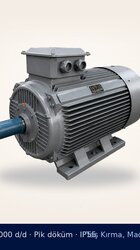
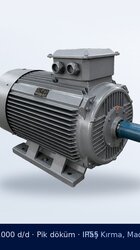
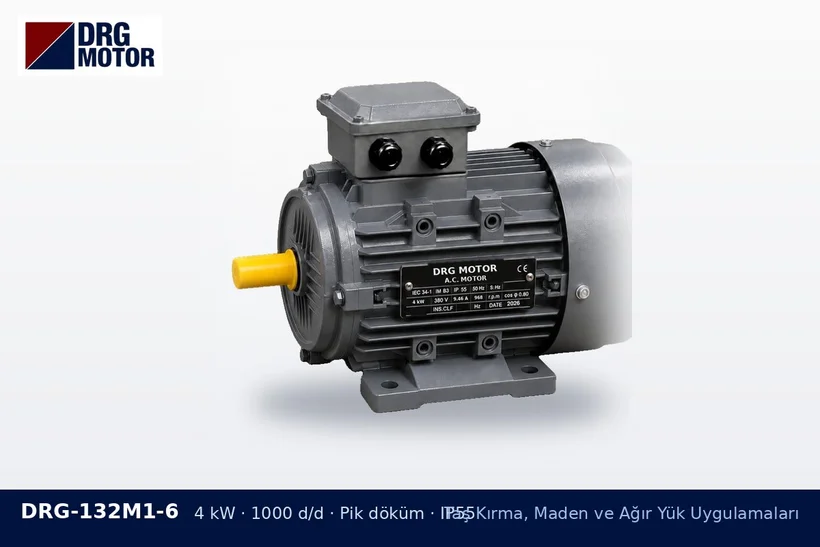
On a sand washing machine, the motor is selected according to the machine type (spiral screw or bucket wheel), the gearbox output speed and how hard it is to restart against the sediment that settles at the bottom of the tank. The power should not be reduced below the figure given by the machine builder, and the speed has to match the input speed of the existing gearbox.
How is the load created in spiral and bucket-wheel types?
In a spiral washer, a long screw turning inside an inclined trough pushes the sand upwards; the load grows with screw diameter, slope and the amount of sand. In the bucket (wheel) type, a large wheel lifts sand out of the pit and turns slowly. Both types have a very low output speed, so the motor is usually in the 1500 rpm class and drives through a gearbox. DRG does not sell gearboxes; the motor is chosen to suit the input connection of the existing gearbox.
Restarting from a silted trough
When a washer stands overnight, fine material settles at the bottom of the trough and in the morning the screw has to break free through this layer. This is why the starting torque of the motor matters as much as its running power at full load. Emptying the machine before stopping, or leaving the water supply on for a while, makes the start easier. If the trough jams often, the feed rate and water flow should be examined first; a larger motor alone may not solve the problem.
Water, slurry and mounting position
- DRG motors are IP55 protected; they withstand water splashes and low-pressure water jets but are not suitable for being buried in slurry or cleaned with high-pressure water.
- Install the motor above the edge of the trough, on a platform that allows maintenance.
- Keep the area in front of the fan cover clear of mud and sand deposits.
- Foot or flange mounting must be checked against the gearbox; verify the dimensions using the motor technical drawings.
Data to collect before ordering
The existing motor nameplate (kW, speed, voltage), the gearbox ratio and input type, the hourly capacity of the machine and the supply voltage on site are enough. Auxiliary equipment driven by vibrating motors, such as a dewatering screen, is assessed separately; the sand washing and dewatering screen motor page gives guidance on this.
Once the data is clear, a suitable power rating among the 4-pole cast iron frame models can be compared in the three-phase motor shop.