 English
 Le français
 Türkçe

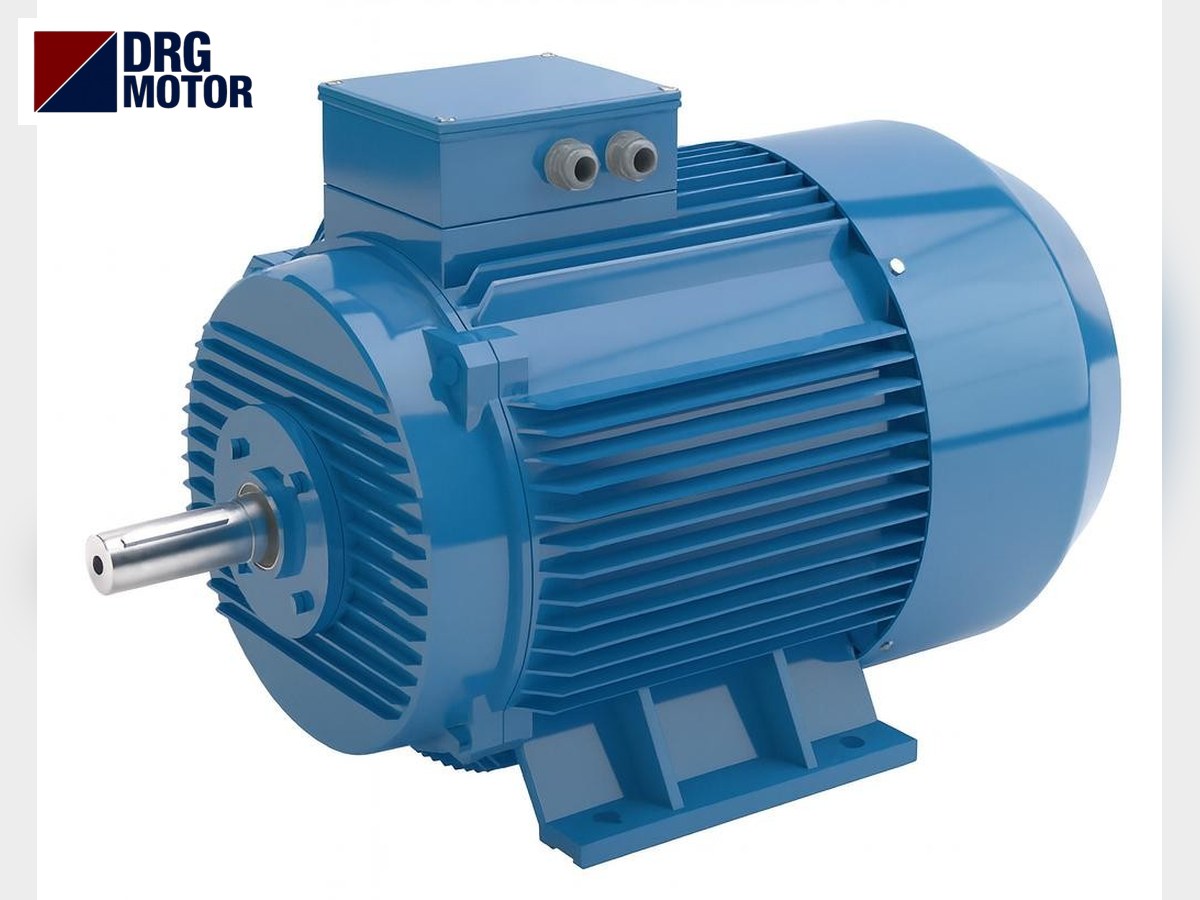
A glass washing machine cleans and dries cut and edged flat glass before it enters the tempering furnace, the laminating line or the insulating glass (double glazing) assembly line. Electric motors inside it do five separate jobs: the conveyor rollers, the rotating brushes, the water pumps in the tanks, the drying blower that pushes pressurised air through air knives, and the adjustment drive that raises the upper section to suit glass thickness. On one maker’s 2500 mm horizontal machine the brush motor is 0.55 kW, the conveyor 1.5 kW, each pump 0.75 kW and the blower 18.5 kW; in other catalogues the blower ranges from 11 to 22 kW. Most of the machine’s electrical load is therefore in drying, not in the brushes.
DRG Motor is a manufacturer, supplier and seller of electric motors. We do not sell the glass washer itself, brush rollers, pump bodies, blower housings, air knives, heaters or speed drives; we supply only the three-phase motors that drive them. Suitable motors from brush to blower are on the Buy Electric Motors Online page.
Sections of horizontal and vertical glass washers
In a horizontal machine the glass lies on rollers; this type is common for large and thick sheets, washing before tempering, and laminating lines. In a vertical machine the glass travels upright against a slightly inclined back rest; insulating glass lines prefer it because it saves floor space. Both types consist of infeed, washing, drying and outfeed sections.
Infeed and pre-wash
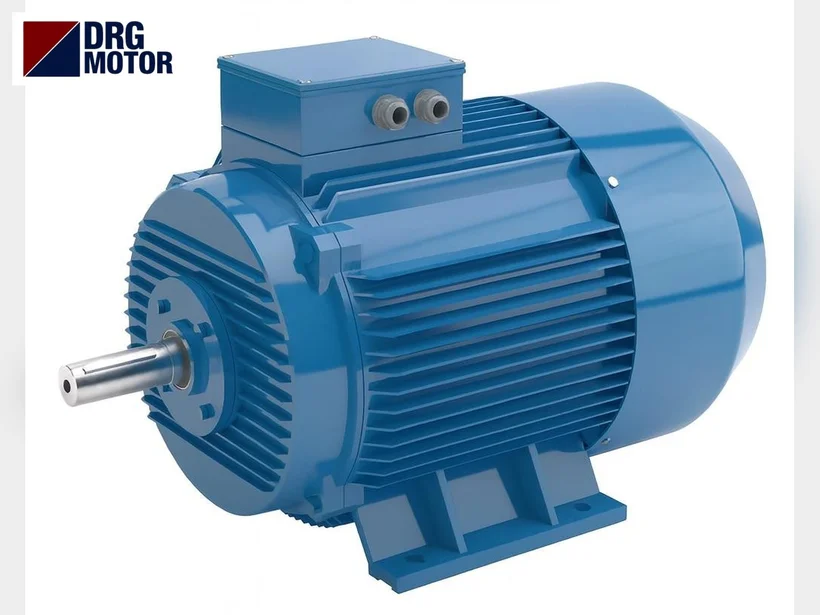
Rubber-covered rollers pull the glass in; some machines spray pressurised water here to remove glass dust left by edging. The rollers turn from one main drive through gears or chain, and speed is set by a frequency converter to suit thickness: fast for thin glass, slow for thick.
Brush section
Brushes rotate in pairs below and above the glass; machines usually have three or four pairs. Soft brushes are reserved for Low-E coated glass and on some machines can be lifted clear of the coating. Brush motors are small; one sheet uses one 0.55 kW motor for the lower and one for the upper group, another machine has a separate motor and contactor for every brush.
Drying section and air knives
Air knives blow a fast stream of air through a narrow slot over and under the glass, wiping off rinse water without leaving drops. A high-pressure blower supplies the air, heated on some machines. Because the blower is loud it sits in a sound-insulated cabinet with a filter on its inlet.
How many kW is a glass washing machine motor? Catalogue values
A) Glass washer data sheets list these drive ratings:
| Machine / drive | Motor power | Single / total | Note |
|---|---|---|---|
| Horizontal 2500 mm: conveyor (main drive) | 1.5 kW | single motor | first maker’s sheet |
| Same machine: brush motors | 0.55 kW × 2 | upper and lower brush groups separate | first maker |
| Same machine: water pumps | 0.75 kW × 3 | one pump per tank | first maker |
| Same machine: drying blower | 18.5 kW | single motor | first maker; machine total 28 kW |
| Same machine: upper section lift | 0.75 kW | runs only during adjustment | first maker |
| Horizontal 2500 mm | 22 kW blower; total 32 kW | single blower | second maker |
| Vertical 1600 / 2000 mm | 16 kW / 22 kW blower | single blower | third maker |
| High-speed horizontal | 2 × 15 kW blower; total 52 kW | two blowers | fourth maker; one stops for narrow glass |
| Horizontal series 1600–3300 mm | 19–60 kW | machine total incl. heaters | fifth maker’s catalogue |
Read together, the catalogues show brush motors of about 0.55 kW, tank pumps of 0.75 kW, a conveyor drive of 1.5 kW and drying blowers of 15–22 kW in glass washers. The machine total (19–60 kW) includes water and air heaters; those heater kilowatts are not motor power and are kept apart when choosing motors.
B) Overlap with the DRG range: 0.55 kW and 0.75 kW brush, pump and lift motors match our 80-frame models, the 1.5 kW conveyor motor a 90L frame, and 11–22 kW blower motors our 2-pole models in 160M, 160L and 180M frames; up to 11 kW they come in aluminium or cast iron, blower motors of 15 kW and above in cast iron only. Outside our range are wet-rotor or monobloc circulation pumps cast in one piece with the motor (there the pump is replaced, not the motor), submersible pump motors, motors with stainless steel housings meant for direct pressure washing, and the servo drive some machines use to lift the upper section.
Click to see current electric motor prices and order nowSEE PRICES →
How is the motor protected in a wet environment?
Where the motor sits
The motors that meet the most water in a glass washer are the brush and pump motors. On most machines brush motors sit outside the side covers, linked to the brush shaft by belt or coupling; pumps stand beside the tanks, close to the floor. DRG motors carry IP55, which covers dust build-up and splashing water from all directions. A tank overflow, a motor left standing in water or a hose aimed at the frame is beyond that protection.
Condensation and warm water
On machines that use heated wash water, a motor frame cooling down overnight can collect condensation inside. Measuring winding insulation on pump and brush motors after a long stop, and keeping the terminal box gasket and cable glands sound, lowers that risk. A motor fitted with its cable gland facing upwards can take in water around the gland, so the mounting position is kept the same as the old motor’s.
Drying blower: the machine’s largest motor
The drying blower is both the largest motor of a glass washer and the one that runs longest at full load. Catalogues describe this fan as a high-pressure centrifugal fan running in the 2-pole class. A rotary-lobe roots blower is a different machine used for wastewater aeration and pneumatic conveying; we covered its motor choice in our roots blower motor article. For general fan motor selection see our Fan Motors category.
Machines with two blowers
One maker fits two 15 kW blowers to its high-speed machine and automatically stops one when glass width drops below 1300 mm. In this layout each blower has its own motor, protection and starter. Converting a single-blower machine to two blowers, or upsizing the blower motor, means recalculating housing, impeller and air duct as well; that decision belongs to the machine maker.
Worked example: current of a 2500 mm horizontal machine and blower starting
Here the data sheet’s motor list is matched drive by drive with DRG models. We assume brushes and conveyor run on 4-pole motors and pumps on 2-pole motors; the lift motor works only during adjustment and is left out:
| Drive | DRG equivalent | Current 400 V | Connection |
|---|---|---|---|
| Conveyor rollers, 1.5 kW | DRG-90L-4 | 3.3 A | star |
| Brush group, 0.55 kW (2 off) | DRG-801-4 | 1.31 A × 2 | star |
| Tank pump, 0.75 kW (3 off) | DRG-801-2 | 1.64 A × 3 | star |
| Drying blower, 18.5 kW | DRG-160L-2 | 32.5 A | delta; suitable for star-delta starting |
| All running | — | 43.34 A | — |
Running, the motors draw about 43.34 A in total, 32.5 A of it by the blower alone. On a 400 V supply, the small drives here (230/400 V windings, up to 3 kW) are wired in star, while the 4 kW and larger units, wound 400/690 V, are wired in delta.
Blower starting current
The nameplate of the 18.5 kW model gives a starting current of 8.2 times rated current; direct-on-line that is about 266.5 A. Because its winding runs in delta at 400 V, this motor can be started star-delta, cutting starting current to roughly a third, about 88.8 A. The fan wheel has high inertia, so starting takes several seconds and the overload relay trip class is chosen accordingly. Our star-delta starting calculator lets you compare the options. If the blower runs on a frequency converter, the drive ramp limits starting current.
DRG motors for glass washing machines
Models matching brush, pump, conveyor and blower drives:
| Model | Power / speed | Frame · shaft D×E | Current 400 V |
|---|---|---|---|
| DRG-801-4 | 0.55 kW / 1400 rpm | 80 cast iron · 19×40 | 1.31 A |
| DRG-802-4 | 0.75 kW / 1420 rpm | 80 cast iron · 19×40 | 1.75 A |
| DRG-801-2 | 0.75 kW / 2880 rpm | 80 cast iron · 19×40 | 1.64 A |
| DRG-90L-4 | 1.5 kW / 1445 rpm | 90L cast iron · 24×50 | 3.3 A |
| DRG-160M1-2 | 11 kW / 2945 rpm | 160M cast iron · 42×110 | 19.6 A |
| DRG-160M2-2 | 15 kW / 2945 rpm | 160M cast iron · 42×110 | 26.5 A |
| DRG-160L-2 | 18.5 kW / 2940 rpm | 160L cast iron · 42×110 | 32.5 A |
| DRG-180M-2 | 22 kW / 2955 rpm | 180M cast iron · 48×110 | 38.5 A |
Brush motors are mostly fitted by B5 flange or foot-mounted B3; pump motors as B3 or B5 depending on pump type. Flange size, shaft diameter and key are confirmed against the old motor:
| Frame | Shaft D×E | Flange P / M / N | Hole S |
|---|---|---|---|
| 80 | 19×40 | 200 / 165 / 130 | 12 |
| 90S/90L | 24×50 | 200 / 165 / 130 | 12 |
| 160M/160L | 42×110 | 350 / 300 / 250 | 18.5 |
Small workshop washers may come with a single-phase motor; for washers we stay with three-phase motors. Some insulating glass presses hold their lifting beam with a brake motor; that motor type is outside our range.
Live price table
Prices of models matching the motors of a glass washer are pulled from the store each time the page opens:
| Model | Power / speed | Frame · current 400 V | Price |
|---|---|---|---|
| DRG-801-40.75 HP | 0.55 kW · 1500 rpm | Cast iron 80 · 1.31 A | $91.72 (€81.91) Details & buy → |
| DRG-802-41 HP | 0.75 kW · 1500 rpm | Cast iron 80 · 1.75 A | $101.93 (€91.03) Details & buy → |
| DRG-801-21 HP | 0.75 kW · 3000 rpm | Cast iron 80 · 1.64 A | $87.39 (€78.04) Details & buy → |
| DRG-90L-42 HP | 1.5 kW · 1500 rpm | Cast iron 90L · 3.3 A | $144.14 (€128.73) Details & buy → |
| DRG-160M1-215 HP | 11 kW · 3000 rpm | Cast iron 160M · 19.6 A | $527.95 (€471.49) Details & buy → |
| DRG-160M2-220 HP | 15 kW · 3000 rpm | Cast iron 160M · 26.5 A | $570.23 (€509.25) Details & buy → |
| DRG-160L-225 HP | 18.5 kW · 3000 rpm | Cast iron 160L · 32.5 A | $714.00 (€637.65) Details & buy → |
| DRG-180M-230 HP | 22 kW · 3000 rpm | Cast iron 180M · 38.5 A | $857.53 (€765.83) Details & buy → |
DRG MOTOR motors are guaranteed against material and manufacturing defects for 2 years from the delivery date (warranty certificate).
Motors in this power range
- DRG-801-4 – 0.55 kW – 1400 rpm – 80 cast iron
- DRG-801-2 – 0.75 kW – 2880 rpm – 80 cast iron
- DRG-90L-4 – 1.5 kW – 1445 rpm – 90L cast iron
- DRG-160M2-2 – 15 kW – 2945 rpm – 160M cast iron
- DRG-160L-2 – 18.5 kW – 2940 rpm – 160L cast iron
Click to see current prices and order these motors nowSEE PRICES →
Browse the products, ask for a quote: brush, pump and blower motors are on the Buy Electric Motors Online page. Mention whether it is a brush, pump or blower motor and add a plate photo via WhatsApp; we check kW, speed, flange and connection together. +90 (542) 666 11 11 is also available.
Frequently asked questions
Does a bigger blower motor improve drying?
Not on its own. Air volume and pressure are set by the impeller and speed; a bigger motor turns the same impeller at the same speed. If drying is poor, check the filter, air knife gap and duct leaks first.
Can the brush motor and conveyor motor be the same model?
If power and speed match, yes, but the mounting differs: brush motors are mostly flange-mounted, conveyor motors foot-mounted or coupled to a gearbox. State the mounting type when ordering.
When a pump motor burns out, must the pump be replaced too?
If the motor separates from the pump, only the motor is replaced. Wet-rotor pumps, or pumps whose motor is integral with the body, are replaced complete.
For questions: +90 (542) 666 11 11 · info@drgmotor.com · contact.


