 English
 Le français
 Türkçe

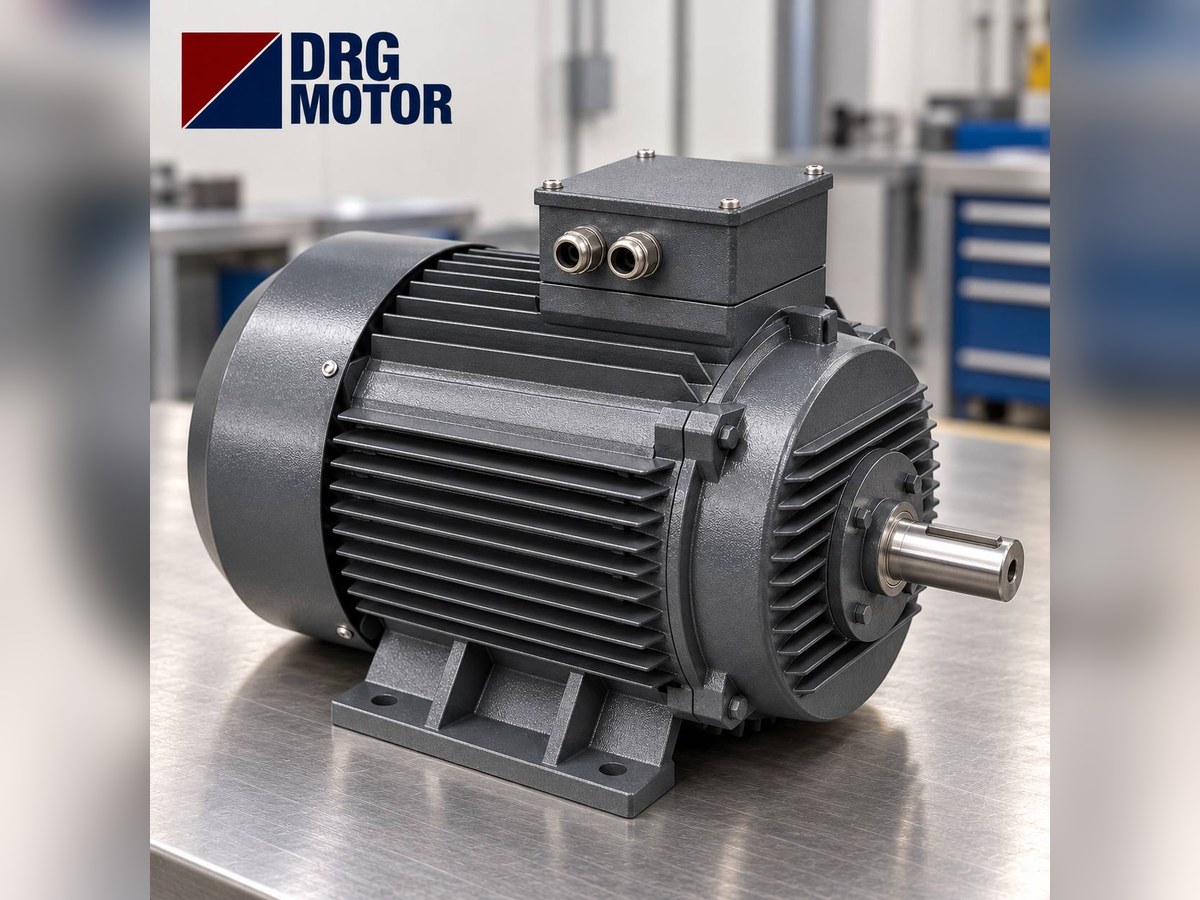
A hopper feeder motor (also called a bunker feeder motor) drives the feeding unit at the hopper outlet, and it can be three different things depending on what sits under the hopper. On a belt hopper feeder, a standard three-phase motor connected to a gearbox drives a short, heavy belt; typical power is 3–18.5 kW. On a vibrating hopper, two vibration motors shake the trough at the outlet. On a hydraulic push feeder, the motor turns a hydraulic pump, and the pump feeds the cylinder that pushes the plate at the bottom of the hopper back and forth. Which motor you need depends on which of these three types you have.
This page compares the three types from the motor's point of view, gives catalogue power values and shows, for the belt type, how the inverter setting is calculated for sand and chippings dosing. Because the belt and hydraulic types use standard IEC motors, suitable models are found on Buy Electric Motors Online. Crusher, screen and conveyor motors are collected on our Stone Crushing Plant Motors page.
What is a hopper feeder and what does it do in a crushing and screening line?
A hopper feeder combines an intermediate store with a dosing unit. The hopper provides the buffer volume that keeps the line running when the machine ahead stops or when a truck is late and material is interrupted. The feeder below draws material from that volume at the required rate. In one Turkish manufacturer's hopper series, volumes range from 12 m³ to 45 m³ [4].
Typical locations in a crushing and screening plant are:
- After the primary crusher, an intermediate surge hopper ahead of the secondary or tertiary crusher.
- Ahead of a screen, a dosing hopper giving it a steady tonnage.
- A dosing belt metering sand and chippings from stock to a concrete batching plant or washing line.
- A primary feed hopper that trucks tip into directly (large vibrating and hydraulic types).
A vibrating feeder is often a trough on its own; a hopper feeder supplies the hopper, frame and feeding unit as a single product. An apron feeder can also be placed under a hopper, but it is a separate class for large, sticky and heavy loads.
Belt, vibrating and hydraulic push hoppers: the difference for the motor
| Hopper type | What the motor does | Motor type | Typical location |
|---|---|---|---|
| Belt | Drives the belt via gearbox | Standard IEC + gearbox | Surge, dosing |
| Vibrating | Shakes the trough | 2 vibration motors | Primary and secondary |
| Hydraulic push | Turns the hydraulic pump | Standard IEC (power pack) | Heavy primary |
On the belt type the belt moves slowly over closely spaced rollers right under the hopper outlet. The adjustable gate at the outlet sets the material height; one manufacturer states that this gate is factory-set within 75–120 mm [1]. The drive pulley is connected to the motor through a bevel hollow-shaft gearbox or a planetary gearbox [1]. The motor is therefore usually a 4-pole standard motor, flange- or foot-mounted.
On the vibrating type two counter-rotating vibration motors shake the trough at the hopper outlet. On large hoppers the motor grows with the hopper volume: in one series the 25 m³ model uses 2 × 3 kW and the 55 m³ model 2 × 11 kW [3].
On the hydraulic push type a steel plate at the bottom of the hopper moves back and forth by cylinder and pushes material forward at each stroke. The electric motor does not move the plate; it turns the pump of the hydraulic power unit. This type is used in coarse, heavy primary feeding and truck dumping; one manufacturer states that the system works with proportional hydraulics and that acceleration and deceleration are controlled [5].
Motor power seen on hopper feeders
A) According to manufacturer catalogues
| Model group / capacity | Motor power | Single or total | Source |
|---|---|---|---|
| Belt, maker A, 250 t/h | 3 kW | Single motor | [1] |
| Belt, maker A, 550 t/h | 7.5 kW | Single motor | [1] |
| Dosing belt, maker B, 200 t/h | 5.5 kW | Single motor | [2] |
| Dosing belt, maker B, 800 t/h | 18.5 kW | Single motor | [2] |
| Vibrating, maker D, 100–150 t/h | 2 × 1.1 kW | Per motor; total 2.2 kW | [4] |
| Vibrating, maker C, 55 m³ | 2 × 11 kW | Per motor; total 22 kW | [3] |
| Hydraulic push, maker E, 600 t/h | 45 kW | Hydraulic unit | [5] |
| Hydraulic push, maker E, 1300 t/h | 90 kW | Hydraulic unit | [5] |
In this machine group, motor options of roughly 1.1–90 kW are seen depending on the manufacturer's model and capacity [4][5]. This range covers three separate drives: a single motor of 3–18.5 kW on belt types [1][2], 1.1–11 kW per motor (2.2–22 kW total) on vibrating types [3][4], and a hydraulic unit of 45–90 kW on hydraulic push types [5].
On a belt feeder the main factor setting the power is the load that the material column in the hopper presses onto the belt. The belt runs slowly but has to shear and pull the material out from under the hopper. As hopper height, belt width and gate height grow, so do this load and the power. The tonnages in capacity tables also depend on material density and gate setting; one manufacturer gives its values for 1.6 t/m³ material [1].
B) The part that overlaps the DRG range
DRG Motor is an electric motor manufacturer, supplier and seller. Our aluminium-frame motors cover 0.25–11 kW and our cast iron motors 0.55–355 kW; speeds are 1000, 1500 and 3000 rpm, supply is 3-phase 230/400 V or 400/690 V, and B3, B5, B14 or B35 mounting is specified on the order.
- All 3–18.5 kW motors of belt hopper feeders are in this range; those up to 11 kW can also be supplied in an aluminium frame.
- The 45–90 kW pump motors of hydraulic push types lie within the cast iron range. The pump, valves and cylinder are the hydraulic unit maker's responsibility; DRG supplies only the motor.
- Vibration motors on vibrating hoppers are not in the store. The DRG vibration motor range on our Vibration Motors page is 0.12–15 kW and covers the 2 × 1.1 – 2 × 11 kW motors in the table; these motors are supplied on quotation.
| Model | Power / speed | Frame · current 400 V | Price |
|---|---|---|---|
| DRG-100L2-44 HP | 3 kW · 1500 rpm | Cast iron 100L · 6.02 A | $203.84 (€182.05) Details & buy → |
| DRG-112M-45.5 HP | 4 kW · 1500 rpm | Cast iron 112M · 7.95 A | $254.38 (€227.18) Details & buy → |
| DRG-132S-47.5 HP | 5.5 kW · 1500 rpm | Cast iron 132S · 10.7 A | $342.01 (€305.44) Details & buy → |
| DRG-132M-410 HP | 7.5 kW · 1500 rpm | Cast iron 132M · 14.3 A | $394.89 (€352.66) Details & buy → |
| DRG-160M-415 HP | 11 kW · 1500 rpm | Cast iron 160M · 20.4 A | $568.76 (€507.94) Details & buy → |
| DRG-160L-420 HP | 15 kW · 1500 rpm | Cast iron 160L · 27.3 A | $678.13 (€605.61) Details & buy → |
| DRG-180M-425 HP | 18.5 kW · 1500 rpm | Cast iron 180M · 33.5 A | $873.49 (€780.08) Details & buy → |
| DRG-225M-460 HP | 45 kW · 1500 rpm | Cast iron 225M · 80.2 A | $1,688.50 (€1,507.94) Details & buy → |
| DRG-250M-475 HP | 55 kW · 1500 rpm | Cast iron 250M · 97.6 A | $2,065.73 (€1,844.82) Details & buy → |
Click to see current electric motor prices and order nowSEE PRICES →
Choosing the motor and gearbox for a belt hopper feeder
On a belt feeder the motor cannot work without a gearbox. One manufacturer gives a belt speed of 0.35 m/s [1], and 0.2–0.6 m/s is seen on dosing belts [2]. At these speeds the drive pulley turns only a few tens of revolutions per minute, while a 4-pole motor turns at about 1450 rpm; the gearbox ratio bridges the gap. Our gearbox output speed and torque calculator gives the ratio and output torque.
Collect this information before choosing a motor:
- Gearbox connection: motor flange (B5 or B14), or foot-mounted motor with coupling? Input flange size of the bevel or planetary gearbox.
- Input speed and ratio on the gearbox nameplate; whether the motor is 4-pole or 6-pole.
- Whether it starts with a full hopper. On lines where the hopper is left full overnight, the motor starts under full load in the morning.
- Is there an inverter, and in what frequency range does it run? If it often drops below 25 Hz, the motor's own fan may not cool enough.
- Is it a weigh belt? On dosing belts working with a scale and PLC, the motor receives constant commands from the inverter.
- Environment: wet material after sand washing, open air, dust.
On the hydraulic push type the questions differ: the power and speed of the power pack motor, whether the motor is connected to the pump with a bell housing and coupling (B35 or B5), and whether the unit starts in star-delta. On a 400 V supply, star-delta starting requires a motor wound for 400/690 V; see our star-delta starting page for details.
Inverter setting for sand and chippings dosing: worked example
On a belt feeder, tonnage at the same gate height is directly proportional to belt speed. A 1000 mm wide feeder rated at 450 t/h at 0.35 m/s in the catalogue [1] is to deliver 300 t/h of crushed sand to a screen.
- Required belt speed: 0.35 × 300 / 450 ≈ 0.233 m/s.
- Motor frequency: 50 × 0.233 / 0.35 ≈ 33.3 Hz.
- At this frequency a 4-pole motor turns at about 967 rpm.
- A belt feeder is a constant-torque load; the 5.5 kW motor keeps its rated torque at 33.3 Hz, but the power it can deliver falls to about 5.5 × 33.3 / 50 ≈ 3.7 kW.
Conclusion: the motor is not downsized, because the torque demand has not changed. If you want to run the 450 t/h feeder permanently at 300 t/h, lowering the gate height instead of using the inverter is also an option; the motor then runs at 50 Hz with full cooling from its own fan. The difference is that lowering the gate can block the flow more easily with fine material. For the 5.5 kW need in the example, the DRG-132S-4 covers the duty with 36.0 Nm rated torque at 1460 rpm and 10.7 A at 400 V.
DRG motor matching: belt and hydraulic types
The table below shows 4-pole motors within the power range of belt hopper feeders. Choose the motor with the same power and speed as the nameplate; if it is connected to a gearbox flange, specify B5 or B14 on the order.
| Model | Power / speed | Frame | Current 400 V |
|---|---|---|---|
| DRG-100L2-4 | 3 kW / 1450 rpm | 100L cast iron | 6.02 A |
| DRG-112M-4 | 4 kW / 1450 rpm | 112M cast iron | 7.95 A |
| DRG-132S-4 | 5.5 kW / 1460 rpm | 132S cast iron | 10.7 A |
| DRG-132M-4 | 7.5 kW / 1460 rpm | 132M cast iron | 14.3 A |
| DRG-160M-4 | 11 kW / 1465 rpm | 160M cast iron | 20.4 A |
| DRG-160L-4 | 15 kW / 1465 rpm | 160L cast iron | 27.3 A |
| DRG-180M-4 | 18.5 kW / 1470 rpm | 180M cast iron | 33.5 A |
For the 45–90 kW pump motors of hydraulic push feeders, cast iron models such as the DRG-225M-4 (45 kW, 80.2 A at 400 V) and the DRG-250M-4 (55 kW, 97.6 A at 400 V) are suitable; 75 and 90 kW 4-pole models are also in the range for larger units. Vibration motors for vibrating hoppers are supplied on quotation: send the motor label and hopper type via the contact page or WhatsApp and ask for the right motor with its current price.
DRG MOTOR motors are guaranteed against material and manufacturing defects for 2 years from the date of delivery (warranty certificate). Our article on the role of a gearbox in an electric motor covers the motor-gearbox relationship in more depth.
DRG motors suited to belt hopper feeders
- DRG-132S-4 – 5.5 kW – 1460 rpm – 132S cast iron
- DRG-132M-4 – 7.5 kW – 1460 rpm – 132M cast iron
- DRG-160M-4 – 11 kW – 1465 rpm – 160M cast iron
- DRG-160L-4 – 15 kW – 1465 rpm – 160L cast iron
- DRG-180M-4 – 18.5 kW – 1470 rpm – 180M cast iron
Click to see current prices and order these motors nowSEE PRICES →
Hopper feeder motor: FAQ
How many kW is a hopper feeder motor?
It depends on the type. Catalogues show 3–18.5 kW on belt hopper feeders, 1.1–11 kW per motor on vibrating hoppers and 45–90 kW for the hydraulic unit on hydraulic push feeders. The exact value is on the feeder nameplate.
Can a belt feeder run without an inverter?
Yes; the belt then runs at a fixed speed and tonnage is set with the gate height. An inverter is used when weighed dosing or variable tonnage to a screen is needed.
What if the motor does not start with a full hopper?
First check whether the rollers under the belt and the pulley are jammed, the gearbox oil and the gate setting. If there is no mechanical fault, starting torque is insufficient; star-delta leaves only a third of the torque at start, so an inverter start is the better choice.
How many amps does a 7.5 kW hopper feeder motor draw?
The 4-pole DRG-132M-4 draws 14.3 A at 400 V. Set the overload relay to the nameplate value.
Send us the hopper nameplate and the motor and gearbox labels; we will confirm the right motor together. Phone +90 (542) 666 11 11, e-mail [email protected], contact page. For all models and current prices, visit Buy Electric Motors Online.
Sources
- MEKA – MBF Series Belt Feeders (katalog) – MBF 6525–1225: 3 / 4 / 5.5 / 7.5 kW, 250–550 t/h, belt speed 0.35 m/s; bevel hollow-shaft or planetary gearbox, optional frequency converter.
- Polygonmach – PFDC Feeding Hopper and Dosing Belt Conveyor – PFDC-600–1400: 5.5–18.5 kW, 200–800 t/h, 10–20 m; VFD belt speed control, 0.2–0.6 m/s.
- FABO – TBX Series Vibrating Feeding Bunkers – TBX-25–55: 25–55 m³ hopper, 2 × 3 / 2 × 4.5 / 2 × 9.2 / 2 × 11 kW vibro motors.
- KENSAN – Feed Bunker (BB serisi) – BB07–BB13: 12–45 m³, 100–300 t/h, 2 × 1.1 – 2 × 3.8 kW, secondary group, 0–200 mm.
- Metso – Opti-Flo feeders and screens range (HRBM push feeders) – HRBM 6012–7019: 45 / 55 / 75 / 90 kW, 600–1300 t/h; proportional hydraulic system.


