 English
 Le français
 Türkçe

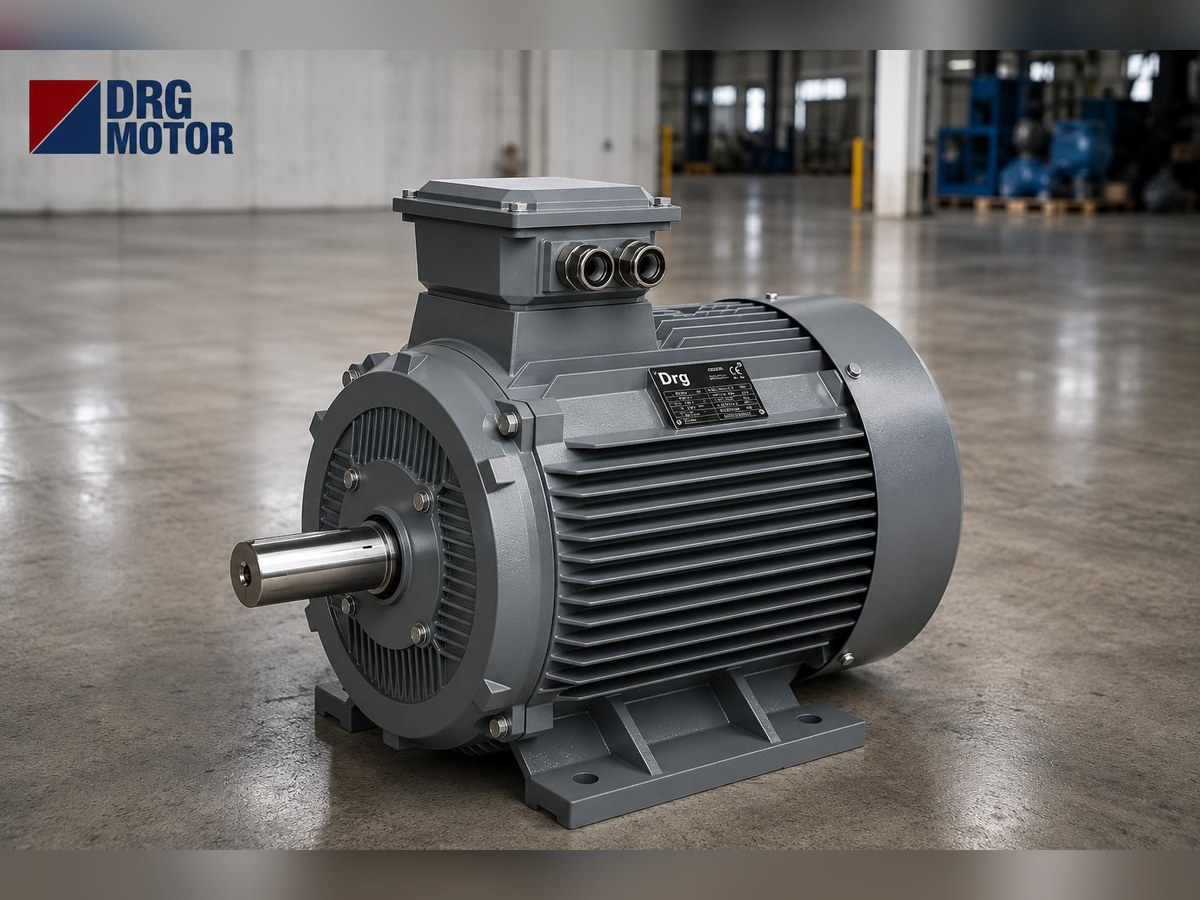
A panel sizing saw divides large boards such as particleboard, MDF and chipboard, stacked on top of each other, into sized parts according to a program. There is no single motor on this machine: a large motor drives the main saw, a scoring motor pre-cuts the coating, a drive moves the saw carriage along the cutting line and a pusher positions the stack back and forth. Maker catalogues list 7.5–54 kW for the main saw motor of horizontal beam saws and 3.7–5.5 kW for vertical panel saws.
DRG Motor is a manufacturer, supplier and seller of electric motors. We do not sell the sizing machine itself, saw and scoring blades, servo axis motors and their drives, gearboxes, hydraulic lift units, electro-spindles or brake motors. Our share is the standard three-phase induction motor used on the main saw, the scorer and suitable auxiliary drives. The choices are on Buy Electric Motors Online.
How does a panel sizing saw work?
On a horizontal beam saw the board stack lies on the machine table. A pressure beam holds the stack down while the saw carriage runs along slides below the table for the length of the cut and returns. After each cut the pusher moves the stack to the next dimension; the control optimises the cutting list and repeats the cycle. In a furniture plant it stands at the head of the line, and the parts go on to edge banding and boring machines.
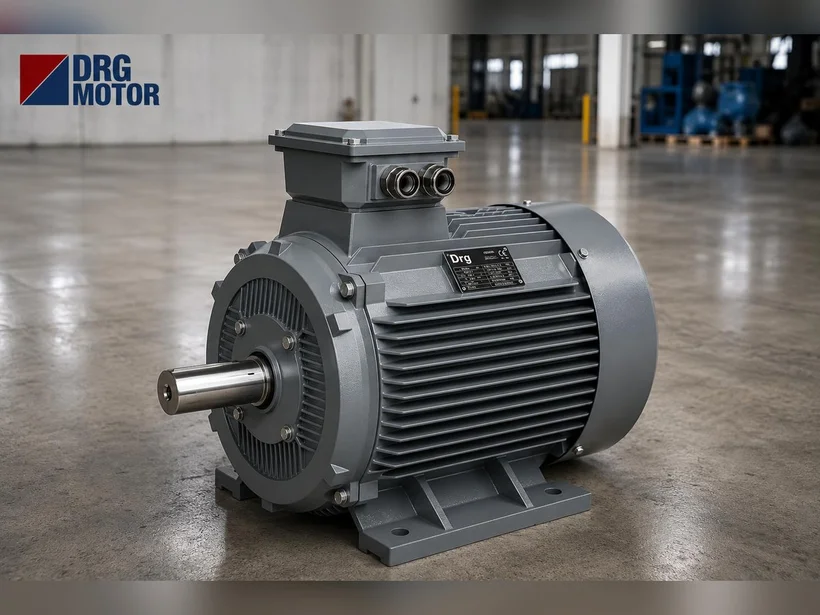
Main saw and scorer on the carriage
The main saw motor and the scoring motor ride on the same carriage. The main blade rises for the cut and lowers for the return; the scorer nicks the coating of the bottom board before it can chip. Because the motor keeps moving with the carriage, its supply comes through a cable chain, and the frame sees more vibration than on a stationary bench. When replacing it, check first the mounting face on the carriage and the pulley alignment.
Carriage travel and pusher drive
Catalogues give carriage speeds up to 120–150 metres per minute and pusher speeds up to 70–90. Newer machines achieve this precise positioning mostly with a servo motor and rack and pinion; servo motors and their drives are not in the DRG range. On simpler or older machines the carriage may run on a geared induction motor with an inverter. On such a machine we look at the motor’s nameplate and gearbox connection together to see whether a standard motor fits.
Vertical panel saw
On a vertical panel saw the board leans against an almost upright frame and the saw motor travels up, down and across on a beam; the motor is turned through 90° to switch between horizontal and vertical cuts. Catalogues give a single saw motor of 3.7–5.5 kW, and the small footprint makes it popular with small shops, board dealers and interior work. The two-speed motor offered on some models is a special pole-changing motor; that type is not in our range.
Sliding table saw versus panel sizing saw
Both machines cut boards, so they are often confused. The differences that affect motor choice are:
| Criterion | Panel sizing saw | Sliding table saw | Effect on selection |
|---|---|---|---|
| Feed | motorised carriage, programmed | table pushed by hand | carriage drive chosen separately on the beam saw |
| Cutting height | board stack, 60–170 mm projection | single board or solid piece | main motor several times larger |
| Main motor position | on the travelling carriage | on the tilting carrier in a fixed frame | cable chain and vibration matter |
| Starting | usually star-delta or inverter | direct on small ratings | panel design decides |
The machine on which single boards are cut and the operator pushes the table is the sliding table saw; its motor selection is described on a separate category page. This page deals only with the motors of sizing saws that cut stacks by program and of vertical panel saws.
Click to see current electric motor prices and order nowSEE PRICES →
How many kW for an MDF cutting machine motor? Catalogue values
A) Motor ratings found in catalogues of beam saw and vertical panel saw makers:
| Machine type | Motor power | Single / total | Note |
|---|---|---|---|
| Horizontal beam saw, 60–95 mm blade projection | 7.5 kW; option 9 / 11 kW | main saw, star-delta start | first maker’s catalogue |
| Same series, inverter main motor | 11 / 15 / 18 kW | main saw | first maker, option |
| Same series, scoring unit | 1.5 kW | scoring blade motor | first maker |
| Mid-range beam saw, 110 mm projection | 18 kW; option 24 kW | main saw | second maker |
| Heavy-duty beam saw | 30 kW; option 47 kW | main saw | second maker, large model |
| Rear-loading heavy machine, 170 mm projection | 54 kW main + 2.2 kW scorer | two separate motors | second maker, older brochure |
| Vertical panel saw, 250 mm blade | 3.7 kW | single saw motor | first maker |
| Vertical panel saw, 300 mm blade | 5.5 kW; option two-speed 4 kW | single saw motor | third maker |
Depending on model and blade projection, these catalogues put the main saw at roughly 7.5–54 kW, the scorer at 1.5–2.2 kW and the single motor of vertical panel saws at 3.7–5.5 kW. As blade projection (the stack height that can be cut) grows, the main motor grows markedly. Part of the catalogue values are given for an intermittent duty class, so on replacement the power and duty note on the old nameplate are what count.
B) Where DRG has a match: 7.5–55 kW two-pole main motors in cast iron frames from 132S to 250M, 1.5–2.2 kW scoring motors in frame 90S/90L, and the 3.7–5.5 kW single motor of vertical saws with our 112M/132S models. For an intermediate rating such as 47 kW the next standard rating (55 kW) is considered; the machine maker confirms whether panel, cable and mechanics allow it. Servo axis motors and two-speed pole-changing motors are outside the range.
Main saw motor: speed, starting and braking
Catalogues list speeds such as 4,650 rpm for the main blade and 5,850 rpm for the scorer; as a two-pole motor is in the 3,000 rpm class, speed is raised by the pulleys. The larger the main motor, the more its starting current governs panel design, which is why catalogues show star-delta starting or an inverter main motor option. Quick stopping of the blade comes from the electronic brake in the machine’s panel, which briefly feeds direct current into the winding; a motor with its own mechanical brake is outside what we supply.
Worked example: starting and blade speed of an 11 kW main motor
Take a machine whose catalogue gives a 370 mm main blade at 4,650 rpm, with an 11 kW two-pole motor (rated torque: DRG-160M1-2, 35.7 Nm):
| Quantity | Calculation | Value | Explanation |
|---|---|---|---|
| Main motor rated current | DRG-160M1-2, 400 V | 19.6 A | 11 kW, 2,945 rpm |
| Direct-on-line starting current | 19.6 × 8.1 | about 159 A | Is/In = 8.1 |
| Current in the star step | 158.8 / 3 | about 53 A | supply shock drops to one third |
| Pulley ratio required | 4,650 / 2,945 | about 1.58 | for the catalogue blade speed |
| Rim speed of a 370 mm blade | π × 0.37 × 4,650 / 60 | about 90 m/s | compare with the blade marking |
Star-delta starting cuts the shock on the supply to a third, but motor torque drops by the same ratio, so the main blade must not touch the stack while starting. The method is detailed on the star-delta starting page and pulley sizes can be tried in the pulley and belt calculator. Never exceed the maximum speed marked on the blade.
Chip extraction, cable chain and motor care
On a sizing saw the chips are drawn from a hood below the carriage into the dust extraction system. If extraction weakens, fine MDF dust sticks to the motor fins and fan cover and the motor heats up. Our IP55 motors are dust-protected; even so, clean the cover and fins regularly. The cable of the carriage motor flexes at every cut: check the cable inside the chain and the terminal box gland during maintenance. For the extraction fan motor, browse our Fan Motors category.
DRG motors for panel sizing saws
Two-pole models suited to the main saw and the scorer (current at 400 V):
| Model | Power / speed | Frame · shaft D×E | Current 400 V |
|---|---|---|---|
| DRG-90L-2 | 2.2 kW / 2895 rpm | 90L cast iron · 24×50 | 4.35 A |
| DRG-132S2-2 | 7.5 kW / 2930 rpm | 132S cast iron · 38×80 | 13.7 A |
| DRG-160M1-2 | 11 kW / 2945 rpm | 160M cast iron · 42×110 | 19.6 A |
| DRG-160L-2 | 18.5 kW / 2940 rpm | 160L cast iron · 42×110 | 32.5 A |
| DRG-180M-2 | 22 kW / 2955 rpm | 180M cast iron · 48×110 | 38.5 A |
| DRG-200L1-2 | 30 kW / 2960 rpm | 200L cast iron · 55×110 | 52.1 A |
| DRG-250M-2 | 55 kW / 2970 rpm | 250M cast iron · 60×140 | 93.5 A |
Our range is made up of three-phase IEC induction motors, aluminium-framed from 0.25 up to 11 kW and cast iron-framed from 0.55 up to 355 kW, with 2, 4 or 6 poles. The main motor of a sizing saw is usually cast iron; depending on how it attaches to the carriage, the order note states foot B3, flange B5 or B14, a combined B34 or B35, or a vertical form. Before the change, write down from the old motor its kW, speed and voltage, how it is connected, the frame number, its shaft and key, the flange or foot size and the pulley diameter. Set against the machine documents, these figures let us settle the right motor with you; no promise of fit is made before the dimensions are confirmed.
B5 flange dimensions
B5 values from the DRG catalogue for main and scoring motors flanged to the carriage (mm):
| Frame | Shaft D×E | Flange P / M / N | Hole S |
|---|---|---|---|
| 90S/90L | 24×50 | 200 / 165 / 130 | 12 |
| 132S/132M | 38×80 | 300 / 265 / 230 | 14.5 |
| 160M/160L | 42×110 | 350 / 300 / 250 | 18.5 |
| 200L | 55×110 | 400 / 350 / 300 | 18.5 |
Live price table
Current prices of the models in sizing saw main and scorer sizes come automatically from the shop:
| Model | Power / speed | Frame · current 400 V | Price |
|---|---|---|---|
| DRG-90S-22 HP | 1.5 kW · 3000 rpm | Cast iron 90S · 3.06 A | $119.41 (€106.64) Details & buy → |
| DRG-90L-23 HP | 2.2 kW · 3000 rpm | Cast iron 90L · 4.35 A | $154.45 (€137.93) Details & buy → |
| DRG-132S2-210 HP | 7.5 kW · 3000 rpm | Cast iron 132S · 13.7 A | $369.43 (€329.92) Details & buy → |
| DRG-160M1-215 HP | 11 kW · 3000 rpm | Cast iron 160M · 19.6 A | $527.95 (€471.49) Details & buy → |
| DRG-160L-225 HP | 18.5 kW · 3000 rpm | Cast iron 160L · 32.5 A | $714.00 (€637.65) Details & buy → |
| DRG-180M-230 HP | 22 kW · 3000 rpm | Cast iron 180M · 38.5 A | $857.53 (€765.83) Details & buy → |
| DRG-200L1-240 HP | 30 kW · 3000 rpm | Cast iron 200L · 52.1 A | $1,273.02 (€1,136.88) Details & buy → |
| DRG-250M-275 HP | 55 kW · 3000 rpm | Cast iron 250M · 93.5 A | $2,180.99 (€1,947.76) Details & buy → |
DRG MOTOR motors are guaranteed against material and manufacturing defects for 2 years from the delivery date (warranty certificate).
Motors in this power range
- DRG-90S-2 – 1.5 kW – 2895 rpm – 90S cast iron
- DRG-160M1-2 – 11 kW – 2945 rpm – 160M cast iron
- DRG-180M-2 – 22 kW – 2955 rpm – 180M cast iron
- DRG-200L1-2 – 30 kW – 2960 rpm – 200L cast iron
- DRG-250M-2 – 55 kW – 2970 rpm – 250M cast iron
Click to see current prices and order these motors nowSEE PRICES →
Browse the products, ask for a quote: all motors that suit your sizing saw are on Buy Electric Motors Online. Photograph the main motor plate, its mounting on the carriage and the pulley and send them on WhatsApp; or call +90 (542) 666 11 11 and give us the blade projection to get started.
Frequently asked questions
Does a stronger main motor make a sizing saw cut faster?
Cutting speed is set by the carriage drive and the control; a stronger main motor only reduces the speed drop under load. Ask the machine maker whether shaft, belt, carriage structure and panel suit the higher rating.
If the scoring motor fails, is it replaced with the same type as the main motor?
No, the scorer is a much smaller motor. It is chosen by the power and shaft size on its own nameplate; it usually turns opposite to the main blade.
What does the price of a panel sizing saw motor depend on?
On power, frame size, frame material and mounting type; the table above is updated with shop data.
For questions about your sizing line, use +90 (542) 666 11 11, info@drgmotor.com or the contact form. Our article on woodworking machine motor supply also helps with motor choice in dusty conditions.


