 English
 Le français
 Türkçe

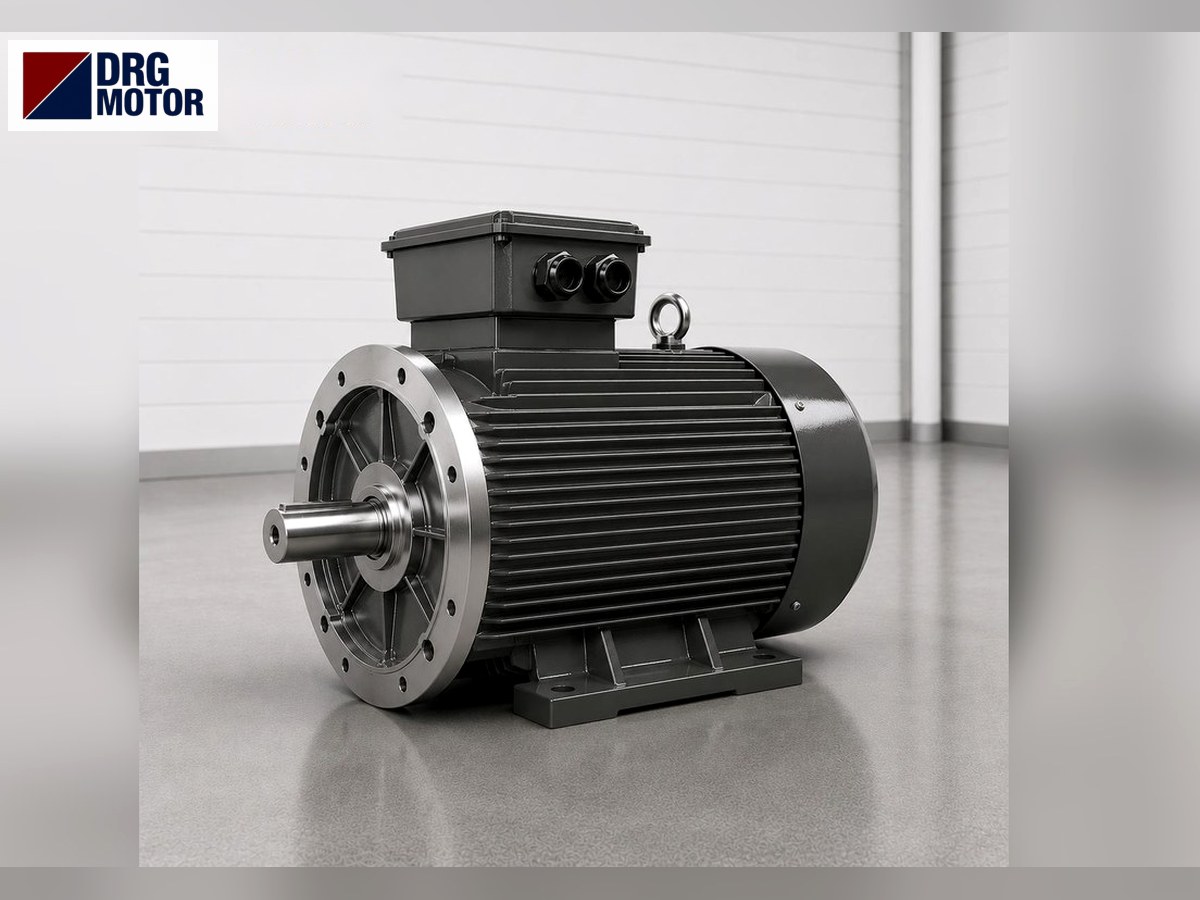
When choosing an electric motor for a parallel shaft gearbox, start from the input side of the gearbox. If it has an IEC motor flange input, the motor sits directly on the gearbox with a B5 or B14 flange; with a free input shaft, the motor is foot-mounted (B3) on a separate base or on a motor platform above the gearbox and drives through a coupling or belts. Motor power comes from the torque and speed required at the gearbox output, and the number of poles from the gearbox ratio. This page covers motor selection for hollow-shaft, shaft-mounted parallel shaft gearboxes used on conveyors, elevators and crane travel drives.
One important distinction: DRG Motor does not sell gearboxes. We supply the three-phase electric motor that goes onto the parallel shaft gearbox you already have or that the machine builder has chosen. The current list of suitable motors is on the Buy Electric Motors Online page.
What is a parallel shaft gearbox and where does the motor go?
In these gearboxes the input and output shafts are parallel but not on the same axis; the helical gear stages in between offset the output to one side. This keeps the housing short and flat. The output is usually a hollow shaft: the gearbox slides onto the shaft of the driven machine and hangs on it. A torque arm stops the housing from rotating; one end is fixed to the gearbox, the other to a rigid point.
Shaft-mounted arrangement
On a conveyor pulley, an elevator head shaft or a travel wheel shaft, the gearbox needs no separate base and sits on the shaft itself. As there is no coupling between the machine shaft and the gearbox, alignment work is reduced. One manufacturer's catalogue lists foot-mounted, hollow-shaft, B5 flange and B14 flange versions of this housing family under separate codes, with the torque arm shown as a separate option.
Why the torque arm matters for the motor
The torque arm does more than hold the gearbox; the motor's starting torque is also transferred to the floor through it. If the arm is loose or fitted at the wrong angle, the gearbox swings at every start, and that movement puts extra load on the motor flange, shaft and bearings. An installation manual for belt-driven shaft mount reducers notes that the torque arm can also be used to tension the belts and recommends positioning it so that it works in tension where possible.
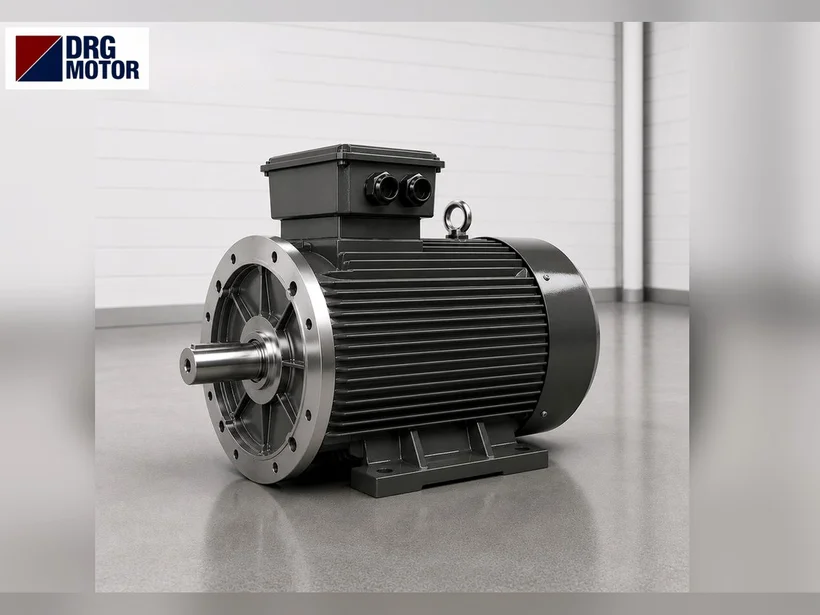
Motor connection: IEC flange input or free shaft?
Parallel shaft gearboxes connect to the motor in three different ways, and the motor order changes accordingly.
Input with IEC motor adapter
Compact helical parallel shaft gearboxes have an IEC motor adapter at the input. One manufacturer's catalogue offers these adapters for IEC motor frames 63 to 280; the adapter number matches the motor frame, and an elastic spider coupling runs between motor and gearbox. In this arrangement the motor is ordered as B5 (large flange) or, on small frames, sometimes as B14 (small flange). If the gearbox IEC input flange and the motor flange and shaft diameter belong to the same frame size, they usually fit; still, compare the dimensions before ordering.
Belt-driven shaft mount reducer with motor platform
On simpler shaft mount reducers the input is a free shaft. The motor is bolted by its feet (B3) to a platform fixed on the gearbox housing and drives the input through V-belts. One manufacturer's manual gives nominal ratios of 9:1, 15:1 and 25:1 for this type; the remaining difference to the required output speed is made up by the pulley ratio. The same manual asks for the belt section and number of belts to be selected separately for the power transmitted.
Large industrial gearbox on a baseplate with coupling
On large industrial parallel shaft gearboxes the motor often stands beside the gearbox on a common baseplate and is connected by a flexible coupling. In one catalogue, ratios in this class run from 6.3:1 to 315:1 and output torque reaches 162,000 Nm. In this layout the motor is foot-mounted B3 and needs no flange. The same catalogue also shows a B5 flange motor fitted through a lantern housing as an alternative. With a baseplate, coupling alignment is the most critical step of a motor replacement.
Motor load on conveyors, elevators and crane travel
The three most common applications for parallel shaft gearboxes ask different things of the motor:
- Belt conveyor: The load is mostly uniform, but when the belt stops loaded, the motor has to start it loaded. On an inclined belt the backstop that prevents runback is part of the gearbox or the adapter; one catalogue lists a backstop version of the IEC adapter under its own code.
- Bucket elevator: The gearbox hangs on the head shaft. Restarting with full buckets and a backstop are the two main requirements here; the motor is chosen with enough margin for the sudden load rise when buckets jam.
- Crane and bridge travel: The mass is large and acceleration and braking are frequent. An industrial gearbox catalogue asks that selection for high-inertia drives such as crane travel and slewing be made with the manufacturer's application engineers. These drives usually use a brake motor; brake motors are not part of the DRG range, so ask us first if you need one.
Click to see current electric motor prices and order nowSEE PRICES →
Power, ratio and service factor: a worked example
Take a belt conveyor whose head pulley needs 8.2 kW of shaft power at 46 rpm. The conveyor runs more than 10 hours a day under uniform load, and the pulley carries a three-stage hollow-shaft parallel shaft gearbox.
- Output torque: 9550 × 8.2 / 46 ≈ 1,702 Nm.
- Gearbox losses: One manufacturer's catalogue gives the efficiency of helical, parallel shaft and bevel helical gearboxes as 0.94 (three stages) to 0.98 (one stage). With 0.94, the power needed at the motor shaft is 8.2 / 0.94 ≈ 8.7 kW; the next standard rating is 11 kW.
- Ratio: With a 4-pole 11 kW motor (DRG-160M-4, 1465 rpm) the required ratio is 1465 / 46 ≈ 31.8.
- Service factor: An industrial gearbox catalogue gives a factor of 1.25 for electric motor drives under uniform load for more than 10 hours a day. The gearbox is therefore selected for 1,702 × 1.25 ≈ 2,128 Nm output torque.
- Check: The rated torque of the 11 kW motor is 71.7 Nm; with ratio 31.8 and efficiency 0.94 this is about 2,146 Nm at the output. The gearbox rated torque should be at least at this level so that the motor at full load does not overstress it.
If a belt-driven shaft mount reducer were used on the same conveyor, a housing with an actual ratio of 24.75 would leave 31.8 / 24.75 ≈ 1.29 to be covered by the pulleys. Try your own values: the gearbox output speed and torque calculator does the arithmetic. How the service factor changes with the number of starts is covered in our article on torque, ratio and service factor.
B5 flange motor dimensions (DRG catalogue)
Summary of the B5 (large flange) dimensions in the DRG catalogue for frames 80–160, the sizes met most often in the applications on this page:
| Frame | Shaft D×E (mm) | Flange P / M / N (mm) | Hole S (mm) |
|---|---|---|---|
| 80 | 19 × 40 | 200 / 165 / 130 | 12 |
| 90S / 90L | 24 × 50 | 200 / 165 / 130 | 12 |
| 100L / 112M | 28 × 60 | 250 / 215 / 180 | 14.5 |
| 132S / 132M | 38 × 80 | 300 / 265 / 230 | 14.5 |
| 160M / 160L | 42 × 110 | 350 / 300 / 250 | 18.5 |
P is the flange outside diameter, M the bolt circle and N the spigot diameter. Frames 80 and 90 share the same flange but have different shafts: a flange that fits does not mean the shaft fits. The B14 (small flange) option is in our range, but since no B14 dimension table is published in our catalogue we give no dimensions here; we confirm the B14 flange at order stage against your gearbox input. All drawings are on the technical drawings page, and the difference between B5 and B14 is explained in the article on choosing a flange motor for a gearbox.
Mounting position, terminal box and starting
Mounting position and oil
Because a shaft-mounted gearbox can sit at different angles on the shaft, the mounting position is not the same on every site; when the position changes, the oil level and the breather location change too. One manufacturer's catalogue states that its power and torque values refer to the horizontal position in which the input stage is not fully submerged in oil, and that churning losses increase in some positions. For the motor, what matters is that the terminal box and cable entry stay accessible in that position.
Terminal box orientation
The same catalogue defines the terminal box position as 0°, 90°, 180° and 270°, viewed from the motor fan cover. Check on the old motor whether the torque arm, pulley or conveyor frame obstructs the box, and state the required orientation in your order.
Starting method
In the DRG range, 400/690 V windings start from 4 kW; these motors can therefore be run up in star-delta from a 400 V network. In star the starting torque drops to about one third, so on an inclined conveyor or elevator that starts loaded this method may not be enough; a soft starter or inverter is then considered. The star-delta starting page compares the methods. For the 4-pole models on this page the starting torque ratio (Ts/Tn) is 2.0–2.3.
Information needed for an order
- Gearbox nameplate: type, ratio, input type (IEC adapter or free shaft) and input frame number (for example "IEC 132").
- Old motor nameplate: kW, speed, voltage, mounting type (B3, B5, B14, B35) and frame.
- Flange input: P, M, N dimensions, shaft D×E and key width; for a B14 input, measure these and send them to us.
- Belt input: foot hole spacing on the motor platform and the pulley bore.
- Application: conveyor, elevator or travel drive; hours per day and starts per hour.
- Mounting position and terminal box orientation.
- Brake requirement: brake motors are not in our range, so let us discuss this at the outset.
The steps on the gearbox side during a motor change are described in the article on replacing only the motor when the gearbox is sound.
DRG motors for parallel shaft gearboxes
DRG Motor is a manufacturer, supplier and seller of electric motors. For motors to be fitted to parallel shaft gearboxes our range is three-phase and offered at 1000, 1500 and 3000 rpm synchronous speed; it covers 0.25–11 kW in aluminium frames and 0.55–355 kW in cast iron frames. We have no 750 rpm (8-pole) motor. Since the selection tables in gearbox catalogues are mostly based on 4-pole motor speed, the table below shows 1500 rpm cast iron models:
| Model | Power / speed | Frame | Current 400 V |
|---|---|---|---|
| DRG-90L-4 | 1.5 kW / 1445 rpm | 90L cast iron | 3.3 A |
| DRG-112M-4 | 4 kW / 1450 rpm | 112M cast iron | 7.95 A |
| DRG-132S-4 | 5.5 kW / 1460 rpm | 132S cast iron | 10.7 A |
| DRG-132M-4 | 7.5 kW / 1460 rpm | 132M cast iron | 14.3 A |
| DRG-160M-4 | 11 kW / 1465 rpm | 160M cast iron | 20.4 A |
| DRG-160L-4 | 15 kW / 1465 rpm | 160L cast iron | 27.3 A |
| DRG-180L-4 | 22 kW / 1470 rpm | 180L cast iron | 39.7 A |
| DRG-200L-4 | 30 kW / 1475 rpm | 200L cast iron | 53.8 A |
The current shop values for these models appear in the table below:
| Model | Power / speed | Frame · current 400 V | Price |
|---|---|---|---|
| DRG-90L-42 HP | 1.5 kW · 1500 rpm | Cast iron 90L · 3.3 A | $144.14 (€128.73) Details & buy → |
| DRG-100L2-44 HP | 3 kW · 1500 rpm | Cast iron 100L · 6.02 A | $203.84 (€182.05) Details & buy → |
| DRG-112M-45.5 HP | 4 kW · 1500 rpm | Cast iron 112M · 7.95 A | $254.38 (€227.18) Details & buy → |
| DRG-132S-47.5 HP | 5.5 kW · 1500 rpm | Cast iron 132S · 10.7 A | $342.01 (€305.44) Details & buy → |
| DRG-132M-410 HP | 7.5 kW · 1500 rpm | Cast iron 132M · 14.3 A | $394.89 (€352.66) Details & buy → |
| DRG-160M-415 HP | 11 kW · 1500 rpm | Cast iron 160M · 20.4 A | $568.76 (€507.94) Details & buy → |
| DRG-160L-420 HP | 15 kW · 1500 rpm | Cast iron 160L · 27.3 A | $678.13 (€605.61) Details & buy → |
| DRG-180L-430 HP | 22 kW · 1500 rpm | Cast iron 180L · 39.7 A | $919.45 (€821.13) Details & buy → |
DRG MOTOR motors are guaranteed against material and manufacturing defects for 2 years from the date of delivery (warranty certificate).
Motors in this power range
- DRG-100L1-4 – 2.2 kW – 1450 rpm – 100L cast iron
- DRG-112M-4 – 4 kW – 1450 rpm – 112M cast iron
- DRG-132M-4 – 7.5 kW – 1460 rpm – 132M cast iron
- DRG-160M-4 – 11 kW – 1465 rpm – 160M cast iron
- DRG-180M-4 – 18.5 kW – 1470 rpm – 180M cast iron
Click to see current prices and order these motors nowSEE PRICES →
Frequently asked questions about parallel shaft gearbox motors
What speed motor goes on a parallel shaft gearbox?
Fit a motor at the speed for which the gearbox ratio was selected. Selection tables are mostly based on a 4-pole (1500 rpm) motor. A 6-pole motor in its place lowers the output speed by about one third; a 2-pole motor doubles the output and may exceed the input speed the gearbox allows.
Can it run without a torque arm?
No. On a shaft-mounted gearbox the torque arm is what holds the housing; without it the housing rotates around the shaft and the motor cable and terminal box are damaged.
Does a belt-driven shaft mount reducer need a B5 motor?
No. The motor is bolted to the platform by its feet, so a B3 foot-mounted motor is enough. What matters is that the shaft diameter suits the pulley and the foot hole spacing suits the platform.
How many amps does an 11 kW parallel shaft gearbox motor draw?
The 4-pole DRG-160M-4 draws 20.4 A at 400 V. For the overload relay setting, open overload relay, fuse and contactor selection.
Send us photos of the gearbox nameplate and the old motor nameplate, and we will check the input dimensions together. Phone +90 (542) 666 11 11, email [email protected], contact page. Prices and the full model list are in our Buy Electric Motors Online shop.


