 English
 Le français
 Türkçe

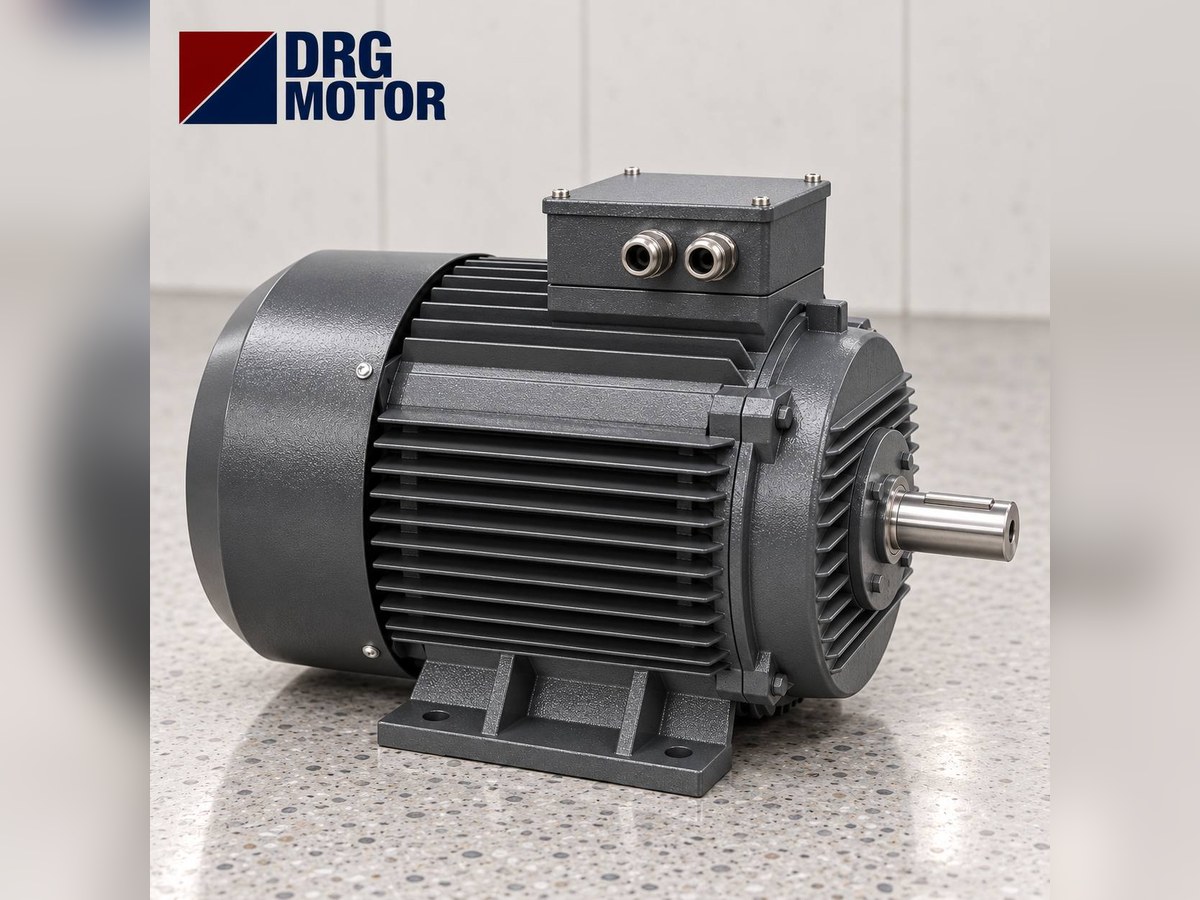
A rotary screen (trommel) is a slightly inclined, slowly turning perforated drum through which material passes; the electric motor in this machine turns the drum through a reducer at only 9–20 revolutions per minute [1][2]. For this duty on stationary electric trommels, manufacturer catalogues show motors in the 4–37 kW range [1]; the motor turns the drum's support wheels or girth gear through a single reducer, and on some types several small gear motors are spread across the wheels [3]. What decides the selection is less the power rating than how far the motor speed is reduced and the starting torque with the drum stopped loaded.
This page covers stationary, mains-powered trommels; diesel-driven mobile trommels are outside its scope. Motors suitable for drum drives and current prices are among the 120 models at Buy Electric Motors Online. Motors for the other machines of the crushing-screening line: Stone Crushing Plant Motors.
What is a rotary screen and what is it used for?
A trommel is a cylinder of perforated plate or screen mesh. Material enters at the high end, is lifted and falls as the drum turns, and moves to the outlet on a 2–2.5° incline [1]; undersize drops through the holes and oversize leaves at the end. Sections with different hole sizes separate several product sizes.
In stone crushing a trommel is used to classify sand, gravel and chippings after the crusher, or to remove clay and fines before it. It is slower, quieter and less prone to blinding than a vibrating screen, so it is preferred for damp, clayey and sticky material. Main applications:
- Sand and gravel washing: Water is sprayed into the drum to wash the gravel and carry clay and mud away; the washed fine fraction usually goes on to a dewatering screen.
- Recycling: Separating construction and demolition waste, compost, soil, municipal and industrial waste [2][3].
- Mineral preparation: Sizing ore before crushing or beneficiation [1].
How it differs from a vibrating screen, and mobile trommels
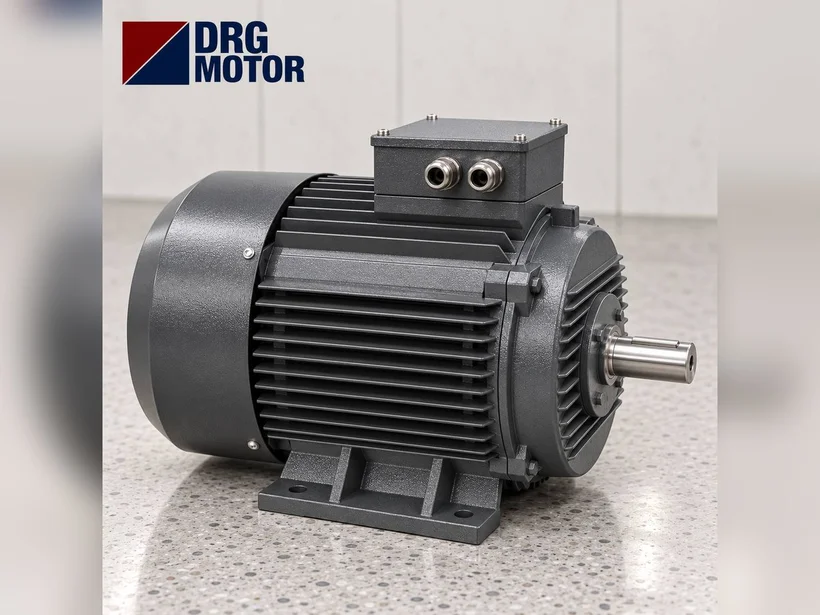
On a vibrating screen (covered on a separate page) the screen surface shakes dozens of times a second and the drive is an eccentric shaft or vibration motors. A trommel has no vibration: the motor only produces a slow, steady rotation. A trommel motor is a standard three-phase induction motor; the load is smooth but starting with a loaded drum is heavy.
Trommels on the market should be split into three groups by energy source:
- Stationary electric trommel: One or more electric gear motors turn the drum. This is the subject of this page.
- Electric but hydraulically driven portable trommel: An electric motor turns a hydraulic pump, and the drum and belts are turned by hydraulic motors. In one example a 44.7 kW, 1800 rpm motor runs with a soft starter, and the drum is turned by chain and hydraulic motor [4].
- Diesel mobile trommel: All movements come from a diesel engine and hydraulic system; in one example the engine is a 130 kW diesel [5]. These have no electric motor and are outside the DRG scope.
How does the motor turn the drum?
Three drive arrangements are found on stationary trommels:
- Wheel (roller) drive: Steel tyres around the drum sit on support wheels below. Some of the wheels are driven and turn the drum by friction. One manufacturer fits a separate 5.5 kW slip-on gear motor to each of four wheels, giving 22 kW of total drive power [3]. In other layouts a single motor, reducer and coupling turn two wheels together through a shaft [1].
- Girth gear or chain drive: A girth gear or chain sprocket attached to the drum is turned by a pinion on the reducer output. There is no slip; it is preferred for heavy, large drums.
- Direct drive by gear motor: On one stationary trommel a 15 kW spur gear motor turns the drum directly with speed control; the sheet gives an output torque of 1160 Nm and a drum speed of 10–20 r/min [2].
On a gear motor with an IEC-flanged motor part (B5 or B14) the motor is replaced with a standard one; if motor and reducer share one housing, the whole gear motor is replaced. The reducer's input flange tells you which.
How many kW is a rotary screen motor? Motor ratings on market models
A) Motor ratings found on manufacturer models
| Model group / capacity | Motor rating | Single / total | Source |
|---|---|---|---|
| Maker A, smallest, Ø1.2 × 3.5 m | 4 kW | Single | [1] |
| Maker A, Ø1.5 × 5 m | 7.5 kW | Single | [1] |
| Maker A, Ø1.8 × 6 m, 12 r/min | 18.5 kW | Single | [1] |
| Maker A, largest, Ø2.4 × 8 m | 37 kW | Single | [1] |
| Maker B, Ø2.0 × 5.5 m, 10–20 r/min | 15 kW | Single (gear motor) | [2] |
| Maker C, Ø1.8–2.5 m, 4 wheels | 4 × 5.5 kW | Total 22 kW | [3] |
| Maker D, portable, hydraulic | 44.7 kW | Single, whole machine | [4] |
| Maker E, mobile diesel | 130 kW diesel | Out of scope | [5] |
In this machine group, motor options of roughly 4–45 kW are found depending on the manufacturer's model and capacity [1][4]. The drum drive itself lies in the 4–37 kW range [1]; the 44.7 kW figure belongs to the portable type, where a single motor feeds the whole machine and turns drum, belts and brushes hydraulically [4]. On the four-motor wheel drive each motor is 5.5 kW and 22 kW is the total [3]; on replacement the per-motor value is the reference.
Power grows with drum diameter and length: in the same catalogue, as the diameter rises from 1.2 m to 2.4 m and the length from 3.5 m to 8 m, the motor rises from 4 kW to 37 kW [1]. Capacity (t/h) and, when washing, the added water also raise the drum load and therefore the power. Drum speed falls as the diameter grows: 17 r/min on the smallest model, 9 r/min on the largest [1].
B) Matching motors in the DRG range
The 4–37 kW drum motors and the 5.5 kW wheel motors of stationary electric trommels are covered by DRG's 4- and 6-pole range; the 44.7 kW class of the portable type is covered by 45 kW. Outside the range: diesel mobile trommels, the hydraulic motors that turn the drum, and single-housing gear motors in which motor and reducer cannot be separated. An 1800 rpm motor on a 60 Hz sheet corresponds to 1500 rpm on a 50 Hz supply.
Click to see current electric motor prices and order nowSEE PRICES →
Worked example: drum speed, reducer ratio and torque
On a trommel the speed chain is calculated before the power. Drum speed is kept below the critical speed at which material sticks to the shell and rotates with it. The general engineering relation is n_critical ≈ 42.3 / √D (D drum diameter in m, n in r/min).
- For a Ø1.8 m drum, n_critical ≈ 42.3 / √1.8 ≈ 31.5 r/min. The catalogue operating speed of 12 r/min [1] is about 38% of this; material tumbles without being carried to the top.
- Assume a wheel drive: tyre diameter equal to the drum (1.8 m), drive wheel 0.45 m. Wheel speed = 12 × 1.8 / 0.45 = 48 r/min.
- If a 4-pole DRG-180M-4 (1470 rpm) is chosen for the catalogue's 18.5 kW, the reducer ratio is ≈ 1470 / 48 ≈ 30.6. With the 6-pole DRG-200L1-6 (980 rpm) the ratio drops to ≈ 20.4; the reducer gets smaller but the motor frame gets larger.
- Total torque delivered to the wheel shafts, ignoring losses, is M = 9550 × 18.5 / 48 ≈ 3,680 Nm. The reducer is selected for this torque.
- On a VFD between 40 and 60 Hz, drum speed can be set between about 9.6 and 14.4 r/min.
You can check the reducer ratio and output torque with your own values in the gearbox output speed and torque calculator.
Trommel motor selection checklist, speed and mounting
Collect the following information, specific to trommels:
- Drum diameter, length, incline and operating speed; hole size and capacity.
- Drive arrangement: wheels, girth gear, chain or direct gear motor; number of driven wheels and number of motors.
- Reducer ratio and input connection: IEC flange size, shaft diameter, coupling type.
- The old motor's nameplate: kW, rpm, frame, voltage, frequency.
- Starting condition: can the drum stop loaded, is there sequence interlocking with the feed belt (when the trommel stops, the feed must stop).
- Washing trommel or not: distance from the spray line to the motor and terminal box, splashing and mud.
- Is speed adjustment required (VFD); on multi-motor wheel drives, whether the motors will be fed from the same VFD.
Speed and mounting
Because drum speed is very low, the motor is usually 4-pole (1500 rpm) or 6-pole (1000 rpm); the reducer ratio sets the speed. If the number of poles is changed, drum speed changes in the same proportion: fitting a 4-pole motor in place of a 6-pole one speeds the drum up by about 50% and shortens the time material stays on the screen. On a gear motor the motor is flange-mounted (B5 or B14); where motor, coupling and reducer sit separately on a base frame, the motor is foot-mounted (B3). The exact type comes from the machine manufacturer's drawing; state the mounting type as a note when ordering.
Starting
A loaded drum is an unbalanced mass at start. DRG motors from 4 kW upwards are wound for 400/690 V and suit star-delta starting at 400 V; however, on a washing drum that stopped loaded, a slow start on a VFD protects both the motor and the wheel surfaces. For the choice of method see the star-delta starting page. Have a qualified electrician carry out the wiring.
DRG motors for rotary screens
DRG Motor is a manufacturer, supplier and seller of electric motors. The three-phase range spans 0.25–11 kW with aluminium frames and 0.55–355 kW with cast iron frames, at 1000, 1500 or 3000 rpm, 230/400 V or 400/690 V, with B3, B5, B14 or B35 mounting (by order note). Models that stand out for trommel drum drives:
| Model | Power / speed | Frame | Current 400 V |
|---|---|---|---|
| DRG-112M-4 | 4 kW / 1450 rpm | 112M cast iron | 7.95 A |
| DRG-132S-4 | 5.5 kW / 1460 rpm | 132S cast iron | 10.7 A |
| DRG-160L-4 | 15 kW / 1465 rpm | 160L cast iron | 27.3 A |
| DRG-180M-4 | 18.5 kW / 1470 rpm | 180M cast iron | 33.5 A |
| DRG-200L1-6 | 18.5 kW / 980 rpm | 200L cast iron | 35.9 A |
| DRG-225S-4 | 37 kW / 1485 rpm | 225S cast iron | 66.1 A |
DRG-132S-4 matches the 5.5 kW per-motor value of the four-motor wheel drive, DRG-160L-4 the 15 kW gear-motor drive in the sheet, and DRG-180M-4 and DRG-200L1-6 the 18.5 kW in the worked example. DRG sells motors, not reducers. For other motors on recycling lines see motor supply for recycling plants.
| Model | Power / speed | Frame · current 400 V | Price |
|---|---|---|---|
| DRG-112M-45.5 HP | 4 kW · 1500 rpm | Cast iron 112M · 7.95 A | $254.38 (€227.18) Details & buy → |
| DRG-132S-47.5 HP | 5.5 kW · 1500 rpm | Cast iron 132S · 10.7 A | $342.01 (€305.44) Details & buy → |
| DRG-132M-410 HP | 7.5 kW · 1500 rpm | Cast iron 132M · 14.3 A | $394.89 (€352.66) Details & buy → |
| DRG-160L-615 HP | 11 kW · 1000 rpm | Cast iron 160L · 22 A | $668.92 (€597.39) Details & buy → |
| DRG-160L-420 HP | 15 kW · 1500 rpm | Cast iron 160L · 27.3 A | $678.13 (€605.61) Details & buy → |
| DRG-200L1-625 HP | 18.5 kW · 1000 rpm | Cast iron 200L · 35.9 A | $1,133.87 (€1,012.62) Details & buy → |
| DRG-180M-425 HP | 18.5 kW · 1500 rpm | Cast iron 180M · 33.5 A | $873.49 (€780.08) Details & buy → |
| DRG-200L-440 HP | 30 kW · 1500 rpm | Cast iron 200L · 53.8 A | $1,235.00 (€1,102.93) Details & buy → |
| DRG-225S-450 HP | 37 kW · 1500 rpm | Cast iron 225S · 66.1 A | $1,527.18 (€1,363.87) Details & buy → |
DRG MOTOR motors are guaranteed against material and manufacturing defects for 2 years from the date of delivery (warranty certificate).
Rotary screen drive motors
- DRG-132S-4 – 5.5 kW – 1460 rpm – 132S cast iron
- DRG-132M-4 – 7.5 kW – 1460 rpm – 132M cast iron
- DRG-160L-4 – 15 kW – 1465 rpm – 160L cast iron
- DRG-180M-4 – 18.5 kW – 1470 rpm – 180M cast iron
- DRG-200L1-6 – 18.5 kW – 980 rpm – 200L cast iron
Click to see current prices and order these motors nowSEE PRICES →
Rotary screen motor: frequently asked questions
What is a trommel screen and how does it differ from a vibrating screen?
A trommel rotates without vibration; it blinds less with wet, clayey material but takes more space for the same capacity.
Four small motors or one large motor on a rotary screen?
Both are used. On a four-wheel drive each wheel turns with its own gear motor [3]; on a single-motor layout one motor turns two wheels through a shaft or turns the girth gear [1]. On replacement the per-motor nameplate value is the reference.
How is drum speed adjusted?
By changing the sheave or reducer ratio, or by adjusting frequency with a VFD. On a VFD the motor's own fan weakens at low speed; if long periods at low speed are planned, this is taken into account in motor selection.
Can an electric motor be fitted to a mobile trommel?
On diesel-hydraulic mobile trommels this is not a motor replacement but a machine conversion; the hydraulic pump's speed, flow and power must be set together with the machine manufacturer.
Send us the drum dimensions or a photo of the motor nameplate and we will choose the drive motor together. You can reach us on +90 (542) 666 11 11, at [email protected] or through the contact page. Prices and other models: Buy Electric Motors Online.
Sources
- Octa Mach – Trommel Screen (stationary rotary trommel, technical parameters) – Ø1.2–2.4 m, 3.5–8 m drums; 4–37 kW, 9–17 r/min drum speed, 30–300 t/h; motor, reducer, coupling and support rollers.
- Doppstadt – Drum Screen SM 620 A, Product Data Sheet (Pols) – stationary electric trommel, Ø2000 × 5500 mm; 15 kW spur gear motor, 1160 Nm, 10–20 r/min, speed-controlled direct drive.
- CRS NI – Trommel Screens – Ø1.8–2.5 m, 6–11 m; 4 × 5.5 kW slip-on gear motors, 4-wheel drive, variable speed.
- Vermeer – TR5300EM Trommel Screen (bayi teknik sayfası) – electric portable trommel; 44.7 kW (60 HP) 1800 rpm motor, soft start, drum turned hydraulically via chain.
- McCloskey – 621 Wheeled Trommel – mobile trommel, 130 kW diesel engine; example outside the DRG scope.


