 English
 Le français
 Türkçe

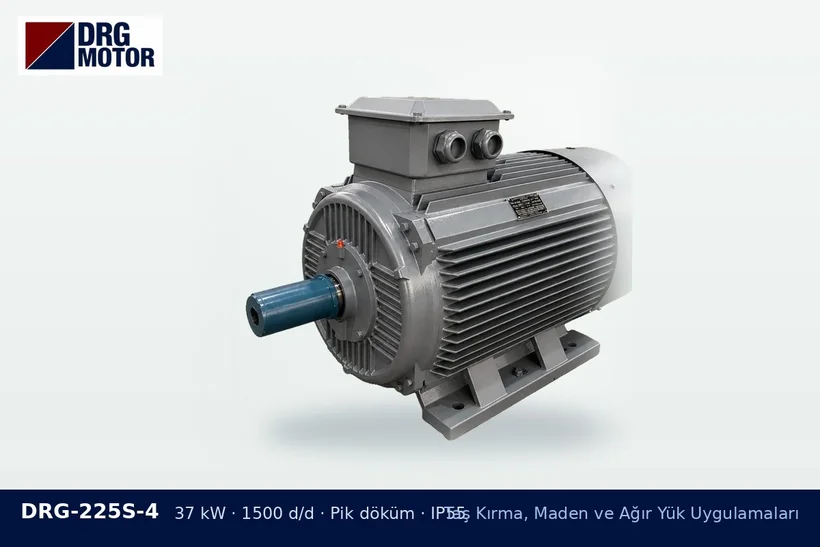
In an asphalt plant, motors are stressed in two ways: by the heat radiated from the drying drum, burner and hot mineral elevator, and by fine mineral dust escaping from the filter. The protection plan is drawn up by looking at each motor’s distance from heat sources and at how clean its cooling air stays.
Map the heat sources
A motor’s rating applies to a given ambient temperature; the standard assessment is usually based on 40 °C ambient and 1000 m altitude. Motors beside the drum shell, behind the burner or above the hot gas duct can exceed this value in summer. Measuring the ambient temperature at each motor during operation shows what measures are needed.
| Equipment | Heat/dust risk | Measure |
|---|---|---|
| Drying drum drive | Radiation from the shell, dust | Heat shield, distance, clear space in front of the fan |
| Filter (exhaust) fan | Hot gas, heat conducted along the shaft | Separate the motor from the fan via the fan bearing block |
| Hot mineral elevator | Hot air accumulating at height | Ventilated platform |
| Cold feed conveyors | Dust, rain | Regular cleaning, canopy |
Dust and cooling air
With IC411 cooling, the motor blows air over its frame fins with its own fan. If the fins and fan cover fill with dust, the motor overheats despite its IP55 protection, because the problem is not dust getting in but cooling being lost on the outside. Cleaning with compressed air at the end of the shift, changing filter bags on time and not enclosing the motor in closed boxes are the most effective measures.
Heat from the shaft on a hot fan
On an exhaust fan, hot gas can carry heat into the fan shaft and from there to the motor bearing. A fan with its own bearing-mounted shaft and a belt drive breaks this path. In a direct-coupled arrangement, measures such as a cooling disc should be assessed together with the fan manufacturer; details are on the high-temperature fan motors page.
For all the plant’s drives you can start from the asphalt plant electric motors page and review the class F insulated models in the three-phase motor shop.