 English
 Le français
 Türkçe

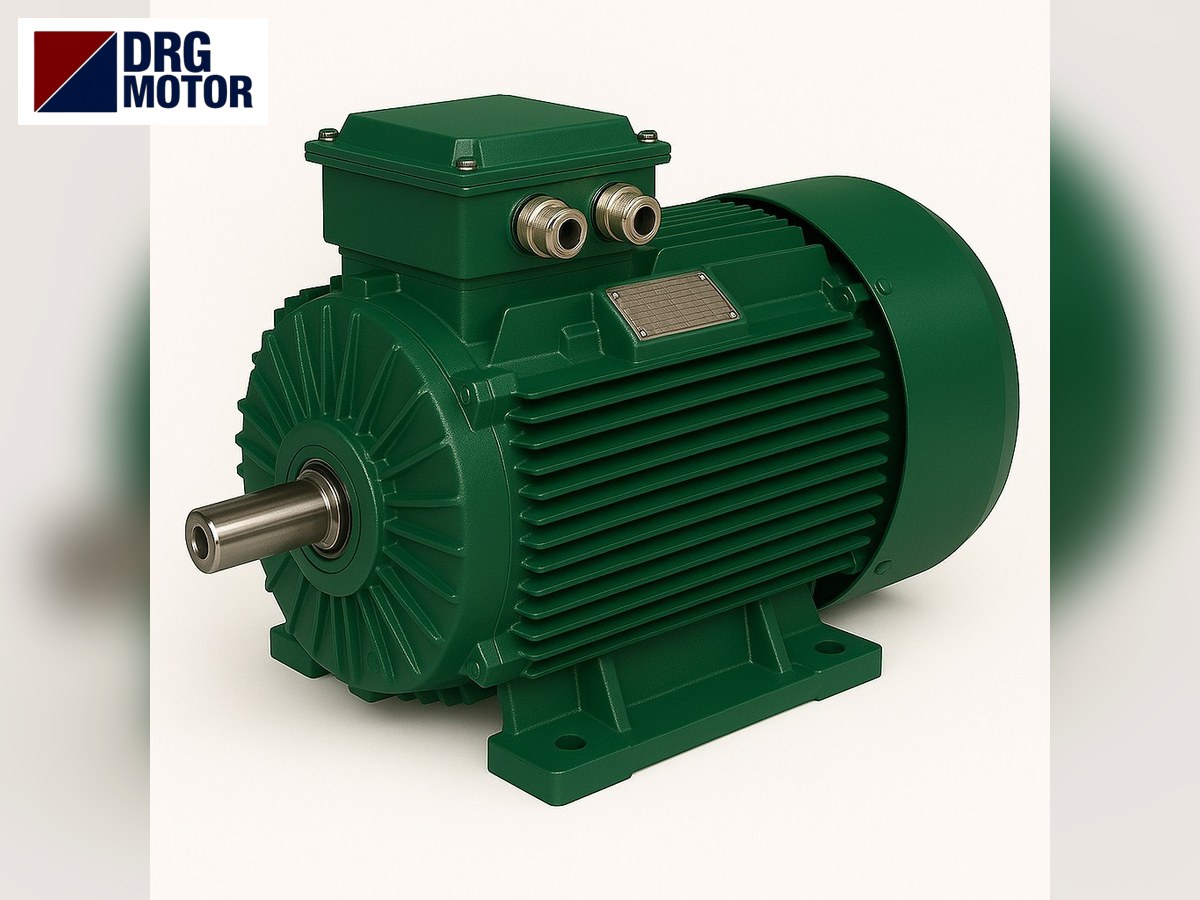
In a concrete batching plant the electric motor turns the belts that carry aggregate from the bins to the mixer, the screws that push cement from the silo into the weigh hopper, the mixer shafts, the hydraulic unit that opens the discharge door and the compressor that feeds the pneumatic circuit. A single plant holds about a dozen motors for these tasks, from 1 kW up to 90 kW. Manufacturer catalogues show 18.5–90 kW per shaft for twin-shaft mixers, 15–90 kW for planetary mixers, 3–22 kW for cement screws and 4–11 kW for aggregate belts. This page covers every motor point of the plant together; purchasing is discussed in our concrete plant motor supply article and the heavy-duty environment in our article on concrete and crushing plants.
DRG Motor is a manufacturer, supplier and seller of electric motors. We do not sell the mixer, the gearbox, the screw tube, the hydraulic unit, the compressor, the pump casing of the water pump or the drive; what we deliver is the three-phase squirrel-cage motor driving each of these units. The motors of a block and paver press are covered separately on the Concrete Block and Paver Machine Electric Motors page. Every model is listed in the Buy Electric Motors Online section.
From aggregate to mixer door: where do the motors work?
A ready-mix or precast plant is made of four flows. Sand and gravel are weighed out of the bins, cement and fly ash come from the silo, water and admixture are metered in; everything meets in the mixer and the concrete drops into the truck mixer or the mould when the door opens. Each flow loads its motor differently.
Aggregate bins, weigh belt and transfer belt
The weigh belt under the bins is short and stops and starts often, cutting material per batch. The inclined transfer belt that lifts weighed aggregate to the mixer is longer and may start under load. Small plants use a skip hoist instead; pulling the skip up on a rope is a hoisting duty.
Cement silo and screw conveyor
Each silo has a screw that pushes cement into the weigh hopper. The motor turns a gearbox flanged to one end of the screw; power grows with tube diameter and length. In dusty air the fan cover and cooling fins must stay clean. General screw sizing is in our auger motor selection article.
Mixer: twin-shaft and planetary
In a twin-shaft mixer each shaft has its own motor and gear unit; large types connect the two motors by belt or direct flange. A planetary mixer has a single motor above the pan on a vertical axis. The small hydraulic unit that opens and closes the mixer door is another motor. Starting with a full pan, starting methods and small site mixers are covered in detail in our concrete mixer motor selection article; we do not repeat them here.
Compressor, water pump and silo vibrator
The compressor feeds the door cylinders, the silo filter cleaning air and the pneumatic valves. The water pump delivers into the metered line; its power depends on line length and flow, and since we found no clear plant-level catalogue value it is selected from application data. The vibrator on the silo cone is not a standard motor but a vibration motor; see the Vibration Motors page for those.
How many kW are concrete plant motors? Catalogue values
A) What makers print in their brochures and data sheets for batching plant drives:
| Equipment / model group | Motor power | Single / total | Note |
|---|---|---|---|
| Twin-shaft mixer, 1.5 m³ dry charge | 2 × 18.5 kW | two motors; 37 kW total | first maker, smallest model |
| Twin-shaft mixer, 7.5 m³ dry charge | 2 × 90 kW | two motors; 180 kW total | first maker, largest model |
| Twin-shaft mixer, 30–160 m³/h compacted concrete | 1 × 37 kW … 2 × 75 kW | one motor per shaft | second maker |
| Twin-shaft mixer door hydraulic unit | 0.75–2.2 kW | single motor | second maker |
| Planetary mixer, 0.5–3 m³ dry charge | 15 / 18.5 / 45 / 90 kW | single motor | first maker |
| Planetary mixer 750 L + skip hoist | 18.5 kW mixer; 9.2 kW skip | separate motors | third maker |
| 30 m³/h plant: weigh belt / transfer belt | 4 kW / 11 kW | separate motors | fourth maker |
| 30 m³/h plant: cement screw / mixer | 7.5 kW / 22 kW | separate motors | fourth maker |
| Cement screw, Ø114–323 mm | 5.5–18.5 kW | per screw | fifth maker |
| Cement screw, Ø273 / Ø323 mm | 3–22 kW / 5.5–22 kW | per screw | sixth maker, by length |
| 100–200 m³/h plant air compressor | 7.5–11 kW | single motor | seventh maker |
Reading the brochures side by side, mixer drives run from roughly 18.5 to 90 kW per shaft (37–180 kW total on twin-motor types), 15–90 kW for planetary mixers, 3–22 kW for cement screws, 4–11 kW for aggregate belts, 7.5–11 kW for compressors and 0.75–2.2 kW for door hydraulics. Screw power changes with tube diameter, length and slope; mixer power with pan volume and concrete consistency. The total installed power of a plant is not the power of one machine.
B) The part that meets the DRG range: none of the listed ratings goes beyond what our cast iron frames cover (0.55 to 355 kW); the small belt, screw and door-hydraulic drives (11 kW and below) may use our aluminium version as well. A 90 kW mixer motor corresponds to frame 280M, a 37 kW motor to frame 225S. What falls outside is the equipment type: a brake motor for a rope-pulled skip that needs a brake is not in our range, and a silo vibrator is not a standard motor. The single-phase motors seen on small site mixers are not recommended in this category either.
Click to see current electric motor prices and order nowSEE PRICES →
Choosing motors for twin-motor and planetary mixers
Why must the two motors carry the same rating?
The two shafts of a twin-shaft mixer are synchronised and share the load between two motors. If a replacement does not match the other motor in power, pole number and rated speed, one motor takes most of the load and heats up sooner. With belt drive, pulley diameters must also stay equal on both sides. When replacing, report the old motor plate power, speed, shaft diameter and flange or foot dimensions together.
Vertical motor on a planetary mixer
The planetary mixer motor sits on top of the gear unit with the shaft pointing down (V1). In this layout the motor must be ordered for vertical mounting and the axial load confirmed by the mixer maker. Besides foot B3 and flange B5/B14/B34/B35, our catalogue covers vertical arrangements such as V1, V3, V5, V6 and V15.
Cement screw: gearbox output speed and torque
One screw maker gives standard gearbox outputs of 140, 200 and 240 rpm. Take our DRG-132M-4: 7.5 kW, four poles, 1460 rpm and 49.1 Nm rated torque on the plate. For 240 rpm output the ratio is 1460 / 240 ≈ 6.08; ignoring gearbox losses, output shaft torque is about 49.1 × 6.08 ≈ 298.7 Nm. Driving the same screw at 140 rpm raises the ratio and the shaft torque; the screw maker states whether its shaft and coupling accept it. The online gearbox calculator repeats this arithmetic for any ratio you enter.
B5 dimensions for a flanged screw motor
Screw gearboxes usually carry the motor by its flange. B5 flange and shaft sizes of common frames:
| Frame | Shaft D×E | Flange P / M / N | Hole S |
|---|---|---|---|
| 112M | 28×60 | 250 / 215 / 180 | 14.5 |
| 132S/132M | 38×80 | 300 / 265 / 230 | 14.5 |
| 160M/160L | 42×110 | 350 / 300 / 250 | 18.5 |
Example: current list of a plant with a 2 × 37 kW mixer
Imagine a mid-size ready-mix site with the drives below and one DRG motor picked for each. This is an assumption; the real list comes from the plant maker’s electrical design.
| Drive | DRG match | Current 400 V | Qty × current |
|---|---|---|---|
| Twin-shaft mixer, 2 × 37 kW | DRG-225S-4 | 66.1 A | 2 × 66.1 = 132.2 A |
| Aggregate transfer belt, 11 kW | DRG-160M-4 | 20.4 A | 1 × 20.4 = 20.4 A |
| Aggregate weigh belt, 4 kW | DRG-112M-4 | 7.95 A | 1 × 7.95 = 7.95 A |
| Two cement screws, 7.5 kW | DRG-132M-4 | 14.3 A | 2 × 14.3 = 28.6 A |
| Air compressor, 7.5 kW | DRG-132S2-2 | 13.7 A | 1 × 13.7 = 13.7 A |
| Mixer door hydraulic unit, 2.2 kW | DRG-100L1-4 | 4.52 A | 1 × 4.52 = 4.52 A |
| All running together | — | — | 207.37 A |
If all motors ran at rated load at once the line would draw about 207.4 A; in practice belts and screws start in sequence during batching. The real peak is the mixer: the DRG-225S-4 model has a starting current 7.4 times its rated current, about 489.1 A per motor in direct-on-line starting. Starting both mixer motors direct at the same moment strains transformer and main breaker sizing; star-delta, a soft starter or a drive, plus a short delay between the two motors, lowers that peak. The methods are compared on our star-delta starting page.
Concrete plants with DRG motors
Models that match the power steps of the plant, from the door hydraulics to the large mixer:
| Model | Power / speed | Frame · shaft D×E | Current 400 V |
|---|---|---|---|
| DRG-100L1-4 | 2.2 kW / 1450 rpm | 100L cast iron · 28×60 | 4.52 A |
| DRG-112M-4 | 4 kW / 1450 rpm | 112M cast iron · 28×60 | 7.95 A |
| DRG-132M-4 | 7.5 kW / 1460 rpm | 132M cast iron · 38×80 | 14.3 A |
| DRG-132S2-2 | 7.5 kW / 2930 rpm | 132S cast iron · 38×80 | 13.7 A |
| DRG-160M-4 | 11 kW / 1465 rpm | 160M cast iron · 42×110 | 20.4 A |
| DRG-180M-4 | 18.5 kW / 1470 rpm | 180M cast iron · 48×110 | 33.5 A |
| DRG-225S-4 | 37 kW / 1485 rpm | 225S cast iron · 60×140 | 66.1 A |
| DRG-280M-4 | 90 kW / 1486 rpm | 280M cast iron · 75×140 | 155 A |
Plant equipment usually runs on 4-pole motors; compressors and some pump drives may use 2-pole motors depending on the machine. On replacement the old pole number is kept. For a quote we need the rating plate picture, whether the winding is wired in star or delta on 400 V, the shaft and key size, the foot bolt pattern or flange diameter and how the gearbox or pulley is coupled; without those measurements we do not claim a fit.
Live price table
Prices of the models that match the power steps of a concrete plant come live from the store:
| Model | Power / speed | Frame · current 400 V | Price |
|---|---|---|---|
| DRG-100L1-43 HP | 2.2 kW · 1500 rpm | Cast iron 100L · 4.52 A | $188.32 (€168.18) Details & buy → |
| DRG-112M-45.5 HP | 4 kW · 1500 rpm | Cast iron 112M · 7.95 A | $254.38 (€227.18) Details & buy → |
| DRG-132M-410 HP | 7.5 kW · 1500 rpm | Cast iron 132M · 14.3 A | $394.89 (€352.66) Details & buy → |
| DRG-160M-415 HP | 11 kW · 1500 rpm | Cast iron 160M · 20.4 A | $568.76 (€507.94) Details & buy → |
| DRG-180M-425 HP | 18.5 kW · 1500 rpm | Cast iron 180M · 33.5 A | $873.49 (€780.08) Details & buy → |
| DRG-225S-450 HP | 37 kW · 1500 rpm | Cast iron 225S · 66.1 A | $1,527.18 (€1,363.87) Details & buy → |
| DRG-250M-475 HP | 55 kW · 1500 rpm | Cast iron 250M · 97.6 A | $2,065.73 (€1,844.82) Details & buy → |
| DRG-280M-4125 HP | 90 kW · 1500 rpm | Cast iron 280M · 155 A | $3,268.56 (€2,919.03) Details & buy → |
DRG MOTOR motors are guaranteed against material and manufacturing defects for 2 years from the delivery date (warranty certificate).
Motors in this power range
- DRG-112M-4 – 4 kW – 1450 rpm – 112M cast iron
- DRG-132M-4 – 7.5 kW – 1460 rpm – 132M cast iron
- DRG-160M-4 – 11 kW – 1465 rpm – 160M cast iron
- DRG-225S-4 – 37 kW – 1485 rpm – 225S cast iron
- DRG-280M-4 – 90 kW – 1486 rpm – 280M cast iron
Click to see current prices and order these motors nowSEE PRICES →
See the models, get a quote: plant motors are on the Buy Electric Motors Online page. Write the mixer type, pan volume or screw diameter and send the old motor plate photo on WhatsApp; you can also call +90 (542) 666 11 11.
Frequently asked questions
Can a mixer take a motor one size larger?
Only if the gear unit, coupling and shaft can carry the torque; the mixer maker confirms it. A larger motor also means recalculating cable size, fuse and overload setting.
Can a screw motor have an aluminium frame?
Yes, up to 11 kW we also supply aluminium frames, and a given IEC frame keeps its flange and shaft sizes whatever the housing material. Where the screw sits in heavy dust or takes knocks, plants tend to prefer cast iron.
Can I buy a silo vibrator from the store?
No; the store has no vibration motors. Ask for a quote for a vibration motor.
For questions: +90 (542) 666 11 11 · info@drgmotor.com · contact.


