 English
 Le français
 Türkçe

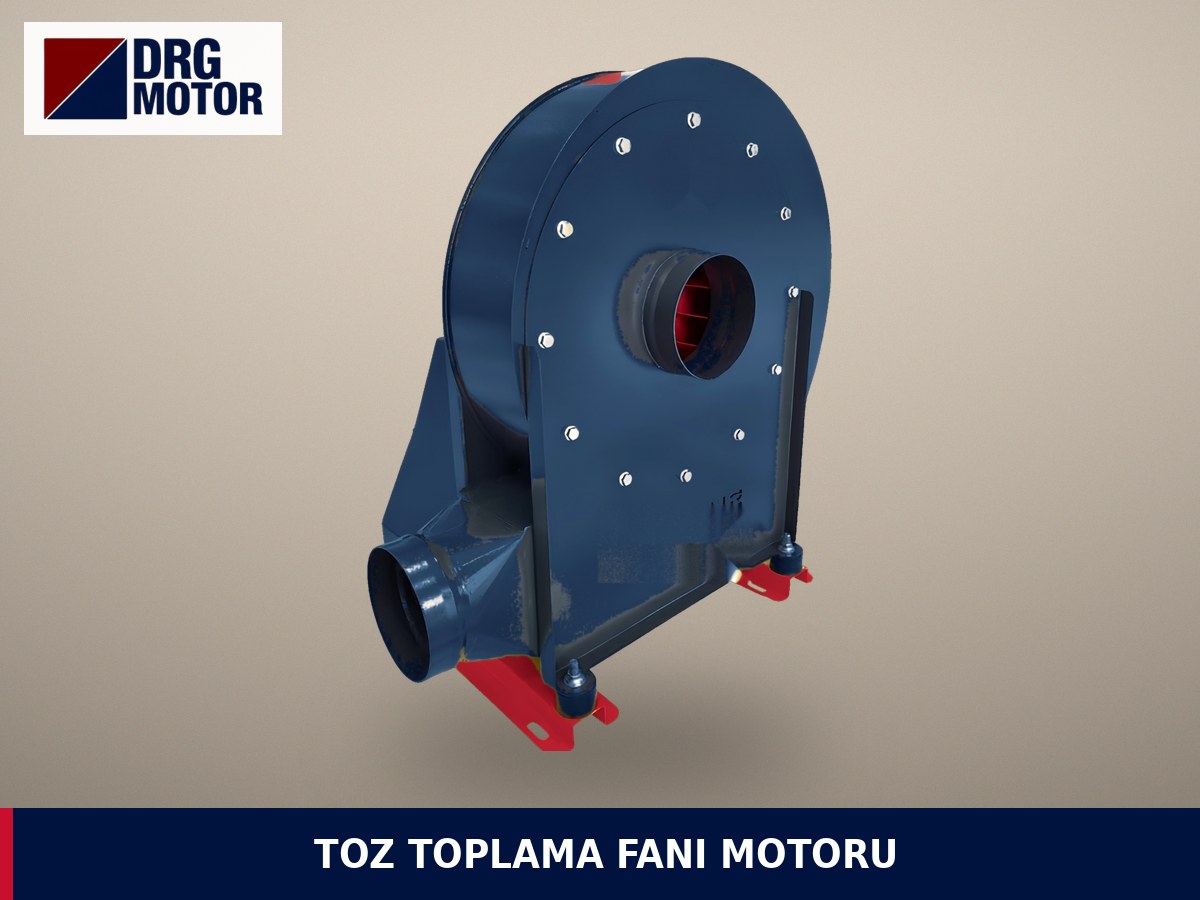
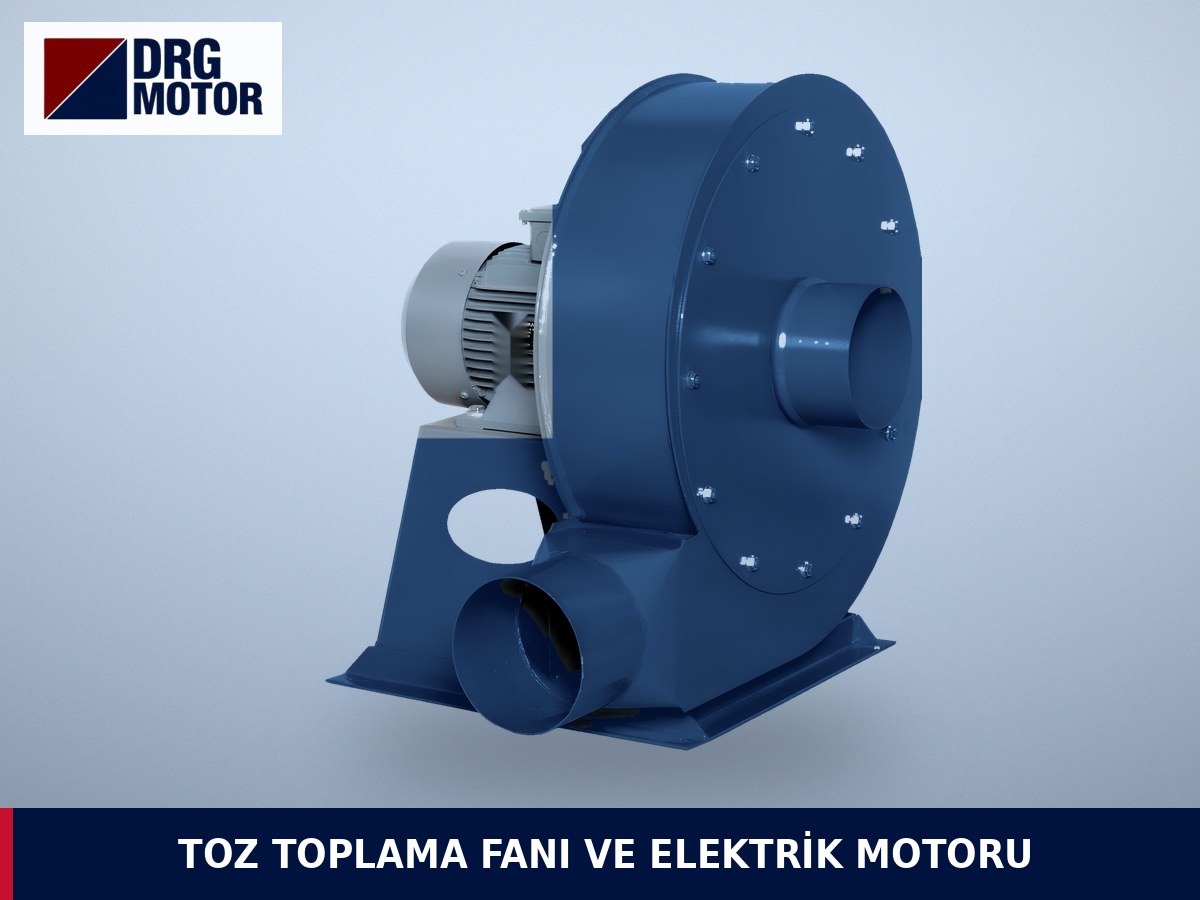
A dust collection fan motor is sized for the shaft power needed to pull the required airflow even when the filter is at its dirtiest; a calculation based on a clean filter leaves the motor too small. In the baghouse example in this article, 9,000 m³/h is drawn at a system pressure of 1,800 Pa with a clean filter and 2,750 Pa with a loaded filter; shaft power rises from 6.0 kW to 9.2 kW, and an 11 kW 2-pole DRG-160M1-2 fits (19.6 A at 400 V, 2945 rpm). You can browse suitable models among the 120 models in our online store.
Dust collection is not a fan type but a purpose: the same job is done with different centrifugal wheels. What drives the motor choice is the system more than the wheel: is the fan before or after the filter, how much does the filter load up, is there combustible dust? The panel, starting method and overload setting must be handled by a qualified electrician, and fan and filter maintenance must not start before the power is locked out.
Where does the fan sit in a dust collection system?
A typical system runs in this order: capture hoods, ductwork, a cyclone or drop-out box if needed, the bag or cartridge filter, the fan and the stack. The fan’s position is one of two options, and it also determines the wheel type.
- After the filter (clean side): The most common layout. The fan keeps the whole system under suction, so any leak draws air in rather than pushing dust out [1]. Since the fan sees filtered air, a more efficient backward inclined wheel can be used; one manufacturer notes this allows a smaller motor [2].
- Before the filter (dirty side): The fan is the first element to meet the dust and material. A self-cleaning radial bladed wheel is needed here [2]; it is preferred on lines carrying long fibres, paper or shavings.
Even on the clean side, dust reaches the fan if a filter bag tears. Build-up inside backward inclined blades causes imbalance and performance loss [4], so a filter failure is often first noticed as fan vibration.
What does the electric motor do in this system?
In both layouts the motor stays outside the airstream. On small and medium fans sitting on top of the filter, the wheel is mounted directly on the motor shaft; the fan in one manufacturer’s manual is a direct-drive unit bolted straight onto the collector’s clean-air outlet [3]. On large systems the fan stands on a separate base and the motor is connected by belts or a coupling; in that layout the fan speed can be changed with pulleys.
In direct drive the motor shaft carries the wheel weight and balance loads; the horizontal or vertical mounting type (such as B3, B5, V1) depends on the fan layout, and the exact type comes from the fan manufacturer’s drawing. In belt drive the motor is usually B3 foot-mounted on a tensioning slide rail.
Responsibilities are separate: fan selection, the fan curve, the wheel, the housing, the filter area and the duct design are the job of the filter or fan manufacturer and the design engineer. The motor supplier provides a motor that matches the given shaft power, speed, mounting type and ambient conditions.
How does the motor load change as the filter loads up?
In a baghouse, dust forms a cake on the fabric surface and air loses pressure passing through it. According to a design guide, new bags show a differential pressure of 0.5–1.5 inches of water (about 125–375 Pa) and normal operation runs at 3–5 inches of water (about 750–1,250 Pa); above 5 inches the bags are blinding [1]. When filter pressure rises, the fan has to work harder to pull the same air [1].
Example assumptions: airflow 2.5 m³/s (9,000 m³/h), hood, duct and cyclone losses 1,500 Pa; clean filter 300 Pa, loaded filter before cleaning 1,250 Pa. Assuming a fan efficiency of 0.75 and constant airflow (held by a damper or inverter), P_shaft = Q·Δp / η_fan:
| Filter condition | System pressure | Shaft power |
|---|---|---|
| Clean (new or just pulsed) | 1,800 Pa | ≈ 6 kW |
| Loaded (limit before cleaning) | 2,750 Pa | ≈ 9.2 kW |
The motor is sized for the highest load, the loaded-filter point: 9.2 kW plus about 10% margin ≈ 10.1 kW, next standard size 11 kW. Direct drive has no belt loss; in belt drive, add the belt loss as well. To try the values for your own system, use the Pump & Fan Motor Power calculator.
| Model | Power / speed | Frame · current 400 V | Price |
|---|---|---|---|
| DRG-132S1-27.5 HP | 5.5 kW · 3000 rpm | Cast iron 132S · 10.1 A | $338.72 (€302.50) Details & buy → |
| DRG-132S2-210 HP | 7.5 kW · 3000 rpm | Cast iron 132S · 13.7 A | $369.43 (€329.92) Details & buy → |
| DRG-160M-415 HP | 11 kW · 1500 rpm | Cast iron 160M · 20.4 A | $568.76 (€507.94) Details & buy → |
| DRG-160M1-215 HP | 11 kW · 3000 rpm | Cast iron 160M · 19.6 A | $527.95 (€471.49) Details & buy → |
| DRG-160L-420 HP | 15 kW · 1500 rpm | Cast iron 160L · 27.3 A | $678.13 (€605.61) Details & buy → |
| DRG-160M2-220 HP | 15 kW · 3000 rpm | Cast iron 160M · 26.5 A | $570.23 (€509.25) Details & buy → |
| DRG-160L-225 HP | 18.5 kW · 3000 rpm | Cast iron 160L · 32.5 A | $714.00 (€637.65) Details & buy → |
| DRG-180M-230 HP | 22 kW · 3000 rpm | Cast iron 180M · 38.5 A | $857.53 (€765.83) Details & buy → |
If airflow is not held constant, the picture can reverse. Right after cleaning, system resistance falls and the fan pulls more air. On a backward inclined wheel the power stops rising after a peak; on a radial bladed wheel power rises with airflow, and the clean-filter moment can be the hardest one for the motor. That is why you should ask the fan manufacturer for the shaft power at both operating points (clean and loaded).
Why don’t we quote a power range?
We did not find a single motor power range for dust collection fans in a reliable source. Power is set by application data: number of capture points and the airflow of each, duct velocity, filter type and differential pressure, cyclone loss, dust type and concentration, air temperature, altitude and drive type.
Click to see current electric motor prices and order nowSEE PRICES →
Starting: damper, heavy wheel and starting method
Dust fans often start in the morning with cold, dense air, a filter cake and loaded ducts. That is why they are started with the outlet damper closed; on a radial bladed wheel in particular, a closed damper clearly reduces the starting power. Radial wheels working on the dirty side are made of thick plate, so they are heavy and take long to accelerate.
The example DRG-160M1-2 has a starting current of 8.1 times rated: about 159 A direct-on-line. Being wound for 400/690 V, it runs in delta at 400 V and suits star-delta starting; in star the line current drops to about 53 A and starting torque to about 23.8 Nm. With the damper closed, this torque starts most fans; with the damper open there is a risk of hanging in star. Long acceleration calls for a heavy-start overload class or a soft starter; for settings see our star-delta starting and overload, fuse and contactor selection tools.
An inverter brings a specific benefit here: as the filter loads up it raises the speed to keep the velocity at the hoods constant, and lowers it when the filter is clean. In that case the motor must be sized for the loaded-filter point at the highest speed.
The motor in a dusty environment: IP protection, cooling and combustible dust
Even when the fan is on the clean side, the motor stands inside a dusty building or plant, often right next to the filter. It cools itself through its finned frame and rear fan; once the gaps between the fins fill with dust, heat cannot escape and the motor runs hot even at nameplate current. One fan manual asks for the motor ventilation openings to be kept clear and, on side mounting, for the drain hole to face down [3].
- An IP55 frame limits the ingress of dust and water jets; still clean the fins regularly.
- A bag, cardboard or pile of dust blocking the back of the fan cover cuts off cooling.
- Do not let pulse air or outdoor humidity turn dust into mud on the motor.
With combustible dusts such as wood, flour, aluminium or magnesium, the system may count as an explosive atmosphere. In that case the fan and motor must carry the relevant explosive atmosphere certification; DRG’s standard motors are not sold with this certification. For details see our explosion-proof electric motor article. Zone classification is the job of the plant owner and a qualified engineer.
What changes by application?
- Stone crushing and screening: abrasive silica dust; cyclone + baghouse is common, and keeping the fan on the clean side extends wheel life.
- Woodworking: chips and shavings are bulky; dirty-side radial fans are common, and combustible dust risk must be assessed.
- Metal grinding: sparks can reach the filter; a spark arrester and regular bag checks are needed.
- Blasting: high dust load and frequent cleaning; filter pressure rises fast, so size the motor for the loaded point.
- Foundry: hot, dusty gas; the fan is chosen for the temperature and the motor is kept away from the hot zone.
Motor selection checklist and DRG match
- Fan data sheet: airflow, total pressure with clean and loaded filter, fan speed, shaft power at both points
- Fan position: before or after the filter
- Drive: direct (wheel on the motor shaft) or belt/coupling
- Old motor nameplate: kW, rpm, frame, mounting type, shaft diameter
- Dust type: abrasive, combustible
- Starting: direct-on-line, star-delta, soft starter or inverter
- Ambient temperature and motor location
DRG range: aluminium frames 0.25–11 kW, cast iron frames 0.55–355 kW; 1000, 1500 and 3000 rpm; 3-phase, 230/400 V or 400/690 V; mounting B3, B5, B14 and B35 by order note. A match is made when the fan’s power and speed fall within this range; 2- and 4-pole models stand out for collector-mounted fans, and their current prices are in the price table above. Specifications of the example motor:
- Power: 11 kW
- Rated speed: 2945 rpm
- Current 400 V: 19.6 A
- cos φ: 0.89
- Rated torque: 35.7 Nm
- Starting current Is/In: 8.1
- Shaft D × E: 42 × 110 mm
- Bearing: 6309-C3
For dimensions see the technical drawings page, and for general information our Fan Motors page. Belts and the fan laws are covered in our industrial fan and extractor motor article.
DRG motors for dust collector fans
- DRG-132S2-2 – 7.5 kW – 2930 rpm – 132S cast iron
- DRG-160M1-2 – 11 kW – 2945 rpm – 160M cast iron
- DRG-160M-4 – 11 kW – 1465 rpm – 160M cast iron
- DRG-160M2-2 – 15 kW – 2945 rpm – 160M cast iron
- DRG-180M-2 – 22 kW – 2955 rpm – 180M cast iron
Click to see current prices and order these motors nowSEE PRICES →
Dust collector fan motor: FAQ
How many kW should a dust collection fan be?
There is no fixed value; airflow and total pressure with a loaded filter decide it. In the example, 9,000 m³/h at 2,750 Pa gave about 9.2 kW shaft power and an 11 kW motor was chosen.
Why does a dust collection fan pull less over time?
The filter cake pressure rises and the fan pulls less air. Watch the differential pressure gauge; if pressure does not drop after cleaning, the bags may be blinded. A bigger motor does not fix the root cause.
Why does the filter fan motor run hot?
The most common causes are dust packed between the fins, a blocked fan cover and a motor sized for the clean-filter point. Clean the frame first, then compare the running current with the nameplate current.
How many amps does an 11 kW dust collection fan motor draw?
The DRG-160M1-2 draws 19.6 A and the DRG-160M-4 draws 20.4 A rated current at 400 V. Direct-on-line starting current is 7.7–8.1 times rated.
Send us the fan nameplate, the filter’s differential pressure and the old motor’s nameplate, and we will confirm the right DRG model together: phone +90 (542) 666 11 11, e-mail [email protected], contact page. For all models and current prices: Buy Electric Motors Online.
Sources
- CED Engineering – Design and Sizing of Baghouse Dust Collectors (D06-005) – baghouse differential pressure: new bags 0.5–1.5 in WC, operation 3–5 in WC, above 5 in WC blinding; fan usually after the filter
- Chicago Blower – Dust Collection Application Brochure – radial bladed fan on the dirty side handling the material first; backward inclined fan on the clean side with a smaller motor
- Donaldson Torit – Radial Blade Fan (TRB) Installation and Operation Manual – direct-drive fan mounted on the collector’s clean-air outlet; keeping motor ventilation openings clear, drain hole facing down
- U.S. DOE – Improving Fan System Performance: A Sourcebook for Industry – contaminant build-up on backward inclined blades, imbalance and performance loss


