 English
 Le français
 Türkçe

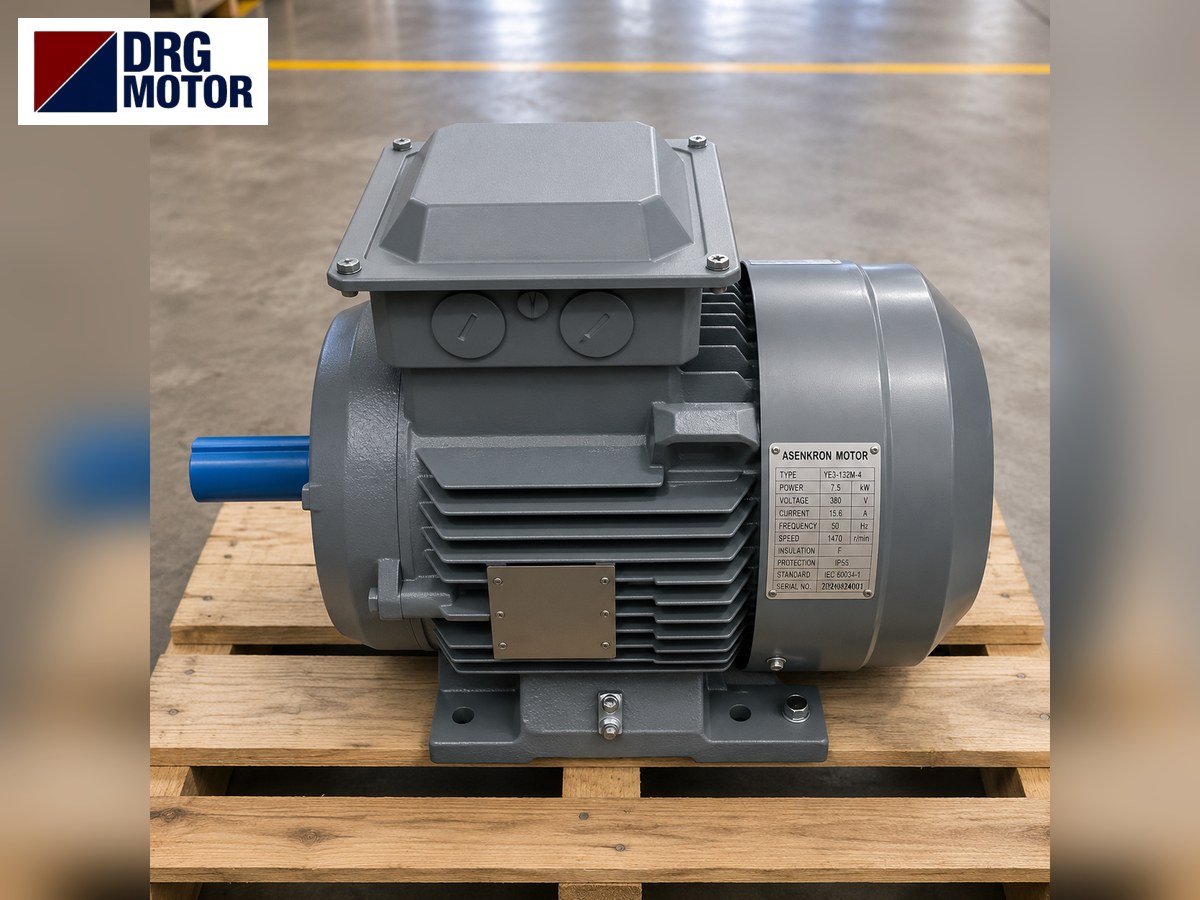
A concrete block and paver machine has no single motor; one line holds about a dozen, from the mixer preparing the concrete to the pallet system taking product to the curing area. The mixer motor mixes the concrete, belts and screws carry material, the hydraulic unit motor turns the pump driving mould and tamper head, the vibration drive compacts concrete in the mould, and chain and pallet drives take product out of the machine. Maker catalogues show 11–37 kW for the mixer, 11–55 kW for a single hydraulic pump motor and 5.5–7.5 kW per motor for the vibration drive.
DRG Motor is a manufacturer, supplier and seller of electric motors. We do not sell block machines, moulds, mixer pans, gearboxes, hydraulic units, pumps, vibration motors or inverters in our shop; our role is the electric drive itself, a three-phase squirrel-cage unit for each of these duties. The models are on Buy Electric Motors Online. Torque and power sizing of the hydraulic pump motor is a separate subject and is covered in our block machine hydraulic pump motor article; this page looks at all the motors of the machine.
Motors on a block line: from raw material to the curing area
The flow runs like this: belts from aggregate bins feed the weigher and mixer, cement comes from the silo by screw; the mixer prepares the concrete and a transfer belt carries it to the hopper above the machine. The feed box fills the mould, vibration and the tamper head compact the product, the mould lifts and the product on its pallet is taken out by the exit chain. Pallets then go to the stacker (elevator) and curing chamber; product returning from curing is taken off the pallet and packed.
Mixer: planetary, twin-shaft and pan type
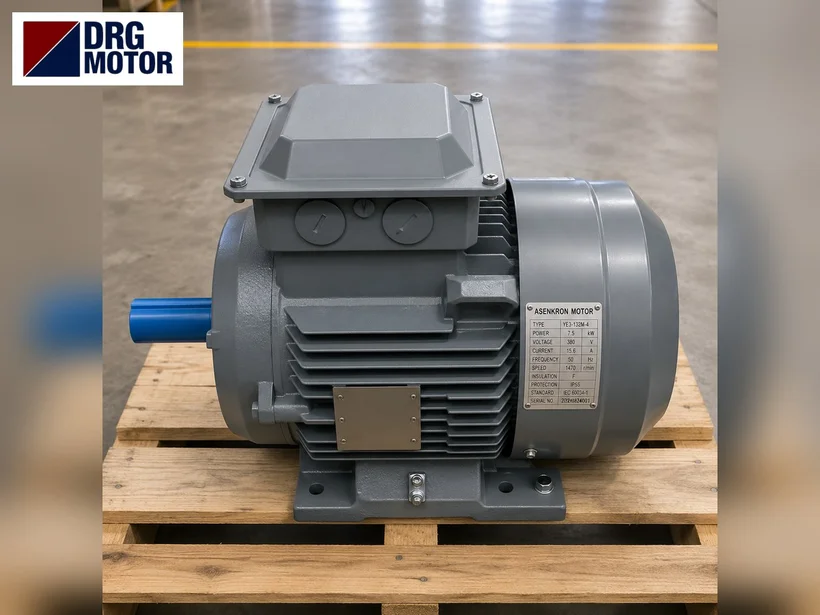
Block concrete is dry and stiff, so the mixer motor works hard. In a planetary mixer the mixing arms turn about their own axis and around the pan axis; in a counter-current pan mixer pan and arms turn in opposite directions; in a twin-shaft mixer two horizontal shafts knead the concrete with paddles. The first maker lists an 11 kW geared motor for a 0.3 m³ mixer and 37 kW for a 0.75 m³ mixer. The mixer motor’s hardest moment is restarting a pan left full after a power cut or fault.
Belts, screw and transfer
Aggregate, sand and grit belts and transfer and switch belts run on geared motors; the first maker gives 1.1–11 kW per belt, and on a large plant 7.5 kW for the aggregate bin belt and 7.2 kW for the cement screw. Dust and damp aggregate soon foul the fan cowls of these motors.
Main machine: hydraulics, vibration and exit
On the main machine the hydraulic unit feeds the cylinders that lift the mould and lower the tamper head. The motor turns the pump; an example of finding power from pump layout and pressure phases is in our article 5570, and the general flow-pressure calculation in the hydraulic pump motor kW calculation. Catalogues show single pump motors of 11, 22, 37 and 55 kW; large machines run two pump motors together.
Vibration: vibration motor or vibrator box with a standard motor?
Mould table vibration is produced in two ways. In the first, vibration motors with unbalanced weights bolt directly under the table; these are a separate product group and must not be confused with a standard motor, see our vibration motors page. In the second, a vibrator box with unbalanced shafts inside is turned by a standard motor through a belt or coupling. The direct-driven twin-shaft oil bath vibrator in the third maker’s data sheet turns with 2 × 7.5 kW motors, the motors have forced air cooling and the vibration frequency is set by inverter. The power makers give for vibration does not always state the motor type: look at the plate of your motor and how it is attached to the table.
Exit chain, pallets and stacking
The product exit chain is 1.1 and 2.2 kW at the first maker. Pallet feed, stacker (green product elevator), finger car and the return line from curing also have geared motors and hydraulic units. We found no reliable catalogue values for these, so we give no figures. The motor is chosen from application data: pallet and product weight, number of levels, lift speed, cycle time and the old motor’s plate are needed.
Click to see current electric motor prices and order nowSEE PRICES →
How many kW is a block machine motor? Catalogue values
A) Figures block and paver machine builders print for each drive:
| Machine / unit | Motor power | Single / total | Note |
|---|---|---|---|
| Semi-automatic machine: 0.3 m³ mixer | 11 kW | single geared motor | first maker, small model |
| Fully automatic machine: 0.75 m³ mixer | 37 kW | single geared motor | first maker, large model |
| Hydraulic unit motor | 11 / 22 kW | single motor | first maker, small / large model |
| Hydraulic power unit, large machines | 55+15 … 45+45 kW | two pump motors | second maker, three models |
| Hydraulic power pack pump motor | 37 kW | single motor | third maker’s data sheet |
| Main vibration drive | 2 × 5.5 / 4 × 7.5 kW | per motor; multiply by count | first maker |
| Direct-driven twin-shaft vibrator box | 2 × 7.5 kW | per motor | third maker, speed by inverter |
| Vibration total, large machines | 60 / 90 / 118 kW | machine total | second maker |
| Top (tamper) vibration | 2 × 0.47–0.9 kW; option 8 kW | per motor / total | first, third, second maker |
| Product exit chain | 1.1 / 2.2 kW | single motor | first maker |
| Material and transfer belts | 1.1–11 kW | per belt | first maker |
| Aggregate bunker belt / cement screw | 7.5 / 7.2 kW | single motor | first maker, large plant |
Depending on model and capacity, the mixer takes roughly 11–37 kW, a single hydraulic pump motor 11–55 kW, the vibration drive 5.5–7.5 kW per motor and belts and chains 1.1–11 kW. Machine totals differ widely: the motors listed for the first maker’s semi-automatic model add up to about 47 kW, whereas on large machines the vibration drive alone reaches 118 kW. Do not read the plant’s total installed power as one motor.
B) Where DRG fits: mixer, hydraulic, belt, screw and chain motors from 1.1 to 55 kW all match our 4-pole 90S to 250M frames; a motor can also be chosen for vibrator boxes turned by a standard motor, with the pole count set by the vibration speed the machine maker wants. Vibration motors bolted straight to the table are not in our shop; in that case contact us for a quote.
Worked example: line current and mixer starting
Take the standard motors of the first maker’s semi-automatic machine with their equivalents in our range: mixer and hydraulics each get a DRG-160M-4 (11 kW, 20.4 A, starting ratio 7.7), both 5.5 kW belts a DRG-132S-4 (10.7 A, ratio 7.9), and the 1.1 kW belt plus exit chain a DRG-90S-4 (2.48 A, ratio 6.8). Vibration motors are added separately from their plates:
| Case | Operation | Current (400 V) | Comment |
|---|---|---|---|
| Rated current of six standard motors | 20.4 + 20.4 + 10.7 + 10.7 + 2.48 + 2.48 | about 67 A | vibration motors excluded |
| Loaded mixer, direct-on-line start | 20.4 × 7.7 | about 157 A | DRG-160M-4, Is/In 7.7 |
| Mixer start while the line runs | 67.2 − 20.4 + 157.1 | about 204 A | worst moment |
| Everything started DOL together | current × Is/In, summed | about 517 A | case to avoid |
| Mixer torque if started in star | 2.2 / 3 | about 0.73 × rated torque | may not turn a full pan |
Two points follow. First, motors should be switched on in sequence; starting them all direct-on-line at once strains the supply for nothing. Second, the hydraulic pump can start unloaded and so suits star-delta, but the torque left in star (one third of the 2.2 Ts/Tn of DRG-160M-4) may not be enough for a full mixer. For the mixer, an operating routine that never stops it full, a soft starter or an inverter is preferred. See our star-delta starting page, and for mixer motor principles in general our concrete mixer motor article.
Brakes, single phase and items outside our range
The stacker elevator and pallet lifts may need a brake motor to hold the load; since we offer no brake motors, those lifts keep the braking arrangement chosen by the machine builder. Single-phase motors on small site-type block machines and servo motors in robotic packing are not in our product line either.
DRG motors for block and paver lines
Our models matching mixer, hydraulic, belt and chain ratings on the line (current at 400 V); the 2-pole model in the last row is an option for a vibrator box turned by a standard motor:
| Model | Power / speed | Frame · shaft D×E | Current 400 V |
|---|---|---|---|
| DRG-90S-4 | 1.1 kW / 1445 rpm | 90S cast iron · 24×50 | 2.48 A |
| DRG-100L2-4 | 3 kW / 1450 rpm | 100L cast iron · 28×60 | 6.02 A |
| DRG-132S-4 | 5.5 kW / 1460 rpm | 132S cast iron · 38×80 | 10.7 A |
| DRG-132M-4 | 7.5 kW / 1460 rpm | 132M cast iron · 38×80 | 14.3 A |
| DRG-160M-4 | 11 kW / 1465 rpm | 160M cast iron · 42×110 | 20.4 A |
| DRG-180L-4 | 22 kW / 1470 rpm | 180L cast iron · 48×110 | 39.7 A |
| DRG-225S-4 | 37 kW / 1485 rpm | 225S cast iron · 60×140 | 66.1 A |
| DRG-132S2-2 | 7.5 kW / 2930 rpm | 132S cast iron · 38×80 | 13.7 A |
DRG builds three-phase IEC induction motors in IP55: up to 11 kW in aluminium and from 0.55 up to 355 kW in cast iron, at nominal 1000, 1500 or 3000 rpm, for foot, flange, combined or vertical mounting. Cast iron frames are preferred for motors standing on a vibrating base. When a block line motor is swapped, plate data, shaft and key, feet or flange and the pulley or coupling half are matched against the machine documents first; we confirm the fit with you once the measurements are in. Dimensions are on the technical drawings page.
Live price table
Prices of models suited to the standard motor ratings on a block line are pulled live from the shop:
| Model | Power / speed | Frame · current 400 V | Price |
|---|---|---|---|
| DRG-90S-41.5 HP | 1.1 kW · 1500 rpm | Cast iron 90S · 2.48 A | $124.09 (€110.82) Details & buy → |
| DRG-132S-47.5 HP | 5.5 kW · 1500 rpm | Cast iron 132S · 10.7 A | $342.01 (€305.44) Details & buy → |
| DRG-132M-410 HP | 7.5 kW · 1500 rpm | Cast iron 132M · 14.3 A | $394.89 (€352.66) Details & buy → |
| DRG-132S2-210 HP | 7.5 kW · 3000 rpm | Cast iron 132S · 13.7 A | $369.43 (€329.92) Details & buy → |
| DRG-160M-415 HP | 11 kW · 1500 rpm | Cast iron 160M · 20.4 A | $568.76 (€507.94) Details & buy → |
| DRG-180L-430 HP | 22 kW · 1500 rpm | Cast iron 180L · 39.7 A | $919.45 (€821.13) Details & buy → |
| DRG-200L-440 HP | 30 kW · 1500 rpm | Cast iron 200L · 53.8 A | $1,235.00 (€1,102.93) Details & buy → |
| DRG-225S-450 HP | 37 kW · 1500 rpm | Cast iron 225S · 66.1 A | $1,527.18 (€1,363.87) Details & buy → |
DRG MOTOR motors are guaranteed against material and manufacturing defects for 2 years from the delivery date (warranty certificate).
Motors in this power range
- DRG-132S-4 – 5.5 kW – 1460 rpm – 132S cast iron
- DRG-132M-4 – 7.5 kW – 1460 rpm – 132M cast iron
- DRG-160M-4 – 11 kW – 1465 rpm – 160M cast iron
- DRG-200L-4 – 30 kW – 1475 rpm – 200L cast iron
- DRG-225S-4 – 37 kW – 1485 rpm – 225S cast iron
Click to see current prices and order these motors nowSEE PRICES →
Browse the products, ask for a quote: motors for your block line are on Buy Electric Motors Online. Send plate photos of the line’s motors in one WhatsApp message, or call +90 (542) 666 11 11 and tell us whether the machine is fully or semi-automatic.
Frequently asked questions
Which is the strongest motor on a block machine?
On small machines mixer and hydraulic motors are often the same size; on large ones the vibration total and the hydraulic unit move ahead. The exact order is in the machine’s motor list.
What should I check when replacing a motor on a paver machine?
Plate power and speed, frame and mounting, shaft and pulley size; on motors standing on the vibrating frame, the fixing method should not change either.
What does the price of a block machine motor depend on?
Rating, pole number and frame; the table above comes from shop data.
Contact: +90 (542) 666 11 11 · info@drgmotor.com · contact page.


