 English
 Le français
 Türkçe

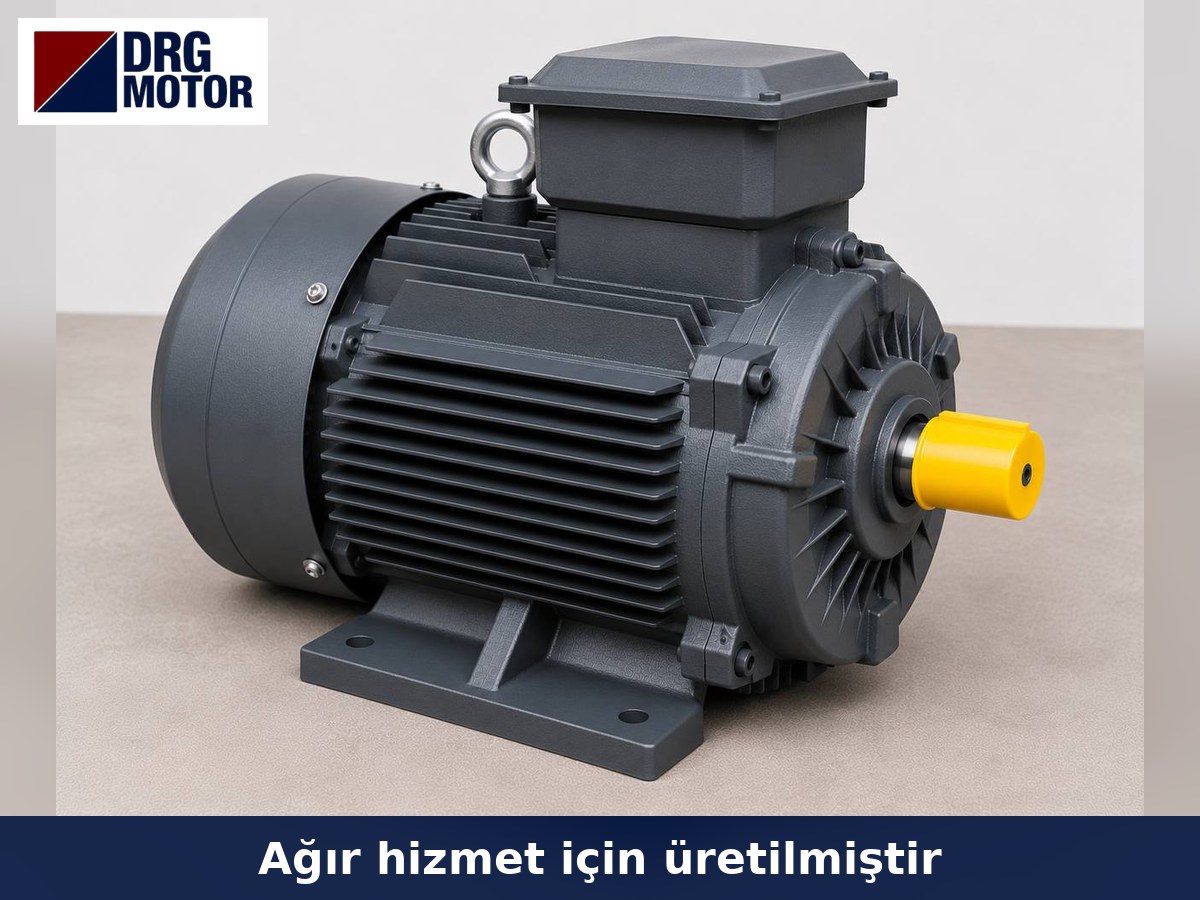
A bone saw cuts bone-in meat and frozen blocks with a band blade in butcher shops and meat rooms; its motor turns the lower wheel that carries the blade. A bone crusher breaks bones with a knife or hammer rotor in slaughterhouses and in bone meal, gelatin and bone broth production; here the motor carries a heavy rotor and its inertia. Both handle the same raw material, but on very different power scales: maker catalogues list 0.75–4 kW for band saws and 3–75 kW for bone crushers.
DRG Motor is a manufacturer, supplier and seller of electric motors. We do not sell the saw or crusher itself, blades and knives, screens, gearboxes or speed drives. We supply the three-phase asynchronous motor that turns the wheel or the rotor; the options are in the Buy Electric Motors Online section.
Bone saw: wheel, blade and motor
A bone band saw has two wheels: the upper tensioning wheel and the lower drive wheel. The motor usually sits behind the lower wheel in the closed compartment of the frame, with the wheel mounted directly on the motor shaft. As blade length and wheel diameter grow, cutting height and motor power grow too. In one maker’s series, the small machine with a 1650 mm blade runs on 1.1 kW, while the large one with a 3160 mm blade uses 2.2 kW.
Why blade speed matters
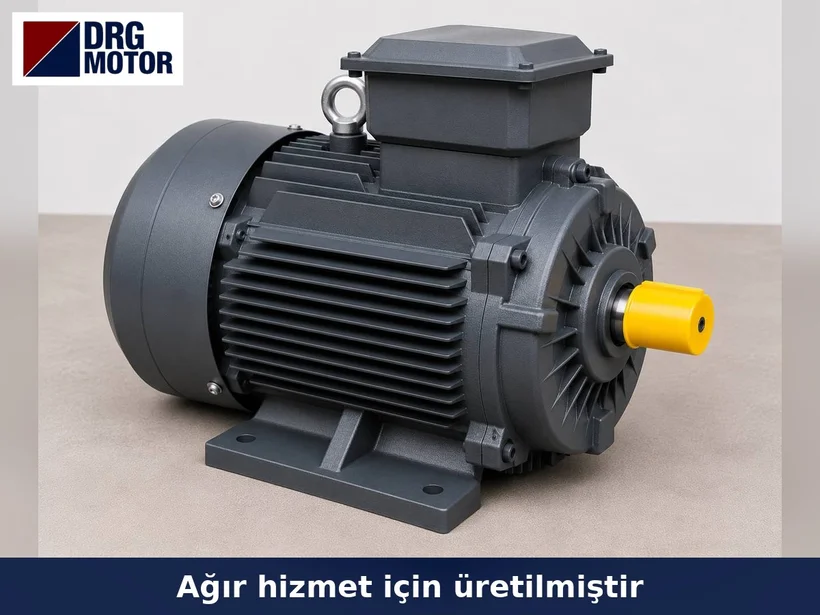
Clean cuts in fresh meat and frozen blocks depend on the blade running at a given speed. One maker’s sheet gives 16 m/s on a machine with a 211 mm wheel and 22.6 m/s with a 300 mm wheel. These figures match exactly if the wheel turns at the speed of a 4-pole motor (calculation below). On a bone saw, then, the motor’s pole number is the blade speed.
Stopping, door switch and brake
After the motor is switched off, the blade keeps running for a while on the inertia of the wheels. Fast stopping when the door opens or the emergency stop is pressed is wanted for operator safety. Machines solve this in different ways: one sheet lists an electronic brake and a 24 V low-voltage safety circuit, while some machines use a brake motor. Brake motors are not in our range. When our standard motor is fitted, stopping stays with an electronic brake in the panel or the machine’s mechanical brake; this arrangement must follow the machine maker’s safety scheme.
Bone crushing and grinding machines
In a bone crusher, bone is broken between a slow rotor with hardened knives and fixed counter-knives; the pieces go on to bone meal, gelatin raw material, broth or pet food lines. For a finer product, a hammer mill or a second grinder follows the crusher. There are also large pre-crushers that take bone and carcass parts together from slaughterhouse waste; one maker’s two models reach up to 10 tonnes per hour with 45 and 75 kW motors.
Knife, hammer and roller types
A knife (claw) crusher splits large bones into coarse pieces and runs slowly; its motor is usually connected through a gearbox or belt. The hammer type reduces coarse bone to a size that passes the screen and runs fast; with its heavy rotor, run-up time is long, see our hammer mill motor article. Roller crushers use two rolls turning towards each other. We found no reliable catalogue value for roller types, so the power choice follows the application data: bone type (cattle, poultry, fish), fresh or dry, hourly amount, output size and, if any, the old motor’s plate values.
How many kW for bone saw and crusher motors? Catalogue values
A) What the makers publish for bone saws and bone crushers:
| Machine / model | Motor power | Single / total | Note |
|---|---|---|---|
| Band saw, 1650 mm blade | 1.1 kW (single-phase version 0.9 kW) | single motor | first maker, 208 mm wheel |
| Band saw, 2460 mm blade | 1.5 kW | single motor | first maker, 320 mm wheel |
| Band saw, 3160 mm blade | 2.2 kW | single motor | first maker, 420 mm wheel |
| Band saw, 400 mm wheel | 2.2 kW; 3 or 4 kW on request | single motor | second maker, three-phase |
| Band saw, 211–300 mm wheels | 0.75–2.2 kW | single motor | third maker, blade speed 16–22.6 m/s |
| Bone crusher, small model | 4 kW | single motor | fourth maker, 100–200 kg/h |
| Bone crusher, mid models | 15–22 kW | single motor | fourth maker |
| Bone crusher, largest model | 75 kW | single motor | fourth maker, 3–6 t/h |
| Bone and carcass pre-crusher | 45 kW / 75 kW | single motor | fifth maker, two models |
| Coarse crusher (bone meal) | 3–11 kW | single motor | sixth maker, shaft 650 rpm |
From the table, bone saws use about 0.75–4 kW depending on model and blade length, and bone crushers 3–75 kW depending on capacity. Every saw has a single motor; the crusher values also show the single rotor motor, and auxiliary motors such as a feed belt or elevator are not included. For small saws, catalogues also list a single-phase version of the same model.
B) Overlap with the DRG range: 0.75–4 kW saw motors are available in our 80–112M frames and 3–75 kW crusher motors in 100L–280S frames; the whole span is covered. Single-phase versions, however, are outside our range; if you need a motor for a small saw on a 230 V single-phase supply, the models on this page can only be used where the shop has a three-phase line and the machine panel is changed accordingly. The details are in the three-phase versus single-phase comparison.
Click to see current electric motor prices and order nowSEE PRICES →
Worked example: blade speed from wheel diameter
Blade speed is v = π × D × n / 60 (D in metres, n in rpm). Let us use the wheel diameters from the third maker’s sheet with the plate speeds of 4-pole motors from our range; the last row shows what happens if a 2-pole motor is fitted to the same wheel by mistake:
| Wheel / motor | Calculation | Blade speed | Comment |
|---|---|---|---|
| 211 mm · DRG-90S-4 | π × 0.211 × 1445 / 60 | ≈ 16 m/s | matches the 16 m/s on the sheet |
| 250 mm · DRG-90S-4 | π × 0.25 × 1445 / 60 | ≈ 18.9 m/s | matches the 18.8 m/s on the sheet |
| 300 mm · DRG-100L1-4 | π × 0.3 × 1450 / 60 | ≈ 22.8 m/s | matches the 22.6 m/s on the sheet |
| 211 mm · DRG-90L-2 | π × 0.211 × 2895 / 60 | ≈ 32 m/s | doubles, not to be used |
So on these saws the motor shaft carries the lower wheel itself, and the motor is a 4-pole one. A 2-pole motor would push the blade to about 32 m/s; the blade, its weld and the wheel bearings are not designed for that. On replacement, pole number and speed must match the old motor plate exactly.
Starting current on a large bone crusher
Consider the fifth maker’s 45 and 75 kW models with their 4-pole counterparts from our range. If a heavy-rotor crusher is started direct on line, the starting peak lasts a long time:
| Motor | Rated current 400 V | Direct-on-line peak | Star-delta, star step |
|---|---|---|---|
| 45 kW · DRG-225M-4 | 80.2 A | 80.2 × 7.4 ≈ 593 A | ≈ 198 A |
| 75 kW · DRG-280S-4 | 129 A | 129 × 6.9 ≈ 890 A | ≈ 297 A |
With star-delta starting, current and torque on the star step are a third of direct-on-line values. The DRG-225M-4 has a rated torque of 289.4 Nm and a starting torque of 2 times that; in star this drops to a third as well. The crusher should therefore start with an empty chamber, and bone should be fed only after the motor reaches full speed. If starting with a full chamber is needed, a soft starter or drive is considered. You can compare the methods in our star-delta tool.
Bone dust, fat, water and protecting the motor
A running saw produces fine bone dust and greasy sawdust; on a crusher line there is bone broth and wash water. Our motor is a standard IP55 industrial motor with a painted cast iron or aluminium frame and does not touch the product. On the saw it sits in the closed compartment of the frame, on the crusher on the base beside the rotor, outside the product flow. During daily cleaning no pressure jet is aimed at the motor; greasy dust is wiped from the fan cover, since a clogged cover lets the winding heat up under an unchanged load. Where the wet zone is hosed down directly and the plant asks for a stainless steel motor, we cannot offer one; contact us to discuss the layout.
DRG motors for bone processing
Our 4-pole models matching saw and crusher powers:
| Model | Power / speed | Frame · shaft D×E | Current 400 V |
|---|---|---|---|
| DRG-90S-4 | 1.1 kW / 1445 rpm | 90S cast iron · 24×50 | 2.48 A |
| DRG-90L-4 | 1.5 kW / 1445 rpm | 90L cast iron · 24×50 | 3.3 A |
| DRG-100L1-4 | 2.2 kW / 1450 rpm | 100L cast iron · 28×60 | 4.52 A |
| DRG-112M-4 | 4 kW / 1450 rpm | 112M cast iron · 28×60 | 7.95 A |
| DRG-160M-4 | 11 kW / 1465 rpm | 160M cast iron · 42×110 | 20.4 A |
| DRG-180L-4 | 22 kW / 1470 rpm | 180L cast iron · 48×110 | 39.7 A |
| DRG-225M-4 | 45 kW / 1485 rpm | 225M cast iron · 60×140 | 80.2 A |
| DRG-280S-4 | 75 kW / 1486 rpm | 280S cast iron · 75×140 | 129 A |
On a saw, the motor shaft goes into the wheel hub, so shaft diameter and length, keyway and flange size must match the old motor; flange mounting (B5 or B14) is common on these machines. On a crusher, a foot-mounted (B3) motor connects by belt or coupling. For saw powers the light aluminium frame (to 11 kW) fits well, while crusher motors are usually cast iron (our cast iron range reaches 355 kW); 2, 4 and 6-pole versions are offered. Send us photos showing the old motor plate, shaft end and flange together with the machine documents; we check suitability with that information and do not promise an exact fit without dimensions.
Live price table
Prices for models in bone saw and crusher power ranges are pulled from the store:
| Model | Power / speed | Frame · current 400 V | Price |
|---|---|---|---|
| DRG-90S-41.5 HP | 1.1 kW · 1500 rpm | Cast iron 90S · 2.48 A | $124.09 (€110.82) Details & buy → |
| DRG-90L-42 HP | 1.5 kW · 1500 rpm | Cast iron 90L · 3.3 A | $144.14 (€128.73) Details & buy → |
| DRG-100L1-43 HP | 2.2 kW · 1500 rpm | Cast iron 100L · 4.52 A | $188.32 (€168.18) Details & buy → |
| DRG-112M-45.5 HP | 4 kW · 1500 rpm | Cast iron 112M · 7.95 A | $254.38 (€227.18) Details & buy → |
| DRG-132M-410 HP | 7.5 kW · 1500 rpm | Cast iron 132M · 14.3 A | $394.89 (€352.66) Details & buy → |
| DRG-160L-420 HP | 15 kW · 1500 rpm | Cast iron 160L · 27.3 A | $678.13 (€605.61) Details & buy → |
| DRG-225M-460 HP | 45 kW · 1500 rpm | Cast iron 225M · 80.2 A | $1,688.50 (€1,507.94) Details & buy → |
| DRG-280S-4100 HP | 75 kW · 1500 rpm | Cast iron 280S · 129 A | $2,916.93 (€2,605.00) Details & buy → |
DRG MOTOR motors are guaranteed against material and manufacturing defects for 2 years from the delivery date (warranty certificate).
Motors in this power range
- DRG-90S-4 – 1.1 kW – 1445 rpm – 90S cast iron
- DRG-100L1-4 – 2.2 kW – 1450 rpm – 100L cast iron
- DRG-160M-4 – 11 kW – 1465 rpm – 160M cast iron
- DRG-225M-4 – 45 kW – 1485 rpm – 225M cast iron
- DRG-280S-4 – 75 kW – 1486 rpm – 280S cast iron
Click to see current prices and order these motors nowSEE PRICES →
Browse the products, ask for a quote: motor options for your saw or crusher are listed on the Buy Electric Motors Online page. Add the blade length and wheel diameter for a saw, or the hourly bone amount for a crusher, to a WhatsApp message; our line +90 (542) 666 11 11 is also open.
Frequently asked questions
What speed should a bone saw motor have?
In the sheets we reviewed, the wheel turns directly at 4-pole motor speed. The exact value is on the old motor plate; changing the pole number changes the blade speed.
Does a bone crusher need a drive?
Not necessarily; a crusher that starts empty can run on star-delta. A drive helps if starting with a full chamber, reversing on a jam or speed adjustment is wanted.
Where do I see the bone saw motor price?
Prices for 1.1–4 kW saw motors appear in the live block above, refreshed from our store.
Contact: +90 (542) 666 11 11 · info@drgmotor.com · contact page.


