 English
 Le français
 Türkçe

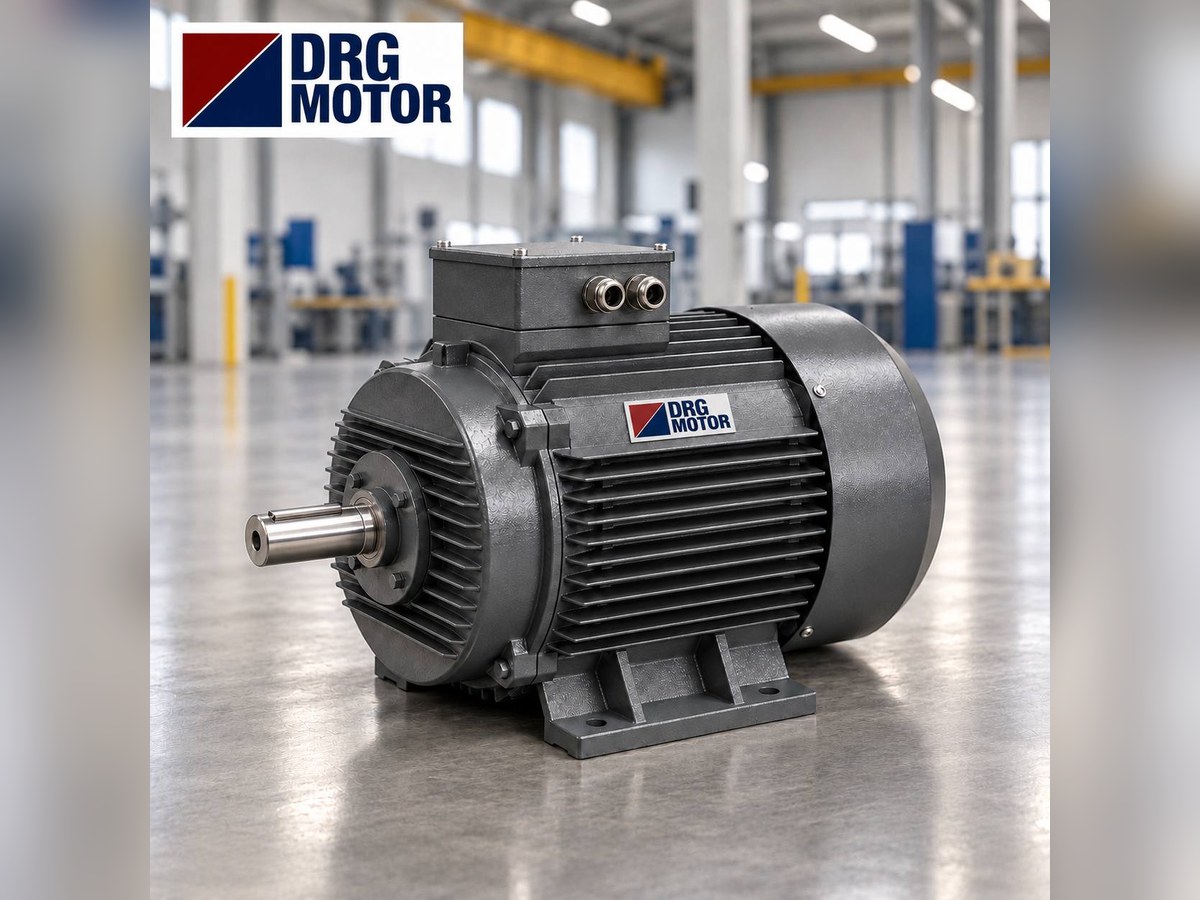
A screw compressor motor is the three-phase induction machine driving the oil-injected or oil-free screw block (the air end). The air end and working pressure set the motor power; the drive arrangement between motor and air end sets its speed. On this page we sort the motors used in screw compressors by drive type, give the market power range from manufacturers' catalogues and show the matching DRG motors with their prices.
DRG Motor does not sell screw compressors; what we sell is the electric motor that turns your compressor's air end. If you are looking for a motor for an existing compressor, the selection steps and live price table below will speed things up.
Where the motor sits in a screw compressor
The heart of a screw compressor is the air end, a pair of meshing male and female rotors. Air entering through the inlet valve is squeezed in the rotor cavities and leaves with the oil towards the separator tank. The electric motor is tied to the input shaft of this unit and holds the rotors at a steady speed for as long as the compressor runs.
The drive type sets motor speed
The motor speed is decided jointly by the design speed of the air end and the transmission in between. There are three basic arrangements:
| Drive type | What sets motor speed? | Flexibility on replacement | Typical mounting |
|---|---|---|---|
| Belt and pulley | Ratio of pulley diameters | Can be tuned by pulleys | B3 on a slide rail |
| Gearbox | Fixed gear ratio | Pole count is kept | B35 / B5 on the gear case |
| Direct coupling / flange | Air-end speed = motor speed | Poles and flange kept as is | B35 / B5 with bell housing |
Belt and pulley arrangement
This is the most common layout at small and medium power. In manufacturers' catalogues a good share of the compact series are belt driven. The motor stands on its feet on a slide rail and belt tension is set by moving the motor. Thanks to the pulley ratio, one air end can be run at different speeds for different pressure options.
Gear or direct arrangement
At medium and high power, manufacturers prefer a gearbox or a direct coupling. One catalogue states that its 15–30 kW models are gear driven, while its large fixed-speed models use an enclosed drive with no coupling. In these designs the motor sits by its flange on the housing or a bell adapter and tolerances are tight.
Why the old motor's plate is the first step on replacement
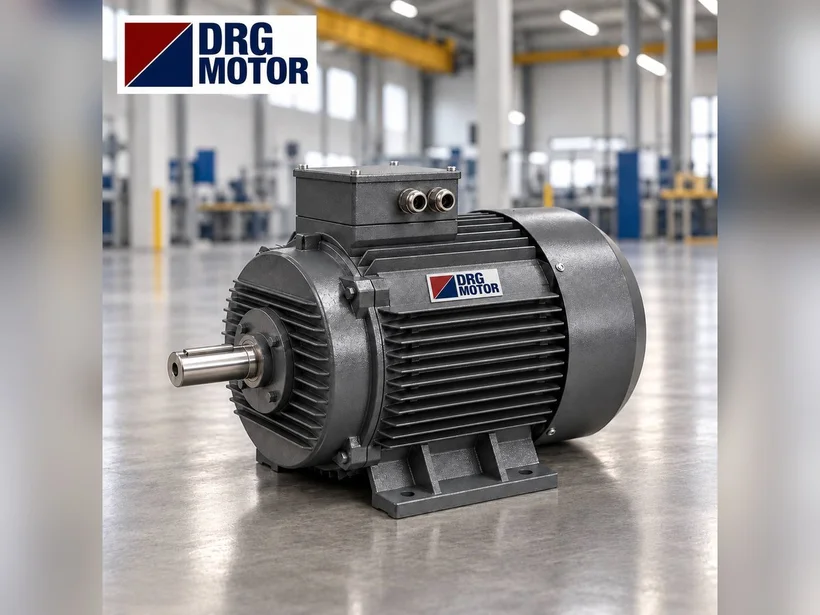
When replacing a motor on a screw compressor, the plate of the motor coming out is the most reliable reference. Its kW, rated speed and current are the values the compressor maker intended for that air end. Frame number, mounting form, shaft diameter and flange size then show whether the new motor will fit.
What to read from the plate
Note power, speed, voltage and connection (Δ, Y or Δ/Y), rated current, IEC frame and mounting type. On a flange motor measure the flange outer diameter and bolt circle; on a belt drive measure the pulley diameter and groove count. Before removal, photograph which way the terminal box faces; cable length inside the canopy is often short.
If the plate cannot be read
If heat or oil has made the plate unreadable, the compressor's own label and manual will guide you. The manual usually lists the main motor power and often its speed. Shaft and flange dimensions should still be confirmed with a caliper on the removed motor.
Click to see current electric motor prices and order nowSEE PRICES →
2-pole or 4-pole?
Screw compressors are found with 2-pole (about 3000 rpm) or 4-pole (about 1500 rpm) main motors. Which one is used depends on the air end's design speed and the transmission ratio; it is a result of compressor design, not a preference of the motor.
On a belt-driven unit
Because the pulley ratio adapts motor speed to air-end speed, belt-driven machines can use either pole count. But the ratio was fixed once at design stage: putting a 4-pole motor in place of a 2-pole one means roughly doubling the motor pulley to keep the same air-end speed. That brings problems of canopy space, belt length and pulley guard. You can check the ratio with the pulley and belt calculator.
On geared and coupled units
A gear ratio is fixed; with a direct coupling the air end turns at motor speed. In both cases the new motor must have the same number of poles as the old one. At the same power, 2- and 4-pole motors can fall into different frames and shaft sizes: in DRG data the 45 kW 2-pole motor has a 55×110 mm shaft, the 4-pole one 60×140 mm.
| Model | Power / speed | Frame · shaft D×E | Current 400 V |
|---|---|---|---|
| DRG-160M2-2 | 15 kW / 2945 rpm | 160M cast iron · 42×110 | 26.5 A |
| DRG-160L-4 | 15 kW / 1465 rpm | 160L cast iron · 42×110 | 27.3 A |
| DRG-200L1-2 | 30 kW / 2960 rpm | 200L cast iron · 55×110 | 52.1 A |
| DRG-200L-4 | 30 kW / 1475 rpm | 200L cast iron · 55×110 | 53.8 A |
| DRG-225M-2 | 45 kW / 2965 rpm | 225M cast iron · 55×110 | 76.8 A |
| DRG-225M-4 | 45 kW / 1485 rpm | 225M cast iron · 60×140 | 80.2 A |
Starting: star-delta, soft starter and inverter
Screw compressors usually start unloaded (inlet closed) and switch to load once the motor is up to speed. Their starting torque demand is therefore lower than on a piston unit and star-delta starting is widely used.
Star-delta
If the panel has a star-delta contactor set, the motor must be wound to run in delta on the 400 V supply. DRG motors from 4 kW are wound 400/690 V and suit this layout. The current on the plate is also the reference for the overload relay setting; do not carry the old motor's setting over blindly, use the plate current.
Soft starter and inverter
A soft starter limits starting current and mechanical shock. On variable-speed compressors an inverter continuously adjusts motor speed to air demand. If a standard induction motor is to run on an inverter, drive and motor rated currents must be matched, and the speed range must be considered because the motor's own fan cools less at low speed. On some variable-speed screw compressors the motor is a special oil-cooled permanent-magnet motor built into the air end; a standard IEC motor cannot replace that type.
Mounting and connection details
How the motor is physically tied to the compressor depends on the drive type. The four points below are checked together.
B3 foot-mounted motor and belt tensioner
On belt machines the motor sits as a B3 foot-mounted unit on a slide rail or a hinged plate. Tension comes from a screw or spring that shifts the motor. If the new motor's foot-hole spacing and shaft height differ from the old one, new holes must be drilled in the rail.
B35 and B5 flange, direct connection
On motors bolted to a gearbox or a bell adapter, spigot diameter, bolt circle and bolt count must match exactly. Choose B35 when foot support is also wanted, B5 when the motor hangs on its flange alone.
Shaft diameter and key
The pulley hub or coupling half must sit tightly on the motor shaft. Key width and height are compared with the old motor; if the shaft diameter changes, the hub is re-machined or a new part is bought.
Coupling
With a flexible coupling the motor and air-end shafts must be on the same axis. After the swap, angular and axial alignment are measured again; misalignment shortens bearing and coupling element life.
Canopy conditions: heat, dust and ventilation
A screw compressor's motor mostly sits inside a closed sound canopy. One manufacturer's catalogue states that its oil-injected screw compressors run at ambient temperatures up to 45 °C; the motor is cooled by this same warm air.
Dust filter and air intake
When the canopy intake filters clog, both air end and motor work with hotter air. If the motor fins and fan cover fill with dust, heat rejection drops. Filters and the motor surface belong in the maintenance plan.
Compressor room ventilation
If the compressor room lacks fresh air, the canopy temperature climbs quickly. A duct and fan arrangement that removes warm room air lets the motor run without tripping its thermal protection. DRG product pages give the motors' protection class as IP55; even so, the motor should not be left exposed to direct water or oil spray.
Motor power in screw compressors: market range and DRG match
This section has two parts: first the main motor ratings seen in catalogues, then the share of those ratings that overlaps the DRG range.
A) Power in manufacturers' catalogues
In oil-injected screw compressor series the main motor power is distributed as below. Values are the single main motor; auxiliary motors such as the cooling fan are separate.
| Model group | Motor power | Single / total | Note |
|---|---|---|---|
| Compact, belt drive | 5.5 – 11 kW | Single main motor | Maker A catalogue, small series |
| Compact, belt drive | up to 22 kW | Single main motor | Maker B catalogue, small series |
| Mid series, gear drive | 15 – 30 kW | Single main motor | Maker A data sheet |
| Mid series | 18.5 – 110 kW | Single main motor | Maker B catalogue |
| Large series, fixed speed | 30 – 90 kW | Single main motor | Maker A brochure |
| Large industrial series | 75 – 515 kW | Single main motor | Maker B catalogue, large series |
Depending on maker and capacity, screw compressors show main motor options of about 5.5–515 kW. When the same air end is chosen for a higher pressure, delivered air falls or the motor moves up one size; flow and pressure set the power together.
B) The part covered by the DRG range
DRG Motor is a manufacturer, supplier and seller of electric motors. Our three-phase IEC induction range goes up to 355 kW in cast iron and, with 2- and 4-pole options, overlaps the 5.5–355 kW part of this range. Main motors above 355 kW, special permanent-magnet motors built into the air end and motors with a compressor maker's own shaft or flange are outside our range.
Live price table
A selection of 2- and 4-pole models from 5.5 to 75 kW suited to screw compressors:
| Model | Power / speed | Frame · current 400 V | Price |
|---|---|---|---|
| DRG-132S-47.5 HP | 5.5 kW · 1500 rpm | Cast iron 132S · 10.7 A | $342.01 (€305.44) Details & buy → |
| DRG-132S2-210 HP | 7.5 kW · 3000 rpm | Cast iron 132S · 13.7 A | $369.43 (€329.92) Details & buy → |
| DRG-160M-415 HP | 11 kW · 1500 rpm | Cast iron 160M · 20.4 A | $568.76 (€507.94) Details & buy → |
| DRG-160M2-220 HP | 15 kW · 3000 rpm | Cast iron 160M · 26.5 A | $570.23 (€509.25) Details & buy → |
| DRG-180L-430 HP | 22 kW · 1500 rpm | Cast iron 180L · 39.7 A | $919.45 (€821.13) Details & buy → |
| DRG-200L-440 HP | 30 kW · 1500 rpm | Cast iron 200L · 53.8 A | $1,235.00 (€1,102.93) Details & buy → |
| DRG-200L1-240 HP | 30 kW · 3000 rpm | Cast iron 200L · 52.1 A | $1,273.02 (€1,136.88) Details & buy → |
| DRG-225M-260 HP | 45 kW · 3000 rpm | Cast iron 225M · 76.8 A | $1,761.85 (€1,573.44) Details & buy → |
| DRG-250M-475 HP | 55 kW · 1500 rpm | Cast iron 250M · 97.6 A | $2,065.73 (€1,844.82) Details & buy → |
| DRG-280S-2100 HP | 75 kW · 3000 rpm | Cast iron 280S · 127 A | $2,883.93 (€2,575.53) Details & buy → |
DRG MOTOR motors are guaranteed against material and manufacturing defects for 2 years from the delivery date (warranty certificate).
Motors in this power range
- DRG-160M-4 – 11 kW – 1465 rpm – 160M cast iron
- DRG-180L-4 – 22 kW – 1470 rpm – 180L cast iron
- DRG-200L1-2 – 30 kW – 2960 rpm – 200L cast iron
- DRG-250M-4 – 55 kW – 1485 rpm – 250M cast iron
- DRG-280S-2 – 75 kW – 2975 rpm – 280S cast iron
Click to see current prices and order these motors nowSEE PRICES →
Frequently asked questions
Three points buyers of screw compressor motors ask about most:
What does a screw compressor motor price depend on?
Power, pole count, frame and mounting type set the price. At the same power a 4-pole motor usually falls into a larger frame. The live table above shows today's figures.
Is there a more detailed replacement guide?
Replacement steps, pulley calculation and the load-idle cycle are covered in our article screw compressor motor selection and replacement. For 2-pole motor supply see compressor motor supply.
Will the motor surely fit the compressor?
The fit becomes clear once kW, speed, voltage and connection, frame and mounting type, shaft diameter and key, flange size and the pulley or coupling connection are compared with the old motor and the compressor maker's documents. We can run this check with you.
Browse the products, ask for a quote: all models are on the Buy Electric Motors Online page. Send a photo of the old motor's plate via WhatsApp or call +90 (542) 666 11 11; the contact page is open too.

