 English
 Le français
 Türkçe

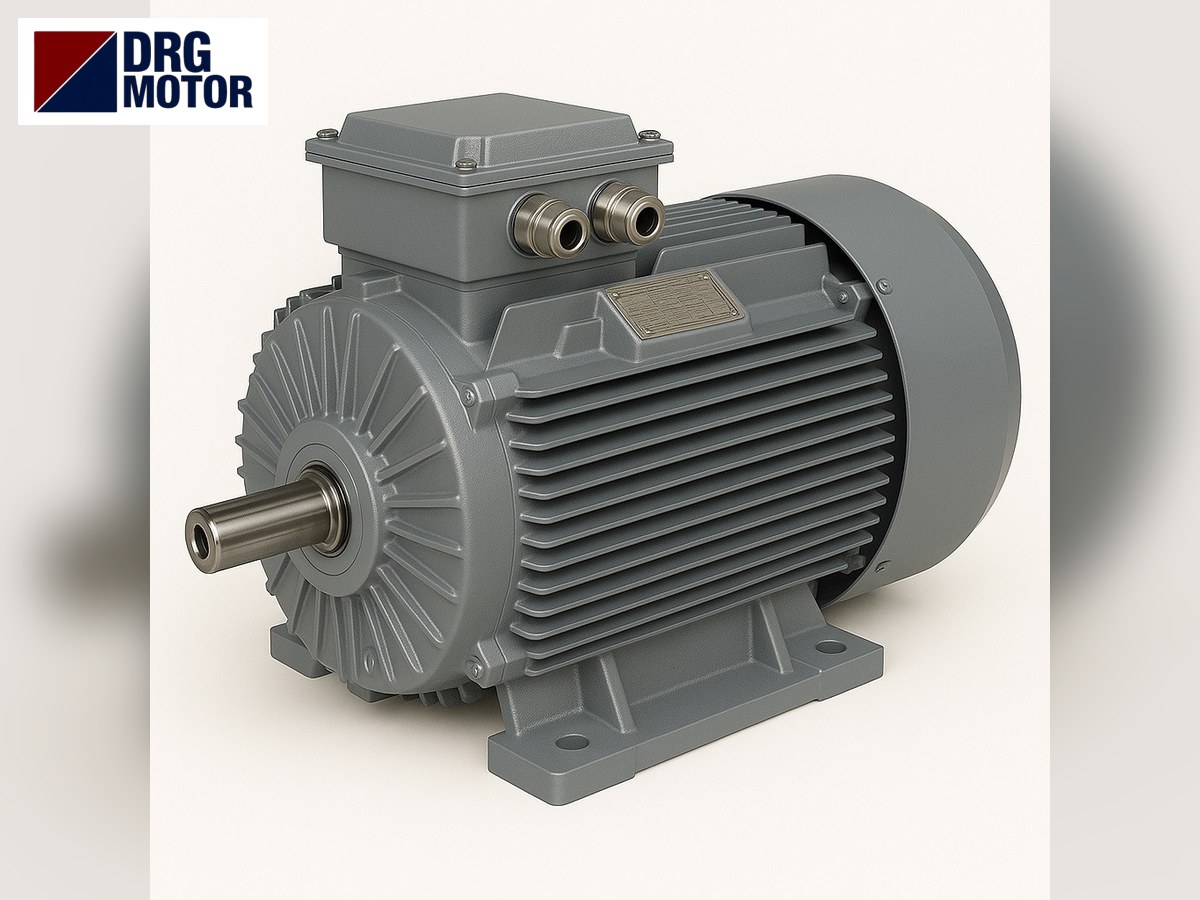
On a circular saw machine the electric motor spins the toothed blade at high speed to cut solid wood, MDF and faced board. On most machines the wood cutting motor is a two-pole (3000 rpm) three-phase motor driving the blade through a belt; sliding table models add a small scoring motor that pre-cuts the board surface. Maker catalogues offer 4 to 15 kW for the main motor of a sliding table saw, chosen according to blade diameter and the material to be cut.
DRG Motor is a manufacturer, supplier and seller of electric motors. We do not sell the saw itself, saw blades, pulleys and belts, brake motors, inverters, gearboxes, hydraulic units, electro-spindles or servo motors; what we supply is the standard IEC induction motor that drives the blade and the scorer. The models are listed on Buy Electric Motors Online.
Table saw and sliding table saw: where does the motor work?
On a table saw the blade rises through a fixed table and the workpiece is pushed by hand along the fence. Joinery shops use it to rip solid timber, cut battens and short parts. On a sliding table saw (format saw) the board travels on a long table running on bearing slides beside the blade, so one person can cut a 2.8–3.2 m particleboard or MDF sheet straight and square.
Main saw motor
The main motor sits inside the saw housing on a carrier that tilts with the blade (0–45°) and moves up and down. The motor therefore rests on this carrier by its feet, not only on its shaft; foot dimensions, shaft height and shaft length on the pulley side are the first points to check when replacing it. Older machines use B3 foot motors; some compact models hold the motor by a flange.
Scoring motor
On melamine or laminate faced board the main blade can chip the face where it exits underneath. The scorer is a small blade in front of the main blade, turning the other way, that nicks the coating a few millimetres deep beforehand. It has its own motor, much smaller than the main one and usually two-pole as well. Adding a scorer to a machine without one is done with the machine maker’s kit, and the motor choice follows that kit’s documents.
How it differs from a panel sizing saw
A sliding table saw and a panel sizing (beam) saw cut the same boards, but their motor layouts are different. On the sliding saw the operator pushes the table; on the beam saw the blade rides on a carriage and divides stacked boards by program. The table below sums up what that means for motor selection:
| Topic | Sliding table saw | Panel sizing saw | Meaning for the motor |
|---|---|---|---|
| Who feeds the cut | the operator pushes the table | the saw carriage travels itself | a travel drive is added on the beam saw |
| Load being cut | usually one board or solid wood | a stack of boards | larger main motor on the beam saw |
| Number of motors | main + scorer (+ setting motors) | main + scorer + carriage + pusher | many auxiliary drives on the beam saw |
| Layout | workshop machine with table | programmed, at the head of a line | beam saw motor rides on the carriage |
In short, a sliding table saw has one main motor and one scoring motor, while a panel sizing saw adds carriage travel and pusher drives. We cover the motors of panel sizing saws on a separate category page.
How many kW is a wood cutting motor? Catalogue values
A) Main motor ratings published by makers of sliding table and compact circular saws:
| Machine class | Main motor | Single / total | Note |
|---|---|---|---|
| Compact sliding table, 315 mm blade | three-phase motors from 5 kW | main saw motor | maker catalogue, entry model |
| Compact, 315 mm + 120 mm scoring blade | 4 or 5.5 kW option | main motor; scorer separate | second maker, single-phase base version too |
| Mid class, variable speed | 4 kW standard; 5.5 / 7.5 kW option | main motor, 1,000–5,000 rpm | third maker |
| Top class, 450–550 mm blade | 5.5 kW standard; 7.5 / 11 / 15 kW option | main motor | third maker, large model |
| 450 mm, three speed steps | 5.5 kW; 3,000 / 4,000 / 5,000 rpm | main motor | fourth maker |
| 450 mm, three steps 3,500–5,500 rpm | 5.5 or 7.3 kW | main motor | second maker, top model |
| Scoring unit (120 mm blade) | 1.1 kW | own motor for the scorer | second maker |
Across these catalogues the main motor spans roughly 4–15 kW with blade diameter and model, while the scorer stays near 1.1 kW. Compact machines with a 315 mm blade sit at the low end, large sliding saws cutting deep with 450–550 mm blades at the top. The “option” ratings in catalogues mean the same machine can be ordered with a stronger motor; the value for your machine is on its own nameplate.
B) Where DRG fits: for main motors from 4 to 15 kW (4 / 5.5 / 7.5 / 11 / 15) we have 2-pole cast iron motors on frames 112M, 132S and 160M; a 1.1 kW scorer fits frame 80. Our range has no pole-changing two-speed motors, no single-phase motors and no brake motors; if your machine uses one of these, ask us and we will look together at what a standard motor can do.
Click to see current electric motor prices and order nowSEE PRICES →
Belt or direct drive, blade diameter and speed
On most circular saws the motor drives the arbor by belt: the pulley ratio sets blade speed and the belt absorbs shocks. Some small table saws carry the blade directly on the motor shaft; blade speed then equals motor speed, and the shaft may be specially machined for the blade flange. A standard IEC shaft has no such machining; on a direct drive machine, photograph the old shaft end and send it to us.
Example: blade speed from the pulley ratio
Let us work out the speed of a 315 mm blade with a 5.5 kW two-pole motor (rated torque: DRG-132S1-2, 17.9 Nm):
| Step | Operation | Result | Comment |
|---|---|---|---|
| Motor speed | DRG-132S1-2 catalogue | 2,930 rpm | 5.5 kW, 2-pole |
| Pulley ratio | 150 mm motor / 110 mm arbor | about 1.36 | the arbor turns faster than the motor |
| Arbor speed | 2,930 × 150 / 110 | about 3,995 rpm | belt slip neglected |
| Rim speed of a 315 mm blade | π × 0.315 × 3,995 / 60 | about 66 m/s | check the speed limit printed on the blade |
| Torque at the arbor | 9,550 × 5.5 / 3,995 | about 13.1 Nm | lower than motor torque, higher speed |
A bigger blade at the same speed has a higher rim speed, which is why large-blade machines use a lower pulley ratio or speed step. Try pulley diameters for your own machine with the pulley and belt calculator. On machines with speed steps, the steps come from pulleys or, on some, from an inverter; DRG does not sell drives.
Quick stopping and starting
Woodworking safety requires the blade to stop quickly. On most machines an electronic brake does the job by pushing direct current through the stator winding for a few seconds (DC injection); the brake board sits in the machine’s panel and is not part of the motor. You will not find a mechanical brake motor in the DRG range. According to our catalogue, motors of 4 kW and above are delta connected on a 400 V supply and suit star-delta starting; if a large-blade machine is slow to run up, the star-delta starting page explains the method.
Chips, dust and motor cooling
The saw housing fills constantly with fine chips. Dust packed into the cooling fins and the fan cover grille makes the motor run warmer for the same cut. Our motors are IP55, which counts as dust-protected, but they do not clear chip build-up by themselves. Keep the machine’s extraction port open, empty the saw housing regularly and blow the fan cover clean with compressed air. For the extraction fan motor, see our Fan Motors category.
DRG motors for circular saw machines
Our two-pole models for the main blade and the scorer (current at 400 V):
| Model | Power / speed | Frame · shaft D×E | Current 400 V |
|---|---|---|---|
| DRG-802-2 | 1.1 kW / 2880 rpm | 80 cast iron · 19×40 | 2.31 A |
| DRG-112M-2 | 4 kW / 2905 rpm | 112M cast iron · 28×60 | 7.45 A |
| DRG-132S1-2 | 5.5 kW / 2930 rpm | 132S cast iron · 38×80 | 10.1 A |
| DRG-132S2-2 | 7.5 kW / 2930 rpm | 132S cast iron · 38×80 | 13.7 A |
| DRG-160M1-2 | 11 kW / 2945 rpm | 160M cast iron · 42×110 | 19.6 A |
| DRG-160M2-2 | 15 kW / 2945 rpm | 160M cast iron · 42×110 | 26.5 A |
All models are three-phase IEC induction motors. The aluminium frame covers 0.25–11 kW and the cast iron frame 0.55–355 kW; speeds are 3000, 1500 or 1000 rpm. The saw carrier decides whether you order a B3 foot motor, a B5/B14 flange motor, a combined B34/B35 or a vertical version. Before replacing, note kW, speed and voltage from the old nameplate, the connection (star/delta), frame and foot size, shaft diameter and key, any flange and the pulley diameter. With these and the machine documents in hand, we pick the right model together; we do not state a match before the dimensions are checked.
B5 flange dimensions
B5 values from the DRG catalogue for flange-mounted saw motors (mm):
| Frame | Shaft D×E | Flange P / M / N | Hole S |
|---|---|---|---|
| 80 | 19×40 | 200 / 165 / 130 | 12 |
| 112M | 28×60 | 250 / 215 / 180 | 14.5 |
| 132S/132M | 38×80 | 300 / 265 / 230 | 14.5 |
| 160M/160L | 42×110 | 350 / 300 / 250 | 18.5 |
Live price table
Prices of our models in main saw and scorer sizes come live from the shop:
| Model | Power / speed | Frame · current 400 V | Price |
|---|---|---|---|
| DRG-802-21.5 HP | 1.1 kW · 3000 rpm | Cast iron 80 · 2.31 A | $96.26 (€85.96) Details & buy → |
| DRG-90S-22 HP | 1.5 kW · 3000 rpm | Cast iron 90S · 3.06 A | $119.41 (€106.64) Details & buy → |
| DRG-112M-25.5 HP | 4 kW · 3000 rpm | Cast iron 112M · 7.45 A | $225.65 (€201.52) Details & buy → |
| DRG-132S1-27.5 HP | 5.5 kW · 3000 rpm | Cast iron 132S · 10.1 A | $338.72 (€302.50) Details & buy → |
| DRG-132S2-210 HP | 7.5 kW · 3000 rpm | Cast iron 132S · 13.7 A | $369.43 (€329.92) Details & buy → |
| DRG-160M1-215 HP | 11 kW · 3000 rpm | Cast iron 160M · 19.6 A | $527.95 (€471.49) Details & buy → |
| DRG-160M2-220 HP | 15 kW · 3000 rpm | Cast iron 160M · 26.5 A | $570.23 (€509.25) Details & buy → |
DRG MOTOR motors are guaranteed against material and manufacturing defects for 2 years from the delivery date (warranty certificate).
Motors in this power range
- DRG-802-2 – 1.1 kW – 2880 rpm – 80 cast iron
- DRG-112M-2 – 4 kW – 2905 rpm – 112M cast iron
- DRG-132S1-2 – 5.5 kW – 2930 rpm – 132S cast iron
- DRG-160M1-2 – 11 kW – 2945 rpm – 160M cast iron
Click to see current prices and order these motors nowSEE PRICES →
Browse the products, ask for a quote: every motor option for your saw is on Buy Electric Motors Online. Send the old nameplate and the pulley side on WhatsApp or call +90 (542) 666 11 11 with the blade diameter, and we will pick the model together.
Frequently asked questions
Can I replace a single-phase saw motor with a three-phase one?
Yes, if your workshop has three phases, but the panel, switch and brake board must change to suit the three-phase motor as well. We do not carry single-phase motors; without a three-phase supply, talk to us first.
Does the scoring motor turn the same way as the main motor?
No, the scoring blade usually turns opposite to the main blade, cutting upward into the underside of the board. Direction is reversed by swapping two phase leads.
What does the price of a circular saw motor depend on?
On power, pole count, frame material and mounting type; the table above stays current with shop data.
Saw questions are welcome by phone (+90 (542) 666 11 11), by e-mail (info@drgmotor.com) or through our contact page. For general motor choice on wood machines, read our woodworking motor article.


