 English
 Le français
 Türkçe

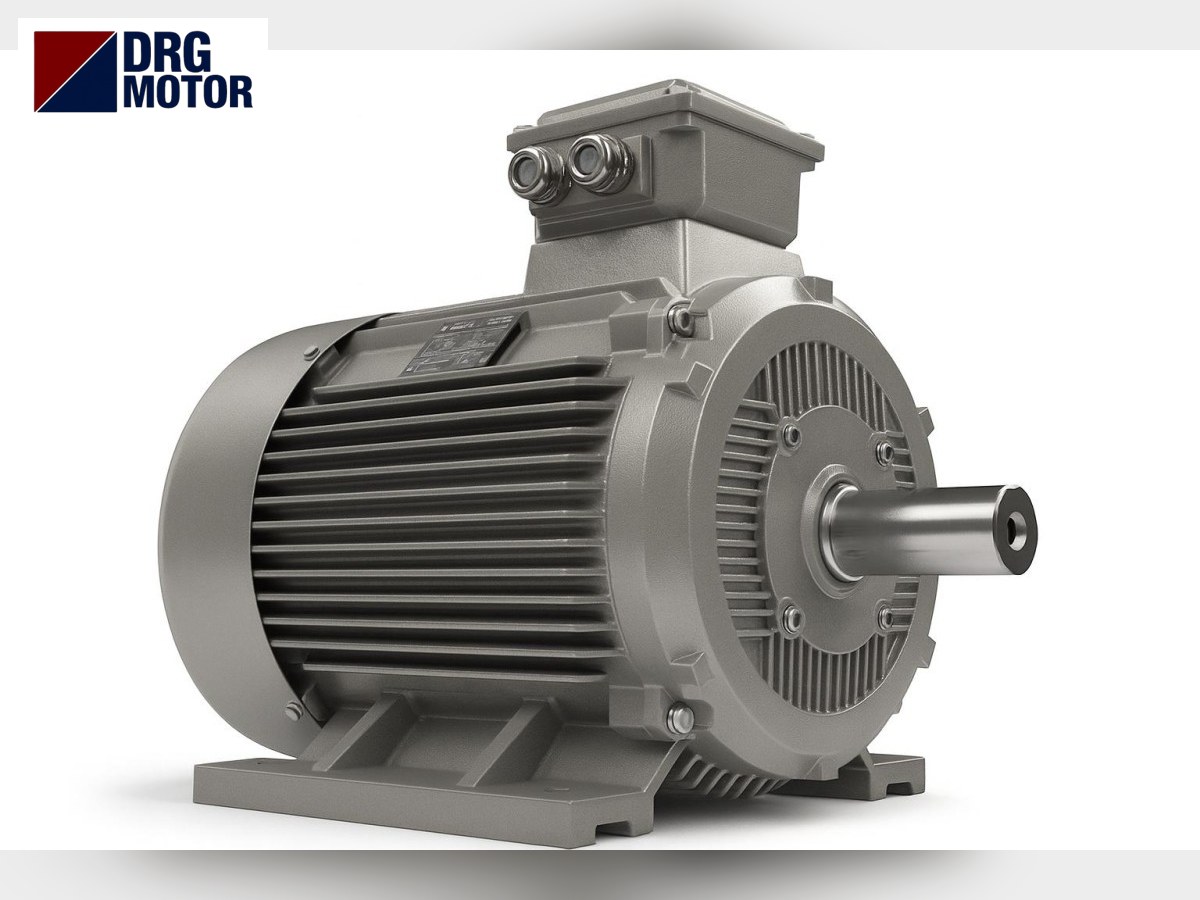
An edge banding machine has no single motor: on this machine, which glues PVC, ABS or veneer tape to a panel edge, every unit has its own drive. The track chain that carries the panel through the machine is pulled by a feed motor, the glue spreading roller by a small motor, and the pre-milling, end trimming and trimming units by separate aggregate motors. Maker catalogues list 0.55–3.7 kW for the feed motor and 0.18–2.2 kW for the aggregate motors. Most aggregates are special high-frequency motors running at around 12,000 rpm and lie outside our range; the part we cover with standard motors is the feed, buffing, glue drive and dust extraction side.
DRG Motor is a manufacturer, supplier and seller of electric motors. We do not sell the edge bander itself, its gearbox, hydraulic or pneumatic units, inverters, electro-spindles or servo motors; our supply is limited to the three-phase IEC induction motor on the machine. The models are listed on Buy Electric Motors Online.
Which motors run on an edge banding machine?
At the infeed the panel rests against a fence, an upper pressure belt or rollers hold it down on the track chain, and the chain carries it at constant speed past the units. In turn, the pre-milling unit straightens the edge, the glue pot applies hot-melt, pressure rollers bond the tape, end trimming saws cut the overhang, trimming units remove the top and bottom excess, and scrapers and buffing wheels finish the job. Each station puts a different load on its motor, so the first step in a motor replacement is to be clear about which unit you are dealing with.
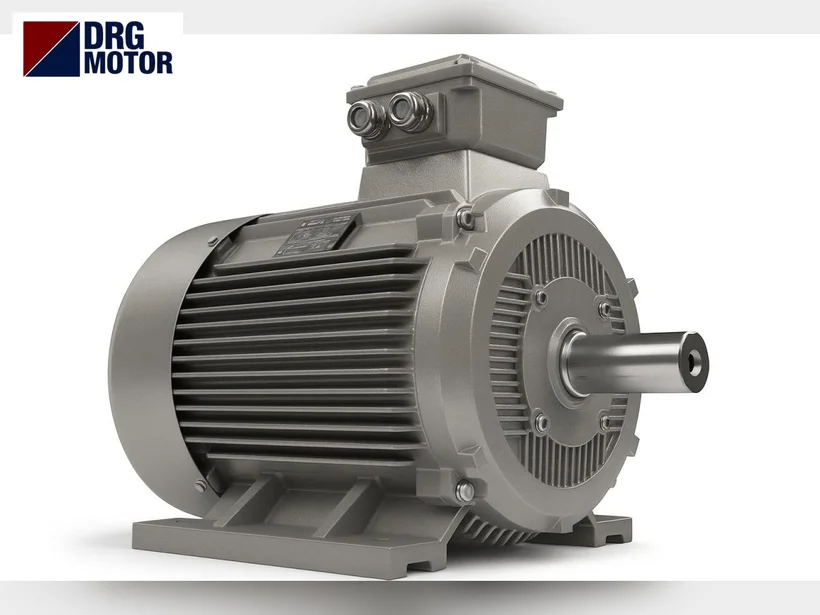
Feed motor and track chain
The feed drive turns a sprocket that pulls the chain and its pads. The motor is bolted to the gearbox by its flange, or stands on feet and drives through a coupling; the gearbox ratio sets the feed speed. In catalogues this motor starts as small as 0.55 kW and reaches a few kW on long machines with pre-milling. Feed speed must stay steady: if it fluctuates, milling and cutting marks change along the panel.
Glue pot and buffing units
The glue pot heaters take most of the electrical power, while the motor that turns the spreading roller is small; on some machines the roller takes its drive from the chain instead of a separate motor. On the buffing unit two small 2-pole motors press cloth or felt wheels at an angle against the tape; one Turkish data sheet gives these motors as 0.25 kW at 2,840 rpm.
Why are high-frequency aggregate motors outside our range?
The synchronous speed of an induction motor follows from frequency and pole count: n = 120 · f / p. On a 50 Hz supply a 2-pole motor reaches at most 3,000 rpm synchronous. The milling and cutting aggregates on an edge bander need 12,000 or 18,000 rpm, which for 2 poles means a 200 Hz or 300 Hz supply. These are small, light, special frames whose shaft is made to carry the tool directly, fed by the machine’s frequency converter or a separate high-frequency unit.
What to do when an aggregate motor fails
None of the pre-milling, end trimming, rough and fine trimming or corner rounding motors can be converted to a standard IEC frame: the tool fitting, shaft end and slide of the unit are machined around that motor. They need a spare part from the machine maker or a rewind. If the nameplate of your motor shows 200 Hz, 300 Hz or a speed above 9,000 rpm, it is not in our range; send us a photo anyway and we will help separate which unit needs which type of motor.
Other items we do not carry
Brake motors, single-phase motors and drives are not part of our offer. Some small workshop edge banders are sold for a 230 V single-phase supply; moving such a machine to a three-phase motor also means changing the control panel, which should be discussed with the machine maker. If the machine stops quickly with DC-injection electronic braking, that brake is a function of the control panel; we have no mechanically braked motor.
How many kW are edge bander motors? Catalogue values
A) Motor ratings given for edge banding units in maker catalogues and data sheets:
| Unit | Motor power | Quantity / speed | Note |
|---|---|---|---|
| Feed (track chain) | 0.55 kW | single motor, 7 m/min feed | first maker, compact model |
| Feed (track chain) | 0.75 kW | single motor, 8 m/min feed | second maker, chain-feed model |
| Feed (track chain) | 3.7 kW | single motor | third maker, automatic model with pre-milling |
| Glue pot / spreading roller | 0.18–0.75 kW | single motor | first and third maker |
| Pre-milling (aggregate) | 0.75–2.2 kW | 2 motors, 8,000–12,000 rpm | high frequency, three makers |
| End trimming (aggregate) | 0.18–0.55 kW | 1–2 motors, 9,000–12,000 rpm | high frequency, three makers |
| Rough/fine trimming, corner rounding | 0.22–0.75 kW | 2–4 motors, 12,000–18,000 rpm | high frequency, four makers |
| Buffing | 0.25–0.37 kW | 2 motors, 2,840 rpm | Turkish maker and third maker |
| Total electrical power of the machine | 8–15 kW | all units + heaters | Turkish maker, two models |
Across these edge banders the feed drive sits at about 0.55–3.7 kW, while each aggregate motor takes 0.18–2.2 kW. The 8–15 kW in the last row is not one motor but the total connected power of the machine, heaters included. Models with pre-milling, corner rounding and grooving carry more motors, and the feed motor grows because it pulls a heavier chain.
B) Where DRG fits: 0.55–3.7 kW feed motors match our 4-pole aluminium and cast iron small frames (71 to 112), and 0.25–0.37 kW buffing motors our 2-pole 63 and 71 frames. A 0.18 kW glue drive falls below 0.25 kW, the smallest rating we offer. High-frequency aggregates are outside the range, as explained above.
Click to see current electric motor prices and order nowSEE PRICES →
Worked example: feed speed, gear ratio and torque
A Turkish maker’s data sheet gives a working speed of 14 m/min and a gearbox output of 23 rpm. From these two values we can derive the effective sprocket diameter and the ratio on the motor side. The motor used is the 0.75 kW DRG-802-4 (rated torque: DRG-802-4, 5.04 Nm):
| Step | Operation | Result | Remark |
|---|---|---|---|
| Catalogue data | feed 14 m/min, gearbox output 23 rpm | — | Turkish maker’s data sheet |
| Effective circumference of the chain sprocket | 14 / 23 | about 0.61 m | effective diameter about 194 mm |
| Overall ratio (DRG-802-4) | 1420 / 23 | about 61.7 | gearbox + chain stage if any |
| Ideal torque at gearbox output | 5.04 × 61.7 | about 311 Nm | gearbox losses not deducted |
| 20 m/min with the same ratio | 23 × 20 / 14 | about 32.9 rpm | motor would need about 71 Hz |
The last row shows the limit of raising speed with an inverter alone: with the same gearbox, 20 m/min would need the motor to turn at about 71 Hz, and above 50 Hz the torque the motor can deliver falls. If faster feed is wanted, the gearbox ratio should be reselected. Try ratios with the gearbox output speed calculator.
Why does chain load vary?
The feed motor does more than carry the panel: friction of the pressure belt, the cutting force of the pre-milling unit and the weight of long, heavy panels on the chain all come back to it as load. If chain lubrication and tension are not kept to the maintenance instructions, motor current climbs. Recording the nameplate current of the old motor and its measured running current is the most reliable basis for choosing the new rating.
Chips, dust and auxiliary motors
The pre-milling and trimming units of an edge bander produce fine chips; one operating manual shows one 120 mm and two 80 mm extraction outlets on the machine. The machine body has no fan of its own; extraction is connected to the workshop’s chip collection system. For that system’s fan motor see our Fan Motors category and our article on motors for dust and extraction. Where the filter or silo of that line is rated as a zone with explosive wood dust, the motor there must carry Ex marking and papers, which our standard motor is not sold with.
DRG motors for edge banding machines
Suitable models from our range for feed and buffing drives (current at 400 V):
| Model | Power / speed | Frame · shaft D×E | Current 400 V |
|---|---|---|---|
| DRG-632-2 | 0.25 kW / 2730 rpm | 63 aluminium · 11×23 | 0.64 A |
| DRG-711-2 | 0.37 kW / 2750 rpm | 71 aluminium · 14×30 | 0.89 A |
| DRG-712-4 | 0.37 kW / 1340 rpm | 71 aluminium · 14×30 | 0.92 A |
| DRG-801-4 | 0.55 kW / 1400 rpm | 80 cast iron · 19×40 | 1.31 A |
| DRG-802-4 | 0.75 kW / 1420 rpm | 80 cast iron · 19×40 | 1.75 A |
| DRG-90L-4 | 1.5 kW / 1445 rpm | 90L cast iron · 24×50 | 3.3 A |
| DRG-112M-4 | 4 kW / 1450 rpm | 112M cast iron · 28×60 | 7.95 A |
The range is three-phase IEC induction only; an edge bander uses its small end, where aluminium (to 11 kW) overlaps the cast iron family that starts at 0.55 kW and climbs to 355 kW, at 2, 4 or 6 poles. The feed drive usually needs a flange version; foot, combined and vertical forms exist too. Whether the feed gearbox takes a large B5 flange, a small B14 flange or a foot motor with coupling is shown by the mounting face of the old motor. Write down the plate rating and speed, the connection and voltage, then measure shaft, key and flange bolt circle and look at how the motor meets its gearbox. Those notes are checked against the edge bander’s manual before we confirm; no advance promise is made that it suits any given machine.
B5 flange dimensions
B5 values of frames matching edge bander feed and buffing ratings (mm, from the DRG catalogue):
| Frame | Shaft D×E | Flange P / M / N | Hole S |
|---|---|---|---|
| 63 | 11×23 | 140 / 115 / 95 | 10 |
| 71 | 14×30 | 160 / 130 / 110 | 10 |
| 80 | 19×40 | 200 / 165 / 130 | 12 |
| 90S/90L | 24×50 | 200 / 165 / 130 | 12 |
On a feed gearbox the hollow input bore must take shaft D over length E, and the spigot N centres the motor on the gearbox housing. We do not give small B14 flange dimensions here; if needed we check them together via the technical drawings page. For flange types, our article on B5 and B14 flange motors will help.
Live price table
Prices of our models in feed, buffing and small auxiliary drive sizes come live from the shop:
| Model | Power / speed | Frame · current 400 V | Price |
|---|---|---|---|
| DRG-632-20.37 HP | 0.25 kW · 3000 rpm | Aluminium 63 · 0.64 A | $67.11 (€59.93) Details & buy → |
| DRG-712-40.5 HP | 0.37 kW · 1500 rpm | Aluminium 71 · 0.92 A | $76.76 (€68.55) Details & buy → |
| DRG-711-20.5 HP | 0.37 kW · 3000 rpm | Aluminium 71 · 0.89 A | $74.44 (€66.48) Details & buy → |
| DRG-801-40.75 HP | 0.55 kW · 1500 rpm | Cast iron 80 · 1.31 A | $91.72 (€81.91) Details & buy → |
| DRG-802-41 HP | 0.75 kW · 1500 rpm | Cast iron 80 · 1.75 A | $101.93 (€91.03) Details & buy → |
| DRG-90S-41.5 HP | 1.1 kW · 1500 rpm | Cast iron 90S · 2.48 A | $124.09 (€110.82) Details & buy → |
| DRG-90L-42 HP | 1.5 kW · 1500 rpm | Cast iron 90L · 3.3 A | $144.14 (€128.73) Details & buy → |
| DRG-112M-45.5 HP | 4 kW · 1500 rpm | Cast iron 112M · 7.95 A | $254.38 (€227.18) Details & buy → |
DRG MOTOR motors are guaranteed against material and manufacturing defects for 2 years from the delivery date (warranty certificate).
Motors in this power range
- DRG-711-2 – 0.37 kW – 2750 rpm – 71 aluminium
- DRG-801-4 – 0.55 kW – 1400 rpm – 80 cast iron
- DRG-802-4 – 0.75 kW – 1420 rpm – 80 cast iron
- DRG-90S-4 – 1.1 kW – 1445 rpm – 90S cast iron
- DRG-112M-4 – 4 kW – 1450 rpm – 112M cast iron
Click to see current prices and order these motors nowSEE PRICES →
Browse the products, ask for a quote: every suitable motor for your edge bander is on Buy Electric Motors Online. Photograph the feed motor nameplate and the face where it meets the gearbox and send it on WhatsApp; calling +90 (542) 666 11 11 and giving us the feed speed of the machine is also a good start.
Frequently asked questions
What speed is the feed motor of an edge bander?
Most catalogue examples use a 4-pole (1500 rpm class) motor with a gearbox. The exact speed is read from the old motor’s plate; if you change it, feed speed changes in the same proportion.
Can a standard motor replace an end trimming motor?
No. These motors run at 9,000–12,000 rpm on high frequency and carry the saw blade directly on the shaft; a standard 2-pole motor cannot reach that speed and does not fit the unit’s slide.
What does the price of an edge banding machine motor depend on?
Power, poles, aluminium or cast iron and the flange decide it; the live table reflects shop prices.
For questions about your edge banding line, contact +90 (542) 666 11 11, info@drgmotor.com or our contact page. For general motor choice on wood machines, see our article on motors for woodworking machines.


