 English
 Le français
 Türkçe

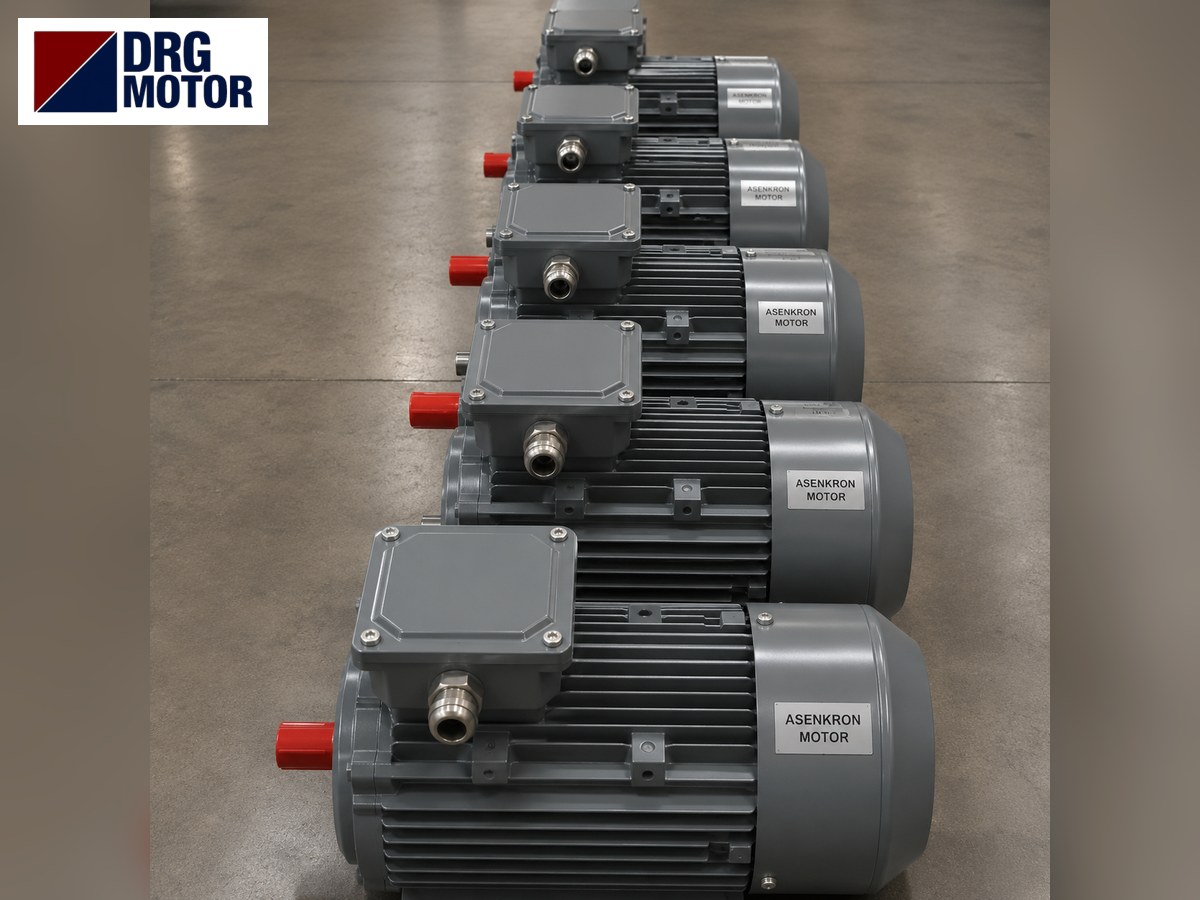
In a brick and roof tile plant, the cutting, setting and stacking machines place the cut green product on dryer and kiln cars, take the fired product off the cars and pack it, and move the cars along the line. Their electric motors drive, through gearboxes, the travelling carriages, lifting slides, grouping belts and hydraulic power pack pumps; on most machines the grippers work on compressed air. Maker catalogues show 13.5–45 kW total installed power for automatic setting machines and 5.5–18.5 kW for transfer cars.
DRG Motor is a manufacturer, supplier and seller of electric motors. We do not sell setting or unloading machines, robots, grippers, gearboxes, hydraulic units or inverters; we provide the three-phase motor alone, for whichever of these drives needs one. The models are on Buy Electric Motors Online.
From cutting to the kiln car: machines on the line and their motors
The clay column from the extruder is split into bricks or tiles on wire cutting machines; the cutter’s own drive is a separate subject and is only mentioned here by its place in the line. The cut products pass over accelerating and spacing belts, are arranged into the setting pattern on the grouping table, and the setting machine then lifts the group and places it on a dryer car or kiln car.
Grouping and spacing belts
These belts open gaps between the products and order the row for the setting head. Each belt has its own geared motor; because spacing comes from speed difference, the motors are usually inverter-fed. The first maker’s list gives 3–11 kW per line for grouping conveyors.
Setting machine: travel, lift and rotation
On a gantry setting machine a carriage runs on rails between grouping table and car; the lift axis lowers the gripper, and on some models the gripper turns 90°. The second maker’s data sheet lists 13.5 kW total motor power for the model setting 20,000 bricks per hour and 18.3 kW for the 30,000 model; grippers run on air at 0.5–0.8 MPa. Where lifting is done by a hydraulic cylinder, the motor’s only job is to turn the hydraulic pump.
Unloading, packing and roof tile stacking
The car leaving the kiln comes to the unloading station. The unloading machine takes off layers of fired bricks and puts them on a grouping belt; strapping and stretch wrapping machines then finish the pack. Roof tiles are fragile, so placing them into dryer and kiln cassettes (H-cassettes, U-cassettes) and taking them out is slower and more controlled; belt, lift and rotation motors of tile stacking systems are therefore mostly small and inverter-driven.
Packing motors
The first maker’s list gives 7.5–30 kW for an unloading machine, 2.2–11 kW for the grouping belt after unloading, 0.75–3 kW for a strapping machine and 1.5–4 kW for stretch wrapping. On lines with robot palletising, the robot axes turn on the robot maker’s servo drives.
Brake motors and servos: outside our range
A vertical lift axis must hold the load when power fails; a brake motor or a brake in the gearbox is normally used here. Brake motors are not in our range; follow the machine maker’s braking solution for the lift axis. Servo motors on robot and precision positioning axes, and single-phase motors, are also not among our products. On horizontal travel, belt and hydraulic pump drives our standard induction motor can be used.
Transfer cars and kiln car pushers
Between dryer and tunnel kiln the cars change track on rail-mounted transfer cars; the car pusher, mechanical or hydraulic, pushes the row of cars into the tunnel, and winches and rope haulers feed the return track. The third maker’s data sheet gives a 30-tonne transfer car with 2.2 + 0.55 kW and a 60-tonne car with 4 + 1.1 kW, two motors each; it does not say which motor travels and which one pushes. The first maker gives 5.5–18.5 kW for transfer cars, 5.5–15 kW for mechanical pushers and 7.5–22 kW for hydraulic pusher stations. Stopping a car precisely on the rail needs a brake and a position sensor.
Click to see current electric motor prices and order nowSEE PRICES →
How many kW for setting and transfer machines? Catalogue values
A) What makers of setting, unloading and transfer equipment publish:
| Machine / station | Motor power | Single / total | Note |
|---|---|---|---|
| Automatic green brick setting machine | 15–45 kW | total installed power | first maker, by capacity |
| Setting machine, up to 20,000 bricks per hour | 13.5 kW | total motor power | second maker’s data sheet |
| Setting machine, up to 30,000 bricks per hour | 18.3 kW | total motor power | second maker’s data sheet |
| Grouping conveyor ahead of setting | 3–11 kW | per line | first maker |
| Fired brick unloading machine | 7.5–30 kW | machine total | first maker |
| Grouping conveyor after unloading | 2.2–11 kW | per line | first maker |
| Strapping and stretch wrapping | 0.75–3 / 1.5–4 kW | per machine | first maker |
| Transfer car (kiln car carrier) | 5.5–18.5 kW | machine total | first maker |
| Transfer car, 30 t and 60 t load | 2.2 + 0.55 / 4 + 1.1 kW | sum of two motors | third maker’s data sheet |
| Mechanical car pusher / hydraulic pusher unit | 5.5–15 / 7.5–22 kW | single drive / hydraulic station | first maker |
Depending on model and hourly output, setting machines show roughly 13.5–45 kW total installed power, transfer cars 2.75–18.5 kW and car pushers 5.5–22 kW. The installed total is the sum of several motors: travel, lift, rotation and grouping drives on a setting machine are separate motors.
B) Where DRG fits: a single motor on these machines mostly sits between 0.55 and 22 kW and matches our 4-pole 80 to 180L frames; pump motors of hydraulic pusher stations fall in this span too. The whole span is inside our range; what stays outside is the braked and servo axes.
Worked example: travel motor of a 60-tonne transfer car
The 60-tonne car in the data sheet travels at 0.14 m/s. Take car plus load as 60 t, a rail resistance factor of 0.01, gearbox and wheel losses as 0.85 efficiency, and a 400 mm wheel (these three values are assumptions):
| Step | Operation | Result | Comment |
|---|---|---|---|
| Rolling resistance | 60,000 × 9.81 × 0.01 | about 5,886 N | assumed resistance factor 0.01 |
| Power at constant speed | 5,886 × 0.14 / 0.85 | about 0.97 kW | gearbox included |
| Adding 0.1 m/s² acceleration | (5,886 + 6,000) × 0.14 / 0.85 | about 1.96 kW | moment of starting |
| Speed of a 400 mm wheel | 0.14 × 60 / (π × 0.4) | about 6.7 rpm | gearbox output |
| Required ratio | 1,450 / 6.7 | about 217 | with DRG-112M-4 |
| Acceleration torque at motor shaft | 2,377 / 217 / 0.85 | about 12.9 Nm | wheel torque 2,377 Nm |
Below 1 kW at constant speed, the demand doubles when starting. The 12.9 Nm acceleration torque in the table is very close to the 14.5 Nm rated torque of the 2.2 kW DRG-100L1-4; the DRG-112M-4 matching the 4 kW in the data sheet (1,450 rpm, 7.95 A at 400 V; rated torque: DRG-112M-4, 26.3 Nm) leaves margin for dirty rails, slopes and uneven loading. Try gearbox ratios with our gearbox output speed and torque tool.
Frequent stop-start and inverters
Setting and transfer drives start and stop on every cycle. Smooth acceleration through an inverter protects both product and motor; a motor held at low revolutions for long periods loses shaft-fan cooling, which raises the question of an independent blower. Inverters are not in our range.
DRG motors for setting and stacking lines
For belts, travel drives and pusher power packs, these 4-pole DRG motors fit the usual sizes; currents are given at 400 V:
| Model | Power / speed | Frame · shaft D×E | Current 400 V |
|---|---|---|---|
| DRG-801-4 | 0.55 kW / 1400 rpm | 80 cast iron · 19×40 | 1.31 A |
| DRG-90S-4 | 1.1 kW / 1445 rpm | 90S cast iron · 24×50 | 2.48 A |
| DRG-100L1-4 | 2.2 kW / 1450 rpm | 100L cast iron · 28×60 | 4.52 A |
| DRG-112M-4 | 4 kW / 1450 rpm | 112M cast iron · 28×60 | 7.95 A |
| DRG-132S-4 | 5.5 kW / 1460 rpm | 132S cast iron · 38×80 | 10.7 A |
| DRG-160M-4 | 11 kW / 1465 rpm | 160M cast iron · 42×110 | 20.4 A |
| DRG-180L-4 | 22 kW / 1470 rpm | 180L cast iron · 48×110 | 39.7 A |
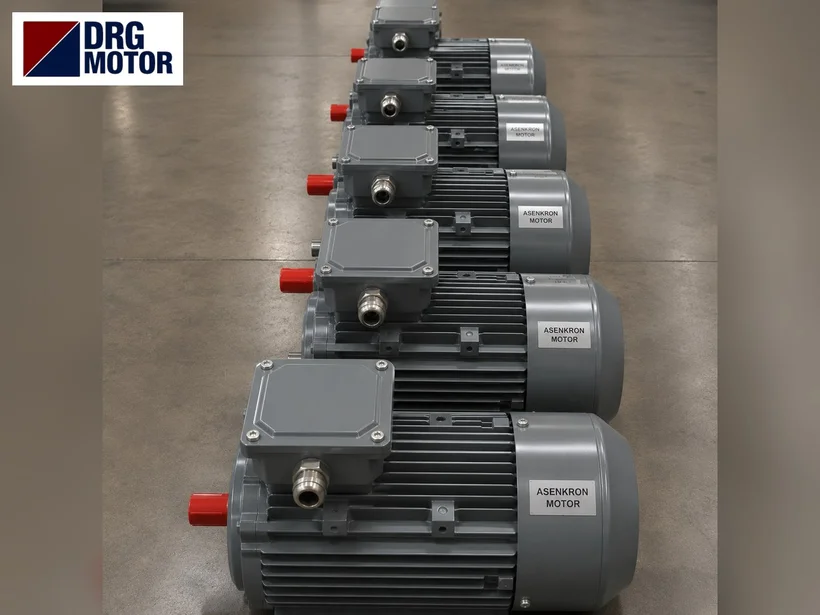
Motors bolted to gearboxes are mostly flange-mounted (B5 or B14), foot-coupled drives use B3. Our range covers three-phase IEC induction motors: our aluminium line ends at 11 kW and the cast iron line carries on to 355 kW, in 2-, 4- or 6-pole form. Swapping a geared drive motor means checking the old plate data against the new one and measuring shaft, key, flange and the gearbox bore it plugs into; we confirm the fit together after seeing the dimensions.
B5 dimensions for gearbox motors
B5 flange values of small frames common on belt and travel gearboxes, mm:
| Frame | Shaft D×E | Flange P / M / N | Hole S |
|---|---|---|---|
| 80 | 19×40 | 200 / 165 / 130 | 12 |
| 90S/90L | 24×50 | 200 / 165 / 130 | 12 |
| 100L/112M | 28×60 | 250 / 215 / 180 | 14.5 |
Because the shaft sits inside the gearbox hollow input, shaft size, length and spigot cannot differ even slightly; our flange motor for gearbox article goes into detail.
Live price table
Prices of models in setting, unloading and transfer drive sizes are pulled live from the shop:
| Model | Power / speed | Frame · current 400 V | Price |
|---|---|---|---|
| DRG-801-40.75 HP | 0.55 kW · 1500 rpm | Cast iron 80 · 1.31 A | $91.72 (€81.91) Details & buy → |
| DRG-90L-42 HP | 1.5 kW · 1500 rpm | Cast iron 90L · 3.3 A | $144.14 (€128.73) Details & buy → |
| DRG-100L1-43 HP | 2.2 kW · 1500 rpm | Cast iron 100L · 4.52 A | $188.32 (€168.18) Details & buy → |
| DRG-112M-45.5 HP | 4 kW · 1500 rpm | Cast iron 112M · 7.95 A | $254.38 (€227.18) Details & buy → |
| DRG-132S-47.5 HP | 5.5 kW · 1500 rpm | Cast iron 132S · 10.7 A | $342.01 (€305.44) Details & buy → |
| DRG-132M-410 HP | 7.5 kW · 1500 rpm | Cast iron 132M · 14.3 A | $394.89 (€352.66) Details & buy → |
| DRG-160M-415 HP | 11 kW · 1500 rpm | Cast iron 160M · 20.4 A | $568.76 (€507.94) Details & buy → |
| DRG-180L-430 HP | 22 kW · 1500 rpm | Cast iron 180L · 39.7 A | $919.45 (€821.13) Details & buy → |
DRG MOTOR motors are guaranteed against material and manufacturing defects for 2 years from the delivery date (warranty certificate).
Motors in this power range
- DRG-90L-4 – 1.5 kW – 1445 rpm – 90L cast iron
- DRG-100L1-4 – 2.2 kW – 1450 rpm – 100L cast iron
- DRG-112M-4 – 4 kW – 1450 rpm – 112M cast iron
- DRG-132M-4 – 7.5 kW – 1460 rpm – 132M cast iron
- DRG-160M-4 – 11 kW – 1465 rpm – 160M cast iron
Click to see current prices and order these motors nowSEE PRICES →
Browse the products, ask for a quote: motors for your setting and transfer line are on Buy Electric Motors Online. Share the list of motors to replace and photos of the gearbox joints on WhatsApp, or call +90 (542) 666 11 11 and describe the stations along the line.
Frequently asked questions
Can a standard motor go on the lift axis of a setting machine?
A vertical axis that could drop its load needs a brake; since brake motors are not in our range, the machine maker’s solution is used there. Horizontal travel and belt drives can take a standard motor.
Why does a transfer car have two motors?
One moves the car along the rail, the other pulls the kiln car on or pushes it off; ratings differ and each motor’s own plate is the reference when replacing.
What sets the price of a brick setting machine motor?
Rating, pole number and frame; the table above updates live from our store.
Contact: +90 (542) 666 11 11 · info@drgmotor.com · contact page.


