 English
 Le français
 Türkçe

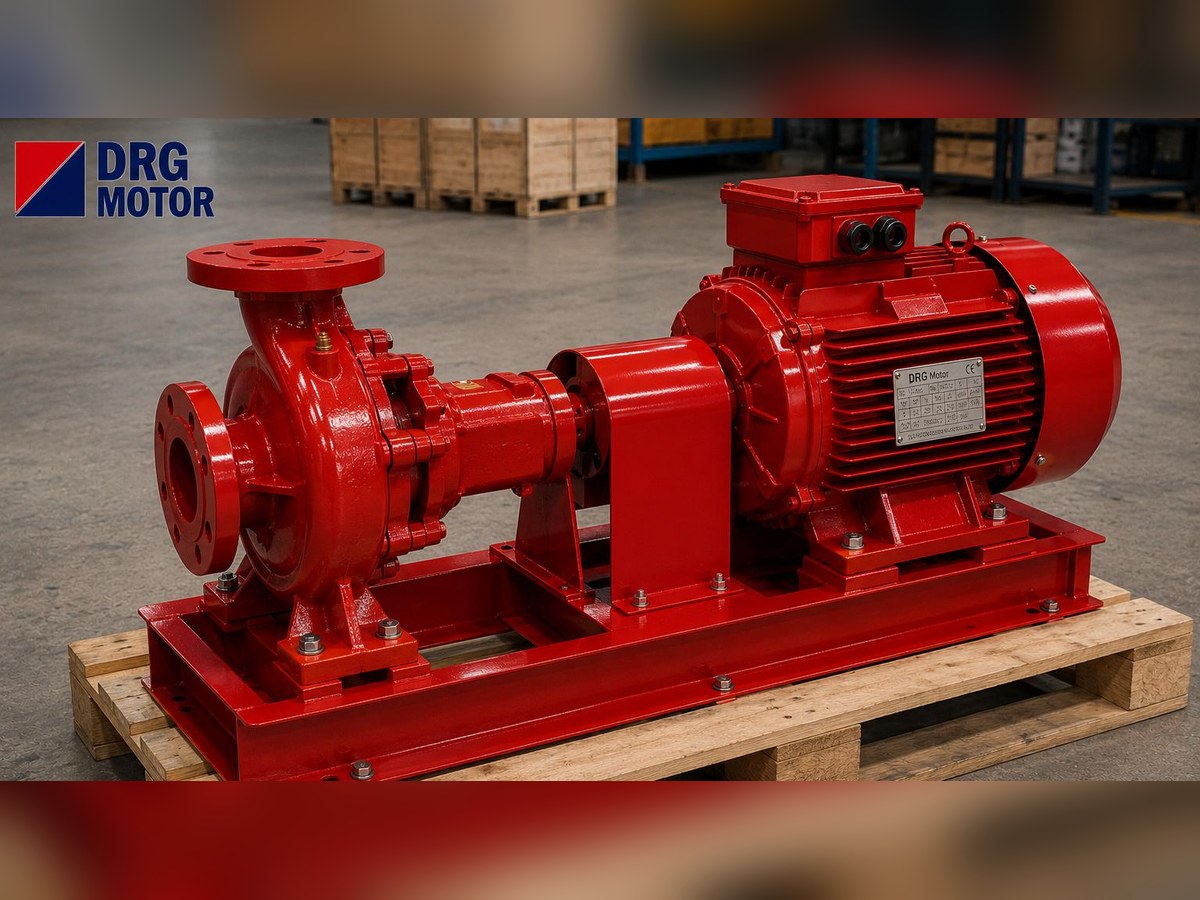
In a drinking and process water treatment plant, electric motors do four jobs: they turn the pumps that lift water into the plant and out to the network, they spin the mixers that disperse coagulant and the slow mixers that let flocs grow, they run the backwash pump and air blower that clean clogged sand filters, and they drive the dosing pumps. Manufacturer catalogues list 0.37–30 kW for rapid mixer motors, 0.12–1.5 kW for flocculator motors and 1.5–250 kW for rotary lobe blowers that are also used for filter backwash; pump power spreads over a very wide band depending on flow and head. This page is not about sewage: it covers the plant that prepares water taken from a dam, a river or a well before it is sent to a town or a factory.
DRG Motor is a manufacturer, supplier and seller of electric motors. We do not sell pump casings, mixer impellers, flocculator paddles, gearboxes, blowers, dosing pumps or inverters; our part is the three-phase squirrel-cage motor that turns each of these machines. All cast iron and aluminium models are listed on the Buy Electric Motors Online page.
From raw water to the clear water tank: where do the motors sit?
In a conventional surface-water plant the water passes through the intake, the rapid mixing chamber where chemicals are added, the flocculation chambers, the settling basin, the sand filters and disinfection before reaching the clear water tank; from there transfer pumps send it to the network. Each station loads the motor differently: flow and head at the pump, the power the impeller puts into the water at the mixer, a slow turn of a few revolutions per minute at the flocculator, and short but heavy bursts a few times a day during filter washing.
Raw water intake and transfer pumps
The pumps that bring raw water in and send treated water to the tank or the network carry the largest motors of the plant. On dry surface pumps the IEC motor is coupled to the pump or built as a close-coupled unit; double-suction split-case pumps are common at large flows. The motor of a submersible borehole pump, by contrast, runs under water and forms one unit with the pump: submersible motors are not in our range. For dry-installed pump motors see the Pump Motors category, and for supply questions our article on treatment plant pump motor supply.
Coagulation: the rapid mixer
The coagulant has to be spread evenly through the water within a few seconds. A vertical-shaft impeller therefore turns fast in a small chamber; in one maker’s standard series the impeller runs at 70–132 rpm with motors of 0.37–30 kW. The motor sits on the bridge above the chamber and usually drives the impeller through a gearbox; chamber volume and the required mixing intensity set its power.
Flocculation: the slow mixer
To let the small particles leaving coagulation grow without breaking, a paddle or frame mixer turns very slowly: catalogues show 3–35 rpm for frame-type models and 7–68 rpm for two-blade vertical flocculators. Motor power is small and the gearbox ratio is large. For vertical operation the motor must be ordered for vertical mounting and the axial load confirmed by the mixer manufacturer.
Settling, filtration and backwash
The flocs sink to the bottom of the settling basin. The scraper bridge that collects that sludge is a separate subject; depending on basin diameter it turns very slowly with a small motor of about 0.37–0.75 kW. As sand filters clog they are washed in reverse, first with air and then with water: the backwash pump and the air blower run at full load a few times a day for a few minutes each time. Here the motor must cope with frequent starts and with starting in humid air after long idle periods.
Dosing and disinfection
For motor-driven diaphragm dosing pumps handling coagulant, chlorine solution or pH correction, one maker’s data sheet lists 0.18–0.37 kW three-phase motors, with 0.55 kW offered only as a single-phase version. On many small dosing pumps the motor is integral with the housing. We have no single-phase motors; on a pump with a standard IEC flange and three-phase supply the motor can be replaced if flange and shaft sizes match. Chemical rooms classified as explosive atmospheres need Ex motors, which are not in our range either.
Click to see current electric motor prices and order nowSEE PRICES →
How many kW does a water treatment plant motor need? Catalogue values
A) Motor ratings given in manufacturer catalogues and data sheets for drinking water line equipment:
| Machine / model group | Motor power | Single / total | Note |
|---|---|---|---|
| Rapid mixer (coagulation), impeller 70–132 rpm | 0.37–30 kW | single motor | first maker, standard series |
| Vertical flocculator, two-blade impeller 7–68 rpm | 0.12–1.1 kW | single motor, gear drive | second maker |
| Frame-type slow mixer, tanks from 1×1 m to 5×5 m | 0.37–1.5 kW | single motor, by impeller speed | third maker |
| Centre-drive clarifier scraper, Ø3–18 m | 0.37–0.75 kW | single motor | fourth maker |
| Rotary lobe blower (incl. drinking-water filter backwash) | 1.5–250 kW | one motor per package | fifth maker, series range |
| Double-suction split-case pump, 10–2500 m³/h | 1.5–630 kW | per pump | sixth maker |
| Motor-driven diaphragm dosing pump, 5.5–500 l/h | 0.18–0.37 kW three-phase; 0.55 kW single-phase only | single motor | seventh maker |
Putting the table together gives 0.12–30 kW on the mixing and flocculation side, 0.37–0.75 kW for the settling basin scraper, 1.5–250 kW for blowers used in backwash and 1.5–630 kW for large transfer pumps. Pump and blower ratings refer to one machine; the installed power of the plant is their sum and includes standby units. Larger flow or head means a larger pump motor, and a larger chamber means a larger mixer motor.
B) Overlap with the DRG range: most of these bands fall inside the power span of our 2-, 4- and 6-pole motors, whose lower limit is 0.25 kW and upper limit 355 kW. The parts that do not overlap: the smallest flocculator motors of 0.12–0.18 kW fall below our smallest motor of 0.25 kW, and split-case pump motors above 355 kW are outside our range. The low speed of slow mixers comes from the gearbox, not the motor, so a slow motor is not what you are after; a 4- or 6-pole motor is used with a suitable gearbox ratio.
Worked example: mixing power and transfer pump
Rapid mixing chamber
The power a mixer puts into the water is calculated from the velocity gradient (G): P = G² · μ · V. Take a flow of 900 m³/h and a retention time of 40 s; the chamber volume is V = 10 m³. Assume the designer chose G = 700 s⁻¹ and that water at 10 °C has a viscosity of μ ≈ 1.31·10⁻³ Pa·s: P ≈ 6.4 kW. This is the power delivered by the impeller to the water; adding gearbox and bearing losses, it makes sense to start from the next step, the 7.5 kW DRG-132M-4; its rated speed is 1460 rpm and its rated current 14.3 A on a 400 V supply. The final choice follows the mixer manufacturer’s calculation.
Three-chamber flocculation
If 20 minutes of flocculation at the same flow is split into three equal chambers, each chamber holds 100 m³. With G stepped down to 60, 40 and 20 s⁻¹, the power put into the water is about 0.47, 0.21 and 0.05 kW respectively. The last chamber needs so little that the maker may have fitted a 0.12–0.18 kW motor, which is below our range. The 0.25 kW DRG-711-4 can only take its place if the gearbox input flange and shaft size match and the mixer manufacturer accepts a larger motor.
Clear water transfer pump
Suppose a pump moves 180 m³/h from the clear water tank into the network at a head of 40 m, and the pump curve gives a hydraulic coefficient of η = 0.75. Shaft power then comes out as P = ρ·g·Q·H ÷ η, about 26.2 kW. That load is covered by the 30 kW DRG-200L1-2, with a rated speed of 2960 rpm and a rated current of 52.1 A on a 400 V network. To try your own figures, use the pump-fan motor power calculator.
Mounting, environment and starting
Vertical motors and flange connection
On mixers and flocculators the motor usually stands vertically on top of the gearbox and is flange-mounted; vertical variants such as V1 and B5 or B14 flanges apply here. Horizontal pumps use foot-mounted B3 or foot-and-flange B35.
Humidity, chemical vapours and outdoor sites
Our motors are IP55 and the catalogue operating conditions are −15 °C to +40 °C ambient and altitude up to 1000 m. On open basin bridges a canopy that keeps direct rain and sun off the motor, and indoors a position away from the dosing room where chlorine and acid vapours collect, extend motor life. If the site is colder or hotter, state it when ordering.
Starting method, inverter and drives outside our range
Large transfer pumps and blowers run on an inverter or a soft starter in most plants; small mixers can be started direct on line. For starting options see our star-delta starting page. Valve and gate actuator motors come with the actuator; for lifting gear that needs a brake motor, note that brake motors are not in our range.
Water treatment line with DRG motors
Eight models matching the power steps of the line, from flocculator to transfer pump:
| Model | Power / speed | Frame · shaft D×E | Current 400 V |
|---|---|---|---|
| DRG-711-4 | 0.25 kW / 1340 rpm | 71 aluminium · 14×30 | 0.66 A |
| DRG-801-4 | 0.55 kW / 1400 rpm | 80 cast iron · 19×40 | 1.31 A |
| DRG-90L-4 | 1.5 kW / 1445 rpm | 90L cast iron · 24×50 | 3.3 A |
| DRG-112M-2 | 4 kW / 2905 rpm | 112M cast iron · 28×60 | 7.45 A |
| DRG-132M-4 | 7.5 kW / 1460 rpm | 132M cast iron · 38×80 | 14.3 A |
| DRG-160M1-2 | 11 kW / 2945 rpm | 160M cast iron · 42×110 | 19.6 A |
| DRG-200L1-2 | 30 kW / 2960 rpm | 200L cast iron · 55×110 | 52.1 A |
| DRG-250M-4 | 55 kW / 1485 rpm | 250M cast iron · 65×140 | 97.6 A |
Mixers and flocculators use 4- or 6-pole motors with a gearbox, while surface pumps mostly use 2- or 4-pole motors with a coupling; the new motor takes over the pole number of the unit it replaces. Light motors sitting on a basin bridge or a mixer platform can have an aluminium frame (11 kW at most), while pumps and blowers more often carry heavy cast iron frames. Winding connection follows the rating: star for 3 kW and smaller, delta once you reach 4 kW; the winding voltage, 230/400 or 400/690 V, is stated in the product page record. Before ordering, send the nameplate photo, mounting code, flange and shaft size and the connection side of the pump or gearbox; a fit is confirmed only after those dimensions are checked.
Live price table
Prices of the models that match a water treatment line are pulled live from the shop:
| Model | Power / speed | Frame · current 400 V | Price |
|---|---|---|---|
| DRG-711-40.37 HP | 0.25 kW · 1500 rpm | Aluminium 71 · 0.66 A | $73.16 (€65.33) Details & buy → |
| DRG-801-40.75 HP | 0.55 kW · 1500 rpm | Cast iron 80 · 1.31 A | $91.72 (€81.91) Details & buy → |
| DRG-90L-42 HP | 1.5 kW · 1500 rpm | Cast iron 90L · 3.3 A | $144.14 (€128.73) Details & buy → |
| DRG-112M-25.5 HP | 4 kW · 3000 rpm | Cast iron 112M · 7.45 A | $225.65 (€201.52) Details & buy → |
| DRG-132M-410 HP | 7.5 kW · 1500 rpm | Cast iron 132M · 14.3 A | $394.89 (€352.66) Details & buy → |
| DRG-160M1-215 HP | 11 kW · 3000 rpm | Cast iron 160M · 19.6 A | $527.95 (€471.49) Details & buy → |
| DRG-180M-425 HP | 18.5 kW · 1500 rpm | Cast iron 180M · 33.5 A | $873.49 (€780.08) Details & buy → |
| DRG-200L1-240 HP | 30 kW · 3000 rpm | Cast iron 200L · 52.1 A | $1,273.02 (€1,136.88) Details & buy → |
| DRG-250M-475 HP | 55 kW · 1500 rpm | Cast iron 250M · 97.6 A | $2,065.73 (€1,844.82) Details & buy → |
DRG MOTOR motors are guaranteed against material and manufacturing defects for 2 years from the delivery date (warranty certificate).
Motors in this power range
- DRG-711-4 – 0.25 kW – 1340 rpm – 71 aluminium
- DRG-90L-4 – 1.5 kW – 1445 rpm – 90L cast iron
- DRG-132M-4 – 7.5 kW – 1460 rpm – 132M cast iron
- DRG-200L1-2 – 30 kW – 2960 rpm – 200L cast iron
- DRG-250M-4 – 55 kW – 1485 rpm – 250M cast iron
Click to see current prices and order these motors nowSEE PRICES →
Choose a motor or request an offer: motors for pumps, mixers and blowers are listed under Buy Electric Motors Online. Send the equipment name, a photo of the old motor’s nameplate and the daily running time via WhatsApp; you can also call +90 (542) 666 11 11.
Frequently asked questions
Why is a flocculator motor so small?
Flocculation aims to grow flocs without breaking them, so the power put into the water is kept low on purpose. Hence the small motor behind a large reduction ratio. A more powerful replacement motor does not change impeller speed, but the manufacturer must approve the load on the gearbox and shaft.
Do the filter backwash blower and an aeration blower use the same motor?
Both may be rotary lobe or similar blowers, but the backwash blower runs briefly a few times a day and its pressure is chosen for the filter bed. Motor power is read from the blower maker’s curve; the same kW figure means different starting conditions in the two duties.
For questions: +90 (542) 666 11 11 · info@drgmotor.com · contact.


