 English
 Le français
 Türkçe

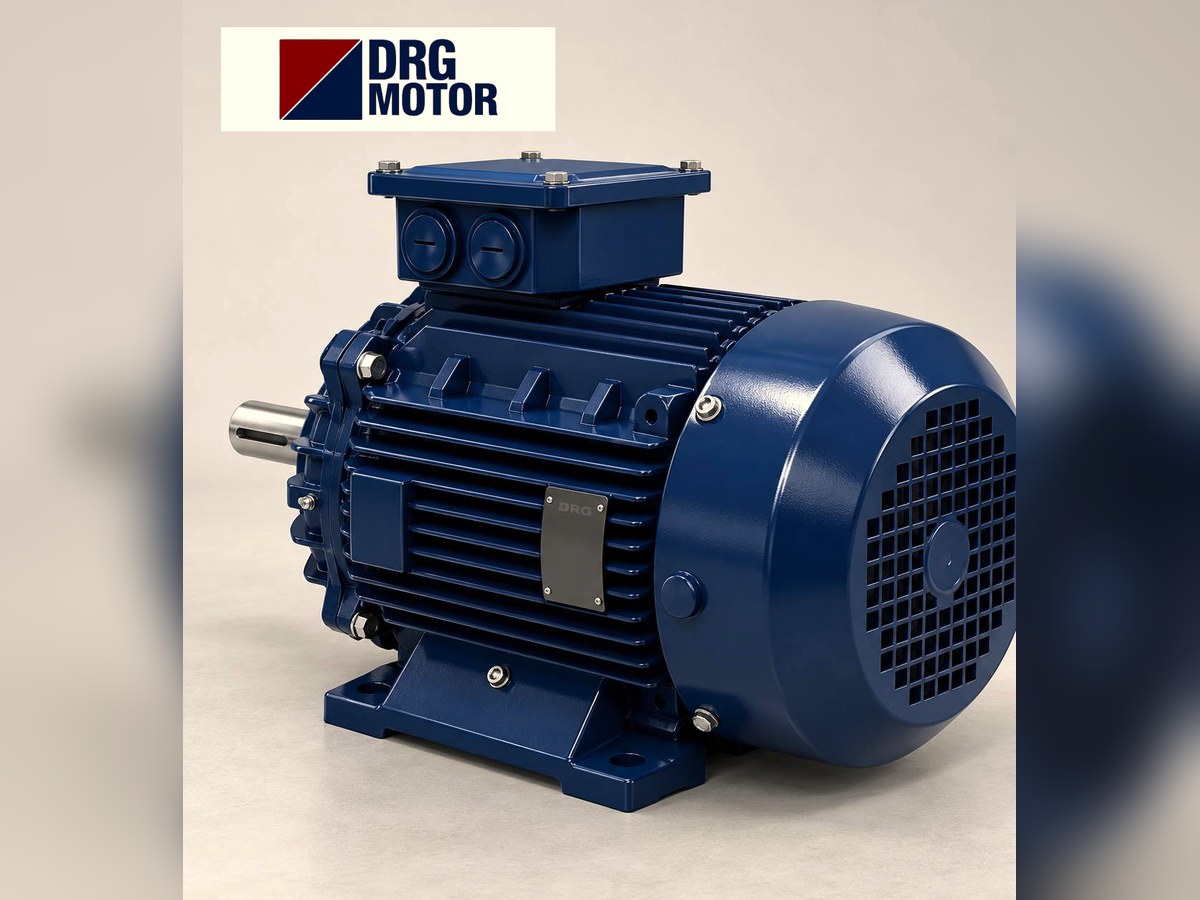
Brushing, bush-hammering and surface blasting machines all give natural stone a textured face, but the electric motor plays a different part in each. In brushing the motor turns the abrasive brush head, in bush-hammering the hammer head; in shot blasting it spins the turbine wheel that throws shot at the stone. In flaming the gas flame does the work and motors only drive the belt, fan, water pump and torch swing. Maker catalogues show 4.4 kW per brush head, 1.1 kW per bush-hammer head and 7.5–11 kW per blast turbine.
DRG Motor is a manufacturer, supplier and seller of electric motors. We do not sell the machines themselves, brushes, hammer tips, torches and gas equipment, turbine wheels or shot, and the same applies to gearboxes, hydraulic units, water pump bodies, inverters, electro-spindles or servo motors. What you buy from us is the three-phase induction motor that runs them. Models are on Buy Electric Motors Online.
Where does the motor work in the four surface processes?
Since four processes share this page, the table sets out the difference first:
| Surface process | What does the work | Where the electric motor is | Note for DRG |
|---|---|---|---|
| Brushing | rotating abrasive brush | brush head, belt, bridge | head and belt motors |
| Bush-hammering | rotating hammer head | head (mostly geared), swing, belt | head, swing and belt motors |
| Flaming | gas torch (flame) | belt, fan, water pump, swing only | auxiliary motors |
| Shot / sand blasting | turbine wheel | turbine, dust fan, elevator, screw, belt | turbine and auxiliary motors |
Tumbling, which ages pieces by rubbing them together in a drum, is not covered here; those machine motors are described on our antiquing and tumbling page.
Brushing machine motors
On a brushing machine, nylon brushes loaded with silicon carbide or diamond grit are fitted to rotating plates. The brushes wear away the softer parts of the stone, leave the hard veins standing and give a leather-like, gently undulating texture. One maker’s 4- and 10-head machines list 6 HP head power and a 4.4 kW plate motor; heads are raised and lowered pneumatically and belt speed is set by inverter.
Choosing a brush head motor
4.4 kW is not a standard IEC step; whether a head motor marked 6 HP is replaced with 4 kW or 5.5 kW depends on the current on the old plate and the real load of the head. Brushing is light work compared with calibrating, but current rises with fresh brushes and high pressure. If the head motor stands vertically, V1 mounting is needed; vertical operation requires the motor to be ordered for vertical mounting and the axial load to be confirmed by the machine maker.
Wet and dry brushing
Traditional brushing is done wet; some newer machines run dry with a dust extraction system. On a wet machine the motor needs protecting from splashes, on a dry one from fine stone dust. In dry brushing the extraction fan motor becomes part of the line; for fan motors see our Fan Motors category.
Bush-hammering machine motors
Bush-hammering breaks the stone face with point blows from toothed hammers, leaving a pitted texture. The hammers are fixed to a rotating head and strike the stone as it turns. The catalogue of a calibrating and bush-hammering machine lists each of its four bush-hammer heads at 1.1 kW and 126 rpm: such a low speed shows that the head is driven through a gearbox. Another maker’s 4–8 head bush-hammering machine has a 7.5 kW main motor, a 1.5–2.2 kW swing motor and a 1.5 kW loading motor.
Impact load and the motor
Hammer blows send a steady stream of small shocks into the head. Gearbox and head bearings take those shocks; the motor’s task is to hold the head at its set speed. Once gearbox and head bearings wear, vibration passes into the motor and shortens bearing life; if the motor sounds different, check the gearbox first. Flange and shaft sizes between motor and gearbox must be kept exactly on replacement.
Surface blasting: flame and shot
Flaming
In flaming, the granite face is heated with the very hot flame of a gas torch; crystals at the surface crack and spall under sudden heating, leaving a rough, matt texture. The flame works the stone, not the motor. One maker’s machines with 11–23 torches list total electrical power of only 2–6 kW; that power runs the torch swing, the chain or belt carrying the stone, cooling water and the exhaust fan. Motors sit outside the flame zone; if one must be close to the hot area, it is chosen with the ambient temperature stated.
Shot and sand blasting
In shot blasting a turbine wheel spins fast and throws steel shot onto the stone. The turbine motor is the main motor of this machine: one maker lists 7.5 kW per turbine, another 11 kW, with one to four turbines. The same machine also has a screw that collects the shot, an elevator lifting it, a separator cleaning it from dust and a dust collector fan; in one catalogue the dust fan motor is 7.5–11 kW. Turbine speed comes from the turbine maker; with a directly coupled turbine motor speed equals turbine speed, with a belt-driven one it is set by pulleys.
Click to see current electric motor prices and order nowSEE PRICES →
How many kW do these machines use? Catalogue values
A) Motor powers given in catalogues for brushing, bush-hammering and blasting machines:
| Machine / section | Motor power | Single / total | Note |
|---|---|---|---|
| Brushing machine, 4 or 10 heads, 500 mm plate | 4.4 kW (6 HP) | per head | maker catalogue |
| Bush-hammer head (4-head section) | 1.1 kW, 126 rpm | per head | calibrating + bush-hammering machine |
| Bush-hammering machine main motor | 7.5 kW | single motor; machine total 35–66 kW | second maker, 4–8 heads |
| Bush-hammering machine swing motor | 1.5–2.2 kW | single motor | second maker |
| Flaming machine | 2–6 kW | whole electrical power of the machine | third maker, 11–23 torches |
| Shot blasting, 1–2 turbines | 7.5 kW | per turbine | fourth maker |
| Shot blasting, 2–4 turbines | 11 kW | per turbine | fifth maker |
| Shot blasting dust collector fan | 7.5–11 kW | single motor | fifth maker |
Depending on maker and process, head motors in this group run at roughly 1.1–7.5 kW, blast turbines at 7.5–11 kW and auxiliary motors at 1.5–11 kW. The 2–6 kW figure for a flaming machine is not one motor but the sum of its small motors. The 35–66 kW total of a bush-hammering machine includes head motors, swing and loading together.
B) Where DRG fits: 1.1 kW head motors match frame 90S, 1.5–2.2 kW swing and belt motors frames 90L and 100L, 4–5.5 kW brush heads frames 112M and 132S, 7.5 kW main motors and turbines frame 132M (4-pole) or 132S (2-pole), and 11 kW turbines and fans frame 160M. Whether a turbine needs 2 or 4 poles depends on its rated speed; do not choose a motor without it.
Worked example: a bush-hammer head and a four-turbine blaster
For the catalogue bush-hammer head of 1.1 kW / 126 rpm and a blaster with 4 × 11 kW turbines, using DRG catalogue data (rated torque: DRG-90S-4, 7.27 Nm):
| Step | Operation | Result | Meaning |
|---|---|---|---|
| Bush-hammer head: gear ratio | 1445 / 126 | about 11.5 | DRG-90S-4 speed / head speed |
| Torque at the head spindle | 9550 × 1.1 / 126 | about 83 Nm | gearbox losses ignored |
| Torque at the motor shaft | DRG-90S-4 catalogue | 7.27 Nm | smaller by the ratio |
| Four-turbine blaster: turbine current | 4 × 20.4 A | about 82 A | 11 kW, with DRG-160M-4 |
| Adding the dust fan | 81.6 + 20.4 A | about 102 A | elevator and screw not included |
The gear ratio comes out near 11.5; the nearest standard ratio is chosen and head speed shifts slightly. If four turbines start together, starting current rises to several times rated current; starting them one after another or using star-delta starting reduces the shock on the panel. To try the ratio, the gearbox output speed calculator does the job.
DRG motors for surface finishing machines
Models from our range for head, turbine and auxiliary drives (current at 400 V):
| Model | Power / speed | Frame · shaft D×E | Current 400 V |
|---|---|---|---|
| DRG-90S-4 | 1.1 kW / 1445 rpm | 90S cast iron · 24×50 | 2.48 A |
| DRG-100L1-4 | 2.2 kW / 1450 rpm | 100L cast iron · 28×60 | 4.52 A |
| DRG-112M-4 | 4 kW / 1450 rpm | 112M cast iron · 28×60 | 7.95 A |
| DRG-132S-4 | 5.5 kW / 1460 rpm | 132S cast iron · 38×80 | 10.7 A |
| DRG-132M-4 | 7.5 kW / 1460 rpm | 132M cast iron · 38×80 | 14.3 A |
| DRG-132S2-2 | 7.5 kW / 2930 rpm | 132S cast iron · 38×80 | 13.7 A |
| DRG-160M1-2 | 11 kW / 2945 rpm | 160M cast iron · 42×110 | 19.6 A |
Our motors are three-phase and IP55; aluminium frames cover 0.25–11 kW, cast iron 0.55–355 kW, at 3000/1500/1000 rpm, ordered as B3, B5, B14, B34, B35 or vertical V1/V3/V5/V6. Before swapping a motor we check its plate against the machine maker’s papers: rating and speed, supply and star/delta link, frame size, mounting, shaft and key, flange and how it drives the pulley or gearbox. Splash on a wet brusher and shot and dust on a blaster are looked at in the same review. We give no firm compatibility promise; we check the data with you.
B5 flange dimensions
B5 values of frames common on head and turbine motors, from the DRG catalogue (mm):
| Frame | Shaft D×E | Flange P / M / N | Hole S |
|---|---|---|---|
| 90S/90L | 24×50 | 200 / 165 / 130 | 12 |
| 132S/132M | 38×80 | 300 / 265 / 230 | 14.5 |
| 160M/160L | 42×110 | 350 / 300 / 250 | 18.5 |
Live price table
Prices of our models in brush, bush-hammer, turbine and auxiliary sizes come live from the shop:
| Model | Power / speed | Frame · current 400 V | Price |
|---|---|---|---|
| DRG-90S-41.5 HP | 1.1 kW · 1500 rpm | Cast iron 90S · 2.48 A | $124.09 (€110.82) Details & buy → |
| DRG-90L-42 HP | 1.5 kW · 1500 rpm | Cast iron 90L · 3.3 A | $144.14 (€128.73) Details & buy → |
| DRG-100L1-43 HP | 2.2 kW · 1500 rpm | Cast iron 100L · 4.52 A | $188.32 (€168.18) Details & buy → |
| DRG-112M-45.5 HP | 4 kW · 1500 rpm | Cast iron 112M · 7.95 A | $254.38 (€227.18) Details & buy → |
| DRG-132S-47.5 HP | 5.5 kW · 1500 rpm | Cast iron 132S · 10.7 A | $342.01 (€305.44) Details & buy → |
| DRG-132M-410 HP | 7.5 kW · 1500 rpm | Cast iron 132M · 14.3 A | $394.89 (€352.66) Details & buy → |
| DRG-132S2-210 HP | 7.5 kW · 3000 rpm | Cast iron 132S · 13.7 A | $369.43 (€329.92) Details & buy → |
| DRG-160M-415 HP | 11 kW · 1500 rpm | Cast iron 160M · 20.4 A | $568.76 (€507.94) Details & buy → |
| DRG-160M1-215 HP | 11 kW · 3000 rpm | Cast iron 160M · 19.6 A | $527.95 (€471.49) Details & buy → |
DRG MOTOR motors are guaranteed against material and manufacturing defects for 2 years from the delivery date (warranty certificate).
Motors in this power range
- DRG-90S-4 – 1.1 kW – 1445 rpm – 90S cast iron
- DRG-112M-4 – 4 kW – 1450 rpm – 112M cast iron
- DRG-132S-4 – 5.5 kW – 1460 rpm – 132S cast iron
- DRG-132S2-2 – 7.5 kW – 2930 rpm – 132S cast iron
- DRG-160M-4 – 11 kW – 1465 rpm – 160M cast iron
Click to see current prices and order these motors nowSEE PRICES →
Browse the products, ask for a quote: all motors for your surface finishing machine are on Buy Electric Motors Online. Tell us the machine type (brush, bush hammer, flame or shot), and send a photo of the motor plate and, if any, the gearbox plate via WhatsApp, or call +90 (542) 666 11 11.
Frequently asked questions
Does a flaming machine need a different motor because of the flame?
Motors are placed outside the flame zone and standard motors are used. If a motor stays close to the hot area, tell us the ambient temperature and selection is made accordingly.
Should a shot blasting turbine motor be 2-pole or 4-pole?
It depends on the turbine’s rated speed. Send the turbine plate or machine catalogue; on a directly coupled turbine the motor speed must match the turbine speed.
What does the price of a brushing machine motor depend on?
On power, frame material and mounting type; the table above is fed live from the shop.
Got a question on a brusher, bush hammer or blaster? Ring +90 (542) 666 11 11, e-mail info@drgmotor.com or fill in the contact form. For cooling and washing water, see the Pump Motors category.


