 English
 Le français
 Türkçe

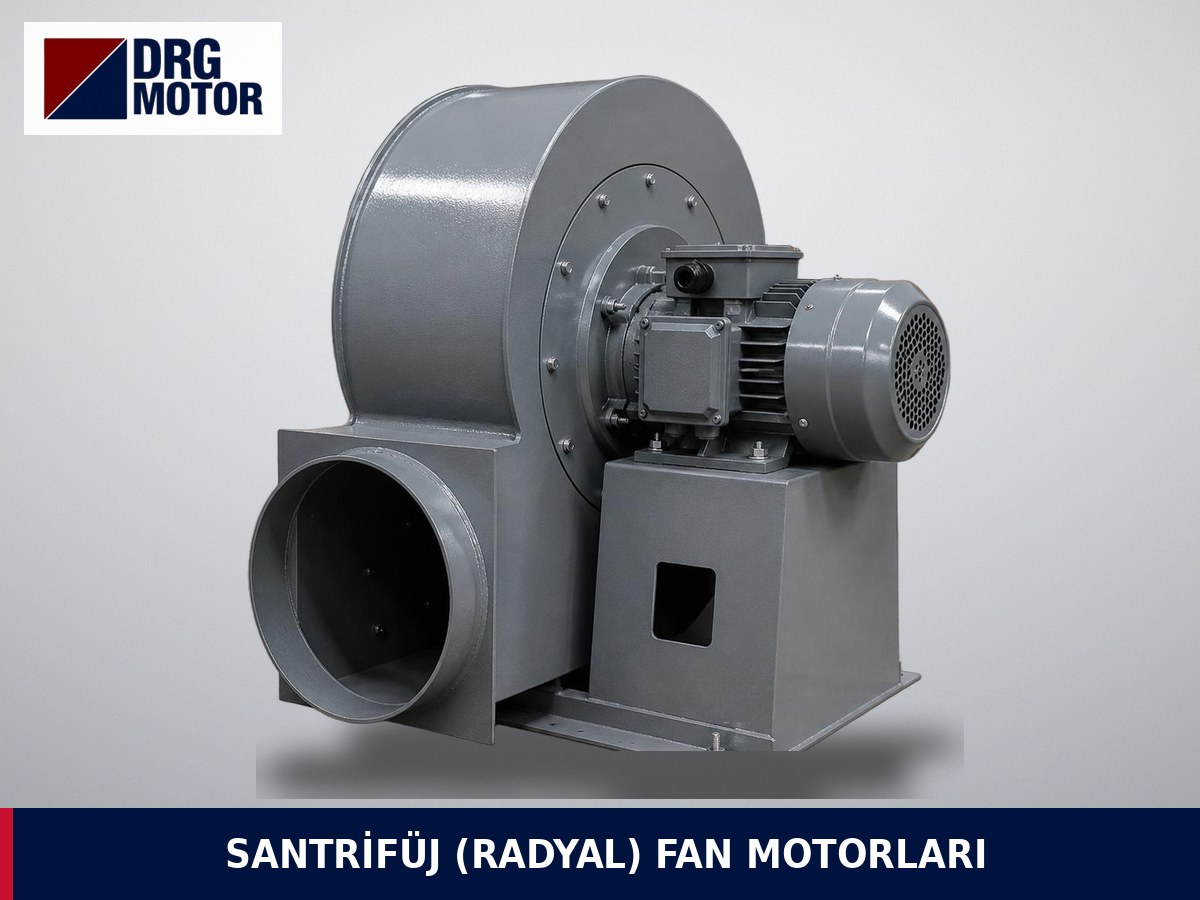
A centrifugal (radial) fan motor is not a separate motor type: the motor driving a centrifugal fan is usually a standard three-phase induction motor, and its power, speed and mounting are chosen according to the fan’s blade type and drive arrangement. The blade type determines how the motor load changes as the flow rises; the drive arrangement determines whether motor speed and fan speed are the same. Without these two pieces of information, the question “how many kW” alone cannot be answered correctly.
In this article we explain the principle of the centrifugal fan, the three blade families, direct, coupled and belt drive arrangements, and how they affect motor selection. DRG Motor is a manufacturer, supplier and seller of electric motors; you can find the 1000, 1500 and 3000 rpm three-phase motors used in centrifugal fans on our Buy Electric Motors Online page. An overview of fan types is on our Fan Motors page.
Centrifugal and radial: the same fan?
In a centrifugal fan, air enters the centre of the impeller parallel to the shaft axis; the rotating blades fling it outwards and it leaves perpendicular to the axis, i.e. turning through 90°. Pressure is created as the air accelerates outwards inside the impeller. A centrifugal fan therefore delivers less flow than an axial fan of the same diameter, but much higher pressure; it is preferred in systems with filters, long ducts or hoods.
In Turkish, “santrifüj” (centrifugal) and “radyal” (radial) usually describe the same fan. The confusion comes from the words describing different things:
| Term | What it describes | Note |
|---|---|---|
| Centrifugal fan | Operating principle | Axial inlet, radial outlet |
| Radial fan | Usually the same principle | Synonym of centrifugal |
| Straight radial blade | Impeller blade shape | A subtype of centrifugal |
| Scroll (volute) | Spiral housing | A housing, not a principle |
| Roof / cabinet type | Installation and cabinet | May contain a centrifugal impeller |
So centrifugal and radial are not two different fan types; “radial” is sometimes used in a narrower sense to mean only the straight radial-bladed impeller. We cover motor selection examples for scroll-housed fans in our centrifugal (scroll) fan motor article, and roof-mounted applications in our roof exhaust fan article.
What do the three blade families mean for the motor?
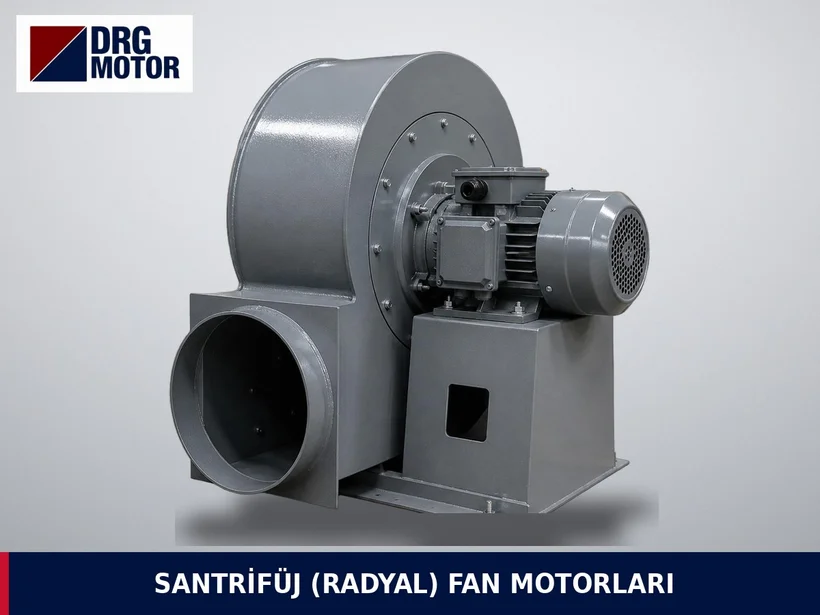
Centrifugal impellers fall into three families by blade shape. Without going into detail, here is what each means on the motor side:
- Forward-curved (multi-blade): gives high flow at low speed, but absorbed power keeps rising with flow; if system resistance is lower than expected the motor can be overloaded, so a power margin is left.
- Backward-curved: the power curve peaks within the operating range and then falls; if the motor is chosen for this peak it is not overloaded whatever the flow, but it turns faster for the same duty.
- Straight radial: self-cleaning in dusty air, air carrying chips or conveyed material; the impeller is heavy and robust, and the long run-up time makes starting method and overload setting important.
For example, one manufacturer’s catalogue gives different maximum absorbed power values for the same impeller size in a single-inlet forward-curved fan series, depending on the housing type [3]. This shows that blade type alone does not set the power; it must be read together with the housing and speed limit.
Click to see current electric motor prices and order nowSEE PRICES →
Drive arrangement: direct, coupled or belt
In a centrifugal fan the motor usually sits outside the airstream; this is the main difference from an axial fan. How the impeller is connected to the motor determines both the motor’s speed and its mounting:
| Arrangement | Fan speed | For the motor |
|---|---|---|
| Direct (impeller on shaft) | Equals motor speed | Shaft and bearings carry impeller |
| Coupled | Equals motor speed | Fan bearings carry impeller |
| Belt and pulley | Set by pulley ratio | Belt loss, radial load |
In direct drive the impeller is mounted on the motor shaft; a manufacturer offering a catalogue of centrifugal fans with IEC standard motors mounts its impeller directly on the motor shaft and balances it dynamically together with the motor [2]. In this arrangement, fan speed can only be the rated speed of a 2, 4 or 6-pole motor; an intermediate speed requires an inverter. Remember that the motor shaft carries the weight and unbalance of the impeller; shaft diameter and length must be compared with the fan manufacturer’s drawing.
In a coupled arrangement the fan has its own bearings and shaft; the motor only transmits torque. It is preferred for heavy fans and fans handling hot gas; misalignment shortens bearing life.
In a belt drive the fan speed is independent of the motor speed and is set by the pulley ratio. This is the most common arrangement for large industrial centrifugal fans. One manufacturer’s catalogue gives belt selection tables for belt-driven centrifugal fans up to a motor power of 30 kW; larger powers are selected separately [1]. Belt loss is added to the motor power; another catalogue gives it as a correction factor according to motor power [3]. We also cover motor selection for belt systems in our belt and pulley drive motor selection article.
Which fan is used, the fan curve, impeller and housing design belong to the fan manufacturer or project engineer. The motor supplier’s job is to provide a motor that matches the given shaft power, speed, mounting and ambient conditions. The motor mounting type also follows from the fan arrangement: in belt-driven fans the motor is usually foot-mounted (B3) on slide rails or a base frame, in direct-drive fans foot- or flange-mounted; the exact type is taken from the fan manufacturer’s drawing.
Data needed for motor selection
- Duty point: flow rate (m³/h or m³/s) and total or static pressure (Pa)
- Shaft power read from the fan curve, and blade type
- Fan speed and drive arrangement (direct, coupling, belt)
- For belt drive: pulley diameters and belt type
- Air temperature and density; denser air at cold start
- Impeller inertia or measured run-up time; whether the damper can be closed at start
- Environment: dust, humidity, outdoors; whether the motor is outside the airstream
- Shaft diameter and length, mounting type, terminal box position
- Whether there is an explosive atmosphere or a smoke extraction duty
The boundary for the last item is clear: an explosive atmosphere requires an ATEX/IECEx-certified fan and motor set, and smoke extraction requires one certified to EN 12101-3. DRG’s standard motors are not sold with these certifications; a DRG motor can only be recommended for ventilation and process duties that do not require certification.
Power and speed: a belt-driven paint shop exhaust fan example
We do not assign a fixed power range to centrifugal fans: power changes with impeller diameter, flow, pressure, blade type, speed, system resistance, air density and drive loss. Shaft power is found from P_shaft = Q·Δp / η_fan; motor power is this divided by the drive efficiency, plus a margin.
Example: in the exhaust of a filtered paint booth, a backward-curved, belt-driven fan is to move 10,080 m³/h (2.8 m³/s) at 1,500 Pa total pressure; assume a fan efficiency of 0.72 and a belt efficiency of 0.95. The shaft power is 2.8 × 1,500 / 0.72 ≈ 5,830 W, i.e. about 5.8 kW. With belt loss, 5.83 / 0.95 ≈ 6.1 kW; adding a 10% margin for filter loading and calculation uncertainty gives about 6.75 kW, so the next standard step, 7.5 kW, is selected. You can run the same calculation with your own values in the Pump & Fan Motor Power calculator.
| Model | Power / speed | Frame · current 400 V | Price |
|---|---|---|---|
| DRG-90L-23 HP | 2.2 kW · 3000 rpm | Cast iron 90L · 4.35 A | $154.45 (€137.93) Details & buy → |
| DRG-100L2-44 HP | 3 kW · 1500 rpm | Cast iron 100L · 6.02 A | $203.84 (€182.05) Details & buy → |
| DRG-112M-45.5 HP | 4 kW · 1500 rpm | Cast iron 112M · 7.95 A | $254.38 (€227.18) Details & buy → |
| DRG-132S-47.5 HP | 5.5 kW · 1500 rpm | Cast iron 132S · 10.7 A | $342.01 (€305.44) Details & buy → |
| DRG-132M-410 HP | 7.5 kW · 1500 rpm | Cast iron 132M · 14.3 A | $394.89 (€352.66) Details & buy → |
| DRG-160M-415 HP | 11 kW · 1500 rpm | Cast iron 160M · 20.4 A | $568.76 (€507.94) Details & buy → |
| DRG-160L-420 HP | 15 kW · 1500 rpm | Cast iron 160L · 27.3 A | $678.13 (€605.61) Details & buy → |
| DRG-180M-425 HP | 18.5 kW · 1500 rpm | Cast iron 180M · 33.5 A | $873.49 (€780.08) Details & buy → |
| DRG-180L-430 HP | 22 kW · 1500 rpm | Cast iron 180L · 39.7 A | $919.45 (€821.13) Details & buy → |
| DRG-200L-440 HP | 30 kW · 1500 rpm | Cast iron 200L · 53.8 A | $1,235.00 (€1,102.93) Details & buy → |
Motor speed versus fan speed
Suppose the fan curve calls for a fan speed of 1,750 rpm at this duty point. The 4-pole 7.5 kW DRG-132M-4 runs at 1,460 rpm under load; the pulley ratio is 1,750 / 1,460 ≈ 1.20. With a 200 mm motor pulley, the fan pulley comes out at about 167 mm; in this example the fan turns faster than the motor. Had we wanted to run the same fan by direct drive, an inverter would be needed, because no number of poles corresponds to 1,750 rpm. You can check the pulley calculation with the pulley and belt calculator.
Note: raising fan speed with a pulley loads the motor directly, because the power absorbed by the fan grows with the cube of speed. If the pulley ratio is to change, the new duty point must be read again from the fan curve.
Starting
The inertia of a centrifugal impeller can be much larger than that of the motor rotor; the starting current lasts a long time until the motor reaches full speed. The DRG-132M-4 has a rated current of 14.3 A at 400 V and a starting current ratio of 7.5; in direct-on-line starting the starting current is about 107 A. As the motor is wound for 400/690 V, it is suitable for star-delta starting on a 400 V network; in star the starting current drops to roughly one third. With large impellers, starting with the damper closed reduces the load. You can compare starting methods in our star-delta starting tool.
Matching with the DRG range
DRG’s three-phase motor range covers 0.25–11 kW in aluminium frames and 0.55–355 kW in cast iron frames; 1000, 1500 and 3000 rpm, three-phase, 230/400 V or 400/690 V, supplied in B3, B5, B14 and B35 mounting with an order note. This range matches most direct, coupled and belt-driven centrifugal fans that use IEC standard motors. Small centrifugal fans with an integrated external-rotor or EC motor are outside this scope: DRG does not sell such integrated motors, and when they fail the whole fan unit is usually replaced. Do not treat every centrifugal fan power on the market as a DRG product; confirm with the fan’s nameplate and drawing.
DRG motors suited to centrifugal fans
Models to consider for the 7.5 kW belt-driven exhaust fan in the example and centrifugal fans of similar power:
- DRG-132S2-2 – 7.5 kW – 3000 rpm – 132S
- DRG-132M-4 – 7.5 kW – 1500 rpm – 132M
- DRG-160M-6 – 7.5 kW – 1000 rpm – 160M
- DRG-160M-4 – 11 kW – 1500 rpm – 160M
Click to see current prices and order these motors nowSEE PRICES →
Centrifugal fan motor: frequently asked questions
What is the difference between a centrifugal fan and a radial fan?
Usually none; both describe a fan where air enters along the axis and leaves perpendicular to it. “Radial” is sometimes used to mean only the straight radial-bladed impeller.
How many kW should a centrifugal fan motor be?
There is no fixed value. It is calculated from flow, pressure, fan efficiency and drive loss using P_shaft = Q·Δp / η_fan, then a margin is added and the next standard power is selected.
What speed should the motor of a belt-driven centrifugal fan be?
Since the pulley ratio sets the fan speed, the motor is usually 4-pole (1500 rpm); 2 and 6 poles can also be used depending on pulley diameters and fan speed. The decision is made with the fan speed and suitable pulley sizes.
Why does a centrifugal fan trip the overload at start-up?
The inertia of the heavy impeller lengthens the start, and the motor draws starting current for a long time. Starting with the damper closed, star-delta or soft starting, and a correct overload setting are part of the solution.
Share the fan catalogue page or a photo of the old motor’s nameplate and we will make the selection together: +90 (542) 666 11 11, [email protected], contact page. For current prices, browse the 120 models in our online store.
Sources
- S&P – HC Centrifugal fans for industry, Technical data 2010 – belt selection tables for belt-driven fans up to 30 kW motors
- Ziehl-Abegg – Centrifugal fans main catalogue with IEC standard motor – impeller mounted directly on the motor shaft
- S&P – FSA Single Inlet Centrifugal Fan with Forward Wheels – maximum absorbed power by housing type, transmission loss factor


