 English
 Le français
 Türkçe

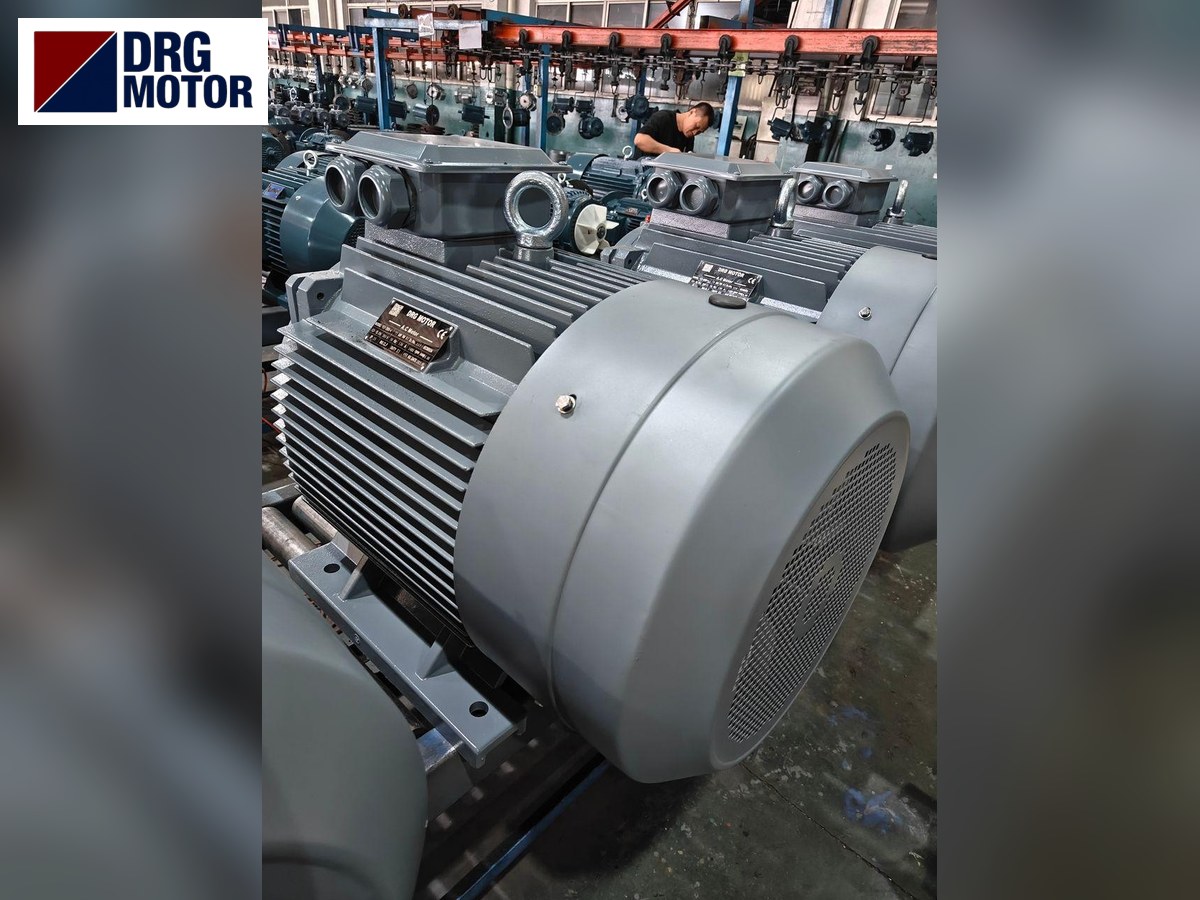
A hydraulic power unit is a ready-built package that supplies pressurised oil to a machine: an oil tank, a pump, the bell housing and coupling that join the pump to the motor, suction and return filters, a relief valve and a valve block. The electric motor inside it has one job, turning the pump shaft at a fixed speed; pressure and flow are set by the pump and the valves. Manufacturer catalogues show motors from 0.55 kW up to 37 kW on standard units, and bell housing selection tables extend to 200 kW. This page gives an overview of the power unit itself; individual machines are covered in their own articles.
DRG Motor is a manufacturer, supplier and seller of electric motors. We do not sell the power unit, the pump, valves, tank or bell housing; what we supply is the unit’s motor. All our motors are listed on the Buy Electric Motors Online page. Some unit builders also deliver the package without a motor, and the buyer then fits a motor of his own choice.
Parts of the unit and where the motor sits
The diagram in a unit catalogue usually follows the same order: motor, pump, bell housing and coupling, suction filter, valve block, return filter, gauge, tank, level gauge and breather. The motor is at the top of this chain and sits either on the tank lid or on a frame next to the tank.
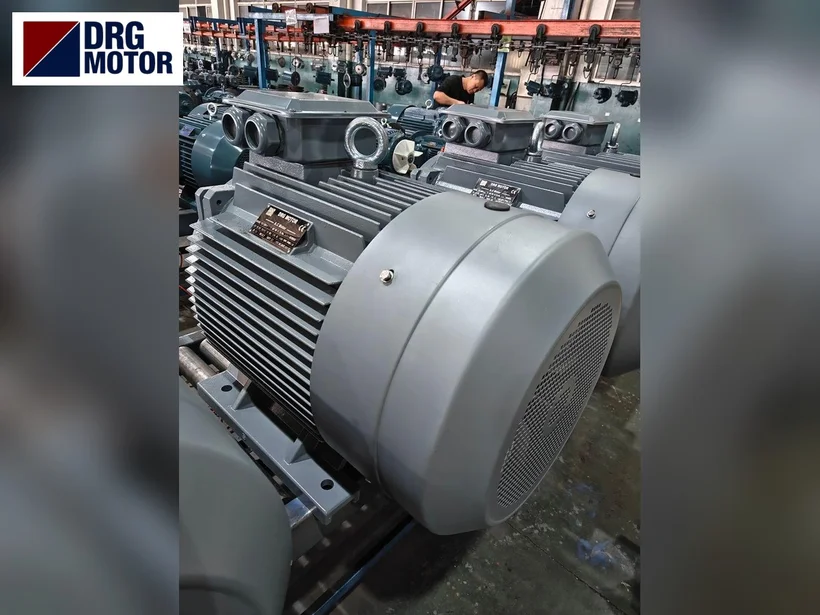
Vertical unit: motor on the lid, pump in the oil
On small and medium units the pump is placed inside the tank, submerged in oil, and the motor stands on the lid with its shaft pointing down. In this layout the motor is a B5 flange design working in the vertical V1 position. Leave room above the lid for air to reach the motor fan and keep the filler and breather away from the fan cowl.
Horizontal unit: frame, bell housing and foot bracket
On units with large tanks the motor and pump lie horizontally beside or above the tank. Either the motor has feet plus a flange (B35), or it hangs from the bell housing by the flange while a bracket under the bell housing carries the weight to the frame. One bell housing maker states that this bracket reduces the load on the motor’s bearing bracket to the B5/V1 level and lets the motor be removed without touching the pump.
Bell housing and coupling size follow the motor frame
The nominal sizes 200, 250, 300, 350 and 400 found in bell housing catalogues are the same as the outer diameter P of the motor’s B5 flange. A 132 frame motor therefore fits a 300 bell housing and a 160 frame motor a 350 one. B5 dimensions from our catalogue:
| Frame | Shaft D×E | Flange P / M / N | Hole S |
|---|---|---|---|
| 90S/90L | 24×50 | 200 / 165 / 130 | 12 |
| 100L/112M | 28×60 | 250 / 215 / 180 | 14.5 |
| 132S/132M | 38×80 | 300 / 265 / 230 | 14.5 |
| 160M/160L | 42×110 | 350 / 300 / 250 | 18.5 |
| 180M/180L | 48×110 | 350 / 300 / 250 | 18.5 |
| 200L | 55×110 | 400 / 350 / 300 | 18.5 |
The coupling hub is bored to the motor shaft D×E. If a different frame is chosen for the same kW, the bell housing changes too, which is why the old motor’s frame number matters on replacement.
How many kW is a power unit motor? Catalogue values
A) Standard power pack catalogues list the following motor sizes:
| Unit / model group | Motor power | Single / total | Note |
|---|---|---|---|
| Compact mini unit (AC motor) | up to 4 kW | single motor | first maker; single- and three-phase options |
| Vertical standard unit, 16 L tank | 0.55–1.5 kW | single motor | second maker, smallest tank |
| Vertical standard unit, 55 L tank | 2.2–7.5 kW | single motor | second maker |
| Vertical standard unit, 180 L tank | 7.5–30 kW | single motor | second maker, largest tank |
| Standard unit, 12–150 L tank, 210 bar | up to 7.5 kW | single motor | third maker |
| Standard unit with fixed vane pump | 0.55–9.3 kW | single motor | fourth maker; 1.1–11 kW with variable piston pump |
| Modular unit, tank up to 565 L | 3–37 kW (frames 100L–225S) | single motor | fifth maker; also sold without motor |
Standard unit motors stay roughly between 0.55 and 37 kW in the catalogues; one bell housing maker’s selection table runs from 0.25 kW on frame 71 to 160–200 kW on frame 315L (for 1500 rpm). Motor power grows with tank volume: in the same catalogue the 16-litre tank tops out at 1.5 kW and the 180-litre tank at 30 kW. As a design note, the tank volume is recommended to be at least three times the pump flow.
B) Overlap with the DRG range: each three-phase motor in the table has a counterpart with us; aluminium bodies suit the smaller packs, cast iron bodies the larger ones (aluminium stops at 11 kW, cast iron at 355 kW). What falls outside our range are the 12/24 V DC motors of mini units and single-phase motors.
Click to see current electric motor prices and order nowSEE PRICES →
kW from pressure and flow: the short way and reading a catalogue
As a rough rule, motor kW equals pressure in bar times flow in L/min divided by 600 × η, and pump flow is Q = displacement (cm³/rev) × speed / 1000. For the origin of the formula, the choice of η and a pressure-flow table, see our hydraulic pump kW calculation article. Here we do something else: compare the selection table of a unit catalogue with the formula.
Example: what pressure can a 2.2 kW motor reach?
The catalogue table gives the highest pressure reachable with a 2.2 kW motor at 1450 rpm for two pump sizes. We calculated the same values from the formula with η = 0.85:
| Pump (1450 rpm) | Flow | Pressure limit in catalogue | By formula (η 0.85) |
|---|---|---|---|
| 11 cm³/rev | 15.95 L/min | 74 bar | about 70 bar |
| 12 cm³/rev | 17.4 L/min | 70 bar | about 64.5 bar |
The catalogue gives slightly higher pressures than the formula, so it assumes lower losses. In practice the value found by the formula is on the safe side. If the relief valve is to be set at the catalogue limit, choosing the motor one step larger and measuring the motor current after pressure setting is the sound approach.
Starting and load by pump type
The pump type in the unit decides what the motor sees at start-up and in operation. Manufacturer catalogues list units with fixed vane, variable vane and variable piston pumps under separate power ranges.
Gear pump and fixed vane pump
It delivers the same volume every revolution. If the valve block does not send oil back to the tank, the motor is loaded at start by the pump turning against pressure. With an unloading valve or open-centre valve the motor runs up unloaded, then pressure builds.
Pressure-compensated variable pump
When the set pressure is reached the pump reduces its displacement; the motor draws little power while holding pressure and is loaded again during movement. On a variable pump unit the motor is therefore sized for the flow at the fastest movement and the working pressure, not for the holding phase.
When does star-delta help?
In star the motor torque falls to about one third. If the pump starts into an open circuit, star-delta lowers the starting current comfortably; if it starts against pressure, the motor may fail to run up in star. Our star-delta starting tool helps with calculation and wiring. On a 400 V network our small motors (3 kW or less) are wired in star and the 4 kW-and-up sizes in delta; a star-delta starter therefore suits only that second group.
Which machines need a power unit motor?
The unit stays the same; what changes is the way the machine works. Each machine has its own article:
- Press brake: rotation direction and pump-to-bell-housing fit are where most replacement mistakes occur; press brake motor replacement.
- Guillotine shear: short peak pressure at the cut; guillotine shear pump motor.
- Pipe bending: short strokes and long waits; pipe bending hydraulic unit motor.
- Filter press: long pressure-holding phase; filter press hydraulic unit motor.
- Plastic injection: the load changes throughout the cycle; for the machine pump motor see our injection pump motor article. Our Plastic Injection Machine Hydraulic Unit Motors page covers that cycle separately.
A power unit needs no brake; when the motor stops, a check valve or a locked cylinder holds the load. Brake motors are not in our range. Single-phase motors used on mini units are not in our range either; where a three-phase supply exists the unit can be moved to a three-phase motor, provided the pump-to-bell-housing dimensions stay the same with the new motor.
Power units with DRG motors
Since most hydraulic pumps are rated for 1500 rpm, the table below lists 4-pole models. Each model’s product record states its voltage (230/400 V or 400/690 V); all are IP55 with class F insulation.
| Model | Power / speed | Frame · shaft D×E | Current 400 V |
|---|---|---|---|
| DRG-90L-4 | 1.5 kW / 1445 rpm | 90L cast iron · 24×50 | 3.3 A |
| DRG-100L1-4 | 2.2 kW / 1450 rpm | 100L cast iron · 28×60 | 4.52 A |
| DRG-112M-4 | 4 kW / 1450 rpm | 112M cast iron · 28×60 | 7.95 A |
| DRG-132S-4 | 5.5 kW / 1460 rpm | 132S cast iron · 38×80 | 10.7 A |
| DRG-132M-4 | 7.5 kW / 1460 rpm | 132M cast iron · 38×80 | 14.3 A |
| DRG-160M-4 | 11 kW / 1465 rpm | 160M cast iron · 42×110 | 20.4 A |
| DRG-160L-4 | 15 kW / 1465 rpm | 160L cast iron · 42×110 | 27.3 A |
| DRG-180L-4 | 22 kW / 1470 rpm | 180L cast iron · 48×110 | 39.7 A |
| DRG-200L-4 | 30 kW / 1475 rpm | 200L cast iron · 55×110 | 53.8 A |
State B5 and V1 mounting in the order for a motor that sits vertically on a tank lid, and B35 for one bolted horizontally to a frame. The kW on the unit’s own plate is usually the motor rating; still, send the motor plate, shaft diameter, flange diameter and the size marked on the bell housing together. No fit is promised before the dimensions are seen; you can compare flange sizes in our technical drawings.
Live price table
Prices of power unit motors come live from the shop data:
| Model | Power / speed | Frame · current 400 V | Price |
|---|---|---|---|
| DRG-90L-42 HP | 1.5 kW · 1500 rpm | Cast iron 90L · 3.3 A | $144.14 (€128.73) Details & buy → |
| DRG-100L1-43 HP | 2.2 kW · 1500 rpm | Cast iron 100L · 4.52 A | $188.32 (€168.18) Details & buy → |
| DRG-112M-45.5 HP | 4 kW · 1500 rpm | Cast iron 112M · 7.95 A | $254.38 (€227.18) Details & buy → |
| DRG-132S-47.5 HP | 5.5 kW · 1500 rpm | Cast iron 132S · 10.7 A | $342.01 (€305.44) Details & buy → |
| DRG-132M-410 HP | 7.5 kW · 1500 rpm | Cast iron 132M · 14.3 A | $394.89 (€352.66) Details & buy → |
| DRG-160M-415 HP | 11 kW · 1500 rpm | Cast iron 160M · 20.4 A | $568.76 (€507.94) Details & buy → |
| DRG-160L-420 HP | 15 kW · 1500 rpm | Cast iron 160L · 27.3 A | $678.13 (€605.61) Details & buy → |
| DRG-180L-430 HP | 22 kW · 1500 rpm | Cast iron 180L · 39.7 A | $919.45 (€821.13) Details & buy → |
| DRG-200L-440 HP | 30 kW · 1500 rpm | Cast iron 200L · 53.8 A | $1,235.00 (€1,102.93) Details & buy → |
DRG MOTOR motors are guaranteed against material and manufacturing defects for 2 years from the delivery date (warranty certificate).
Motors in this power range
- DRG-100L1-4 – 2.2 kW – 1450 rpm – 100L cast iron
- DRG-132M-4 – 7.5 kW – 1460 rpm – 132M cast iron
- DRG-160M-4 – 11 kW – 1465 rpm – 160M cast iron
- DRG-180L-4 – 22 kW – 1470 rpm – 180L cast iron
- DRG-200L-4 – 30 kW – 1475 rpm – 200L cast iron
Click to see current prices and order these motors nowSEE PRICES →
Products and quotes: you can find the match for your unit motor on the Buy Electric Motors Online page. Send photos of the motor plate, bell housing and pump via WhatsApp or call +90 (542) 666 11 11. For other pump applications see the Pump Motors category, and for all industrial motors the General Purpose Industrial Electric Motors page.
Frequently asked questions
Is the kW on the unit plate the motor’s or the pump’s?
Unit plates usually show the rated power of the fitted motor. For the pump the given values are displacement (cm³/rev) and maximum pressure; you work out the power from these two and the speed.
Can I replace the motor of a vertical unit with a horizontal motor?
A motor for vertical operation must be ordered for vertical mounting and the axial load confirmed by the pump manufacturer. A motor of the same frame and flange ordered as V1 sits on the lid.
The unit runs hot; is the motor too small?
Check the oil temperature and the motor current first. Hot oil is often caused by oil constantly dumped over the relief valve or by a small tank; if the motor current is below the plate value, the motor is not undersized. For the relay setting, use our overload-fuse-contactor calculator.
Is the price of a power unit motor shown online?
The live table above pulls current prices of 4-pole unit motors from the shop.
Questions: +90 (542) 666 11 11 · info@drgmotor.com · contact.


