 English
 Le français
 Türkçe

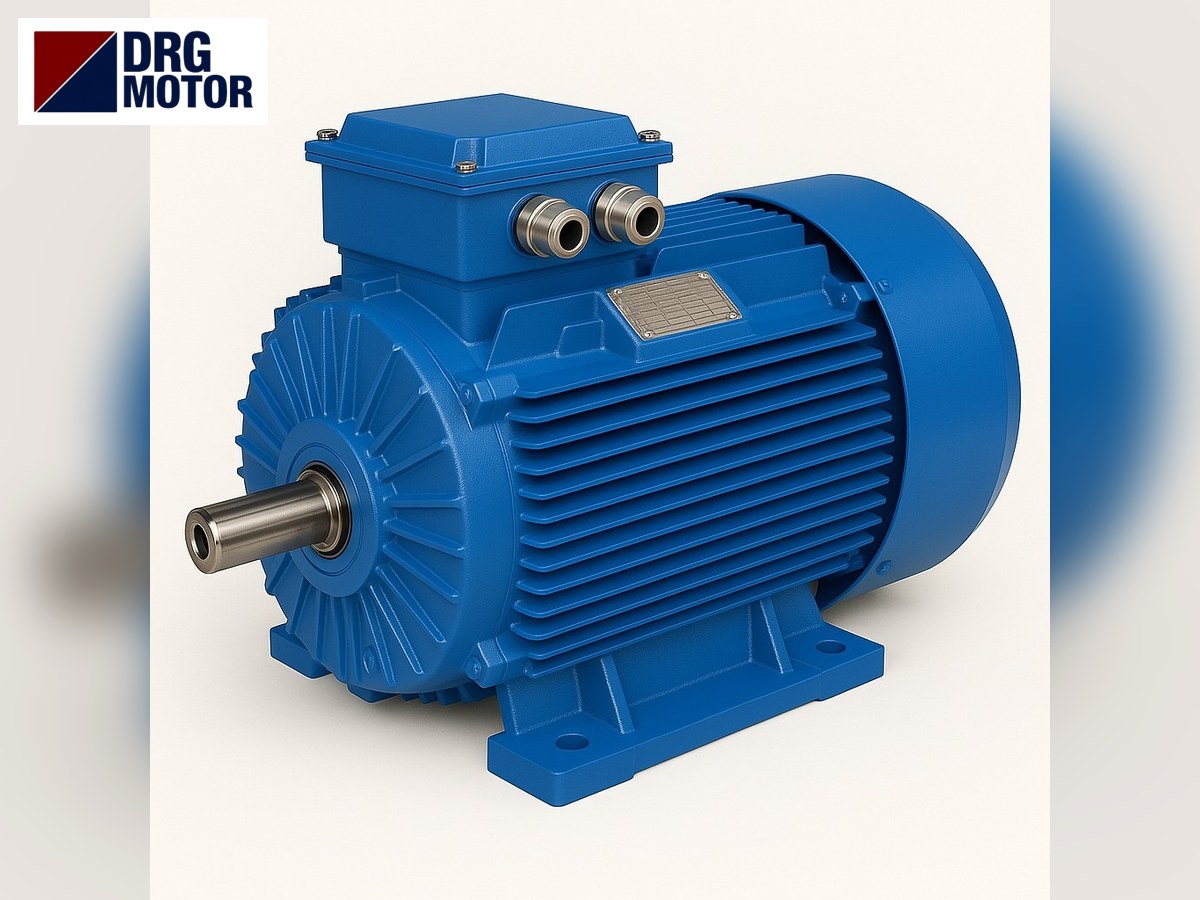
A thicknesser (thickness planer) draws the board under the cutterblock with powered rollers and brings it out with both faces parallel and at the set size. To do that it usually runs not one but three electric motors: the main motor that spins the block, the feed motor that moves the board, and the table lift motor that sets the dimension. Maker catalogues list main motors of 7–22 kW, feed motors of 1.5–3.7 kW and a 0.37 kW table motor for working widths of 520–1350 mm. Surface planers and four-sided moulders are not the subject of this page.
DRG Motor is a manufacturer, supplier and seller of electric motors. We do not sell thicknessers, cutterblocks, feed rollers, gearboxes, inverters or brake modules, and hydraulic units, electro-spindles or servo drives are likewise outside what we offer. On this machine our part is the three-phase induction motors of the main drive, the feed and the table lift. Options are on Buy Electric Motors Online.
What each of the three motors does
The board rests on a cast-iron table; a serrated infeed roller grips it, the block cuts from above, and a smooth outfeed roller pushes it out. Two idle rollers set in the table cut friction. The finished size is the distance between table and block; the operator keys in a value on the digital readout and the table motor moves the table there through its screws. Each motor sees a different kind of load, so each is chosen on its own.
Main motor: the cutterblock
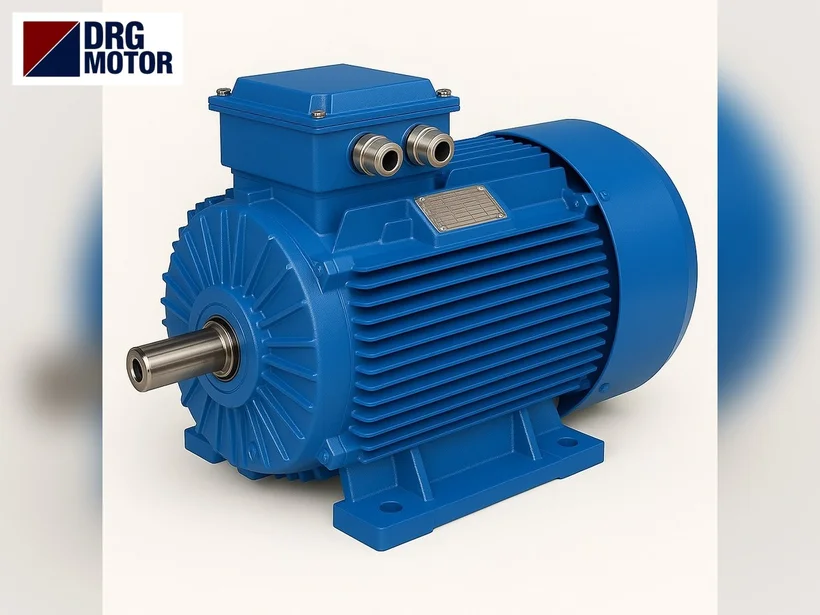
The block cuts across the whole width of the board; catalogues give speeds of 4000–6000 rpm. The main motor is 2-pole and drives the block through belt and pulleys. Its rating grows with width and depth of cut: 7–9.2 kW in the 630 mm class, 22 kW on a 1350 mm wide machine. A heavy block and large pulley mean high starting inertia, so star-delta is used at the larger ratings.
Feed motor: rollers and travel
The feed motor is 4-pole and turns infeed and outfeed rollers together through a gearbox, chain or cardan shafts. Catalogues give 4–22 m/min, often stepless by inverter. Hardwood and fine finishing call for slow feed; softwood roughing for fast feed. Faster feed raises the volume of wood the main motor removes each second, so the two motors have to be considered together.
Table lift motor
This small motor turns the four corner screws via chain or gears. The load is heavy but the movement is short and occasional: the motor runs a few seconds when the size is changed, then stops. The screw thread itself keeps the table from creeping down under its weight; whether the motor also needs a brake is shown in the machine maker’s diagram. When it fails, check the limit switches and gearbox along with the motor.
How it differs from the surface planer and the combination machine
On a surface planer the block sits in the table, the operator pushes the board and no thickness is set; there is one motor. A thicknesser sets the size, the feed is motorised and the block sits above the board. A board entering the thicknesser should already have one face trued; otherwise a bowed board is pressed flat by the rollers and springs back as it leaves.
Double-sided thicknesser
In series production both faces are machined in one pass: a lower block trues the board and the upper block gives the thickness. There are two main motors and a stronger feed motor; one catalogue lists 11 kW on the top block, 7.5 kW on the bottom block and 3 kW feed for the 620 mm model. A combined planer-thicknesser, by contrast, does both jobs one after the other with a single motor, and a machine that cuts all four sides at once is a four-sided moulder.
How many kW for a thicknesser motor? Catalogue values
A) Motor ratings published by thicknesser builders:
| Machine | Motor power | Single / total | Note |
|---|---|---|---|
| Thicknesser, 630 mm, Ø120 block | block 7.5 kW · feed 1.5 kW · table 0.37 kW | three separate motors | maker catalogue A |
| Thicknesser, 640 mm, block 6000 rpm | block 7.5 kW · feed 1.5 kW · table 0.37 kW | total 9.37 kW | maker catalogue B |
| Thicknesser, 520–630 mm | block 7 kW; 9 kW on request | main motor | maker catalogue C |
| Thicknesser, 630 mm | block 9.2 kW; 14 kW on request | main motor | maker catalogue D |
| Wide thicknesser, 1350 mm | block 22 kW · feed 3.7 kW | two separate motors | catalogue B, widest model |
| Double-sided thicknesser, 420 / 620 mm | top 7.5 / 11 kW · bottom 7.5 kW · feed 2.2 / 3 kW | three motors | catalogue B |
Depending on model and working width, this group shows roughly 7–22 kW on the main motor, 1.5–3.7 kW on the feed and 0.37 kW on the table drive. Where a row lists several drives, add them up only for the panel, never for one motor. Small single-phase hobby thicknessers are on sale too; DRG has no single-phase motors, so ask us about a machine of that class.
B) Overlap with the DRG range: 7.5–22 kW main motors are covered by our 2-pole cast-iron models in 132S, 160M, 160L and 180M frames; 1.5–3 kW feed motors by 4-pole 90L and 100L frames; the 0.37 kW table motor by a 71-frame aluminium model. In-between catalogue figures such as 7, 9 and 9.2 kW correspond to our 7.5 and 11 kW steps, and 14 kW to 15 kW. When the step goes up, check whether shaft diameter, pulley and protective devices change.
Click to see current electric motor prices and order nowSEE PRICES →
Worked example: feed roller speed and surface finish
Here the catalogue feed band of 5–18 m/min is worked through for a Ø70 mm roller driven by DRG-90L-4 (4-pole, 1.5 kW):
| Step | Operation | Result | Comment |
|---|---|---|---|
| Roller speed at 18 m/min | 18 / (π × 0.070) | about 82 rpm | Ø70 mm feed roller |
| Overall reduction | 1445 / 82 | about 17.6 | DRG-90L-4, 1.5 kW |
| Roller speed at 5 m/min | 5 / (π × 0.070) | about 23 rpm | slowest catalogue speed |
| Required frequency | 50 Hz × 5 / 18 | about 14 Hz | same ratio, via inverter |
| Knife mark, 18 m/min | 18000 / (4 × 5000) | 0.9 mm | 4 knives, 5000 rpm block |
| Knife mark, 5 m/min | 5000 / (4 × 5000) | 0.25 mm | fine finish |
The gearbox and chain sprockets provide this ratio between them; you can try it with the gearbox output speed calculator. If the motor is to run around 14 Hz for long periods its own fan will not keep up; consider a separate fan or a lighter load. The last two rows show what feed does to the surface: at fast feed the knife marks open up almost fourfold.
Braking, starting and chips: points specific to a thicknesser
Stopping the main motor
On a thicknesser the knives sit inside a closed hood, yet the block must be fully at rest before the service cover is opened. Fast stopping is usually done by a direct-current brake: a short DC injection is applied to the winding at switch-off. It works with a standard induction motor. Mechanically braked motors are not in the DRG range; if your machine has a motor with a brake lining, let us know.
Starting in sequence
The right order is main motor first, feed second; if the feed runs before the block is up to speed, the board meets idle knives. The control circuit provides this interlock. Star-delta is common on main motors of 7.5 kW and above; the wiring of the changeover is explained on the starting methods page.
Shavings and extraction
A wide thicknesser produces a large volume of shavings every minute; catalogues show one or two extraction outlets of 150–160 mm. If extraction is weak, shavings get under the rollers, the feed motor load rises and the main motor labours in a choked hood. For extraction-side motors see the Fan Motors category and our extraction motor supply article.
DRG motors for thicknessers
Models suited to the main, feed and table drives (current at 400 V):
| Model | Power / speed | Frame · shaft D×E | Current 400 V |
|---|---|---|---|
| DRG-132S2-2 | 7.5 kW / 2930 rpm | 132S cast iron · 38×80 | 13.7 A |
| DRG-160M1-2 | 11 kW / 2945 rpm | 160M cast iron · 42×110 | 19.6 A |
| DRG-160M2-2 | 15 kW / 2945 rpm | 160M cast iron · 42×110 | 26.5 A |
| DRG-180M-2 | 22 kW / 2955 rpm | 180M cast iron · 48×110 | 38.5 A |
| DRG-90L-4 | 1.5 kW / 1445 rpm | 90L cast iron · 24×50 | 3.3 A |
| DRG-712-4 | 0.37 kW / 1340 rpm | 71 aluminium · 14×30 | 0.92 A |
Cast-iron frames (0.55–355 kW) are usual for the main motor and aluminium frames (0.25–11 kW) for the small drives. Speed options are 3000, 1500 and 1000 rpm; mounting may be B3 foot, B5 or B14 flange, B34 and B35 combined, or vertical. When taking motors off a thicknesser, record for each of the three a nameplate photo, shaft and key size and the pulley or gearbox connection. We compare these with the machine’s wiring diagram and confirm fit with you; we promise exact fit for no machine.
Flange connection dimensions (B5)
On many machines the feed and table motors are flanged to a gearbox. B5 dimensions from the DRG catalogue (mm):
| Frame | Shaft D×E | Flange P / M / N | Hole S |
|---|---|---|---|
| 71 | 14×30 | 160 / 130 / 110 | 10 |
| 90S/90L | 24×50 | 200 / 165 / 130 | 12 |
| 132S/132M | 38×80 | 300 / 265 / 230 | 14.5 |
| 160M/160L | 42×110 | 350 / 300 / 250 | 18.5 |
Foot dimensions and other drawings are on our technical drawings page.
Live price table
Current shop prices for motors suited to the main and auxiliary drives of a thicknesser:
| Model | Power / speed | Frame · current 400 V | Price |
|---|---|---|---|
| DRG-712-40.5 HP | 0.37 kW · 1500 rpm | Aluminium 71 · 0.92 A | $76.76 (€68.55) Details & buy → |
| DRG-90L-42 HP | 1.5 kW · 1500 rpm | Cast iron 90L · 3.3 A | $144.14 (€128.73) Details & buy → |
| DRG-100L2-44 HP | 3 kW · 1500 rpm | Cast iron 100L · 6.02 A | $203.84 (€182.05) Details & buy → |
| DRG-132S2-210 HP | 7.5 kW · 3000 rpm | Cast iron 132S · 13.7 A | $369.43 (€329.92) Details & buy → |
| DRG-160M1-215 HP | 11 kW · 3000 rpm | Cast iron 160M · 19.6 A | $527.95 (€471.49) Details & buy → |
| DRG-160M2-220 HP | 15 kW · 3000 rpm | Cast iron 160M · 26.5 A | $570.23 (€509.25) Details & buy → |
| DRG-160L-225 HP | 18.5 kW · 3000 rpm | Cast iron 160L · 32.5 A | $714.00 (€637.65) Details & buy → |
| DRG-180M-230 HP | 22 kW · 3000 rpm | Cast iron 180M · 38.5 A | $857.53 (€765.83) Details & buy → |
DRG MOTOR motors are guaranteed against material and manufacturing defects for 2 years from the delivery date (warranty certificate).
Motors in this power range
- DRG-132S2-2 – 7.5 kW – 2930 rpm – 132S cast iron
- DRG-160M1-2 – 11 kW – 2945 rpm – 160M cast iron
- DRG-180M-2 – 22 kW – 2955 rpm – 180M cast iron
- DRG-90L-4 – 1.5 kW – 1445 rpm – 90L cast iron
- DRG-712-4 – 0.37 kW – 1340 rpm – 71 aluminium
Click to see current prices and order these motors nowSEE PRICES →
Browse the products, request an offer: send the nameplates of the main, feed and table motors as separate photos via WhatsApp and we will reply on each one. All models are on Buy Electric Motors Online; we are also reachable on +90 (542) 666 11 11.
Frequently asked questions
Can a burnt feed motor be replaced with one of the same power but a different speed?
Roller speed changes in direct proportion to motor speed; fitting a 1000 rpm motor in place of a 1500 rpm one cuts feed by a third. The gearbox mounting dimension may also differ. Stay with the same speed.
Does it make sense to go one step up on the main motor?
Only if belts, pulleys, block bearings and panel suit that rating. A larger motor eases the main drive but does not change roller grip or block strength; the decision follows the machine maker’s figures.
The table motor runs but the table does not rise. Is the motor faulty?
Usually not: check the chain, the screws, keys and limit switch. Once you have measured that the motor turns and draws current, move on to the mechanical side.
For any question about your thicknesser motors, write to info@drgmotor.com or use our contact page. For a general introduction, there is our woodworking electric motor article.


