 English
 Le français
 Türkçe

A stone separating roller has two rolls, one smooth and one with a helical groove cut into its surface; as clay is squeezed through the gap, hard stones that cannot be crushed drop into the groove, are carried sideways by the roll’s rotation and thrown out at the edge of the machine. The rolls are usually driven by two separate electric motors through belts or gearboxes, and their speeds differ. Catalogues for brick plants show 22–75 kW per roll. In short, the stone separating roller does not crush stone, it removes it from the clay; fine crushing of the clay is the job of the crushing rolls that follow.
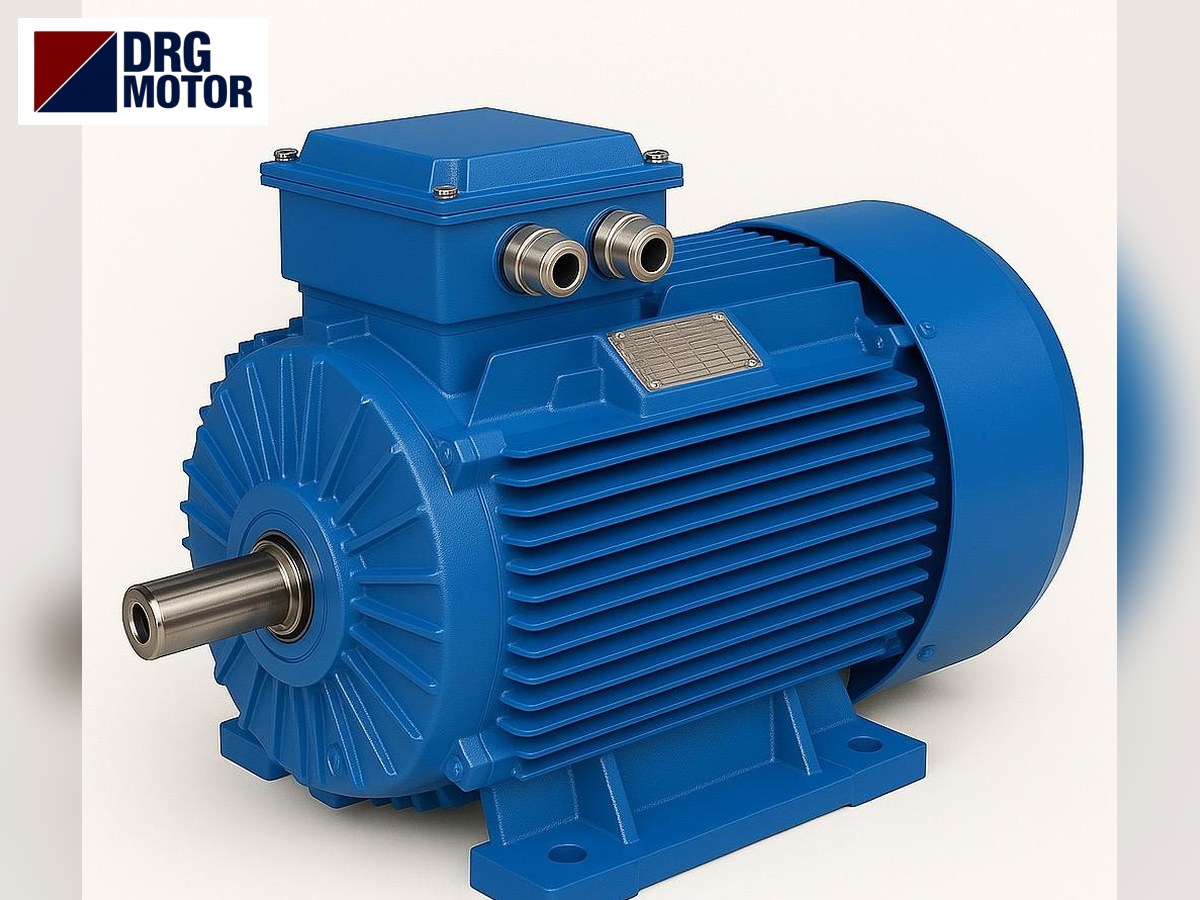
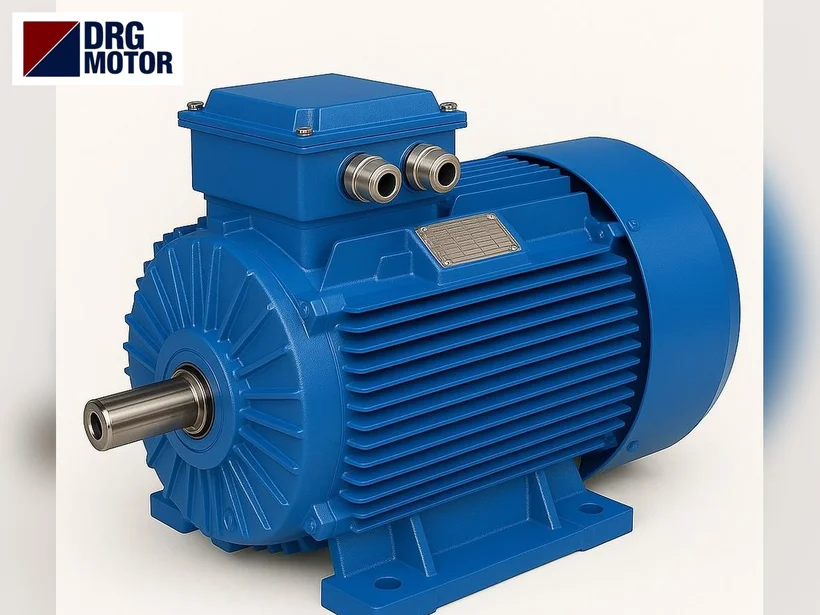
DRG Motor is a manufacturer, supplier and seller of electric motors. We do not sell the roller machine, roll shells, scrapers, gearboxes or inverters; our contribution is the three-phase asynchronous motor behind the rolls. Models are listed on the Buy Electric Motors Online page.
How does a stone separating roller work?
Clay coming from the crusher must be spread evenly along the roll length; one maker recommends a wide belt with a clay leveller for this and asks for a magnet on the feed belt to catch metal pieces. The rolls sit a few millimetres apart, with the gap set by adjusting screws. Clay passes smeared onto the smooth roll, whose surface is kept clean by an exchangeable scraper. Small, soft stones are crushed with the clay, while large, hard ones are separated: a domestic maker writes that hard bodies above 15 mm that cannot be crushed are removed.
Helical grooved roll and smooth roll
The grooved roll turns slowly; its groove acts like a screw, carrying the stone to one end of the roll and its discharge hatch. The smooth roll turns faster and draws the clay into the gap. The grooved roll is faced with wear-resistant hard metal; if the smooth roll loses parallelism, crushing becomes uneven, which is why a grinder for the smooth roll also appears in accessory lists.
Beater-bar stone separating rolls
Some makers separate stones with a different machine: a fast roll carrying beater bars works against a large feed roll. This type pre-crushes clay up to 3 Mohs and removes small stones at the same time. Its motor layout differs as well: the beater roll takes the big motor (45–75 kW in one data sheet), while the feed roll turns on a small motor of 5.5–11 kW.
How it differs from clay crushers and crushing rolls
All three machines work with two rolls and are often confused. A clay crusher has toothed or knife rolls that break large lumps, with a gap of tens of millimetres. In a stone separating roller one roll is grooved, the task is separation and the gap is a few millimetres. Crushing rolls have two smooth rolls, a gap going below one millimetre and a much higher surface speed, so their motors are clearly larger. Skipping the stone separating roller lets hard stones score the shells of the crushing rolls and upset their gap.
One motor or two?
A domestic maker states that its machine is built to be driven by one or two motors. With one motor the two rolls are linked by a belt or gear arrangement and the speed difference comes from the pulley ratio. With two motors each roll has its own pulley or gearbox; an Italian maker drives the rolls with two right-angle geared motors and mounts the grooved roll’s motor on a movable support that follows shell wear. With two motors, keeping both at the same pole count is the simplest way to preserve the pulley ratios.
How many kW for a stone separating roller motor?
A) Motor ratings given in makers’ catalogues for stone separating and stone removing rollers:
| Machine / roll | Motor power | Single / total | Note |
|---|---|---|---|
| Stone separating roller, Ø500×700 mm | 22 kW + 22 kW | two motors, 44 kW total | first maker, 40–60 t/h, 220–245 rpm |
| Stone separating roller, Ø600×1200 mm | 30 kW + 30 kW | two motors, 60 kW total | first maker, 70–100 t/h |
| Stone separator roller, Ø500×700 mm | 22 kW + 22 kW | per roll | second maker, 250/225 rpm |
| Grooved-roll stone separator, 750×1000 mm | 55 kW + 37 kW | fast and slow roll differ | third maker, 40–70 m³/h |
| Same series, heavy type | 75 kW + 45 kW | two motors, 120 kW total | third maker, 50–100 m³/h |
| Beater-bar stone separating roller, 800 mm | 45 kW / 5.5 kW | beater roll / feed roll | fourth maker, gap 5–25 mm |
| Same series, 1200 mm | 75 kW / 5.5–11 kW | beater roll / feed roll | fourth maker, 176 t/h wet |
Published figures for these rollers sit at roughly 22–75 kW per roll, varying with model and roll size; feed rolls on beater-bar types run on 5.5–11 kW. The total for a twin-motor machine stays between 44 kW and 120 kW. Higher capacity and harder clay call for a larger model and motor; do not confuse single-motor power with the machine total.
B) Overlap with the DRG range: the whole 5.5–75 kW band lies within our range. Our 4- and 6-pole models in 180L and 200L frames suit 22 and 30 kW roll motors, cast iron frames from 225S to 280S suit 37–75 kW, and 132S and 160M frames suit feed rolls. With geared drives the motor comes from us and the gearbox from the machine maker or your gearbox supplier.
Click to see current electric motor prices and order nowSEE PRICES →
Example: pulley ratios for two rolls at different speeds
The first maker’s Ø500×700 mm roller lists roll speeds of 220–245 rpm and motors of 22 kW + 22 kW. Taking 245 rpm for the fast roll and 220 rpm for the slow roll, let us work out surface speeds and the pulley ratios needed with two different DRG motors:
| Quantity | Calculation | Result | Comment |
|---|---|---|---|
| Fast roll surface speed | π × 0.5 × 245 / 60 | about 6.4 m/s | first maker’s Ø500 roll |
| Slow roll surface speed | π × 0.5 × 220 / 60 | about 5.8 m/s | difference of roughly 10 per cent |
| Fast-side ratio with DRG-180L-4 | 1470 / 245 | about 6.0 | 4 poles, 22 kW |
| Slow-side ratio with DRG-180L-4 | 1470 / 220 | about 6.7 | same motor, different pulley |
| Fast / slow ratio with DRG-200L2-6 | 980 / 245 and 980 / 220 | about 4.0 and 4.5 | 6 poles, 22 kW |
| Torque on the roll shaft | 9550 × 22 / 245 and / 220 | about 858 and 955 Nm | the slow roll carries more torque |
Even with two motors of equal power and speed, the pulley ratios differ; that difference smears the clay onto the smooth roll and helps the stone roll into the groove. Changing the pole count on replacement means recalculating both pulley pairs. Try diameters with the pulley and belt calculator and, on geared layouts, check the output speed with the gearbox output speed tool.
What happens to the motor when a stone arrives?
When a hard stone jams in the gap, the rolls are forced to stall for a moment and motor current jumps. Machines carry hydraulic or spring safety devices for this, and one maker offers rotation sensors on the fast and slow shafts as accessories. On the motor side, the task is to set the thermal or electronic overcurrent relay to the nameplate current and to interlock the two motors so that if one stops the other stops too. Otherwise one roll keeps turning, clay does not pass properly and the grooved roll wears for nothing.
Information needed
- Nameplates of both roll motors: kW, speed, voltage, connection.
- One motor or two; belt or gearbox drive?
- Pulley diameters for belts; input flange (B5) and shaft size for gearboxes.
- Roll diameter and width, expected throughput.
- Starting method and interlock between the two motors.
- Environment: clay dust, mud splashes, outdoor installation (our motors are IP55).
Items outside our range
Small motors that set the roll gap automatically are often machine-specific geared or brake units; brake motors, servos and single-phase motors are outside our range. If roll pressure comes from a hydraulic unit, the unit is not supplied by us; for the pump motor alone see the hydraulic pump motor selection article. Should the roller area be classified as hazardous, for instance because of coal dust, an Ex-rated motor becomes mandatory and our standard motors do not come with that certificate.
DRG motors for stone separating rollers
Our models matching roll and feed motor ratings (current at 400 V):
| Model | Power / speed | Frame · shaft D×E | Current 400 V |
|---|---|---|---|
| DRG-132S-4 | 5.5 kW / 1460 rpm | 132S cast iron · 38×80 | 10.7 A |
| DRG-160M-4 | 11 kW / 1465 rpm | 160M cast iron · 42×110 | 20.4 A |
| DRG-180L-4 | 22 kW / 1470 rpm | 180L cast iron · 48×110 | 39.7 A |
| DRG-200L2-6 | 22 kW / 980 rpm | 200L cast iron · 55×110 | 42.5 A |
| DRG-200L-4 | 30 kW / 1475 rpm | 200L cast iron · 55×110 | 53.8 A |
| DRG-225M-6 | 30 kW / 980 rpm | 225M cast iron · 60×140 | 56.2 A |
| DRG-225S-4 | 37 kW / 1485 rpm | 225S cast iron · 60×140 | 66.1 A |
| DRG-250M-4 | 55 kW / 1485 rpm | 250M cast iron · 65×140 | 97.6 A |
| DRG-280S-4 | 75 kW / 1486 rpm | 280S cast iron · 75×140 | 129 A |
Belt-driven rollers use a B3 foot motor on a tensioning slide; on geared types a flange-mounted (B5) motor fits the gearbox input. All motors in our range are 3-phase asynchronous IEC motors, available in aluminium to 11 kW and in cast iron to 355 kW. We confirm fit with the old motor’s nameplate, shaft and key dimensions and mounting face; we give no firm promise of fit without dimensions.
B5 flange dimensions for geared drives
B5 values of frames often used on geared rollers, mm:
| Frame | Shaft D×E | Flange P / M / N | Hole S |
|---|---|---|---|
| 132S/132M | 38×80 | 300 / 265 / 230 | 14.5 |
| 160M/160L | 42×110 | 350 / 300 / 250 | 18.5 |
| 180M/180L | 48×110 | 350 / 300 / 250 | 18.5 |
| 200L | 55×110 | 400 / 350 / 300 | 18.5 |
On a gearbox input, the motor’s D (shaft), E (shaft length) and N (spigot) must equal the gearbox values. For details see our flange motor for gearboxes article and the technical drawings.
Live price table
Prices of models in stone separating roller ratings are fetched from the shop:
| Model | Power / speed | Frame · current 400 V | Price |
|---|---|---|---|
| DRG-132S-47.5 HP | 5.5 kW · 1500 rpm | Cast iron 132S · 10.7 A | $342.01 (€305.44) Details & buy → |
| DRG-160M-415 HP | 11 kW · 1500 rpm | Cast iron 160M · 20.4 A | $568.76 (€507.94) Details & buy → |
| DRG-200L2-630 HP | 22 kW · 1000 rpm | Cast iron 200L · 42.5 A | $1,194.62 (€1,066.87) Details & buy → |
| DRG-180L-430 HP | 22 kW · 1500 rpm | Cast iron 180L · 39.7 A | $919.45 (€821.13) Details & buy → |
| DRG-200L-440 HP | 30 kW · 1500 rpm | Cast iron 200L · 53.8 A | $1,235.00 (€1,102.93) Details & buy → |
| DRG-225S-450 HP | 37 kW · 1500 rpm | Cast iron 225S · 66.1 A | $1,527.18 (€1,363.87) Details & buy → |
| DRG-225M-460 HP | 45 kW · 1500 rpm | Cast iron 225M · 80.2 A | $1,688.50 (€1,507.94) Details & buy → |
| DRG-250M-475 HP | 55 kW · 1500 rpm | Cast iron 250M · 97.6 A | $2,065.73 (€1,844.82) Details & buy → |
| DRG-280S-4100 HP | 75 kW · 1500 rpm | Cast iron 280S · 129 A | $2,916.93 (€2,605.00) Details & buy → |
DRG MOTOR motors are guaranteed against material and manufacturing defects for 2 years from the delivery date (warranty certificate).
Motors in this power range
- DRG-180L-4 – 22 kW – 1470 rpm – 180L cast iron
- DRG-200L-4 – 30 kW – 1475 rpm – 200L cast iron
- DRG-225S-4 – 37 kW – 1485 rpm – 225S cast iron
- DRG-250M-4 – 55 kW – 1485 rpm – 250M cast iron
- DRG-280S-4 – 75 kW – 1486 rpm – 280S cast iron
Click to see current prices and order these motors nowSEE PRICES →
Browse products, ask for a quote: motors for your roller are listed on the Buy Electric Motors Online page. Send photos of both nameplates to our WhatsApp line or call +90 (542) 666 11 11; we will clarify roll speeds and the drive layout together.
Frequently asked questions
Is a stone separating roller the same as a clay roller?
"Clay roller" is a general name covering stone separating rollers, crushing rolls and some crushers. You can spot the stone separator by its grooved roll.
Can the two roll motors have different ratings?
Yes; some makers give the fast roll a larger motor (for example 55 kW + 37 kW). Keep the same pairing when replacing.
Why do the rolls turn at different speeds?
The speed difference smears clay on the smooth roll and helps the stone head for the groove; at equal speeds separation weakens.
What does the price of a stone separating roller motor depend on?
Power, pole count and frame; current figures sit in the price table earlier on this page.
Questions: +90 (542) 666 11 11 · info@drgmotor.com · contact.


