 English
 Le français
 Türkçe

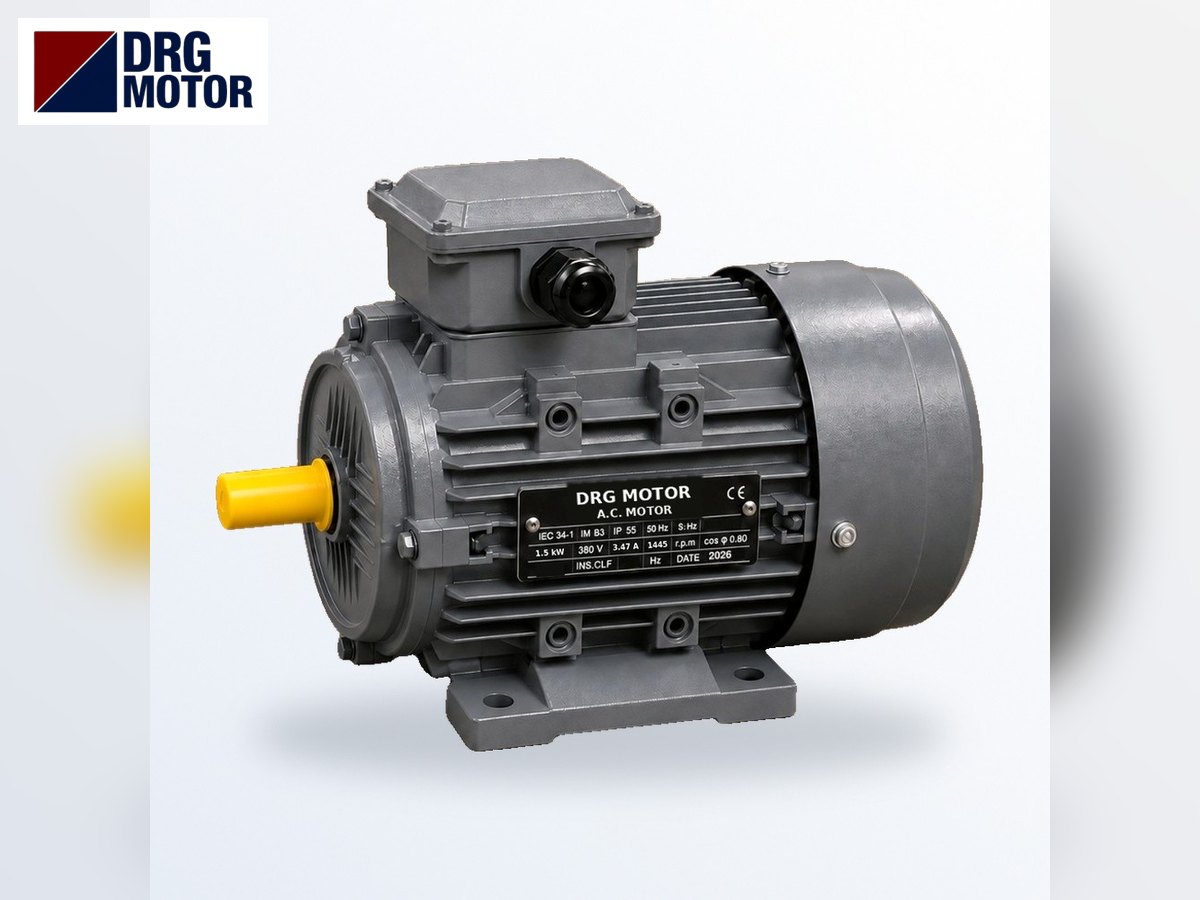
On a pallet stretch wrapper the electric motor produces three movements: it rotates the load or the film arm, moves the film carriage up and down the mast, and on many models drives the rollers that stretch the film. All of these drives are small; on machines on the market the rotation motor is mostly 0.75–1.1 kW and the carriage and pre-stretch motors sit around 0.18–0.37 kW. This band falls in the lower part of our aluminium housing electric motors range.
DRG Motor is a manufacturer, supplier and seller of electric motors. We do not sell the stretch wrapper itself, worm gearboxes, turntable gears, chains, film carriages, frequency inverters or brake motors; we supply the three-phase aluminium-frame asynchronous motor that is coupled to these parts.
Which motor drives what on a stretch wrapper?
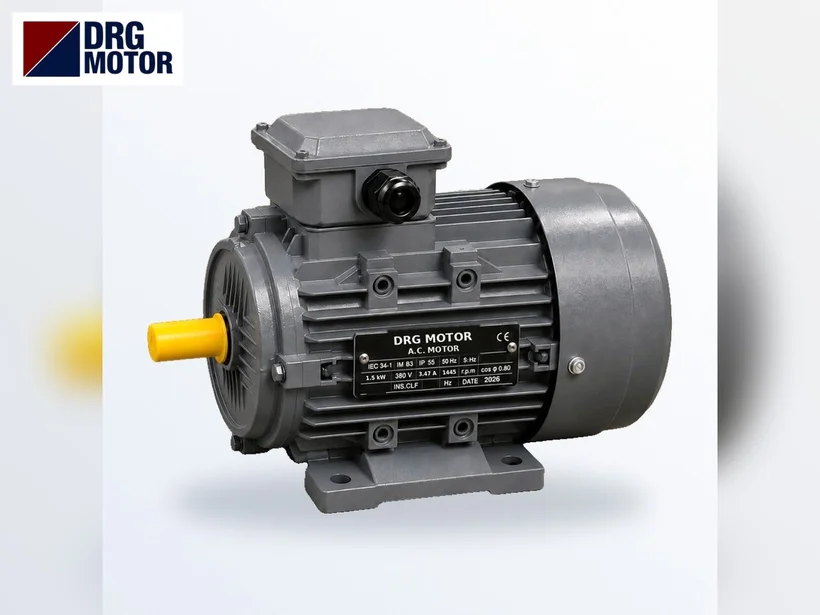
Turntable drive
On a turntable machine the pallet stands on a round table that turns a few revolutions per minute. The motor sits in the low base under the table; motion passes through a worm gearbox to a chain sprocket or to a ring gear around the table. To let a heavy load start without jerking, the speed ramp is set by an inverter.
Raising and lowering the film carriage
The carriage holding the film roll is pulled inside the mast by a chain. On most machines its motor sits at the foot or top of the mast and works through a self-locking worm gearbox. The control follows the carriage with limit switches; in each cycle the carriage climbs from bottom to top and comes back down.
Pre-stretch rollers
With powered pre-stretch, two rubber rollers turn at different speeds and elongate the film before it reaches the pallet. The motor turning these rollers travels up and down on the carriage. Many machines use a small motor here whose housing is made for that machine or which forms one unit with its gearbox; such motors are outside our range.
Rotary arm machines and conveyor lines
For light loads that tip over easily the pallet stays still and the film arm circles around it. The rotation motor is then on the top beam and the carriage motor rides on the rotating arm. An automatic conveyor line adds pallet conveyors, a film cut-and-seal unit and a top sheet dispenser; choosing the conveyor motors is a separate task. The split of duties is clear: one motor rotates, one lifts, one stretches; a failure in one does not mean replacing the others.
Motor ratings on stretch wrappers on the market
A) Values given in maker sheets and user manuals:
| Machine type | Rotation drive | Carriage and pre-stretch | Note |
|---|---|---|---|
| Semi-automatic turntable, single-phase supply | turntable 750 W | carriage 370 W; lift through a worm gearbox | user manual, parts list |
| Fully automatic turntable, 220 V | turntable 0.75 kW, 0–10 rpm | lift 0.25 kW, pre-stretch 0.25 kW | product sheet |
| Inline automatic, 380 V three-phase | turntable 0.75 kW | lift 0.18 kW, pre-stretch 0.18 kW | product sheet |
| Heavy-duty turntable | turntable 1.5 HP, inverter-driven, 0–16 rpm | pre-stretch 1 HP, carriage 1 HP | one-page technical sheet |
| Rotary arm automatic, 380 V | arm 1.1 kW (1.5 kW option) | film feed 0.37 kW, carriage 0.37 kW (0.55 kW option) | product sheet |
Rotation drives fall between 0.75 and 1.5 kW, while lift and pre-stretch stay at 0.18–0.55 kW. Load weight, table diameter and wrapping speed push the rotation motor up; the figures come from sample models, and on your own machine the nameplate and the machine maker’s documents govern.
B) Overlap with the DRG range: for turning, lifting and stretching drives rated 0.25–1.5 kW, the matching aluminium motors are those with 71, 80 and 90 frames. Motors of 0.18 kW and below are not in our range; the lightest aluminium motor we list is 0.25 kW; fitting it where a 0.18 kW unit used to sit means comparing its frame, shaft and flange with the removed one. A drive close to 11 kW does not appear on these machines.
Click to see current electric motor prices and order nowSEE PRICES →
Why an aluminium frame suits stretch wrappers
Less mass on the moving carriage and arm
The pre-stretch motor travels the mast with the carriage in every cycle; on a rotary arm machine the carriage motor also circles with the arm. Less moving mass means less load on the lifting chain, the arm bearings and the counterweight. That is the real gain: a lighter motor reduces the weight of the part that moves.
Fitting into a low turntable base, easier service
The turntable motor lies horizontally inside a base only a few tens of centimetres high. A finned aluminium housing makes it easier to fit into that narrow space and to lift out by hand when it fails. Portable turntables moved by forklift also become slightly lighter overall.
Cast iron has its own strengths: machines exposed to constant shocks, strong vibration or power demand above 11 kW are better served by a cast iron frame. A stretch wrapper is not in that class, so an aluminium housing is a comfortable choice here.
Dimensions and connections checked when choosing the motor
Read power, synchronous and rated speed, voltage and connection (star or delta) from the old motor’s plate. Then settle the mounting: on worm gearboxes the motor usually sits on a small flange (B14) or a large flange (B5); a foot-mounted B3 motor appears only on belt or chain layouts. Shaft size, keyway and the spigot of the flange have to repeat what the old unit had; any mismatch leaves the motor unable to engage the gearbox input.
How gearbox, chain and gear connections affect the choice
The table and carriage motors drive a gearbox input, not the load directly. The motor is therefore chosen to the input flange and shaft bore of the gearbox; raising the power can exceed the torque the gearbox allows. DRG does not sell gearboxes; if the gearbox is sound, only the motor is replaced. For details see our Electric Motors for Gearboxes page.
Starting, stop-start duty and speed control
The table starts and stops once per pallet, which means hundreds of starts per shift. A hard start can topple a tall pallet or tear the film. The rotation motor is therefore usually ramped up and down by an inverter, which also sets wrapping speed. The carriage motor may have its own speed setting. Should the design call for holding the carriage with a brake, that job belongs to a brake motor, a product outside our range. A carriage held by a self-locking worm gearbox can use a standard motor; the decision follows the machine maker’s design.
Environment: cold stores, dust and moisture
DRG motors are designed for −15 °C to +40 °C ambient. A wrapper working inside a deep-freeze store goes below this limit; for such a site the motor is assessed separately with the ambient temperature stated. The motors carry IP55: dust is kept out and low-pressure jets of water from any angle do no harm. High-pressure washing of the wrapper, steam cleaning and submersion all lie beyond what IP55 covers. In food stores that are washed down, the terminal box and cable entry should face downwards and drainage in the turntable base should stay open so water does not collect.
Worked example: from table speed to motor torque
Assumption: the table turns at most 12 rpm, the motor is DRG-802-4 (0.75 kW, 1420 rpm, 5.04 Nm). Torque available at the table with losses ignored, and the inverter settings:
| Quantity | Value | How it was found | Comment |
|---|---|---|---|
| Overall ratio | 118.3 | 1420 / 12 | worm gear + chain or pinion |
| Table torque (losses ignored) | about 596 Nm | 5.04 Nm × ratio | upper limit; real value is lower |
| Frequency for 10 rpm | about 41.7 Hz | 50 × 10 / 12 | inverter setting |
| Frequency for 4 rpm | about 16.7 Hz | 50 × 4 / 12 | fan slows down, watch heating |
The calculation shows how hard the motor can push the table if the existing gearbox ratio is kept; gearbox and chain losses lower this figure. At very slow wrapping such as 4 rpm the motor drops to about 17 Hz and its own fan slows too; if heavy loads are wrapped at that speed for long periods, watch the motor surface temperature. The carriage can be checked the same way with DRG-712-4 (0.37 kW, 2.64 Nm).
Information we need for a replacement
- Photo of the failed motor’s nameplate (power, speed, voltage, current)
- The motor’s job: table, arm, carriage or pre-stretch
- Flange type and shaft bore of the gearbox input
- Supply: three-phase 400 V, or single-phase line with an inverter?
- Environment: cold store, dusty or washed-down area
- Daily running time and pallets per hour
Some semi-automatic machines are fed from a single-phase 220 V line and an internal inverter runs small three-phase motors. Single-phase motors are not something we propose for these wrappers; our 230/400 V wound aluminium motors can run on such an inverter in delta connection, and the inverter’s power limit is checked.
DRG aluminium models and prices
4-pole aluminium models matching the rotation, lift and pre-stretch points of a stretch wrapper:
| Model | Power / speed | Current 400 V · torque | Aluminium frame · shaft D×E |
|---|---|---|---|
| DRG-711-4 | 0.25 kW · 1500 → 1340 rpm | 0.66 A · 1.78 Nm | 71 · 14×30 |
| DRG-712-4 | 0.37 kW · 1500 → 1340 rpm | 0.92 A · 2.64 Nm | 71 · 14×30 |
| DRG-801-4 | 0.55 kW · 1500 → 1400 rpm | 1.31 A · 3.75 Nm | 80 · 19×40 |
| DRG-802-4 | 0.75 kW · 1500 → 1420 rpm | 1.75 A · 5.04 Nm | 80 · 19×40 |
| DRG-90S-4 | 1.1 kW · 1500 → 1445 rpm | 2.48 A · 7.27 Nm | 90S · 24×50 |
| DRG-90L-4 | 1.5 kW · 1500 → 1445 rpm | 3.3 A · 9.91 Nm | 90L · 24×50 |
Live price table
The table below reads prices from our shop each time the page opens:
| Model | Power / speed | Frame · current 400 V | Price |
|---|---|---|---|
| DRG-711-40.37 HP | 0.25 kW · 1500 rpm | Aluminium 71 · 0.66 A | $73.16 (€65.33) Details & buy → |
| DRG-712-40.5 HP | 0.37 kW · 1500 rpm | Aluminium 71 · 0.92 A | $76.76 (€68.55) Details & buy → |
| DRG-801-40.75 HP | 0.55 kW · 1500 rpm | Aluminium 80 · 1.31 A | $87.55 (€78.19) Details & buy → |
| DRG-802-41 HP | 0.75 kW · 1500 rpm | Aluminium 80 · 1.75 A | $97.30 (€86.90) Details & buy → |
| DRG-90S-41.5 HP | 1.1 kW · 1500 rpm | Aluminium 90S · 2.48 A | $118.44 (€105.78) Details & buy → |
| DRG-90L-42 HP | 1.5 kW · 1500 rpm | Aluminium 90L · 3.3 A | $137.59 (€122.88) Details & buy → |
DRG MOTOR motors are guaranteed against material and manufacturing defects for 2 years from the delivery date (warranty certificate).
Motors in this power range
- DRG-712-4 – 0.37 kW – 1340 rpm – 71 aluminium frame
- DRG-802-4 – 0.75 kW – 1420 rpm – 80 aluminium frame
- DRG-90S-4 – 1.1 kW – 1445 rpm – 90S aluminium frame
Click to see current prices and order these motors nowSEE PRICES →
Browse the products, ask for a quote: every rating is listed on the Buy Electric Motors Online page. Send your machine’s nameplate photo and the movement the motor performs to our WhatsApp line, and we will check flange and shaft fit with you. For other stations of a packaging line, see our article on motor needs in packaging lines.
Frequently asked questions
The table jerks while turning; is the motor faulty?
Usually not: a slack chain, worn table wheels or a badly set inverter ramp give this symptom. Measure the motor current; if it is below the plate value, check the mechanical parts first.
The carriage drifts down when idle; what should be done?
The gearbox may have lost its self-holding ability, or the machine may have been designed with a brake. If a brake is needed, a brake motor is required and it is not in our range; a standard motor will not solve this.
Will a rotary arm machine’s motor fit a turntable machine?
The power may be similar but the mounting differs: the arm motor usually stands vertically on the top beam with a different gearbox. They are not swapped without comparing the plate and the flange separately.
For questions: +90 (542) 666 11 11 · info@drgmotor.com · contact.


