 English
 Le français
 Türkçe

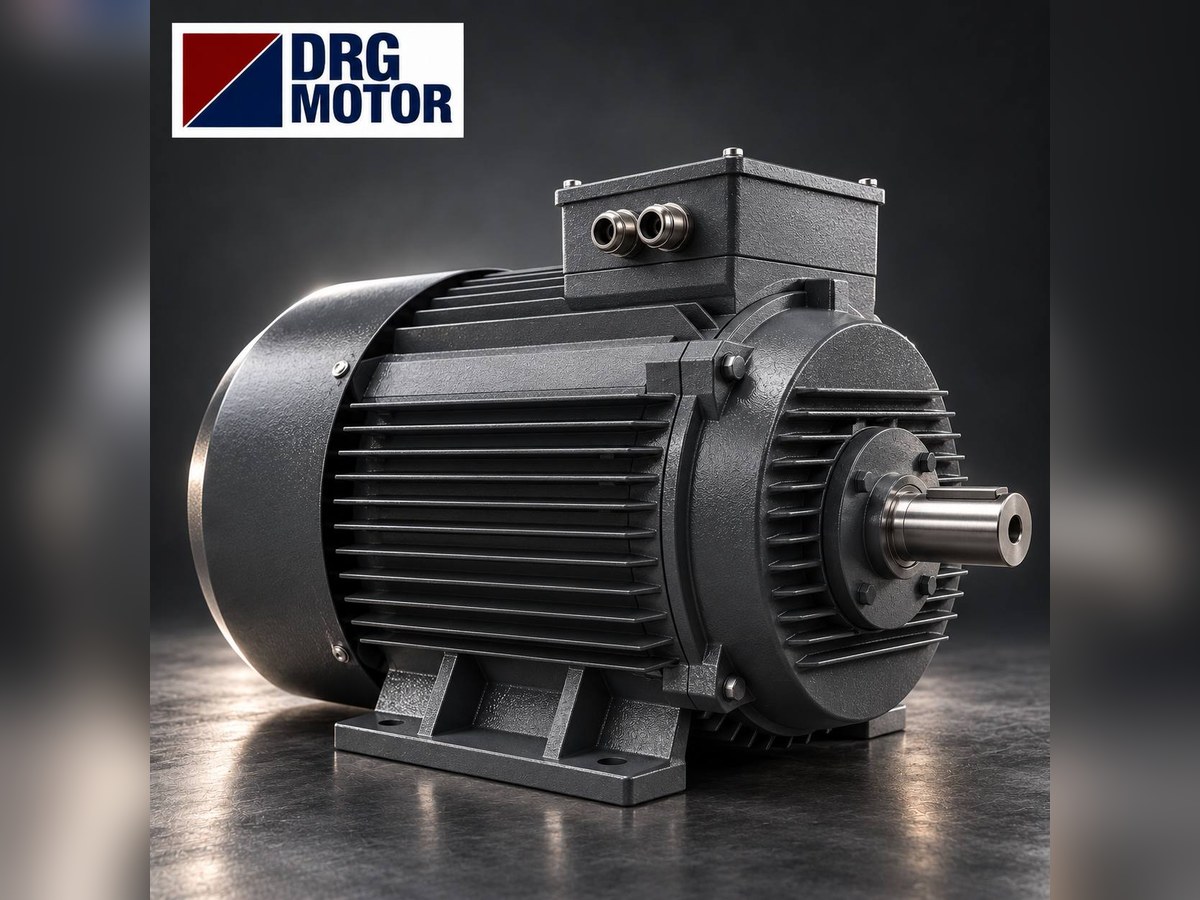
A feed elevator motor is the three-phase motor that turns the head pulley of a bucket elevator, usually through a shaft-mounted gearbox, and lifts grain, mash or pellets vertically to the top of a silo or bin. Manufacturer catalogues show 1.1–30 kW on feed and grain elevators depending on capacity and height, and up to a maximum of 132 kW on large grain elevators. The main data that determine the motor are capacity (t/h), lift height, belt speed and the product being carried.
This page covers the elevators inside a feed mill: from raw material intake to the ingredient silos, between the grinding and mixing sections, and from the pellet cooler to the finished product silos. We do not repeat here the Q·H/367 calculation and starting discussion covered step by step in bucket elevator motor selection and power sizing; this page focuses on conditions particular to feed mills. For prices, see our Buy Electric Motors Online store.
Where do elevators work in a feed mill?
A feed mill is often a multi-storey building, and material enters each section from above, by gravity. That is why there is an elevator before each main process. In a typical line elevators are found at these points:
- Intake elevator: takes grain tipped from trucks out of the intake pit and lifts it to the ingredient silos or the pre-cleaner. It is the highest-capacity elevator in the mill.
- Elevators before and after grinding: carry grain drawn from the silos to the grinding bin, and ground material to the dosing bins.
- Post-mixing elevator: lifts the mixed mash to the pellet press bin or to the mash silos.
- Pellet elevator: carries pellets from the cooler to the screen and the finished product silos or the loading bin.
What sets feed and grain elevators apart?
Protecting the product: slower belts for pellets and mash
Most bucket elevators discharge centrifugally: as the buckets pass over the head pulley they throw the material into the outlet spout. Grain survives this impact, but pellets break and create fines. One manufacturer therefore gives two belt speeds: 1.8 m/s for pellets and sticky mash, and 2.6 m/s for maximum capacity with free-flowing grain. Choosing the slower speed on the same casing reduces capacity; on a 400 mm model, 153 m³/h at 2.6 m/s drops to 106 m³/h at 1.8 m/s. The motor and gearbox are chosen for this speed.
Hygiene: a residue-free boot
At formula changes, feed left in the elevator boot contaminates the next batch. Feed elevators therefore often use residue-free (self-cleaning) boots, belts resistant to oil and fatty acids, and plastic buckets. Their effect on the motor is indirect: while the line is being emptied, the elevator keeps running for a while without feed.
Dust: monitoring and explosion venting
The elevator casing is one of the dustiest places in a feed mill. Catalogues offer speed sensors, belt slip and misalignment detectors, and explosion relief panels on the legs and head as options; some makers supply the drive unit as a separate option for dust zone 22. If the risk assessment classifies the drive location as a dust zone, an Ex-approved motor is required there. No DRG motor carries Ex approval; a standard DRG motor belongs only where no dust zone has been declared.
How many kW for a feed elevator motor? Market values
A) Power values in manufacturer catalogues
| Elevator / capacity | Motor power | Single or total | Note |
|---|---|---|---|
| 20–40 t/h, 10 m | 1.5–3 kW | Single motor | Maker catalogue, small model |
| 60–80 t/h, 15 m | 5.5–7.5 kW | Single motor | Same catalogue, mid model |
| 100–120 t/h, 20 m | 11–15 kW | Single motor | Same catalogue, large model |
| 14–21 m³/h, up to 35 m | 1.1–2.2 kW | Single motor | Second maker, small size |
| 166–259 m³/h, up to 41 m | 11–30 kW | Single motor | Second maker, large size |
| 37–50 t/h, up to 45 m | 7.5 kW (max.) | Single motor | Third maker, smallest |
| 280–420 t/h, up to 70 m | 132 kW (max.) | Single motor | Third maker, largest |
Elevator makers' catalogues run from about 1.1 kW up to 132 kW depending on model and capacity; inside a feed mill, most legs sit between 1.1 and 30 kW. Each value is the single drive motor of one elevator. A mill may have five to ten elevators; their sum is installed power and says nothing about one elevator's motor. Catalogues are given for grain; the same elevator cannot fill its buckets completely with mash, and the real capacity stays at the lower end of the table.
B) What the DRG range covers
DRG Motor is a manufacturer, supplier and seller of electric motors. An elevator drive can take a DRG motor in an aluminium frame (to 11 kW) or cast iron (to 355 kW); pole count (2, 4 or 6) and winding voltage are chosen when ordering. The flange that fits the gearbox input (B5 or B14) is written on the order. The entire 1.1–132 kW range seen on feed and grain elevators lies within this range. For bucket elevator motor prices, the table below shows current values:
| Model | Power / speed | Frame · current 400 V | Price |
|---|---|---|---|
| DRG-90L-42 HP | 1.5 kW · 1500 rpm | Cast iron 90L · 3.3 A | $144.14 (€128.73) Details & buy → |
| DRG-100L2-44 HP | 3 kW · 1500 rpm | Cast iron 100L · 6.02 A | $203.84 (€182.05) Details & buy → |
| DRG-112M-45.5 HP | 4 kW · 1500 rpm | Cast iron 112M · 7.95 A | $254.38 (€227.18) Details & buy → |
| DRG-132S-47.5 HP | 5.5 kW · 1500 rpm | Cast iron 132S · 10.7 A | $342.01 (€305.44) Details & buy → |
| DRG-132M-410 HP | 7.5 kW · 1500 rpm | Cast iron 132M · 14.3 A | $394.89 (€352.66) Details & buy → |
| DRG-160M-415 HP | 11 kW · 1500 rpm | Cast iron 160M · 20.4 A | $568.76 (€507.94) Details & buy → |
| DRG-160L-420 HP | 15 kW · 1500 rpm | Cast iron 160L · 27.3 A | $678.13 (€605.61) Details & buy → |
| DRG-180L-430 HP | 22 kW · 1500 rpm | Cast iron 180L · 39.7 A | $919.45 (€821.13) Details & buy → |
| DRG-200L-440 HP | 30 kW · 1500 rpm | Cast iron 200L · 53.8 A | $1,235.00 (€1,102.93) Details & buy → |
| DRG-225M-460 HP | 45 kW · 1500 rpm | Cast iron 225M · 80.2 A | $1,688.50 (€1,507.94) Details & buy → |
Click to see current electric motor prices and order nowSEE PRICES →
How to read a catalogue table: comparison with net lifting power
Elevator makers mostly give power as a table rather than a calculation. In one grain elevator catalogue the motor is read by capacity class and extension length (lift height). Putting the table motor next to the net lifting power shows why the former is clearly larger. Net lifting power is the mass flow multiplied by the height, divided by 367.
| Capacity × height | Net lifting power | Catalogue motor | Ratio |
|---|---|---|---|
| 40 t/h × 10 m | 1.09 kW | 3 kW | about 2.8 times |
| 80 t/h × 15 m | 3.27 kW | 7.5 kW | about 2.3 times |
| 120 t/h × 20 m | 6.54 kW | 15 kW | about 2.3 times |
The difference covers scooping resistance at the boot, friction from belt and bucket weight, gearbox losses, and a margin for loaded starts and sudden surges into the boot. The ratio is higher on small elevators because fixed losses weigh more against a small net power. The practical conclusion: choosing a motor from the lifting formula alone leaves a feed elevator underpowered; without a table, the old motor's nameplate is the most reliable starting point.
Example: a pellet elevator
Take an elevator that lifts pellets from the cooler 18 m up to the finished product silos. The press produces at most 12 tonnes of pellets per hour, 8 tonnes on average. One manufacturer recommends sizing the elevator for the peak capacity of the connected machine, not the average; otherwise the elevator becomes a bottleneck when the press runs fastest. To avoid breaking pellets, the belt will run at 1.8 m/s. With a 600 mm head pulley this gives a pulley speed of about 57 rpm; with a 4-pole 1460 rpm motor the gear ratio is about 26. Net lifting power is 12 × 18 / 367 ≈ 0.59 kW; given the catalogue ratios, a motor in the 1.5–2.2 kW band is to be expected. The exact value comes from the elevator maker's table. Enter the motor speed and target pulley speed in our gearbox output speed and torque calculator to confirm this ratio.
Drive arrangement: shaft-mounted gearbox and backstop
Shaft-mounted gearbox
For feed and grain elevators, almost every catalogue shows a helical geared motor mounted directly on the head shaft. The gearbox sits on the head shaft and is tied to the casing by a torque arm; the motor is flanged to the gearbox input. Being able to fit the geared motor on the right or left side makes platform layout easier. When changing the motor, the flange type (B5 or B14), shaft diameter and key size must match the gearbox input; see the technical drawings page for dimensions.
Backstop
When an elevator stops loaded, the buckets on the rising leg carry load and the belt wants to run backwards. If it does, feed dumps into the boot, chokes it and makes the next start harder. One manufacturer recommends a backstop as standard. The backstop belongs to the gearbox or head shaft, not the motor; when the motor is changed, check that the backstop is still in place and that the direction of rotation is correct on the first run. A motor run in the wrong direction loads the backstop and can damage the gearbox.
Loaded starts and sequential operation
In a feed mill the elevator forms a chain with the machines before and after it. If one machine stops, the elevator feeding it also stops and its buckets stay full. Start-up runs against the direction of flow: first the distribution conveyor on the silo top, then the elevator, and last the machine feeding the elevator. This way the elevator takes no load while empty. Still, a loaded start after a fault is unavoidable, and the motor's starting torque must cope with it. On DRG 4-pole motors the starting torque ratio (Ts/Tn) is between 2.0 and 2.4.
Star-delta starting is available on DRG motors from 4 kW, where the 400/690 V winding begins. In star, though, torque falls to a third, which may not lift a tall elevator with full buckets; a soft starter or inverter is then worth considering. The options are compared on the star-delta starting page. When the speed sensor detects belt slip it stops the elevator and its feeder; this sensor must be reconnected whenever the motor is changed.
Checklist for choosing a feed elevator motor
- The elevator's duty: intake, grinding, mixing or pellet line. The peak capacity of the connected machine.
- Lift height and total elevator length; is capacity given for grain or for mash?
- Belt speed (slow for pellets?), head pulley diameter and gear ratio.
- Gearbox: shaft-mounted or not, input flange and shaft diameter; is there a backstop?
- Starting: is there sequential start and interlocking, and how often does it restart loaded?
- Dust zone assessment: is the drive location classified? An Ex requirement rules out a standard motor.
- Outdoor head: rain cover and sealing of cable entries.
- Old nameplate data and the measured current; when setting protection, use the overload, fuse and contactor selection page.
DRG motor options for feed elevators
Listed below are 4-pole models in the band where most feed and grain elevators fall:
| Model | Power / speed | Frame | Current 400 V |
|---|---|---|---|
| DRG-100L1-4 | 2.2 kW / 1450 rpm | 100L cast iron | 4.52 A |
| DRG-132S-4 | 5.5 kW / 1460 rpm | 132S cast iron | 10.7 A |
| DRG-132M-4 | 7.5 kW / 1460 rpm | 132M cast iron | 14.3 A |
| DRG-160M-4 | 11 kW / 1465 rpm | 160M cast iron | 20.4 A |
| DRG-160L-4 | 15 kW / 1465 rpm | 160L cast iron | 27.3 A |
| DRG-200L-4 | 30 kW / 1475 rpm | 200L cast iron | 53.8 A |
DRG MOTOR motors are guaranteed against material and manufacturing defects for 2 years from the delivery date (warranty certificate). Grinding, mixing and pelleting motors are surveyed in a separate article, feed mill motor supply.
Motors in this power range
- DRG-90L-4 – 1.5 kW – 1445 rpm – 90L cast iron
- DRG-112M-4 – 4 kW – 1450 rpm – 112M cast iron
- DRG-132M-4 – 7.5 kW – 1460 rpm – 132M cast iron
- DRG-160L-4 – 15 kW – 1465 rpm – 160L cast iron
- DRG-180M-4 – 18.5 kW – 1470 rpm – 180M cast iron
Click to see current prices and order these motors nowSEE PRICES →
Feed elevator motor: frequently asked questions
What size motor does a grain elevator need?
It depends on capacity and height. Manufacturer catalogues show 1.5–3 kW for 20–40 t/h at 10 m and 11–15 kW for 100–120 t/h at 20 m. Expect a motor of roughly 2–3 times the net lifting power; the exact value is in the maker's table.
Why does a pellet elevator run slower?
With centrifugal discharge, the faster the belt, the harder pellets hit the head and the more they break. Pellets and mash therefore use a lower belt speed; capacity drops and the gear ratio increases.
Does the backstop change when the elevator motor is replaced?
No. It is part of the gearbox or head shaft. Only the direction of rotation is checked when the motor is changed; a faulty backstop is repaired separately.
How many amps does an 11 kW elevator motor draw?
The 4-pole DRG-160M-4 draws 20.4 A at 400 V.
Capacity, lift height, product and the old nameplate are usually enough to pin down a motor; send them to +90 (542) 666 11 11, [email protected] or through the channels on our contact page. The feed elevator motor price list is kept up to date in the Buy Electric Motors Online store.


