 English
 Le français
 Türkçe

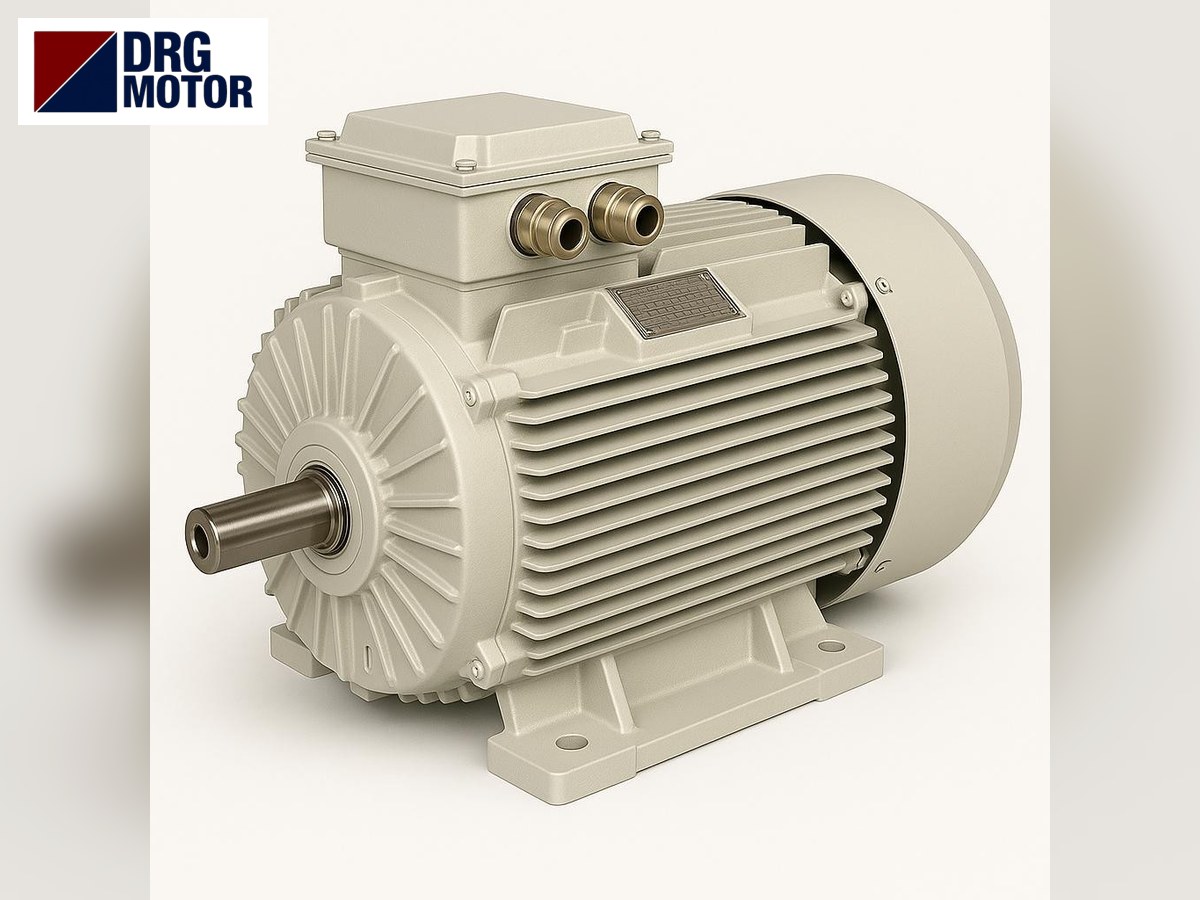
On a potato peeler the electric motor creates the movement that abrades or brushes off the skin: in a batch peeler it turns the carborundum-coated disc in the base; in a continuous peeler it turns rows of abrasive or brush rollers and the auger that moves the product along. The 25–50 kg peelers of restaurants and catering kitchens have one small motor; continuous peelers on crisp and frozen fries lines have several motors and several kW of installed power. Maker catalogues show 0.75–1.86 kW motors for batch peelers and 3.75–11.37 kW installed power for continuous peelers and brush machines.
DRG Motor is a manufacturer, supplier and seller of electric motors. We do not sell the peeler, carborundum discs and rollers, brushes, gearboxes, steam vessels or drives. For these machines we provide the three-phase induction motor behind the disc, rollers or auger; it is listed on the Buy Electric Motors Online page.
Peeling methods and the motor’s job
Potatoes are peeled in three ways. In abrasive peeling, the tuber rubs on a rough surface and loses a thin layer of skin. In knife peeling, blades cut the skin from the turning tubers. In steam peeling, tubers are steamed briefly in a pressure vessel; when the pressure is released suddenly, the skin loosens and is then removed in a brush machine. The motor’s job differs in each method; in steam peeling the steam, not the motor, separates the skin, and the motor does the brushing and conveying that follow.
Abrasive disc (batch) peeler
A carborundum-coated disc turns in the base of a cylindrical chamber whose wall is also abrasive. The disc throws the potatoes around, the tubers rub against wall and disc and are peeled, and water sprayed from above washes the peel out through the bottom drain. One batch, with filling and emptying, takes a few minutes; on one sheet peeling time is adjustable from 1 to 10 minutes, with a cycle of about 2–3 minutes. Below the base, a gearbox or belt links the motor to the disc. Some of the small restaurant models are single-phase.
Continuous roller and brush peelers
In a continuous peeler, tubers pass over rows of carborundum-coated or brush rollers placed side by side; an auger in the middle of the rollers carries them from one end to the other. On one maker’s 12-roller machine, the rollers turn at different speeds via a timing belt. In the revolver type, the rollers form a drum; drum and rollers each have their own speed setting, and the motors sit in a section separated from the product area. These machines have a roller group motor, an auger motor and sometimes a separate drum motor; sheets usually give their total as installed power.
Brushing after steam peeling
In a steam peeler, tubers are held in steam for a short time in a pressure vessel; one maker gives 30–60 seconds of steaming at up to 16 bar. When the vessel opens, the skin is loose but still on the tuber. A brush peel remover and a washer clean it off. One brush machine sheet lists 3.75–8.75 kW installed power for 5–15 tonnes per hour, a speed-controlled auger and a pump that draws off the waste water below. The boiler and pressure vessel are not motor work; our range concerns the brush roller, auger and pump motors.
How many kW for a potato peeler motor? Catalogue values
A) Powers listed on maker sheets for batch and continuous peelers:
| Machine / model | Motor or installed power | Single / total | Note |
|---|---|---|---|
| Abrasive disc peeler, 25 kg batch | 0.75 kW | single motor | first maker |
| Abrasive disc peeler, 25 kg batch | 0.9 kW | single motor, 230–400 V three-phase | second maker; single-phase version too |
| Abrasive disc peeler, 25 kg, 250–400 kg/h | 1.12 kW | single motor, 400 V | third maker |
| Abrasive disc peeler, 50 kg batch | 1.86 kW (single-phase 1.49 kW) | single motor | fourth maker |
| Revolver peeler, 300–700 kg/h | 6.5 kW | installed; drum and rollers at separate speeds | fifth maker |
| Continuous roller peeler, 12 rollers, 2.5–8 t/h | 11.37 kW | installed (rollers + auger) | fifth maker |
| Knife peeler, three sizes | 2.38 / 2.57 / 6.75 kW | installed | fifth maker |
| Brush peel remover (after steam), 5–15 t/h | 3.75–8.75 kW | installed; speed-controlled auger | sixth maker |
Batch peelers use about 0.75–1.86 kW for their single motor, depending on maker and batch size. For continuous peelers and brush machines, sheets give installed power per machine rather than per motor: from 2.38 to 11.37 kW. They add up several motors; one motor alone is smaller. Where the sheet does not list individual motors, the machine’s motor plates or the maker’s documents are the reference.
B) Overlap with the DRG range: 0.75 and 0.9 kW motors correspond to our 0.75 kW frame 80 and 1.1 kW frame 90S models, and the 1.12 kW motor to the 1.1 kW step. 1.86 kW is not a standard IEC step; our nearest steps are 1.5 and 2.2 kW, and the right one is decided with the old motor plate. Single motors inside continuous machines are generally chosen from steps in the 0.55–5.5 kW band, which our range covers fully. Single-phase versions are not in our range.
Click to see current electric motor prices and order nowSEE PRICES →
Worked example: batches, starts per hour and power ratio
The third maker’s 25 kg peeler delivers up to 400 kg per hour. That is 400 / 25 = 16 batches per hour, about 3.75 minutes per batch including filling and emptying. Each batch means a start: the motor starts 16 times an hour. Our 1.1 kW DRG-90S-4, which suits this machine, has a rated current of 2.48 A at 400 V and a direct-on-line starting peak of 2.48 × 6.8 ≈ 16.9 A. If disc and chamber are loaded at start, the motor draws high current for longer; with such frequent starts, setting the overload relay to the plate current and keeping the fan cover clean matter.
Installed power relative to capacity
Dividing installed power from the sheets by hourly capacity lets us compare peeler types on one scale:
| Machine | Calculation | kW per t/h | Comment |
|---|---|---|---|
| 25 kg batch peeler | 1.12 / 0.4 | ≈ 2.8 | batch machine highest at its scale |
| Continuous roller peeler | 11.37 / 2.5 … 11.37 / 8 | ≈ 4.55 … 1.42 | ratio falls as capacity rises |
| Brush peel remover | 3.75 / 5 … 8.75 / 15 | ≈ 0.75 … 0.58 | steam has already loosened the skin |
This ratio is installed motor power per tonne, not energy use; real consumption depends on load and running time. It still shows that large lines peel with less motor power per tonne, and that brushing after steam peeling has the lowest ratio.
Water, starch and motor location
The area around a peeler is both wet and starchy: sprayed water, peel pieces and starchy sludge splash everywhere and leave a hard layer when they dry. The motor we propose never touches the potatoes; it is an IP55 industrial unit in a painted aluminium or cast iron housing. In a batch peeler they sit in the closed compartment under the base; in a continuous peeler, in a drive section separated from the product area. Starchy dirt on the fan cover hinders cooling; during washing the drive bay is kept out of the hose jet and the dirt is wiped away with a damp cloth. Should a section washed directly with water demand a stainless housing, we cannot provide that motor; let us look at the layout together.
Cutting and dicing line
Peeled potatoes are usually cut on the same line: a fries cutter, slicer or dicer stands right after the peeler. Their motors work in the same wet, starchy environment and the same placement rule applies. Power selection for cutting machines depends on knife type and capacity; on this page we give values for the peeling section only.
DRG motors for potato peelers
4-pole models matching batch peeler, roller, auger and brush drive powers:
| Model | Power / speed | Frame · shaft D×E | Current 400 V |
|---|---|---|---|
| DRG-802-4 | 0.75 kW / 1420 rpm | 80 cast iron · 19×40 | 1.75 A |
| DRG-90S-4 | 1.1 kW / 1445 rpm | 90S cast iron · 24×50 | 2.48 A |
| DRG-90L-4 | 1.5 kW / 1445 rpm | 90L cast iron · 24×50 | 3.3 A |
| DRG-100L1-4 | 2.2 kW / 1450 rpm | 100L cast iron · 28×60 | 4.52 A |
| DRG-100L2-4 | 3 kW / 1450 rpm | 100L cast iron · 28×60 | 6.02 A |
| DRG-112M-4 | 4 kW / 1450 rpm | 112M cast iron · 28×60 | 7.95 A |
| DRG-132S-4 | 5.5 kW / 1460 rpm | 132S cast iron · 38×80 | 10.7 A |
| DRG-132M-4 | 7.5 kW / 1460 rpm | 132M cast iron · 38×80 | 14.3 A |
On a batch peeler the motor usually sits on the base gearbox with a flange (B5 or B14) or connects by belt; on a continuous peeler, roller and auger motors are used with gearboxes in flange or foot (B3) form. At peeler powers both aluminium and cast iron housings are possible. Send photos of the old motor plate, connection side and shaft end with the machine details; we confirm fit with that information and do not promise exact fit without seeing dimensions.
B5 dimensions for small flange motors
Small frames used on batch peeler and auger gearboxes, mm:
| Frame | Shaft D×E | Flange P / M / N | Hole S |
|---|---|---|---|
| 80 | 19×40 | 200 / 165 / 130 | 12 |
| 90S/90L | 24×50 | 200 / 165 / 130 | 12 |
| 100L/112M | 28×60 | 250 / 215 / 180 | 14.5 |
For foot sizes and other drawings see our technical drawings page, and for fitting a flange motor to a gearbox see our B5/B14 flange motor article.
Live price table
Current prices of models at peeler powers:
| Model | Power / speed | Frame · current 400 V | Price |
|---|---|---|---|
| DRG-802-41 HP | 0.75 kW · 1500 rpm | Cast iron 80 · 1.75 A | $101.93 (€91.03) Details & buy → |
| DRG-90S-41.5 HP | 1.1 kW · 1500 rpm | Cast iron 90S · 2.48 A | $124.09 (€110.82) Details & buy → |
| DRG-90L-42 HP | 1.5 kW · 1500 rpm | Cast iron 90L · 3.3 A | $144.14 (€128.73) Details & buy → |
| DRG-100L1-43 HP | 2.2 kW · 1500 rpm | Cast iron 100L · 4.52 A | $188.32 (€168.18) Details & buy → |
| DRG-100L2-44 HP | 3 kW · 1500 rpm | Cast iron 100L · 6.02 A | $203.84 (€182.05) Details & buy → |
| DRG-112M-45.5 HP | 4 kW · 1500 rpm | Cast iron 112M · 7.95 A | $254.38 (€227.18) Details & buy → |
| DRG-132S-47.5 HP | 5.5 kW · 1500 rpm | Cast iron 132S · 10.7 A | $342.01 (€305.44) Details & buy → |
| DRG-132M-410 HP | 7.5 kW · 1500 rpm | Cast iron 132M · 14.3 A | $394.89 (€352.66) Details & buy → |
DRG MOTOR motors are guaranteed against material and manufacturing defects for 2 years from the delivery date (warranty certificate).
Motors in this power range
- DRG-802-4 – 0.75 kW – 1420 rpm – 80 cast iron
- DRG-90S-4 – 1.1 kW – 1445 rpm – 90S cast iron
- DRG-100L1-4 – 2.2 kW – 1450 rpm – 100L cast iron
- DRG-112M-4 – 4 kW – 1450 rpm – 112M cast iron
- DRG-132M-4 – 7.5 kW – 1460 rpm – 132M cast iron
Click to see current prices and order these motors nowSEE PRICES →
Browse the products, ask for a quote: suitable motors for your peeler are on the Buy Electric Motors Online page. Send the batch size or hourly capacity and the motor plate to our WhatsApp line; you can also call +90 (542) 666 11 11.
Frequently asked questions
My peeler runs on 230 V single-phase. Can I fit a DRG motor?
We only make three-phase motors. If a 400 V three-phase line reaches the kitchen and an electrician rewires the switch and timer relay, the swap is possible; otherwise it is not. Background: three-phase or single-phase?.
Does the peeler disc need a brake?
Opening the lid already cuts power through the machine’s own interlock. For a faster stop, a panel-mounted electronic brake does the job; we do not make brake motors.
Where is the potato peeler motor price shown?
The live table on this page shows current store prices for the 0.75–7.5 kW models.
Reach us: +90 (542) 666 11 11 · info@drgmotor.com · contact.


