 English
 Le français
 Türkçe

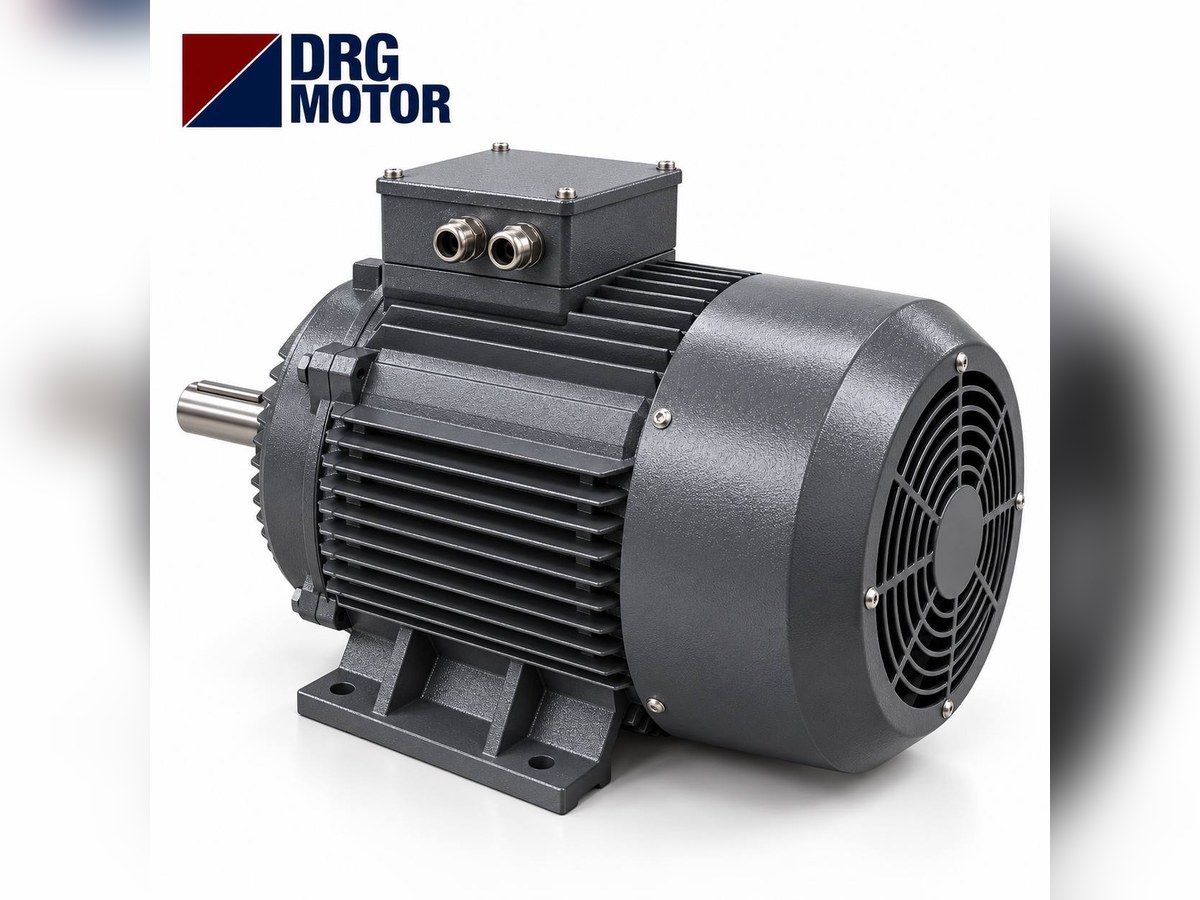
Flour mill electric motors are the three-phase induction motors that turn every machine from wheat intake to the bagged flour: roller mills, plansifters, bucket elevators, screw conveyors, pneumatic conveying fans and aspiration fans all run on them. In manufacturers' catalogues the motor of a single machine ranges from vibration motors below half a kilowatt on separators up to 110 kW on pneumatic conveying fans. A modern mill runs hundreds of machines and most of them are electrically driven, so motors are chosen from a plant list rather than one by one.
This page follows the mill flow section by section and explains what the motor does in each section, the power values found in catalogues and which part the DRG range covers; each machine type is detailed on the sub-pages of this category. You can review ready models on Buy Electric Motors Online.
From wheat to flour: the mill flow and the role of the motors
In a flour mill the product flows from top to bottom and is lifted again after every passage. The load on a motor depends on where it sits in this flow.
Wheat intake and raw wheat silos
Wheat tipped from the truck passes from the intake hopper to chain conveyors and bucket elevators and, after pre-cleaning, is distributed to the silos. These are conveying motors that start loaded: elevators and chain conveyors mostly run on a shaft-mounted gearbox with a 4-pole motor.
Cleaning section and tempering
Before milling, wheat passes the separator, destoner, indented cylinder, scourer and optical sorter. The separator and the destoner are shaken by two vibration motors fixed to the body; the scourer runs on a single standard motor turning its rotor. A dampening screw then adds water and the wheat rests in the tempering bin. Because the dampening screw mixes and pushes wet, dense grain, it needs more power than a dry screw of the same diameter.
First break and the roll passages
Tempered wheat enters the first break roller mill. Break (fluted roll) and reduction (smooth roll) passages each run in their own machine with their own main motor. The main motor turns the fast roll through belts; the slow roll follows at a fixed speed difference set by gears or a toothed belt inside the mill. The feed roll that spreads the product between the rolls takes power from a separate small geared motor. Roller mills are the machine group carrying the largest total power in the mill.
Plansifter, purifier and auxiliary machines
The product leaving each roll passage goes to the plansifter. A plansifter is a sieve cabinet swinging freely on suspensions, and its motor turns an eccentric weight through a belt. The purifier grades semolina with air and vibration and runs on two or four small vibration motors. Bran finishers, impact detachers and infestation destroyers (entoleters) are rotor machines with one motor each.
Flour silos, packing and conveying
Flour leaving the sifter goes through flour screws and pneumatic lines to the flour silos and then to the packing machines. In pneumatic conveying a fan or a rotary positive blower carries the product and rotary valves feed the line. Dust from every machine is drawn off by central aspiration and jet filters. The pneumatic fan and the aspiration fan are among the largest single motors in the mill; fan selection is covered on the Fan Motors page.
Motor power in catalogues, section by section
The values below come from technical catalogues of flour milling machine builders. Each row is the motor of one machine, not the total installed power of the plant.
| Machine | Motor power | Single or total | Note |
|---|---|---|---|
| Grain separator | 2 × 0.28 – 2 × 0.75 kW | Two vibration motors | Maker catalogue, 4 models |
| Scourer | 7.5 – 18.5 kW | Single motor | Maker catalogue, 3 models |
| Destoner | 2 × 0.25 – 2 × 0.55 kW | Two vibration motors | Maker catalogue, 3 models |
| Intensive dampener | 7.5 – 11 kW | Single motor | Maker catalogue, 3 models |
| Roller mill main drive | 5.5 – 45 kW | Per machine or per side | Four maker catalogues |
| Roller mill feed roll | 0.55 – 0.75 kW | Geared motor | Maker catalogues |
| Plansifter | 3 – 11 kW | Single motor | 4–8 compartment models |
| Purifier | 2 × 0.40 – 4 × 0.40 kW | Vibration motors | Maker catalogue, 2 models |
| Bran finisher | 5.5 – 11 kW | Single motor | Maker catalogue, 2 models |
| Infestation destroyer | 11 – 18.5 kW | Single motor | Maker catalogue, 2 models |
| Pneumatic conveying fan | 7.5 – 110 kW, 3000 rpm | Single motor | High-pressure fan series |
| Aspiration fan | 4 – 30 kW, 1500 rpm | Single motor | Low-pressure fan series |
In these machine groups motor options of about 0.25–110 kW are seen, depending on the manufacturer's model and capacity. The largest single motors sit on pneumatic conveying fans and roller mills; on vibrating separators, destoners and purifiers the power per motor stays below one kilowatt. Motor count and energy load do not sit in the same place: an engineering article shows that sifting machines take only a small share compared with grinding machines.
Click to see current electric motor prices and order nowSEE PRICES →
Where in the mill a DRG motor fits, and where it does not
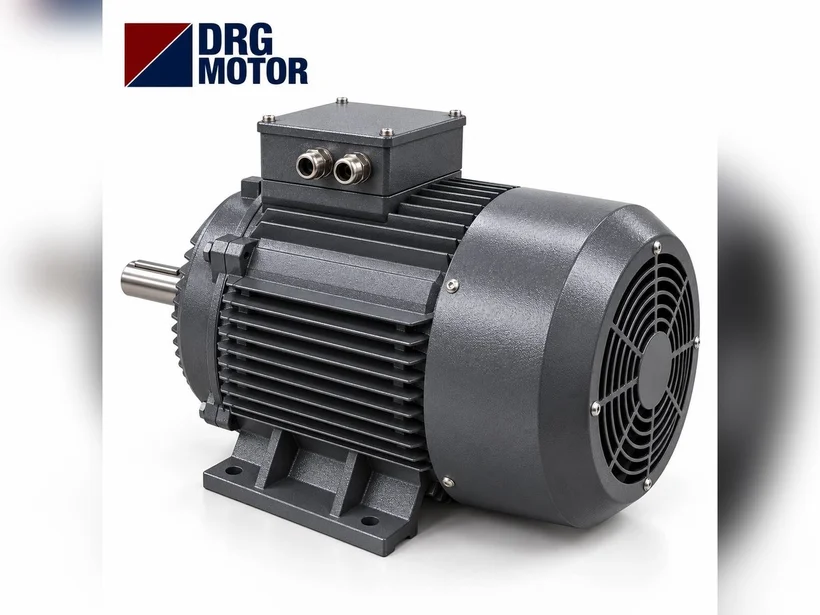
DRG Motor is a manufacturer, supplier and seller of electric motors. Our range includes three-phase induction motors with aluminium frames from 0.25 to 11 kW and cast iron frames from 0.55 to 355 kW; speeds are 1000, 1500 and 3000 rpm, voltages 230/400 V and 400/690 V. The mounting arrangement (B3, B5, B14, B35) is written as a note on the order and the motors are IP55.
Motors covered by the range
- Main motors of roller mills, 5.5–45 kW (4-pole, belt drive).
- Plansifter drive motors, 3–11 kW (6- or 4-pole, belt drive).
- Single motors of rotor machines such as scourers, bran finishers, impact detachers and entoleters.
- Standard motors at the gearbox input of elevators, chain conveyors and screws.
- 1500 rpm motors for aspiration fans and 3000 rpm motors for pneumatic fans.
Outside the range
- Ex (explosion-protected) motors: Flour dust is combustible. If the plant's hazardous-area classification requires an Ex motor at some point, the DRG range has no equivalent.
- Vibration motors: The motors on separators, destoners and purifiers are a separate product group and are not sold in the online store. Ask for a quotation for the 0.12–15 kW DRG vibration motor range on the Vibration Motors page.
- Servo and stepper motors: Used on small pack fillers; not in the range.
- Integrated-drive and direct-drive motors: Permanent-magnet synchronous motors and built-in geared motors used on some new roller mills and bran machines are parts of the machine builder.
| Model | Power / speed | Frame · current 400 V | Price |
|---|---|---|---|
| DRG-90L-42 HP | 1.5 kW · 1500 rpm | Cast iron 90L · 3.3 A | $144.14 (€128.73) Details & buy → |
| DRG-112M-45.5 HP | 4 kW · 1500 rpm | Cast iron 112M · 7.95 A | $254.38 (€227.18) Details & buy → |
| DRG-132S-47.5 HP | 5.5 kW · 1500 rpm | Cast iron 132S · 10.7 A | $342.01 (€305.44) Details & buy → |
| DRG-160M-610 HP | 7.5 kW · 1000 rpm | Cast iron 160M · 15.4 A | $579.49 (€517.52) Details & buy → |
| DRG-132M-410 HP | 7.5 kW · 1500 rpm | Cast iron 132M · 14.3 A | $394.89 (€352.66) Details & buy → |
| DRG-160M-415 HP | 11 kW · 1500 rpm | Cast iron 160M · 20.4 A | $568.76 (€507.94) Details & buy → |
| DRG-160L-420 HP | 15 kW · 1500 rpm | Cast iron 160L · 27.3 A | $678.13 (€605.61) Details & buy → |
| DRG-180L-430 HP | 22 kW · 1500 rpm | Cast iron 180L · 39.7 A | $919.45 (€821.13) Details & buy → |
| DRG-200L-440 HP | 30 kW · 1500 rpm | Cast iron 200L · 53.8 A | $1,235.00 (€1,102.93) Details & buy → |
| DRG-200L2-250 HP | 37 kW · 3000 rpm | Cast iron 200L · 64 A | $1,484.05 (€1,325.35) Details & buy → |
What motor selection has in common across the mill
Round-the-clock operation and heating
Flour mills often run for days without stopping; motors start rarely and spend many hours under load. The margin between the rated current and the running current therefore matters. A motor chosen at the limit trips its overload in hot roof floors in summer; one chosen far too large runs at a poor power factor at low load. The right step is to keep the machine's rated value and to measure the current while running.
Flour dust and explosion risk
IP55 protection limits dust entering the winding but does not stop flour building up on the cooling fins. If the fan cover grille and the fins are not cleaned regularly, the motor cannot draw its own cooling air. Dust explosion is a separate topic: zone classification is the job of the plant's safety study, and the motor is chosen to match it.
The starting pattern depends on the machine
A roller mill starts empty with the rolls disengaged and product is fed afterwards, so its start is easy. A plansifter, by contrast, needs high starting torque to pass quickly through its resonance range. Fans with heavy impellers take long to run up, and elevators and chain conveyors may start loaded. Across the 4-pole DRG models in the catalogue, Ts/Tn varies from 2.0 to 2.3. Star-delta starting cuts this torque to one third; you can compare where it fits on the star-delta starting page.
How to prepare a motor load list
Before asking for motor quotations for a new mill or a capacity increase, draw up a motor list.
- Machine name, passage or position number and the motor power given by the machine builder.
- Speed (number of poles), mounting arrangement, shaft diameter and frame size.
- Drive type: belt, coupling, gearbox input or direct.
- Starting: direct on line, star-delta, soft starter or inverter.
- Floor and environment: dust load, temperature, zone classification.
Below is an example section taken from the milling floor of a mill; powers and currents are DRG catalogue values:
| Machine (qty) | Motor code | Total power | Total current 400 V |
|---|---|---|---|
| Break roller mill (4) | DRG-180L-4 | 88 kW | 158.8 A |
| Reduction roller mill (4) | DRG-160L-4 | 60 kW | 109.2 A |
| Plansifter (2) | DRG-160M-6 | 15 kW | 30.8 A |
| Pneumatic fan (1) | DRG-200L2-2 | 37 kW | 64 A |
| Total (11) | – | 200 kW | 362.8 A |
In this section 11 motors carry 200 kW of installed power and a total rated current of 362.8 A at 400 V. The sum of rated currents is the starting value for sizing the transformer and the main panel; the real load is set by simultaneity and running current. You can check each motor's cable size with the motor cable size calculator.
Spare motor strategy: which motor stops the whole mill?
The spare motor decision follows the criticality of the machine. When the first break roller mill, the main plansifters or the pneumatic conveying fan stops, the whole mill stops; keeping one spare motor of the same code ready on site makes sense for these. In the example above the four identical break roller mills can share one spare motor, and one spare is enough for the reduction mills too. If a separator or a screw in the cleaning section fails, the wheat in the tempering bins keeps the mill fed for a while, so these motors are less critical.
How to cut the number of spares for roller mill motors by frame and shaft size is explained in our article Flour Mill Roller Motor Selection and Spare Motor Supply. For the general supply plan of a line, see High-Torque Motor Supply for Grain and Flour Mills.
DRG motor options for flour mills
The table gives one example from the power levels often seen in different sections of the mill:
| Model | Power / speed | Frame | Current 400 V |
|---|---|---|---|
| DRG-90L-4 | 1.5 kW / 1445 rpm | 90L cast iron | 3.3 A |
| DRG-112M-4 | 4 kW / 1450 rpm | 112M cast iron | 7.95 A |
| DRG-132M-4 | 7.5 kW / 1460 rpm | 132M cast iron | 14.3 A |
| DRG-160M-4 | 11 kW / 1465 rpm | 160M cast iron | 20.4 A |
| DRG-200L-4 | 30 kW / 1475 rpm | 200L cast iron | 53.8 A |
| DRG-200L2-2 | 37 kW / 2960 rpm | 200L cast iron | 64 A |
DRG MOTOR motors are guaranteed against material and manufacturing defects for 2 years from the delivery date (warranty certificate).
Motors in this power range
- DRG-801-4 – 0.55 kW – 1400 rpm – 80 cast iron
- DRG-90S-4 – 1.1 kW – 1445 rpm – 90S cast iron
- DRG-160M1-2 – 11 kW – 2945 rpm – 160M cast iron
- DRG-225M-6 – 30 kW – 980 rpm – 225M cast iron
Click to see current prices and order these motors nowSEE PRICES →
Frequently asked questions about flour mill motors
How many electric motors does a flour mill have?
It depends on capacity and the flow sheet. Large mills have hundreds of machines and most run on their own motor.
What is usually the biggest single motor in a mill?
As a single motor it is usually the pneumatic conveying fan or a large roller mill. In catalogues high-pressure fans reach 110 kW and roller mills 45 kW.
Can a standard motor be used where there is flour dust?
In areas not classified as hazardous, an IP55 standard motor is used and cleaned regularly. If the zone classification requires an Ex motor, a standard motor is not suitable; the DRG range has no Ex motors.
What information should I give when buying a flour mill motor?
Send the old motor's nameplate (kW, speed, voltage), the mounting arrangement, the shaft diameter and the machine name. For dimensions see the technical drawings page.
Send your mill's motor list or the nameplate of a single machine and we will work out the matching DRG codes together. Phone +90 (542) 666 11 11, e-mail [email protected], contact page, WhatsApp wa.me/905426661111. All models and current prices are on Buy Electric Motors Online.


