 English
 Le français
 Türkçe

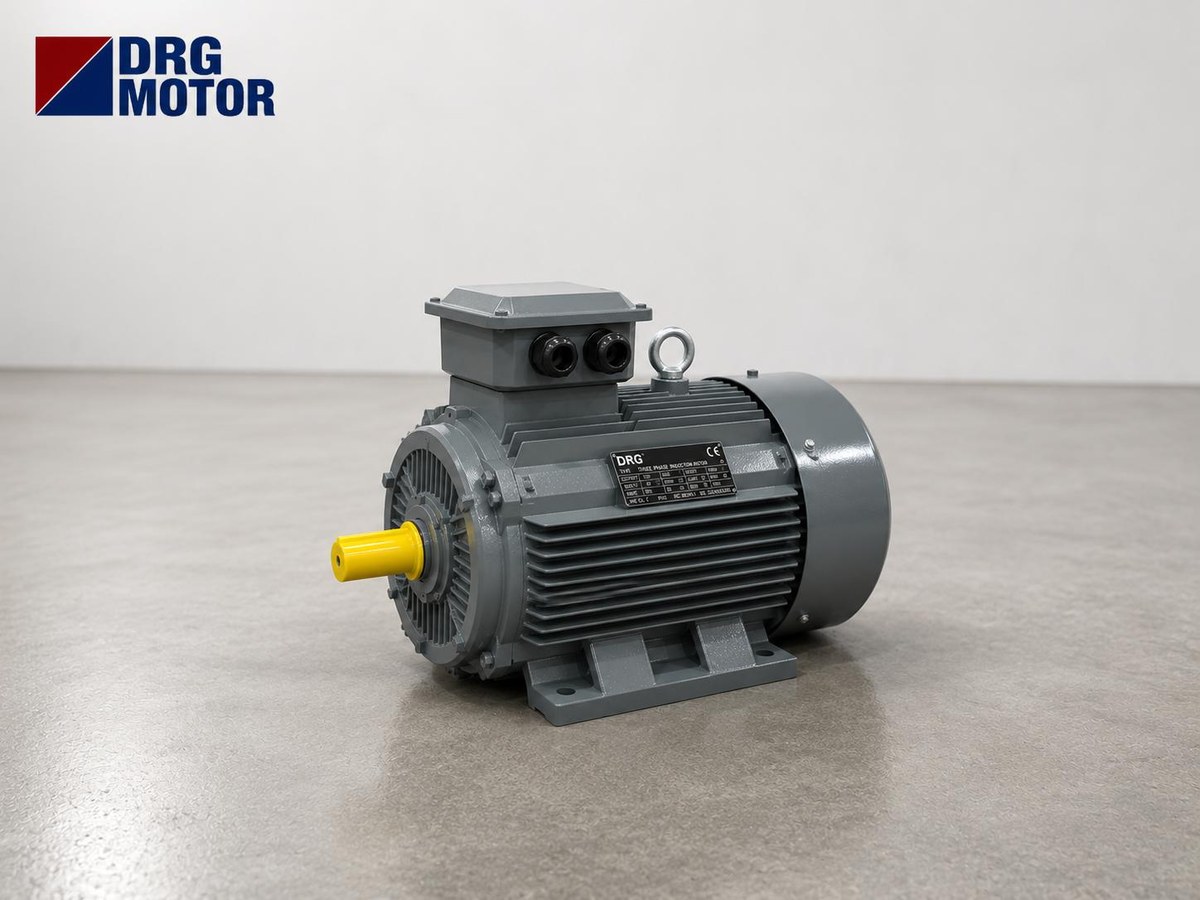
Porcelain and glazed tiles coming out of the kiln cannot be boxed until their size and edges are right. On a ceramic squaring and calibrating machine, electric motors turn the spindles that grind the four tile edges with diamond wheels, the calibrating heads that bring the surface to one thickness and the lapping or polishing heads; the belt that carries the tile through the machine has its own motor too. Maker catalogues show 1.5–11 kW per squaring spindle and 11–15 kW per polishing head. This page covers the final processing of ceramic tiles and large slabs; calibrating and polishing lines for natural stone slabs are a separate subject.
DRG Motor is a manufacturer, supplier and seller of electric motors. We do not sell the squaring or polishing machine itself, diamond wheels, abrasive shoes, spindle bearing units, gearboxes or inverters. What we deliver is the induction motor driving spindles, heads and belts; our models are listed on Buy Electric Motors Online. For an overview of motors across a ceramic plant, see our ceramic plant motor guide.
What do calibrating, squaring and polishing mean for ceramic tiles?
In a tile plant the word “calibration” covers two jobs. The first is edge work: tiles move a few millimetres in size because of shrinkage in the press and kiln, and the squaring machine grinds all four edges so that every tile has the same size and a true right angle. This is what catalogues sell as a “rectified tile”; most large-format porcelain laid with thin joints goes through it. The second is surface calibration: on polished porcelain, calibrating heads remove surface waviness before polishing and bring the tile to one thickness.
Dry and wet squaring
Older lines grind wet; water cools the diamond wheel and binds the dust, but the tiles have to be dried afterwards. Newer dry squaring lines use no water, send the dust to extraction and work with fast-running grinding spindles. On one maker’s dry line, the 44–48 spindles of older wet lines were cut to 32. On a dry line the motor’s enemy is fine porcelain dust; on a wet line it is muddy spray.
Chamfer, bullnose and groove work
At the end of a squaring bench there is usually a small chamfering spindle that takes the sharpness off the edge. Bullnose machines round one edge, cut a groove and bevel the underside; each operation has its own small motor, lined up one after another.
Motors on the machine and what they do
A squaring line usually has two benches: the first grinds two edges, the tile is turned by 90°, the second grinds the other two. Each bench has two facing rows of spindles, and one spindle means one motor. A line therefore holds far more motors than a stand-alone machine, many of them with the same rating.
Grinding and calibrating spindles
On most machines the grinding wheel sits on the motor shaft or on a short spindle unit coupled to the motor. Number and rating of spindles follow tile thickness and belt speed; thick outdoor porcelain needs more power per spindle. One catalogue states that motors up to 11 kW per spindle can be fitted for thick material. There are also high-speed, inverter-driven special grinding spindles; their speed and frequency come from the machine maker and must be checked before any swap to a standard motor.
Polishing and lapping heads
On a line polishing machine the tile moves on the belt while 6–20 heads mounted on a bridge work the surface; the heads spin and the bridge swings across the tile. The head motor drives the head through belts or a gearbox and stands on a vertical axis. Lappato gives a semi-gloss and full polishing a mirror gloss; the same machine can do both with different abrasives, so it is the head and stone that change, not the motor.
Belt, stop and swing motors
The belt carrying the tile, the stop carriage that aligns it, the drive that swings the head bridge and the screws that set head height all run on small motors. Most of them are geared and speed-controlled by inverter.
How many kW is a ceramic calibrating machine motor? Catalogue values
A) What squaring, calibrating and polishing machine builders list for each motor:
| Machine / unit | Motor power | Single / total | Note |
|---|---|---|---|
| Dry squaring line, grinding spindle | 5.5 kW | per spindle; 8+8, up to 10+10 spindles | first maker |
| Same line, total of 32 spindles | 240 kW installed | line total (about 110 kW drawn) | first maker |
| Dry squaring machine, gauging spindle | 5.5 kW | per spindle; up to 12 per bench | second maker |
| Same machine, chamfering spindle | 1.5 kW | per spindle | second maker |
| Squaring spindle for thick material | up to 11 kW | per spindle | third maker |
| Line polishing (lappato) head | 11–15 kW | per head; 6–20 heads | third maker |
| Same polishing line, main transmission | 15 kW | single motor | third maker |
| Satellite calibrating/lapping head | 15 kW | per head | head maker’s data sheet |
| Bullnose machine: squaring-groove, chamfer, polish | 3 / 2.2 / 1.5 kW | per unit | fourth maker |
| Same machine: swing, belt, stop | 4 / 2.2 / 0.75 kW | per unit; machine total 33.05 kW | fourth maker |
Depending on model, tile thickness and belt speed, this machine group uses roughly 1.5–11 kW per squaring spindle, 11–15 kW per polishing and lapping head and 0.75–15 kW for belts and auxiliary drives. Line totals grow with the number of spindles and heads: the 240 kW in the table is the installed power of a squaring line, not one motor. The same catalogue says the power drawn stays around 110 kW; the motors do not run flat out all the time.
B) Where DRG fits: 1.5–5.5 kW squaring and chamfer motors match our 90L to 132S frames, 11–15 kW polishing head motors the 160M and 160L cast iron frames, and 0.75–4 kW belt and swing motors the 80 to 112M frames. None of the spindle, head or belt motors listed one by one in these data sheets goes beyond what we build. High-frequency grinding spindles, axis servos and brake motors for end-of-line robots are outside our range.
Click to see current electric motor prices and order nowSEE PRICES →
Worked example: power and current on a 32-spindle dry line
Take the first maker’s dry line: 8+8 spindles on two benches, 32 in total, each 5.5 kW. As spindle motor we use the 2-pole DRG-132S1-2 from our range (5.5 kW, 2930 rpm) and, on the polishing line, the 15 kW DRG-160L-4:
| Case | Operation | Result | Note |
|---|---|---|---|
| 32 spindles × 5.5 kW | 32 × 5.5 | 176 kW | grinding spindles only |
| Line installed power − spindle power | 240 − 176 | 64 kW | belts, chamfer, fans, auxiliaries |
| Rated current of 32 spindles, DRG-132S1-2 | 32 × 10.10 | 323.2 A | 400 V |
| One spindle, direct-on-line start | 10.10 × 8.3 | 83.8 A | Is/In = 8.3 |
| 12 lapping heads × DRG-160L-4 | 12 × 27.3 | 327.6 A | sum of rated currents |
| One head in star-delta | 27.3 × 7.8 / 3 | 71 A | 213 A direct-on-line |
Two points stand out. First, three quarters of the installed power sits in the grinding spindles, so panel, cable and transformer sizing start from the spindle count. Second, if all 32 spindles started direct-on-line together, the supply would see a surge of several thousand amperes; lines therefore bring spindles in one by one, mostly on inverters. Try star-delta starting with our star-delta tool.
Reading spindle current after a motor change
On calibrating and squaring machines the operator follows spindle current to judge wheel wear. One catalogue describes measuring the power taken by each spindle and automatically slowing the belt and bridge when a limit is passed. After fitting a new motor, reset these limits to its plate current; otherwise the machine either slows down for no reason or notices overload too late.
Dust, water and items outside our range
In dry squaring, fine porcelain dust builds up on the motor’s fan cowl and weakens cooling; if an extraction hood clogs, dust settles on the frame. On wet lines, water must not reach the terminal box. Our IP55 motors are used in both settings; still, placing the motor and its cable entry away from where the spray comes from is easier than any later repair.
Ordering vertical head motors
Polishing head motors usually stand vertical. Vertical operation requires the motor to be ordered for vertical mounting and the axial load to be confirmed by the machine maker; state V1 (shaft down) or V3 (shaft up) clearly on the order.
What our range does not include
High-frequency grinding spindles, servo motors driving CN axes, brake motors needed on head lifts or stacking robots and the single-phase motors of small workshop cutters are outside our range. Ask the machine maker for these; for items that a standard IEC motor can replace, we compare the dimensions with you.
DRG motors for calibrating and polishing machines
Models picked for squaring spindles, chamfers, polishing heads and belt drives (400 V current):
| Model | Power / speed | Frame · shaft D×E | Current 400 V |
|---|---|---|---|
| DRG-90L-4 | 1.5 kW / 1445 rpm | 90L cast iron · 24×50 | 3.3 A |
| DRG-100L-2 | 3 kW / 2895 rpm | 100L cast iron · 28×60 | 5.71 A |
| DRG-112M-4 | 4 kW / 1450 rpm | 112M cast iron · 28×60 | 7.95 A |
| DRG-132S1-2 | 5.5 kW / 2930 rpm | 132S cast iron · 38×80 | 10.1 A |
| DRG-132S-4 | 5.5 kW / 1460 rpm | 132S cast iron · 38×80 | 10.7 A |
| DRG-160M1-2 | 11 kW / 2945 rpm | 160M cast iron · 42×110 | 19.6 A |
| DRG-160M-4 | 11 kW / 1465 rpm | 160M cast iron · 42×110 | 20.4 A |
| DRG-160L-4 | 15 kW / 1465 rpm | 160L cast iron · 42×110 | 27.3 A |
Motors we ship to squaring and polishing lines are three-phase IEC induction machines. Light duties such as chamfer and belt are served by aluminium frames up to 11 kW; head motors get cast iron frames, a series that climbs to 355 kW. Grinding spindles usually take 3000 rpm, heads mostly 1500 rpm, with foot, flange or vertical-shaft construction as needed. When a spindle motor is to be swapped, we look together at where the wheel seats, the flange spigot, shaft end length, the power-speed-voltage on the plate and the winding connection; we confirm the fit with you after this comparison and give no promise of fit without seeing the dimensions.
B5 dimensions for flange-mounted spindle motors
B5 flange values of the frames often found on squaring and head motors, mm:
| Frame | Shaft D×E | Flange P / M / N | Hole S |
|---|---|---|---|
| 90S/90L | 24×50 | 200 / 165 / 130 | 12 |
| 100L/112M | 28×60 | 250 / 215 / 180 | 14.5 |
| 132S/132M | 38×80 | 300 / 265 / 230 | 14.5 |
| 160M/160L | 42×110 | 350 / 300 / 250 | 18.5 |
Where the grinding spindle seats on the motor flange, the spigot diameter N and shaft D×E must match exactly. For foot-mounted motors see the technical drawings page.
Live price table
Below, live shop prices for the squaring, chamfer, polishing-head and belt sizes:
| Model | Power / speed | Frame · current 400 V | Price |
|---|---|---|---|
| DRG-90L-42 HP | 1.5 kW · 1500 rpm | Cast iron 90L · 3.3 A | $144.14 (€128.73) Details & buy → |
| DRG-100L2-44 HP | 3 kW · 1500 rpm | Cast iron 100L · 6.02 A | $203.84 (€182.05) Details & buy → |
| DRG-100L-24 HP | 3 kW · 3000 rpm | Cast iron 100L · 5.71 A | $177.89 (€158.87) Details & buy → |
| DRG-112M-45.5 HP | 4 kW · 1500 rpm | Cast iron 112M · 7.95 A | $254.38 (€227.18) Details & buy → |
| DRG-132S-47.5 HP | 5.5 kW · 1500 rpm | Cast iron 132S · 10.7 A | $342.01 (€305.44) Details & buy → |
| DRG-132S1-27.5 HP | 5.5 kW · 3000 rpm | Cast iron 132S · 10.1 A | $338.72 (€302.50) Details & buy → |
| DRG-160M-415 HP | 11 kW · 1500 rpm | Cast iron 160M · 20.4 A | $568.76 (€507.94) Details & buy → |
| DRG-160L-420 HP | 15 kW · 1500 rpm | Cast iron 160L · 27.3 A | $678.13 (€605.61) Details & buy → |
DRG MOTOR motors are guaranteed against material and manufacturing defects for 2 years from the delivery date (warranty certificate).
Motors in this power range
- DRG-90L-4 – 1.5 kW – 1445 rpm – 90L cast iron
- DRG-100L2-4 – 3 kW – 1450 rpm – 100L cast iron
- DRG-132S1-2 – 5.5 kW – 2930 rpm – 132S cast iron
- DRG-132S-4 – 5.5 kW – 1460 rpm – 132S cast iron
- DRG-160L-4 – 15 kW – 1465 rpm – 160L cast iron
Click to see current prices and order these motors nowSEE PRICES →
Browse the products, ask for a quote: motors suited to your ceramic calibrating and polishing machine are on Buy Electric Motors Online. A WhatsApp photo of the spindle motor plate is the quickest start; by phone (+90 (542) 666 11 11), tell us how many spindles the bench has and which tile format runs on it.
Frequently asked questions
Can a 4-pole motor of the same kW replace a squaring spindle motor?
Not if the wheel sits directly on the motor shaft: speed halves and grinding speed drops. Keep the old pole count, and ask the machine maker if speed is to change.
Is a lappato head motor different from a full-polish head motor?
On most lines the motor is the same; head, abrasive and pressure differ. Read the rating from the machine data sheet.
How do I check what a tile polishing head motor costs?
The live table above is updated from the shop; you can order through the product links.
For questions: +90 (542) 666 11 11 · info@drgmotor.com · contact.


