 English
 Le français
 Türkçe

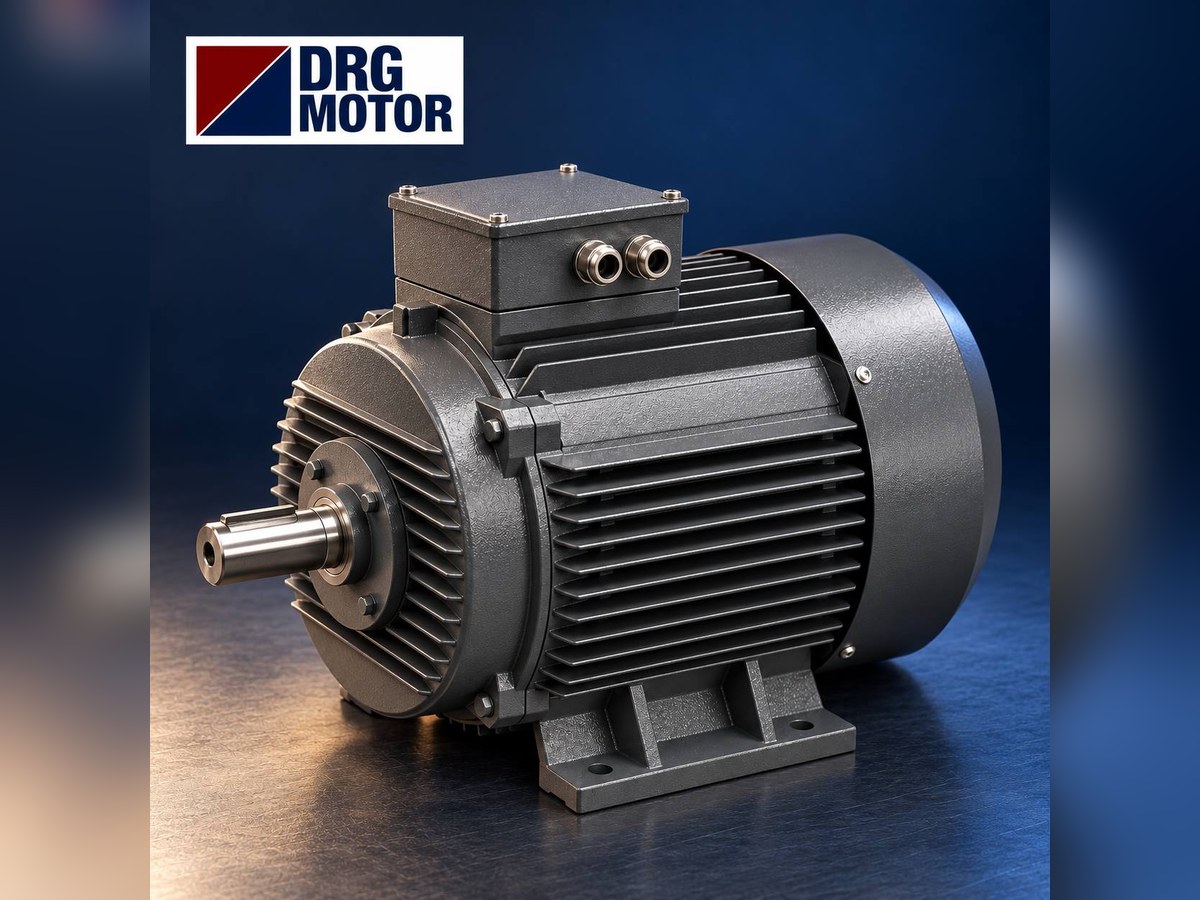
A grain and seed cleaning machine motor drives the pre-cleaning machines that remove straw, cobs, soil, stones and dust from the harvested crop. These machines have two separate motor duties: the drive motor that moves the screen drum or screen box, and the aspiration fan motor that sucks out light foreign matter. In manufacturer catalogues the drive motors are 0.25–2.2 kW and the fan motors 0.75–15 kW; the largest motor on a cleaner is usually its fan.
This page covers pre-cleaning only, that is, the removal of coarse and light foreign matter. Grading kernels by size, length and specific weight is a separate job and the subject of the Grain Screening and Grader Machine Electric Motors page. Live prices for the motors named here: Buy Electric Motors Online.
What does pre-cleaning remove, and what not?
The pre-cleaner roughly cleans the crop before it enters the silo, dryer or grader. What it removes falls into three groups:
- Coarse foreign matter: straw, cobs, leaves, soil clods, string and bag pieces. Being larger than the kernels, they stay on top of the screen.
- Light foreign matter: dust, husks, empty heads, light fragments. They are removed by an air stream.
- Heavy foreign matter: kernel-sized stones, glass and metal. A destoner and a magnet catch them.
Broken kernels, weed seeds and shrivelled kernels largely pass through pre-cleaning. Separating them needs the fine screens of a grader, the indented cylinder of a trieur and a gravity table. The aim of pre-cleaning is to stop, already at the intake pit, the straw that would clog the dryer, the stones that would strain the elevator and the dust that would cause heating in storage.
Cleaning machine types and what the motors do
Drum pre-cleaner
The crop is fed into or onto a perforated cylinder lying horizontal or slightly inclined. The cylinder turns slowly; kernels pass through the holes, coarse pieces are discharged at the end of the cylinder. The motor turns the drum through a gearbox. In one manufacturer's data sheet a dual-screen drum with 50 t/h pre-cleaning capacity turns at 21.9 rpm with a 1.5 kW motor. The waste auger below runs on a separate small motor. At harvest peak the main problem of a drum is blinded holes; a brush or scraper prevents it.
Aspirator (air channel) cleaner
As the crop falls as a thin curtain through a vertical air channel, an opposing air stream lifts the light particles. The air goes to a cyclone or expansion chamber where the dust settles. Here the motor turns a centrifugal fan; fan speed and damper setting decide cleaning quality. In air-recycling types the fan is inside the machine and the air circulates in a closed loop, so less dust is released outside.
Screen box pre-cleaner
An inclined screen box with one or two decks moves the crop forward with an oscillating motion. The box is shaken either by an eccentric shaft and belt from a standard motor, or by two vibration motors fixed to the box. Eccentric drives use a standard IEC motor; in vibration motor types the motor itself creates the vibration and belongs to a separate product group.
Destoner
In a destoner an inclined, perforated deck oscillates back and forth while air is blown from below. The air loosens the grain and lets it slide down, while heavy stones stay in contact with the deck surface and are carried upwards. There are two motor duties: the deck's oscillating drive and the fan supplying the air. In suction types the fan is not on the machine but in the plant's central aspiration; in pressure types the fan sits on the machine.
Magnet
A plate or bar magnet catches iron pieces in the product flow and has no motor. In self-cleaning rotary drum magnets the drum is turned by a small geared motor. The magnet is usually placed before the elevator and before sensitive machines such as crushers or mills.
Click to see current electric motor prices and order nowSEE PRICES →
How many kW is a cleaning machine motor?
A) Values in manufacturer catalogues
| Machine / capacity | Motor power | Single or total | Note |
|---|---|---|---|
| Drum, wheat 70 t/h | 0.55 kW + fan 4–5.5 kW | Drum and fan separate | Manufacturer catalogue, small model |
| Drum, wheat 100 t/h | 0.55 kW + fan 5.5–11 kW | Drum and fan separate | Same catalogue, large model |
| Waste auger (under drum) | 0.25 kW | Auxiliary motor | Same catalogue |
| Dual-screen drum, 50 t/h | 1.5 kW | Single drum motor | Second manufacturer's sheet |
| Aspirator, 12–60 t/h | 0.75–7.5 kW | Single fan motor | 2900 rpm, B5 flange |
| Air-recycling aspirator | 2.2–4 kW | Single fan motor | Intake 1–50 t/h |
| Screen box cleaner, 45 t/h | 2.2 kW + 0.75 kW | Screens and feeder separate | Screen shaft 300 rpm |
| Destoner, 5–30 t/h | 0.37–1.1 kW deck | Pressure type + fan 7.5–15 kW | Manufacturer catalogue |
For cleaners, catalogue motors sit between about 0.25 and 15 kW each. Because the moving mass is small, drum and screen drives rarely exceed 2.2 kW; the real power goes to the fan. Fan power depends less on tonnage than on the volume of air extracted and the resistance of the line: a cyclone, filter and long ducting raise the pressure. The total installed power of a cleaner is the sum of drum, fan and auger motors; on the 100 t/h drum, for example, it can reach 0.55 + 11 + 0.25 kW, about 11.8 kW.
B) The match in the DRG range
DRG Motor is a manufacturer, supplier and seller of electric motors. Our range covers 0.25–11 kW in aluminium frames and 0.55–355 kW in cast iron frames, 1000/1500/3000 rpm, 3-phase 230/400 V or 400/690 V; B3, B5, B14 and B35 mounting is specified with the order note. All standard drive and fan motors of 0.25–15 kW on cleaning machines fall within this range. For screen boxes driven by vibration motors, see our Vibration Motors page; the DRG vibration motor range is 0.12–15 kW, but these motors are not in the online shop and are supplied on quotation.
| Model | Power / speed | Frame · current 400 V | Price |
|---|---|---|---|
| DRG-801-40.75 HP | 0.55 kW · 1500 rpm | Cast iron 80 · 1.31 A | $91.72 (€81.91) Details & buy → |
| DRG-90L-42 HP | 1.5 kW · 1500 rpm | Cast iron 90L · 3.3 A | $144.14 (€128.73) Details & buy → |
| DRG-100L1-43 HP | 2.2 kW · 1500 rpm | Cast iron 100L · 4.52 A | $188.32 (€168.18) Details & buy → |
| DRG-90L-23 HP | 2.2 kW · 3000 rpm | Cast iron 90L · 4.35 A | $154.45 (€137.93) Details & buy → |
| DRG-112M-25.5 HP | 4 kW · 3000 rpm | Cast iron 112M · 7.45 A | $225.65 (€201.52) Details & buy → |
| DRG-132S1-27.5 HP | 5.5 kW · 3000 rpm | Cast iron 132S · 10.1 A | $338.72 (€302.50) Details & buy → |
| DRG-132S2-210 HP | 7.5 kW · 3000 rpm | Cast iron 132S · 13.7 A | $369.43 (€329.92) Details & buy → |
| DRG-160M1-215 HP | 11 kW · 3000 rpm | Cast iron 160M · 19.6 A | $527.95 (€471.49) Details & buy → |
| DRG-160M2-220 HP | 15 kW · 3000 rpm | Cast iron 160M · 26.5 A | $570.23 (€509.25) Details & buy → |
Example: motor power for an aspiration fan
One manufacturer specifies 10,600 m³/h of aspiration air for its 45 t/h combi cleaner; that is about 236 m³/h per tonne. At the same ratio, the cleaner of a 38 t/h intake line needs about 9,000 m³/h of air. Assume a total resistance of 1,400 Pa for the air channel, cyclone and ducting, and a fan efficiency of 0.62:
- Airflow: 9,000 / 3,600 = 2.5 m³/s.
- Fan shaft power: P = Q·Δp / η = 2.5 × 1,400 / 0.62 ≈ 5.6 kW.
- A factor of 1.1 for belt loss and filter loading gives ≈ 6.2 kW. The next standard step is 7.5 kW.
- If the fan is direct-coupled, the 2-pole DRG-132S2-2 (7.5 kW, 2930 rpm, 13.7 A at 400 V) is a suitable candidate.
When an inverter brings fan speed to 0.9 times, airflow also falls to 0.9 times, while power drops to about 0.9³ ≈ 0.73 times. So on light crops (oats, sunflower), adjusting speed uses less energy than running the fan at full speed and throttling with a damper, and lowers the risk of losing good kernels up the channel. To calculate with your own values, use the pump and fan motor power calculator.
Speed, drive and mounting
Aspiration fan
Aspirator fans are mostly driven directly by a 2-pole motor; one manufacturer's sheet gives the motor as 2,900 rpm with a B5 flange. On larger fans speed is set by belt and pulley and the motor sits on a foot-mounted (B3) base.
Drum
A low drum speed such as 20–25 rpm is obtained with a 4-pole motor and gearbox. To get from a 1,445 rpm motor to 21.9 rpm, the overall ratio must be about 66; this is usually achieved by gearbox and chain sprocket together. Try the ratio for your drum in the gearbox tool.
Eccentric screen box
On an eccentric-shaft box the motor turns the shaft through a belt; on one sheet the screen shaft turns at 300 rpm. With a 4-pole motor the pulley ratio is about 4.8. Confirm the mounting on the cleaner manufacturer's drawing.
Checklist for choosing a cleaning machine motor
- Intake rate: If the cleaner's capacity is below the unloading rate of the intake pit, the line waits for it. Capacity drops with wet and dirty crop; do not push the motor to compensate.
- Fan rotation: A centrifugal fan running backwards looks as if it works but delivers only part of the air. After a motor change, check the direction against the arrow on the fan housing.
- Fan current: With the damper fully open, motor current must not exceed the nameplate current; current rises when the filter is cleaned.
- Waste auger: A blocked waste auger trips the overload and stops the drum; set the protection of this small motor separately.
- Eccentric box: Belt tension and balance weights; imbalance strains the motor bearings.
- Dust: Brush the fan cowl and fins every week. If the cleaner stands in a closed room classed as a dust zone, the motor must carry Ex marking; DRG does not offer Ex motors.
- Starting order: Fan and drum first, feed last; reverse when stopping. That way crop does not pile onto a full drum.
Motors in this power range
The most common ratings on cleaning machines:
| Model | Power / speed | Frame | Current 400 V |
|---|---|---|---|
| DRG-801-4 | 0.55 kW / 1400 rpm | 80 cast iron | 1.31 A |
| DRG-90L-4 | 1.5 kW / 1445 rpm | 90L cast iron | 3.3 A |
| DRG-112M-2 | 4 kW / 2905 rpm | 112M cast iron | 7.45 A |
| DRG-132S1-2 | 5.5 kW / 2930 rpm | 132S cast iron | 10.1 A |
| DRG-132S2-2 | 7.5 kW / 2930 rpm | 132S cast iron | 13.7 A |
| DRG-160M1-2 | 11 kW / 2945 rpm | 160M cast iron | 19.6 A |
- DRG-801-4 – 0.55 kW – 1400 rpm – 80 cast iron
- DRG-90L-4 – 1.5 kW – 1445 rpm – 90L cast iron
- DRG-100L1-4 – 2.2 kW – 1450 rpm – 100L cast iron
- DRG-112M-2 – 4 kW – 2905 rpm – 112M cast iron
- DRG-132S2-2 – 7.5 kW – 2930 rpm – 132S cast iron
- DRG-160M1-2 – 11 kW – 2945 rpm – 160M cast iron
Click to see current prices and order these motors nowSEE PRICES →
DRG MOTOR motors are guaranteed against material and manufacturing defects for 2 years from the delivery date (warranty certificate). For the dust collection side of the fan see our dust collection and filter fan motor page, and for other fan types the Fan Motors category.
Grain cleaning motor: frequently asked questions
How many motors does a wheat cleaning machine have?
A simple drum cleaner has one drum motor. Models with aspiration add a fan motor and often a waste auger motor; combined screen box machines also have a feeder motor.
When an aspirator fan motor burns out, should the same power be bought?
Yes, buy a motor with the same nameplate power and speed. A higher-speed motor overloads the fan; a lower-speed motor reduces airflow and spoils cleaning.
Does a drum pre-cleaner need an inverter?
Usually not; the drum turns at constant speed. An inverter is used more to adjust fan speed to the crop.
Are a pre-cleaner and a grader the same machine?
No. A pre-cleaner removes coarse and light foreign matter; a grader sorts kernels by size, length and weight and is used for seed preparation.
Tell us the fan size and the old motor's plate values; we will match a replacement. Phone +90 (542) 666 11 11, e-mail [email protected], contact page. Shop page: Buy Electric Motors Online.


