 English
 Le français
 Türkçe

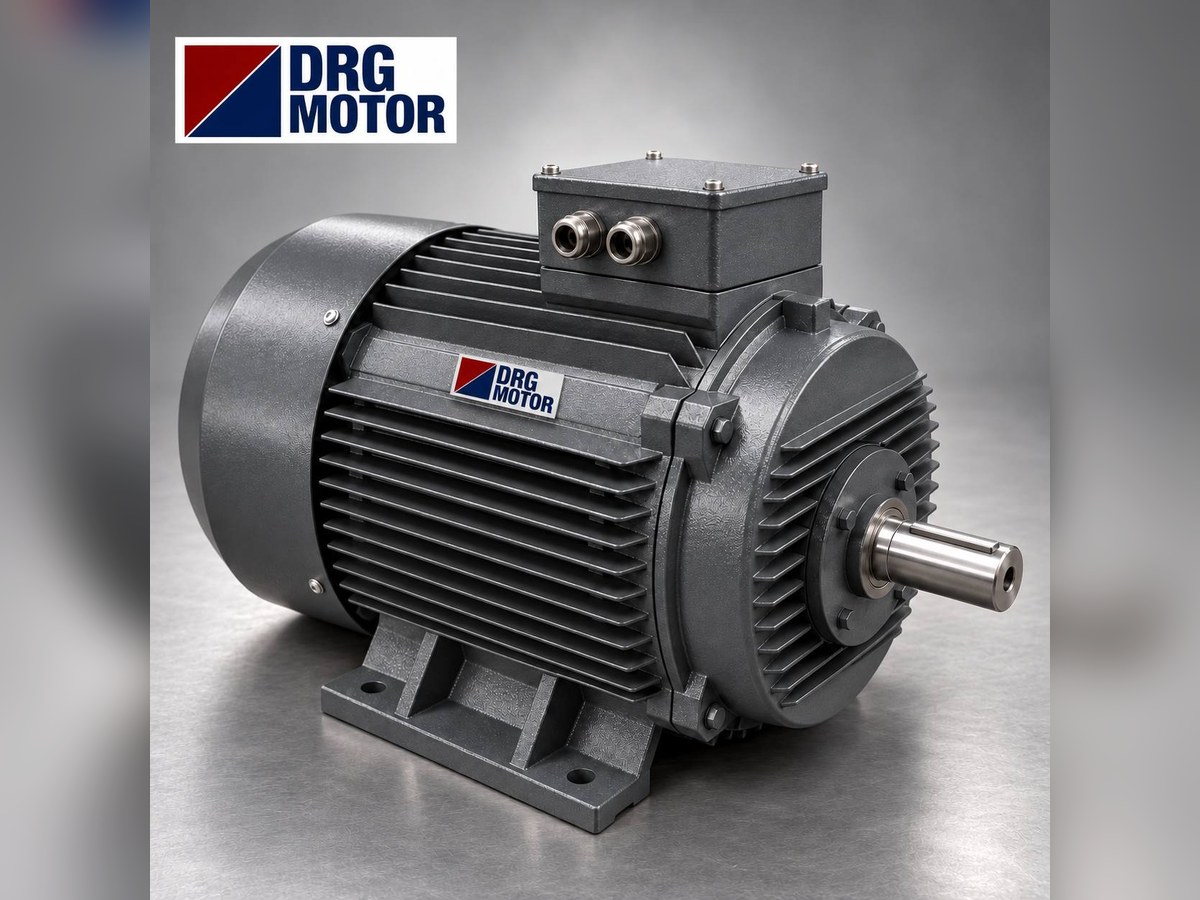
A plastic washing line motor is any of the three-phase electric motors that turn the machines converting shredded, dirty plastic into clean flakes: the wet granulator rotor, the paddle shaft of the friction washer, the screws and paddle drums of the sink-float tank, the hot wash tank agitator, the water pumps, the centrifugal dryer and the drying fans. A single line runs dozens of motors, small and large. The right choice depends on the power and speed each machine needs, on the wet surroundings and on how the machine starts.
This page covers the motor, not the machine. DRG Motor does not sell washing machines, gearboxes, water pumps or inverters; we supply the electric motor that drives them. Suitable models are listed on our Buy Electric Motors Online page.
What is a washing line and how does it change with the material?
A washing line takes collected packaging, film, crates, drums or bottle regrind, removes sand, soil, paper, oil and adhesive, then dewaters it and prepares dry flakes for extrusion or sale. The order of the machines stays broadly the same, but which machine works hardest depends on what is being washed.
Film and soft plastics (LDPE, LLDPE, PP woven bags)
Agricultural film, stretch film and woven sacks hold water and wrap around rotors and screws. These lines usually have several friction washers and floating tanks after the wet granulator, and the final dewatering is done by a screw squeezer instead of, or together with, a centrifuge. The largest motor of the line is often found in that squeezer.
Rigid plastics (HDPE drums, PP crates)
Rigid parts load the wet granulator with impacts, and the flakes are heavier and sandier. In the sink-float tank HDPE and PP float while heavy dirt settles. A centrifugal dryer is normally enough for dewatering, so a squeezer is rarely needed. Oily containers call for an additional hot wash tank.
Where does the PET bottle line differ?
PET is also processed on a washing line, but it adds steps of its own (removing labels, floating off caps, washing in hot caustic). We cover those on a separate page, PET Bottle Recycling Line Motors; here we focus on the machines shared by film and rigid plastic lines.
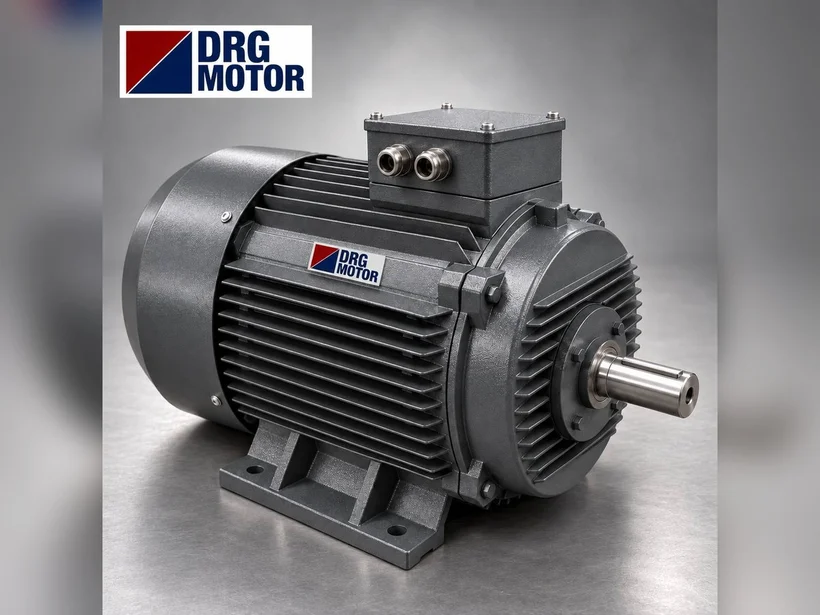
Motors along the line, machine by machine
Wet granulator
A wet granulator is a knife granulator with water sprayed continuously into the cutting chamber. The water does the first rough wash and cools the knives. The motor usually turns the rotor through belts and pulleys; in one catalogue we reviewed the rotor runs at 470 rpm and motor power ranges from 55 to 90 kW with rotor diameter. Our plastic granulator motor article explains load behaviour and pulley sizing; what matters here is that the wet granulator motor faces impact loads and splashing water at the same time.
Friction washer
A paddle shaft spinning fast inside an inclined housing rubs the flakes against each other and against the screen, tearing off stuck dirt. Catalogues give rotor speeds of 720–1200 rpm; the motor usually sits at the upper end of the housing with a belt drive. With a long shaft and heavy paddles, starting with a full housing strains the motor, and restarting without emptying the washer after a line stop is one of the most common reasons for overload trips.
Sink-float tank: paddle drums and bottom screw
Paddles or drums turning above the water push the floating flakes forward, while the bottom screw removes the heavy dirt that sinks. These motors are small (from 0.37 kW to 5.5 kW in the catalogue we reviewed) and usually run through a gearbox for low output speed. Because speed sets how long the material stays in the tank, they are often adjusted with an inverter.
Hot wash tank agitator and pumps
Rigid plastic with oil or glued labels is stirred in heated water with detergent. The agitator motor stands vertically on top of the tank and is slowed down by a gearbox, so it must be ordered for vertical mounting. The water loop is driven by centrifugal pumps: pre-wash water, tank feed, filter backwash and sludge pumps. Pump motors are mostly 2-pole and directly coupled.
Dewatering and drying motors
Flakes leaving the wash carry a large share of water. Two or three different machines are lined up at the end of the line to remove it, and each motor does a different job.
Centrifugal dryer
A paddle rotor spinning fast inside a screen basket throws water out by centrifugal force. In the catalogue, rotor speed drops as size grows: a Ø400 mm shaft at 1400 rpm, a Ø750 mm shaft at 1080 rpm. The heavy rotor takes seconds to reach speed, so starting current lasts longer and protection settings must allow for it. Starting inertia and pulley choice are discussed in our plastic drying and squeezer motor article.
Squeezer
Typical of film lines: a large screw presses the film towards a die, squeezes out the water and discharges semi-plasticised lumps. The screw turns slowly, so the main motor delivers high torque through a gearbox. In the two models we reviewed the main motor is 90 and 132 kW, with the outlet cutter and fan driven by separate small motors.
Thermal drying fan
To remove the last moisture, the flakes are carried through a hot-air pipe. The motor turns the fan; heat comes from an electric heater or steam. Fan motors are usually 2- or 4-pole, direct or belt driven. Since the air and the heater are separate circuits, heater power is not part of motor selection.
Click to see current electric motor prices and order nowSEE PRICES →
Motor power in washing machines on the market
The table below is compiled from models published in different manufacturers' catalogues. Each figure is the rating of one machine's motor; the installed total of a line is far higher.
| Machine / model group | Motor power | Single motor or total | Note |
|---|---|---|---|
| Wet granulator, Ø630 mm rotor | 55 kW | single motor | maker catalogue, small model; rotor 470 rpm |
| Wet granulator, Ø800 mm rotor | 90 kW | single motor | same catalogue, large model |
| Friction washer, Ø350 mm rotor | 15 / 22 kW | single motor, two options | maker catalogue; rotor 720–1200 rpm |
| Friction washer, Ø750 mm shaft | 55 kW | single motor | second maker, large model; 1080 rpm |
| Sink-float tank, 4–6 m | 5.5 + 3.7 kW screws; 0.37 + 2.2 kW drums | four separate motors | maker catalogue |
| Centrifugal dryer, Ø400 / Ø750 mm shaft | 37 / 55 kW | single motor | maker catalogue, small and large model |
| Film squeezer | 90 / 132 kW main; 4 / 5.5 kW cutter; 5.5 kW fan | main and auxiliaries separate | maker catalogue, two models |
| Pipe-type thermal dryer | 5.5 kW blower + 5.5 kW suction fan | two fan motors | line catalogue; the electric heater is not a motor |
Taken together, the single motors in these washing machines range from about 0.37 kW to 132 kW. Power changes with hourly flake output, rotor diameter, whether the material is film or rigid and how dirty it is. At the same capacity a film line needs a bigger final motor than a rigid line because of the squeezer.
Worked example: wash water pump and friction washer pulley
Pump motor
Assume a pump feeding the pre-wash tank lifts 30 m³ of water per hour to a 25 m head with a pump efficiency of 0.65. P = ρ · g · Q · H / η_pump = 1000 × 9.81 × (30 / 3600) × 25 / 0.65 ≈ 3.14 kW. The next standard size is 4 kW; a good fit here is the 2-pole DRG-112M-2, rated 2905 rpm and 7.45 A at 400 V. Try your own values in the pump and fan motor power calculator.
Friction washer pulley ratio
In the catalogue a 45 kW washer runs its rotor at 1200 rpm. Our 4-pole 45 kW motor DRG-225M-4 runs at 1485 rpm, giving a ratio of 1485 / 1200 ≈ 1.24. With a 200 mm motor pulley the rotor pulley is about 248 mm. Rotor torque, ignoring losses, is 45 × 9550 / 1200 ≈ 358 Nm; the motor's rated torque is 289.4 Nm, and the pulley ratio covers the difference. The exact ratio comes from the machine maker's drawing.
Water, moisture and splashing: protecting the motor
The washing line is the wettest part of a plant. DRG motors are IP55, meaning protection against dust and water jets from any direction. Places washed with high-pressure jets or submerged need higher protection; IP66 motors are not in our range.
- Mount the motor outside the splash zone where possible, above the tank edge; the belt guard should not channel water onto the motor.
- Close the terminal box gasket and cable gland tightly and form a drip loop so the cable enters the gland from below.
- On vertical agitator motors the shaft points down; order the vertical version and keep water from collecting on top.
- Caustic or detergent water wears the paint over time; do not hose the motor directly during cleaning.
- After long stoppages, measure winding insulation of motors in wet areas before restarting.
Vibrating machines on the line, such as dewatering screens, usually run on vibration motors. Those vibratory units belong to a different product family from the standard induction motor; send us the machine details and read our vibration motors article first.
DRG motors: power ratings for washing lines
DRG Motor is a manufacturer, supplier and seller of electric motors. Most of the ratings used on a washing line fall inside our range: on a wash line, aluminium bodies cover the tank paddles, screws and pumps up to 11 kW, while cast iron takes the granulator, washers and dryers up to 355 kW, in 6-, 4- or 2-pole versions. Mounting types are B3, B5, B14, B34, B35 and vertical versions depending on frame. The examples below come from our product data:
| Model | Power / speed | Frame · shaft D×E | Current 400 V |
|---|---|---|---|
| DRG-112M-2 | 4 kW / 2905 rpm | 112M cast iron · 28×60 | 7.45 A |
| DRG-132S-4 | 5.5 kW / 1460 rpm | 132S cast iron · 38×80 | 10.7 A |
| DRG-160L-4 | 15 kW / 1465 rpm | 160L cast iron · 42×110 | 27.3 A |
| DRG-225S-4 | 37 kW / 1485 rpm | 225S cast iron · 60×140 | 66.1 A |
| DRG-225M-4 | 45 kW / 1485 rpm | 225M cast iron · 60×140 | 80.2 A |
| DRG-250M-4 | 55 kW / 1485 rpm | 250M cast iron · 65×140 | 97.6 A |
| DRG-280M-4 | 90 kW / 1486 rpm | 280M cast iron · 75×140 | 155 A |
Before ordering a replacement, put these side by side: the old nameplate's power, speed, voltage and winding connection; frame and mounting type; shaft diameter and key; flange size if any; pulley or coupling arrangement. We check these against the machine maker's documents and do not promise an exact fit before we see the nameplate and photos. For heavy-starting machines such as centrifugal dryers and squeezers, also tell us the starting method.
Live price table
Prices of our motors in ratings common on washing lines come live from the store:
| Model | Power / speed | Frame · current 400 V | Price |
|---|---|---|---|
| DRG-112M-25.5 HP | 4 kW · 3000 rpm | Cast iron 112M · 7.45 A | $225.65 (€201.52) Details & buy → |
| DRG-132S-47.5 HP | 5.5 kW · 1500 rpm | Cast iron 132S · 10.7 A | $342.01 (€305.44) Details & buy → |
| DRG-132M-410 HP | 7.5 kW · 1500 rpm | Cast iron 132M · 14.3 A | $394.89 (€352.66) Details & buy → |
| DRG-160L-420 HP | 15 kW · 1500 rpm | Cast iron 160L · 27.3 A | $678.13 (€605.61) Details & buy → |
| DRG-180L-430 HP | 22 kW · 1500 rpm | Cast iron 180L · 39.7 A | $919.45 (€821.13) Details & buy → |
| DRG-225S-450 HP | 37 kW · 1500 rpm | Cast iron 225S · 66.1 A | $1,527.18 (€1,363.87) Details & buy → |
| DRG-225M-460 HP | 45 kW · 1500 rpm | Cast iron 225M · 80.2 A | $1,688.50 (€1,507.94) Details & buy → |
| DRG-250M-475 HP | 55 kW · 1500 rpm | Cast iron 250M · 97.6 A | $2,065.73 (€1,844.82) Details & buy → |
| DRG-280S-4100 HP | 75 kW · 1500 rpm | Cast iron 280S · 129 A | $2,916.93 (€2,605.00) Details & buy → |
| DRG-280M-4125 HP | 90 kW · 1500 rpm | Cast iron 280M · 155 A | $3,268.56 (€2,919.03) Details & buy → |
DRG MOTOR motors are guaranteed against material and manufacturing defects for 2 years from the delivery date (warranty certificate).
Motors in this power range
- DRG-132S-4 – 5.5 kW – 1460 rpm – 132S cast iron
- DRG-180L-4 – 22 kW – 1470 rpm – 180L cast iron
- DRG-225M-4 – 45 kW – 1485 rpm – 225M cast iron
- DRG-250M-4 – 55 kW – 1485 rpm – 250M cast iron
- DRG-280M-4 – 90 kW – 1486 rpm – 280M cast iron
Click to see current prices and order these motors nowSEE PRICES →
Browse products, request a quote: all models are on the Buy Electric Motors Online page. Send photos of your line's motor nameplates via WhatsApp and we will prepare a quote matching each machine.
Frequently asked questions
Which is the largest motor on a plastic washing line?
On rigid lines it is usually the wet granulator or the centrifugal dryer; on film lines it is often the squeezer's main motor. The exact answer depends on line capacity and the machine list.
Is an HDPE washing line motor different from a film line motor?
Both use the same type of three-phase induction motor; the difference is how power is distributed. On HDPE lines the granulator takes impacts, on film lines wrapping and squeezing loads dominate. Choose by the machine's nameplate.
Cast iron or aluminium frame in wet areas?
Both are available up to 11 kW. Cast iron is heavier and more impact resistant; aluminium is lighter. Both are IP55; what matters most is closing the terminal box and gland properly.
What does a washing line motor cost?
Power, speed and frame set the price; today's figures sit in the live table higher up the page, and a whole line list can be quoted in one go.
Send us your washing line machine list and motor nameplates and we will match them together: phone +90 (542) 666 11 11, e-mail [email protected], contact page. For a broader plant view, our motor selection in recycling plants article is a useful guide.


