 English
 Le français
 Türkçe

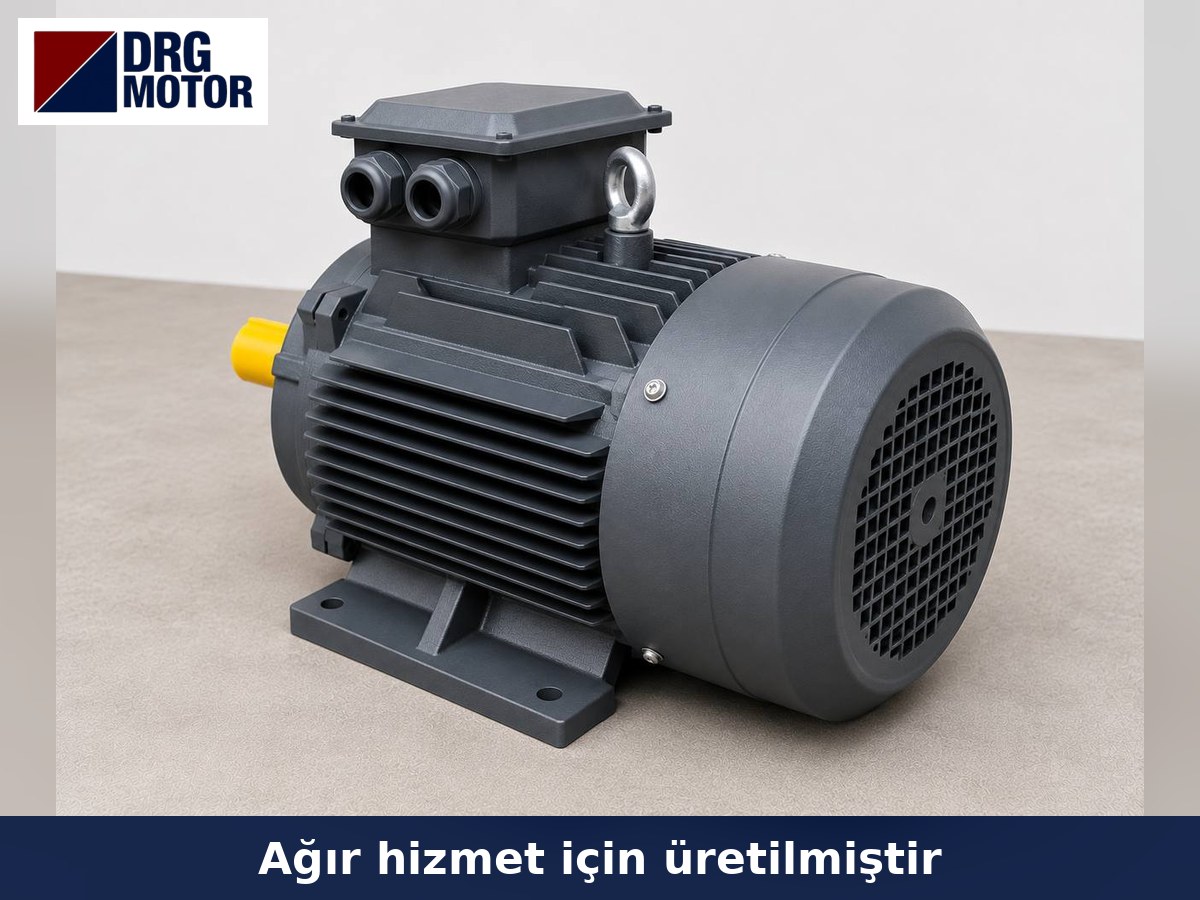
In a plant that cleans municipal sewage or factory effluent, electric motors are concentrated in three zones: preliminary treatment where coarse solids and grit are removed, the biological basins where micro-organisms are supplied with oxygen, and the sludge building where the resulting sludge is dewatered. According to manufacturer catalogues, screen and grit classifier motors are small, around 0.37–0.75 kW; aeration blowers reach 1.5–250 kW, surface aerators 0.75–110 kW and decanter main motors 11–160 kW. Aeration usually takes the largest share of the plant’s electricity. This page is not about plants that prepare drinking water; it covers the plant that treats dirty water before discharge.
DRG Motor is a manufacturer, supplier and seller of electric motors. We do not sell screens, grit chambers, blowers, aerators, mixers, pumps, decanters, belt presses, gearboxes or inverters; we supply the drive motor of these machines where it stands in a dry location. All models are on the Buy Electric Motors Online page.
Motor map of a wastewater line: from preliminary treatment to the sludge building
Incoming wastewater first passes the screens and the grit chamber, then the primary settling tank and then the activated sludge basins. In the basins blowers or surface aerators provide oxygen and mixers keep the liquor moving. Sludge separated in the final clarifier is partly returned to the basin and the surplus is thickened and dewatered. Motor selection answers a different question in each zone.
Screens and grit removal
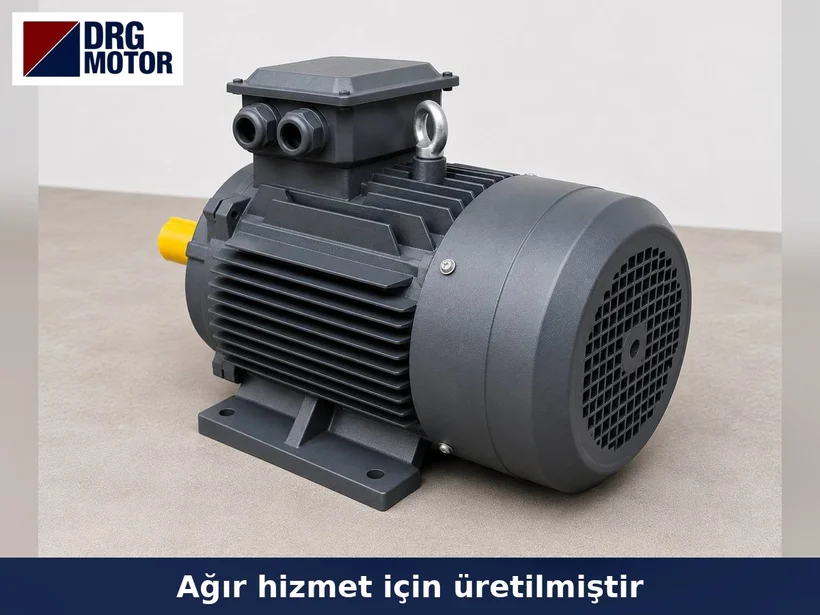
Rotary drum or rake screens, and screw classifiers that wash grit and lift it out, turn at low speed. A modest motor drives a high-ratio gearbox; since torque can rise suddenly when the screen blinds, most makers use a torque limiter or current monitoring. These motors work at the channel edge in a smelly, splash-prone environment.
Biological basin: blowers and surface aerators
In a diffused-air system, rotary lobe, screw or turbo blowers push air to diffusers at the bottom of the basin; the blower must produce enough pressure to overcome basin depth and pipe losses. With a surface aerator the motor stands above the basin and turns the rotor directly or through a gearbox; one maker’s data sheet stresses that the motor is air-cooled and never touches the liquid. For power and speed details of Roots-type blower motors see our Roots blower motor article.
Mixers and pumps: submersible units are outside our range
Submersible mixers in anoxic basins and equalisation tanks, and the submersible pumps in sewage lift stations, carry their motors under water in one housing with the equipment. Their sealed, oil-chambered construction rules out a swap with an ordinary IEC motor: submersible motors are not in our range. A DRG motor fits only the dry-installed drives in this area, such as dry-pit centrifugal sludge pumps, return sludge pumps or vertical-shaft mixers hung from a bridge. For submersible pump supply see our submersible pump article.
Sludge thickening and dewatering
Surplus sludge drawn from the final clarifier goes through a thickener and then to a decanter, a belt press or a screw press. In a decanter the main motor that spins the heavy bowl is separate from the scroll motor; on a belt press the motor driving the belts is a few kW. The detailed decanter start-up calculation is in our sludge dewatering motor article; here we only place these machines within the plant as a whole.
Click to see current electric motor prices and order nowSEE PRICES →
How many kW for a wastewater treatment plant motor? Catalogue values
A) Motor ratings read in the catalogues and data sheets of wastewater equipment makers:
| Equipment / model group | Motor power | Single / total | Note |
|---|---|---|---|
| Rotary drum fine screen (Ø980 mm drum, 3 rpm) | 0.55–0.75 kW | single motor, direct drive | first maker |
| Screw grit classifier, 5–35 l/s | 0.37–0.75 kW | single motor | second and third makers |
| Rotary lobe aeration blower | 1.5–250 kW | one motor per package | fourth maker, series range |
| Surface aerator (floating or bridge-mounted) | 0.75–110 kW | single air-cooled motor | fifth maker |
| Submersible mixer (propeller 210–900 mm) | 0.8–22 kW | integral underwater motor | sixth maker |
| Submersible wastewater pump | 1.3–680 kW | integral underwater motor | seventh maker |
| Belt filter press, 5–50 m³/h sludge | 0.75–3.3 kW | belt drive | eighth maker |
| Decanter centrifuge, 2–100 m³/h | 11–160 kW main + 4–55 kW scroll | two separate motors | ninth maker |
From these values, preliminary treatment motors sit around 0.37–0.75 kW, the aeration side covers 0.75–250 kW and sludge dewatering 0.75–160 kW (with a separate 4–55 kW scroll motor on a decanter). The figures refer to one machine; where several blowers or aerators serve the same basin, total power is their sum. Higher pollutant load and deeper basins mean more blower power; more sludge flow means a bigger decanter.
B) Overlap with the DRG range: screen, grit classifier, belt press, dry-installed pump, blower, surface aerator and decanter motors all fall within our 0.25–355 kW, 2/4/6-pole range. What does not overlap is the motor type rather than the power: the integral motors of submersible mixers and submersible pumps are outside our range. Large turbo blowers above 355 kW in a single unit are also outside it.
Worked example: motor power for an aeration blower
Pressure and air power
Assume 20 m³ of air per minute must be delivered to an activated sludge basin, with diffusers at 5 m water depth and 8 kPa of pipe and diffuser losses. The blower must then produce a differential pressure of about 57 kPa. Using the adiabatic compression relation, the power transferred to the air is about 16.1 kW. Taking blower and belt losses together with a coefficient of 0.70, shaft power is about 23 kW.
Choosing the motor
For a shaft power of about 23 kW the next standard step is 30 kW; the 4-pole DRG-200L-4 sits at that step, with a rated speed of 1475 rpm and a rated current of 53.8 A from a 400 V supply. The 22 kW DRG-180L-4 one step below is marginal here: when belt tension or fouled diffusers raise the load, the motor goes above its nameplate value. To find the blower speed from the pulley ratio, use the pulley-belt calculator.
Daily energy and inverter
If this blower runs 18 hours a day at about 23 kW shaft power, daily consumption is roughly 414 kWh. Because dissolved oxygen in the basin changes during the day, larger plants drive blowers through an inverter and set airflow from oxygen measurement. If the motor is to run long periods at low speed on an inverter, mention cooling and bearing currents in your enquiry; we do not sell the inverter itself.
Motors in a wet, smelly environment
Humidity, hydrogen sulphide and outdoor sites
In a wastewater plant, hydrogen sulphide (H2S) and moisture attack terminal boxes, cable glands and paint. For our IP55 motors the catalogue sets these limits: ambient temperature no lower than −15 and no higher than +40 °C, and site height no more than 1000 m above sea level. Placing screen motors at the channel edge where wash water cannot hit them directly, fitting a canopy to motors on open basin bridges, and checking insulation before restarting after a long stop all extend motor life.
Cases outside our range
Digesters, biogas pipework and enclosed screen houses are often zoned as explosive atmospheres; such zones call for Ex motors, which are outside our range. Gate and valve actuators come with their own motors; the brake motor needed by lifting gear and the single-phase motor found on small dosing pumps are not in our range either. In these cases contact the equipment manufacturer.
Wastewater plant drives with DRG motors
Eight models covering the plant’s power steps, from the screen drive up to a large aeration blower:
| Model | Power / speed | Frame · shaft D×E | Current 400 V |
|---|---|---|---|
| DRG-801-4 | 0.55 kW / 1400 rpm | 80 cast iron · 19×40 | 1.31 A |
| DRG-100L1-4 | 2.2 kW / 1450 rpm | 100L cast iron · 28×60 | 4.52 A |
| DRG-132M-4 | 7.5 kW / 1460 rpm | 132M cast iron · 38×80 | 14.3 A |
| DRG-160M-4 | 11 kW / 1465 rpm | 160M cast iron · 42×110 | 20.4 A |
| DRG-180L-4 | 22 kW / 1470 rpm | 180L cast iron · 48×110 | 39.7 A |
| DRG-200L-4 | 30 kW / 1475 rpm | 200L cast iron · 55×110 | 53.8 A |
| DRG-225M-4 | 45 kW / 1485 rpm | 225M cast iron · 60×140 | 80.2 A |
| DRG-280S-4 | 75 kW / 1486 rpm | 280S cast iron · 75×140 | 129 A |
Match the old motor’s number of poles: 4 poles are common on geared screen, classifier and belt press drives, while blowers may use 2 or 4 poles because speed is set by the pulleys. Aluminium frames (up to 11 kW) suit small ratings and cast iron frames suit large drives such as blowers and decanters. We offer foot-mounted B3, flange B5 and combined B35 versions. For a quote we need the nameplate picture, the shaft and keyway dimensions, the distance between foot holes or the flange size, and where in the plant the machine sits; until we have checked these measurements we do not confirm a fit.
Live price table
Current prices of motors matching wastewater equipment come straight from the shop:
| Model | Power / speed | Frame · current 400 V | Price |
|---|---|---|---|
| DRG-801-40.75 HP | 0.55 kW · 1500 rpm | Cast iron 80 · 1.31 A | $91.72 (€81.91) Details & buy → |
| DRG-802-41 HP | 0.75 kW · 1500 rpm | Cast iron 80 · 1.75 A | $101.93 (€91.03) Details & buy → |
| DRG-100L1-43 HP | 2.2 kW · 1500 rpm | Cast iron 100L · 4.52 A | $188.32 (€168.18) Details & buy → |
| DRG-132M-410 HP | 7.5 kW · 1500 rpm | Cast iron 132M · 14.3 A | $394.89 (€352.66) Details & buy → |
| DRG-160M-415 HP | 11 kW · 1500 rpm | Cast iron 160M · 20.4 A | $568.76 (€507.94) Details & buy → |
| DRG-180L-430 HP | 22 kW · 1500 rpm | Cast iron 180L · 39.7 A | $919.45 (€821.13) Details & buy → |
| DRG-200L-440 HP | 30 kW · 1500 rpm | Cast iron 200L · 53.8 A | $1,235.00 (€1,102.93) Details & buy → |
| DRG-225M-460 HP | 45 kW · 1500 rpm | Cast iron 225M · 80.2 A | $1,688.50 (€1,507.94) Details & buy → |
| DRG-280S-4100 HP | 75 kW · 1500 rpm | Cast iron 280S · 129 A | $2,916.93 (€2,605.00) Details & buy → |
DRG MOTOR motors are guaranteed against material and manufacturing defects for 2 years from the delivery date (warranty certificate).
Motors in this power range
- DRG-801-4 – 0.55 kW – 1400 rpm – 80 cast iron
- DRG-100L1-4 – 2.2 kW – 1450 rpm – 100L cast iron
- DRG-180L-4 – 22 kW – 1470 rpm – 180L cast iron
- DRG-200L-4 – 30 kW – 1475 rpm – 200L cast iron
- DRG-280S-4 – 75 kW – 1486 rpm – 280S cast iron
Click to see current prices and order these motors nowSEE PRICES →
Pick a motor or get a quote: blower, screen and sludge line motors are on the Buy Electric Motors Online page. Send the machine type, nameplate photo, daily running time and number of starts via WhatsApp, or call +90 (542) 666 11 11.
Frequently asked questions
Can I replace a surface aerator motor with a standard motor?
If the motor stands dry above the basin and turns the rotor via a flange or a gearbox, yes, provided power, speed, flange and shaft size match. On types with an underwater motor built into the rotor, no.
Does a larger blower motor give more aeration?
Not on its own. Airflow is set by blower speed and pressure; a stronger motor can only carry more load. If more airflow is needed, check the blower maker’s curve first.
For questions: +90 (542) 666 11 11 · info@drgmotor.com · contact. For an overview of the other motors in the plant, read our article on motor selection in wastewater treatment.


