 English
 Le français
 Türkçe

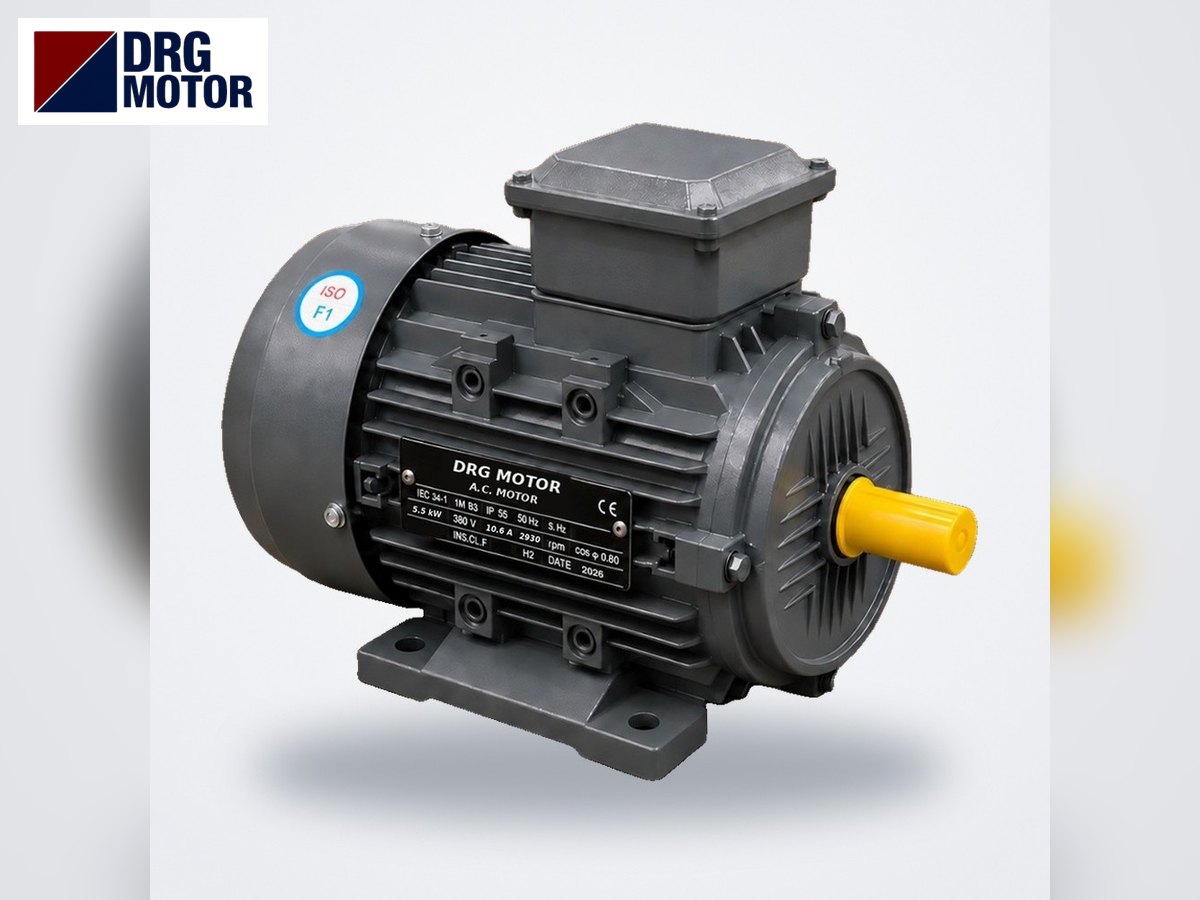
On a metal belt grinder the electric motor turns the drive drum that carries the abrasive belt; on a polishing lathe it spins felt and cloth mops; on a deburring machine it runs, next to the belt, the brushes, the conveyor that carries the part and the fan that pulls away the dust. What these machines share is high speed, metal dust and sparks. This page covers the metalworking side: which motor works where, when an aluminium housing is the right choice, and why shaft and speed decide the match. Belt speed from drum diameter is worked out in our article on belt speed and power selection for a belt sander, and mop loading in polishing in our article on polishing motor speed and shaft load.
DRG Motor is a manufacturer, supplier and seller of electric motors. We do not sell grinding or polishing machines, belt drums, brushes, polishing spindles and bearings, dust extraction units, drives or panels; DRG’s share is the three-phase cage motor behind each of these. All our light-housing models can be viewed in the Aluminium Housing Electric Motors category.
Where motors sit on grinding, polishing and deburring machines
Belt grinder: drum on the motor shaft
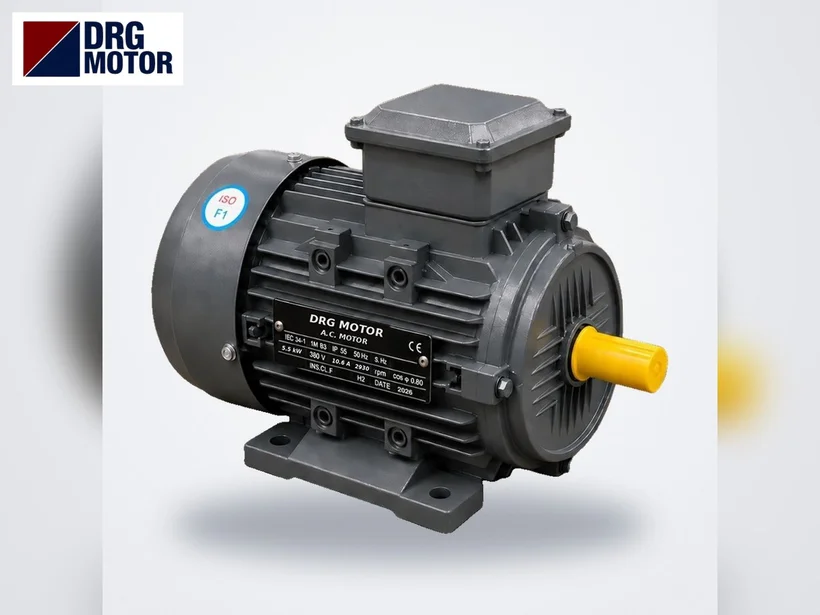
On a workshop belt grinder the drive drum is usually fitted straight onto the motor shaft with no belt or gearbox in between. The motor also carries the frame that holds the belt arm. Shaft diameter, shaft length and key therefore have to match the drum bore exactly. For fast material removal most makers choose a 2-pole motor of about 3000 rpm; for stainless and heat-sensitive work a two-speed motor or an inverter provides the slow setting.
Polishing lathe: double-ended spindle
On a polishing lathe felt or cloth mops turn on both sides of one motor, or each end has its own motor. To keep the mop away from the operator, the shaft end may be longer than standard and carry a tapered thread. A standard IEC motor shaft is not made for that; extended or double-ended special shafts are outside our range. Such lathes use either a standard motor belting a separate polishing spindle in its own bearings, or the machine maker’s motor.
Deburring machine: four separate duties
On a wide-belt machine that deburrs laser and press-brake parts, the belt motor, rotating brush motors, conveyor drive and the vacuum fan that holds parts on the bed each run on their own. The brushes turn in a planetary head; the conveyor runs slowly through a gearbox and inverter.
Dust extraction fan
The extraction fan behind a belt grinder or polisher is a separate motor. It should sit on the clean-air side, out of the dirty stream; otherwise its cooling fins clog quickly.
How many kW for metal grinding and polishing motors? Sheet values
A) Motor ratings seen in maker catalogues:
| Machine | Motor power | Speed / number of motors | Note |
|---|---|---|---|
| Compact belt grinder, 75 × 2000 mm belt | 1.5 / 2 kW | two-speed, 1500 / 3000 rpm | first maker, small model |
| Belt grinder, 75 × 2000 mm | 4 kW | single speed, 3000 rpm | first maker |
| Belt grinder, 150 × 2000 mm | 4 kW | single speed, 3000 rpm | first maker, wide belt |
| Workshop belt grinder, 50 × 2000 mm | 2.2 kW | 2800 rpm, three-phase | second maker |
| Double-ended polishing lathe, two motors | 2.2 kW × 2 | adjustable up to 3000 rpm | polishing sheet |
| Deburring machine, 450 mm working width | belt 7.5 kW; brushes 1.5 kW × 2 | conveyor 1.1 kW; vacuum 11 kW | deburring sheet, narrowest model |
| Deburring machine, 1300–1500 mm width | belt 22 kW; brushes 4 kW × 4 | conveyor 2.2 kW; vacuum 18.5 kW | same sheet, widest model |
Workshop belt grinders run on 1.5–4 kW, polishing lathes on around 2.2 kW per motor. Deburring machines are a class apart: even the narrowest model exceeds 20 kW installed, and on the widest the belt motor alone is 22 kW. Your machine’s plate still governs.
B) Overlap with the DRG range: belt grinder and polishing motors, plus the belt, brush, conveyor and vacuum motors of narrow deburring machines, all sit within what our aluminium motors cover, 0.25 to 11 kW. Belt and vacuum motors of wide deburring machines exceed 11 kW; those are served by cast iron motors listed under General Purpose Electric Motors. Outside our range: two-speed (pole-changing) motors, polishing motors with long or double-ended special shafts, brake motors and motors built as one piece with the drum.
Click to see current electric motor prices and order nowSEE PRICES →
How it differs from wood sanding
Wide-belt calibrating sanders, drum sanders and brush machines from the wood shop are covered on our Sanding Machine Electric Motors page. Three things change on the metal side. First, sparks and hot swarf are produced, so the machine is not connected to the same extraction line as wood dust. Second, metal dust conducts electricity; if it builds up in the terminal box and on winding overhangs it opens a leakage path. Third, aluminium and magnesium dust can ignite; where the area is classed as explosive, an Ex-protected motor is mandatory and that type is outside our range.
Aluminium housing on these machines
A motor that carries the head
On a belt grinder the motor is part of the body holding the belt arm and drum; on some machines the arm is swung from horizontal to vertical together with the motor. A light motor makes swinging the arm and moving the machine easier. On a double-ended polishing lathe a compact housing means a narrower body between the two mops either side of the operator.
When cast iron?
For heavy-impact grinding, constant vibration and high power, a cast iron housing is the sturdier option. The 15–22 kW belt motor of a wide deburring machine is in any case above the aluminium range.
Points to check when choosing the motor
Speed and poles
Belt and mop surface speed is tied directly to motor speed; with no belt drive in between, a change of pole count halves or doubles surface speed. Example: the 2-pole DRG-100L-2 runs at a rated 2895 rpm; at the rim of a 300 mm polishing mop that comes to about 45.5 m/s. The maximum speed marked on the mop or drum must not be exceeded.
Shaft, flange and mounting
A foot-mounted (B3) motor sits on the machine body; a flange motor bolts to the head with a B5 or B14 flange. We do not give B14 dimensions; measure the old motor’s flange. Large-flange and shaft sizes in the catalogue are:
| Frame | Shaft D×E | Flange P / M / N | Hole S |
|---|---|---|---|
| 80 | 19×40 | 200 / 165 / 130 | 12 |
| 90S/90L | 24×50 | 200 / 165 / 130 | 12 |
| 100L/112M | 28×60 | 250 / 215 / 180 | 14.5 |
| 132S/132M | 38×80 | 300 / 265 / 230 | 14.5 |
Starting, stopping and speed control
Drums and mops are light, so run-up is short; but a belt grinder is switched on and off many times a day. A polishing mop keeps spinning long after switch-off; where a brake is demanded, bear in mind DRG has no brake motor to offer. An inverter can be used for speed setting; DRG does not supply inverters.
Metal dust, IP55 and the fan cover
An IP55 motor keeps dust out and is protected against low-pressure water jets from any direction. High-pressure washing, steam cleaning and running under water are beyond that protection; on wet grinders the motor stays out of the splash zone with the terminal box facing down. The motor’s own fan cools the housing from outside: if the fan cover grille clogs with metal dust the motor overheats. Clean the grille weekly with low-pressure air or a brush and keep the motor’s surroundings between −15 and +40 °C.
Example: motor match for a narrow deburring machine
We matched the 450 mm model on the sheet with our aluminium models. The sheet gives no speed for the belt and vacuum motors, so 2 poles were assumed; the brush motor was taken as 4-pole from the 1440 rpm on the sheet:
| Duty on the sheet | Aluminium DRG model (assumed) | Qty | Current 400 V |
|---|---|---|---|
| Abrasive belt 7.5 kW | DRG-132S2-2 | 1 | 13.70 A |
| Rotating brush 1.5 kW | DRG-90L-4 | 2 | 6.60 A |
| Conveyor 1.1 kW | DRG-90S-4 | 1 | 2.48 A |
| Vacuum fan 11 kW | DRG-160M1-2 | 1 | 19.60 A |
| Total (22.6 kW installed) | — | 5 | 42.38 A |
Together the five motors draw about 42.38 A. The two largest are wound for 400/690 V and connected in delta on 400 V mains; brush and conveyor motors stay in star. Starting the vacuum fan and belt motor a few seconds apart rather than together eases the supply. For starting methods see our star-delta tool.
Aluminium DRG motors for grinding and polishing
| Model | Power · speed | Frame · shaft D×E | Current 400 V · torque |
|---|---|---|---|
| DRG-90S-2 | 1.5 kW · 3000 rpm (rated 2895) | 90S aluminium · 24×50 | 3.06 A · 4.95 Nm |
| DRG-90L-2 | 2.2 kW · 3000 rpm (rated 2895) | 90L aluminium · 24×50 | 4.35 A · 7.26 Nm |
| DRG-100L-2 | 3 kW · 3000 rpm (rated 2895) | 100L aluminium · 28×60 | 5.71 A · 9.9 Nm |
| DRG-112M-2 | 4 kW · 3000 rpm (rated 2905) | 112M aluminium · 28×60 | 7.45 A · 13.1 Nm |
| DRG-132S1-2 | 5.5 kW · 3000 rpm (rated 2930) | 132S aluminium · 38×80 | 10.1 A · 17.9 Nm |
| DRG-132S2-2 | 7.5 kW · 3000 rpm (rated 2930) | 132S aluminium · 38×80 | 13.7 A · 24.4 Nm |
| DRG-90L-4 | 1.5 kW · 1500 rpm (rated 1445) | 90L aluminium · 24×50 | 3.3 A · 9.91 Nm |
| DRG-160M1-2 | 11 kW · 3000 rpm (rated 2945) | 160M aluminium · 42×110 | 19.6 A · 35.7 Nm |
Live price table
The table below shows the price of these aluminium-housing motors live from store data:
| Model | Power / speed | Frame · current 400 V | Price |
|---|---|---|---|
| DRG-90L-42 HP | 1.5 kW · 1500 rpm | Aluminium 90L · 3.3 A | $137.59 (€122.88) Details & buy → |
| DRG-90S-22 HP | 1.5 kW · 3000 rpm | Aluminium 90S · 3.06 A | $113.98 (€101.79) Details & buy → |
| DRG-90L-23 HP | 2.2 kW · 3000 rpm | Aluminium 90L · 4.35 A | $147.43 (€131.66) Details & buy → |
| DRG-100L-24 HP | 3 kW · 3000 rpm | Aluminium 100L · 5.71 A | $169.81 (€151.65) Details & buy → |
| DRG-112M-25.5 HP | 4 kW · 3000 rpm | Aluminium 112M · 7.45 A | $215.40 (€192.36) Details & buy → |
| DRG-132S1-27.5 HP | 5.5 kW · 3000 rpm | Aluminium 132S · 10.1 A | $323.33 (€288.75) Details & buy → |
| DRG-132S2-210 HP | 7.5 kW · 3000 rpm | Aluminium 132S · 13.7 A | $352.64 (€314.93) Details & buy → |
DRG MOTOR motors are guaranteed against material and manufacturing defects for 2 years from the delivery date (warranty certificate).
Motors in this power range
- DRG-90L-2 – 2.2 kW – 2895 rpm – 90L aluminium
- DRG-100L-2 – 3 kW – 2895 rpm – 100L aluminium
- DRG-112M-2 – 4 kW – 2905 rpm – 112M aluminium
- DRG-132S2-2 – 7.5 kW – 2930 rpm – 132S aluminium
Click to see current prices and order these motors nowSEE PRICES →
Browse the products, ask for a quote: every model is on the Buy Electric Motors Online page. A quote needs, sent to our WhatsApp line: machine type (belt grinder, polisher, deburring), a photo of the old nameplate, how drum or mop sits on the shaft, shaft Ø and length, flange, single or two-speed, supply voltage, hours of use per day and how often it is switched on. Phone: +90 (542) 666 11 11.
Frequently asked questions
My belt grinder is two-speed; what if I fit a single-speed DRG motor?
A 3000 rpm 2-pole motor gives the high speed and the slow setting is lost. If slow speed is needed, the motor is fed from an inverter or the drum diameter is changed.
The brush motor of a deburring machine burned out; will a standard motor do?
When the brush motor is a stand-alone unit flanged onto the planetary head, its plate data (kW, rpm, flange, shaft) are compared with our models; if it is a special motor built into the head, it comes from the machine maker.
What replaces a small single-phase polishing motor?
We offer no single-phase motor for this job. Where three phases reach the shop, fit a small three-phase motor; where the socket gives only 220 V, connect the motor in delta and drive it from an inverter fed by single phase (its label must read 230/400 V).
For questions: +90 (542) 666 11 11 · info@drgmotor.com · contact.


