 English
 Le français
 Türkçe

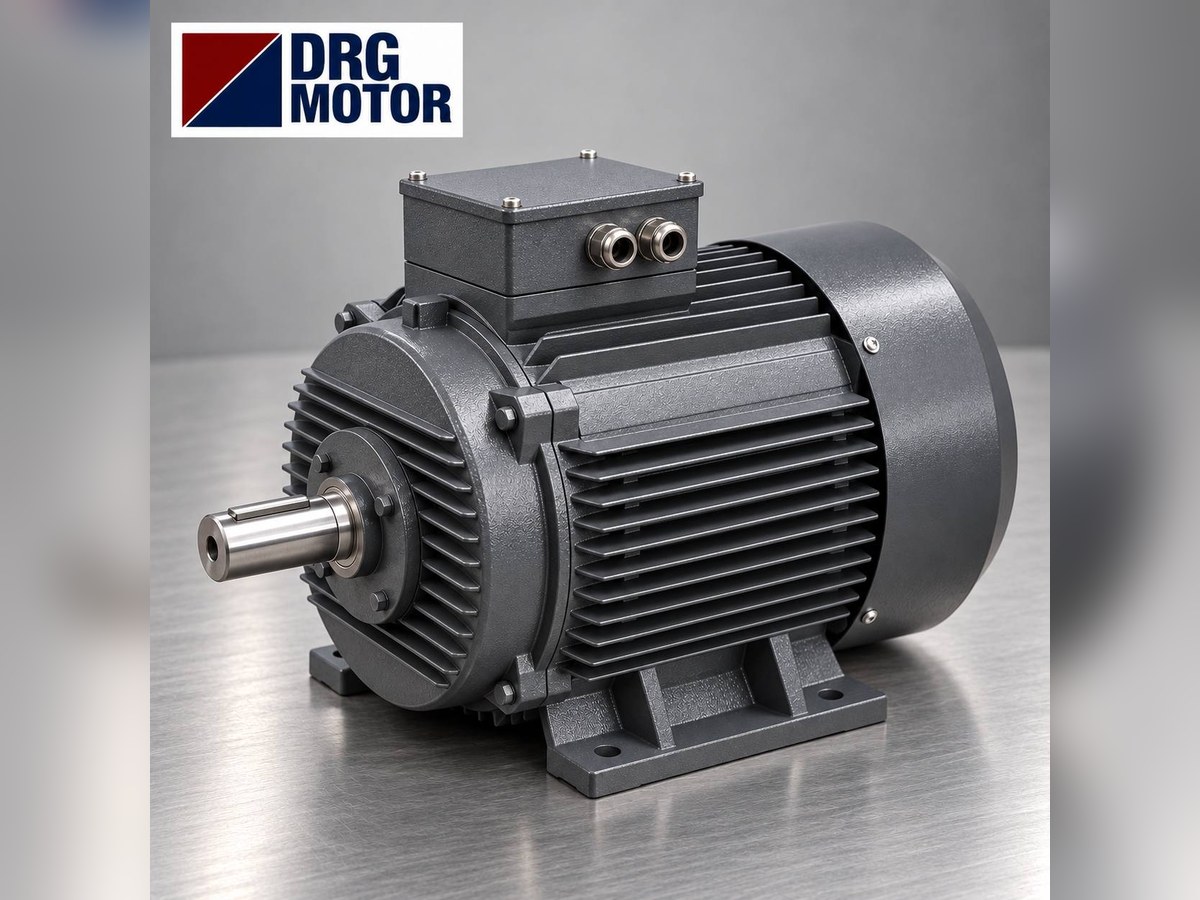
In a grain dryer, the main job of the electric motors is to turn the fans that push air heated by the burner through the grain column; most of the dryer's electrical load sits in these fan motors. Besides them, the burner fan, the loading auger that carries wet grain to the top, the discharge mechanism that draws dried grain from the bottom and, in batch dryers, the recirculating auger that keeps the grain moving each run on their own motors. In manufacturer catalogues a single dryer fan motor is roughly between 4.4 kW and 37 kW; in large tower dryers the number of fans rises to six, so the machine's total installed power can exceed 190 kW.
This page treats the dryer as a list of motors: which motor sits where, the power values in catalogues, the long running period of the maize harvest and how to avoid loading the supply with several fans at once. The fan's own technology, that is impeller type and the link between airflow and motor power, is covered separately in the Fan Motors category and is not repeated here. You can find the current list of suitable motors on Buy Electric Motors Online.
How many motors does a dryer have, and what does each one do?
The number and layout of motors change with the dryer type. Two main families are used at this link of the post-harvest chain.
Tower (vertical) dryers
Grain is loaded at the top, descends slowly under its own weight through columns or mixed-flow cells and is discharged in metered amounts at the bottom. The heating section and the cooling section are supplied by separate fans; large towers have between two and six fans. The descent speed is set by the metering roll or discharge mechanism at the bottom, and this small motor (0.56 kW in one catalogue) is in fact the part that sets the dryer's capacity. The loading auger at the top and the discharge conveyor at the bottom are usually between 1.1 and 11 kW.
Batch and recirculating dryers
A set quantity of grain is taken in, held until it is dry and then discharged. In recirculating types a vertical centre auger keeps lifting grain from the bottom to the top, so the grain is mixed and dries evenly. This auger's motor can be close to the fan motor or even larger: in one catalogue a batch dryer holding 13.5 tonnes of maize has a 7.5 kW fan and an 11 kW centre auger. Some portable batch dryers drive both the fan and the augers by belt from the tractor's power take-off (PTO) or from a single large electric motor; switching to an electric motor only makes sense when the dryer stands in a fixed place with an adequate supply.
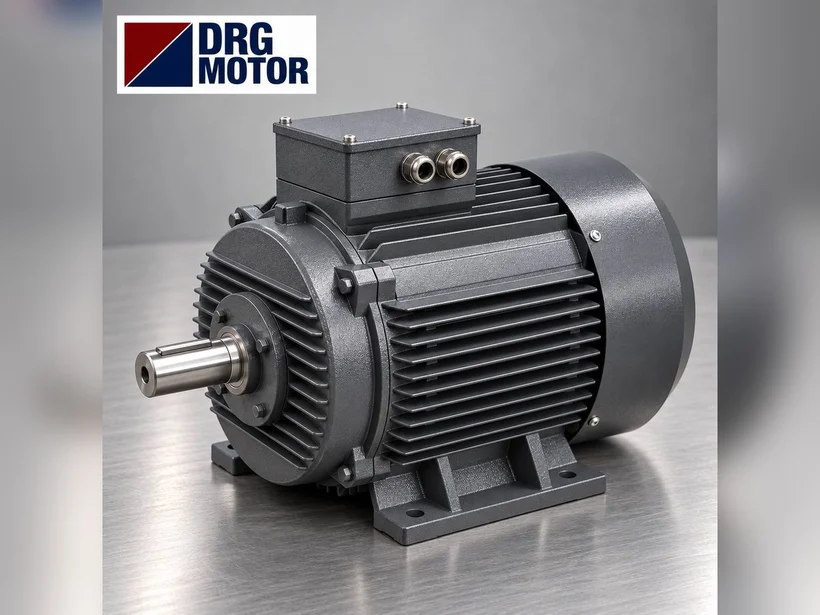
The motors other than the fans
- Burner fan: Supplies combustion air and is small (0.75 kW in one catalogue). It is considered together with the burner setting; a motor with a different speed upsets the combustion setting.
- Loading auger or elevator: Lifts wet grain to the top of the dryer. Wet maize is heavier and stickier than dry grain, so this motor starts under load.
- Discharge and metering mechanism: Roll, gate or chain table. Low power, its speed is usually adjusted with an inverter.
- Recirculating auger: Only in batch types; keeps the grain moving throughout drying.
- Dust extractor: Some dryers have a separate extractor motor to separate chaff and dust from the exhaust air (2.2 kW in one catalogue).
Grain dryer motor power: single fan and total
A) Power values in manufacturer catalogues
| Dryer / model group | Motor power | Single or total | Note |
|---|---|---|---|
| Batch dryer, 11.8 m³ | Fan 4.4 kW | Single fan | Maker catalogue, smallest model |
| Batch dryer, 45.5 m³ | Fan 30 kW | Single fan | Same catalogue, largest model |
| Recirculating batch, 13.5 t maize | Fan 7.5 + centre auger 11 kW | Separate motors | Filling 4, dust 2.2, burner 0.75 kW |
| Portable recirculating batch | Fan 11.2 kW (15 HP) | Single fan | Vertical auger 7.5 kW separate |
| Single-motor portable batch | 11.4–30 kW | Fan and augers on one motor | Belt drive, 15–40 HP |
| Modular tower, per column | Fan 11.2–22.4 kW | Single fan | Level/unload auger 1.1–7.5 kW |
| Mixed-flow tower, small series | 2 × 11.2 kW fans | Total ≈ 30 kW | Load and discharge 3.7 kW |
| Mixed-flow tower, large series | 6 × 29.8 kW fans | Total ≈ 194 kW | Single fan up to 50 HP (37.3 kW) |
For dryer fans, motor options of roughly 4.4–37 kW per single fan are seen, varying with the model and the dryer's capacity. Loading, discharge and recirculating auger motors are a further 0.56–11 kW. Values in American catalogues are given in horsepower (HP); in the table they are converted at 1 HP = 0.746 kW.
How to read total installed power
The electrical power written on a dryer quotation or nameplate is usually the sum of all motors. For example, in a large six-fan mixed-flow tower the fans alone come to about 179 kW; with the loading and discharge motors the total reaches 194 kW. This figure is for sizing the supply connection and transformer; when replacing a motor, look at the failed motor's own nameplate. Moisture also changes running time: the same dryer handles 25 % moisture maize at roughly half the capacity it reaches with 20 % maize, so the motors run much longer for the same tonnage.
B) The match in the DRG range
DRG Motor is an electric motor manufacturer, supplier and seller. Our range consists of 3-phase motors, 0.25–11 kW in aluminium frames and 0.55–355 kW in cast iron frames, at 1000/1500/3000 rpm and 230/400 V or 400/690 V; mounting is stated on the order as B3, B5, B14 or B35. All of the 4.4–37 kW dryer fan values and the 0.56–11 kW auger values fall within this range. Special fan-motor units built into a dryer, and applications that require an explosive-atmosphere (Ex) certificate, are outside the DRG range.
| Model | Power / speed | Frame · current 400 V | Price |
|---|---|---|---|
| DRG-90S-41.5 HP | 1.1 kW · 1500 rpm | Cast iron 90S · 2.48 A | $124.09 (€110.82) Details & buy → |
| DRG-112M-45.5 HP | 4 kW · 1500 rpm | Cast iron 112M · 7.95 A | $254.38 (€227.18) Details & buy → |
| DRG-132S-47.5 HP | 5.5 kW · 1500 rpm | Cast iron 132S · 10.7 A | $342.01 (€305.44) Details & buy → |
| DRG-132M-410 HP | 7.5 kW · 1500 rpm | Cast iron 132M · 14.3 A | $394.89 (€352.66) Details & buy → |
| DRG-160M-415 HP | 11 kW · 1500 rpm | Cast iron 160M · 20.4 A | $568.76 (€507.94) Details & buy → |
| DRG-160L-420 HP | 15 kW · 1500 rpm | Cast iron 160L · 27.3 A | $678.13 (€605.61) Details & buy → |
| DRG-180M-425 HP | 18.5 kW · 1500 rpm | Cast iron 180M · 33.5 A | $873.49 (€780.08) Details & buy → |
| DRG-180L-430 HP | 22 kW · 1500 rpm | Cast iron 180L · 39.7 A | $919.45 (€821.13) Details & buy → |
| DRG-200L-440 HP | 30 kW · 1500 rpm | Cast iron 200L · 53.8 A | $1,235.00 (€1,102.93) Details & buy → |
| DRG-225S-450 HP | 37 kW · 1500 rpm | Cast iron 225S · 66.1 A | $1,527.18 (€1,363.87) Details & buy → |
Click to see current electric motor prices and order nowSEE PRICES →
What does round-the-clock running in the maize season change?
Wheat and barley usually come from the field dry enough; the dryer's busiest period is the maize harvest. Wet maize must be dried on the day it is harvested, so the dryer and its motors can run day and night for weeks. These two extremes govern motor selection and maintenance.
Hot, dusty and humid air
Fan motors usually sit outside the dryer, next to the heating section; ambient temperature rises with late summer sun and heat radiated by the burner. Fine dust from maize cobs and chaff sticks to the cooling fins of the motor frame. As the fins clog, the same load heats the motor more. That is why cleaning the fan cover and frame with compressed air during the season and keeping the overload relay at nameplate current matter. If the dryer stands outdoors, the motor must be protected from rain and dew, the terminal box entry should face downwards and cable glands must be tight.
Start and end of season
In a motor that has stood for months, bearing grease can stiffen and the winding can absorb moisture. At the start of the season the motor is run briefly with the coupling or belt removed, noise and vibration are checked and, if possible, insulation resistance is measured. At the end of the season motors are cleaned and covered. A qualified electrician should carry out these checks, with the dryer isolated and the panel locked out.
Not starting the fans together: supply and starting method
The line feeding a dryer is often a long line from a village or field transformer. If several large fan motors start at the same moment, their starting currents add up, voltage drops and the most distant motor may fail to start.
Example: a four-fan tower dryer
Take a dryer with four 11 kW fans (DRG-160M-4, 20.4 A at 400 V, starting current ratio Is/In = 7.7), two 4 kW augers (DRG-112M-4, 7.95 A) and one 0.75 kW metering motor (DRG-802-4, 1.75 A).
| Case | Calculation | Current from supply | Comment |
|---|---|---|---|
| All running | 4 × 20.4 + 2 × 7.95 + 1.75 | ≈ 99 A | About 69 kVA |
| Four fans start together | 4 × 20.4 × 7.7 | ≈ 628 A (fans only) | Fuses and transformer stressed |
| Fans in sequence, last fan starting | 3 × 20.4 + 2 × 7.95 + 1.75 + 157 | ≈ 236 A | Peak falls below one third |
Starting the fans one after another a few seconds apart lowers the peak current from about 628 A to 236 A. If the panel is replaced, this sequence must be kept. With its 400/690 V winding, any DRG motor from the 4 kW step up can start in star-delta on a 400 V network; since a fan accelerates without load, the weaker star-stage torque is no obstacle here. Compare the methods on the star-delta starting page.
Long line and generator
For a dryer far from the transformer, cable size must be chosen for the voltage drop at the moment of starting; a size that is enough for 99 A running current may give too much drop at start-up. Check it with the motor cable size calculator. For dryers running on a generator, generator size is chosen not from total running power but from the current drawn while the largest motor starts.
Checklist when replacing a failed dryer motor
- Old motor's nameplate: power, speed, voltage, frequency and mounting type. On imported dryers the motor may be rated for 60 Hz; a 4-pole motor turns at about 1750 rpm at 60 Hz but 1450–1475 rpm at 50 Hz. As fan speed drops, ask the dryer maker for the 50 Hz value.
- Is the fan impeller fitted directly on the motor shaft or belt driven? On a direct-driven fan the shaft diameter and length (D × E) must be identical.
- Mounting: foot (B3), flange (B5) or foot and flange together (B35). The exact type comes from the dryer manufacturer's drawing.
- Direction of rotation: after connecting the new motor, compare its rotation with the arrow on the fan casing; a reversed fan still delivers a little air, far too little, and the grain may leave under-dried without anyone noticing.
- Panel: adjust the thermal protection to the new plate current and leave the staggered start timing unchanged.
DRG models for dryer motors
Listed below are 4-pole cast iron models matching to the fan and auger power values in catalogues. If a different pole count is needed, the old nameplate decides.
| Model | Power / speed | Frame | Current 400 V |
|---|---|---|---|
| DRG-112M-4 | 4 kW / 1450 rpm | 112M cast iron | 7.95 A |
| DRG-132M-4 | 7.5 kW / 1460 rpm | 132M cast iron | 14.3 A |
| DRG-160M-4 | 11 kW / 1465 rpm | 160M cast iron | 20.4 A |
| DRG-160L-4 | 15 kW / 1465 rpm | 160L cast iron | 27.3 A |
| DRG-180L-4 | 22 kW / 1470 rpm | 180L cast iron | 39.7 A |
| DRG-200L-4 | 30 kW / 1475 rpm | 200L cast iron | 53.8 A |
| DRG-225S-4 | 37 kW / 1485 rpm | 225S cast iron | 66.1 A |
DRG MOTOR motors are guaranteed against material and manufacturing defects for 2 years from the date of delivery (warranty certificate). For irrigation pumps see the Pump Motors page; for general information on motor supply to farms, read our article on motor supply for the agriculture sector.
Motors in this power range
- DRG-132S-4 – 5.5 kW – 1460 rpm – 132S cast iron
- DRG-160M-4 – 11 kW – 1465 rpm – 160M cast iron
- DRG-160L-4 – 15 kW – 1465 rpm – 160L cast iron
- DRG-180M-4 – 18.5 kW – 1470 rpm – 180M cast iron
- DRG-200L-4 – 30 kW – 1475 rpm – 200L cast iron
- DRG-225S-4 – 37 kW – 1485 rpm – 225S cast iron
Click to see current prices and order these motors nowSEE PRICES →
Frequently asked questions about grain dryer motors
How many kW is a grain dryer fan motor?
It depends on the size of the dryer and the number of fans. In manufacturer catalogues a single fan motor starts at 4.4 kW on small batch dryers and goes up to 37 kW on large tower dryers. The dryer's total power is found by multiplying by the number of fans.
What speed motor is fitted to a maize dryer?
Fan and auger motors are mostly 4-pole; on a 50 Hz supply that means about 1450–1485 rpm. The most reliable information is the old motor's nameplate, because fan speed sets the quantity of drying air.
Why does a dryer fan motor trip its overload?
The most common causes are cooling fins clogged with dust, imbalance from chaff and dust stuck on the impeller, a lost phase and a wrongly set overload relay.
How many amps does an 11 kW dryer fan motor draw?
The nameplate current of the 11 kW, 4-pole DRG-160M-4 is 20.4 A at 400 V. With direct-on-line starting, about 7.7 times this is seen at the moment of start; if there are several fans, they should be started in sequence.
Send us your dryer type, the nameplate of the failed motor and how the fan is connected to the motor (direct or by belt); we will identify the right motor together before the season starts. Phone +90 (542) 666 11 11, e-mail [email protected], contact page. You can order the motor you choose for the dryer on Buy Electric Motors Online.


