 English
 Le français
 Türkçe

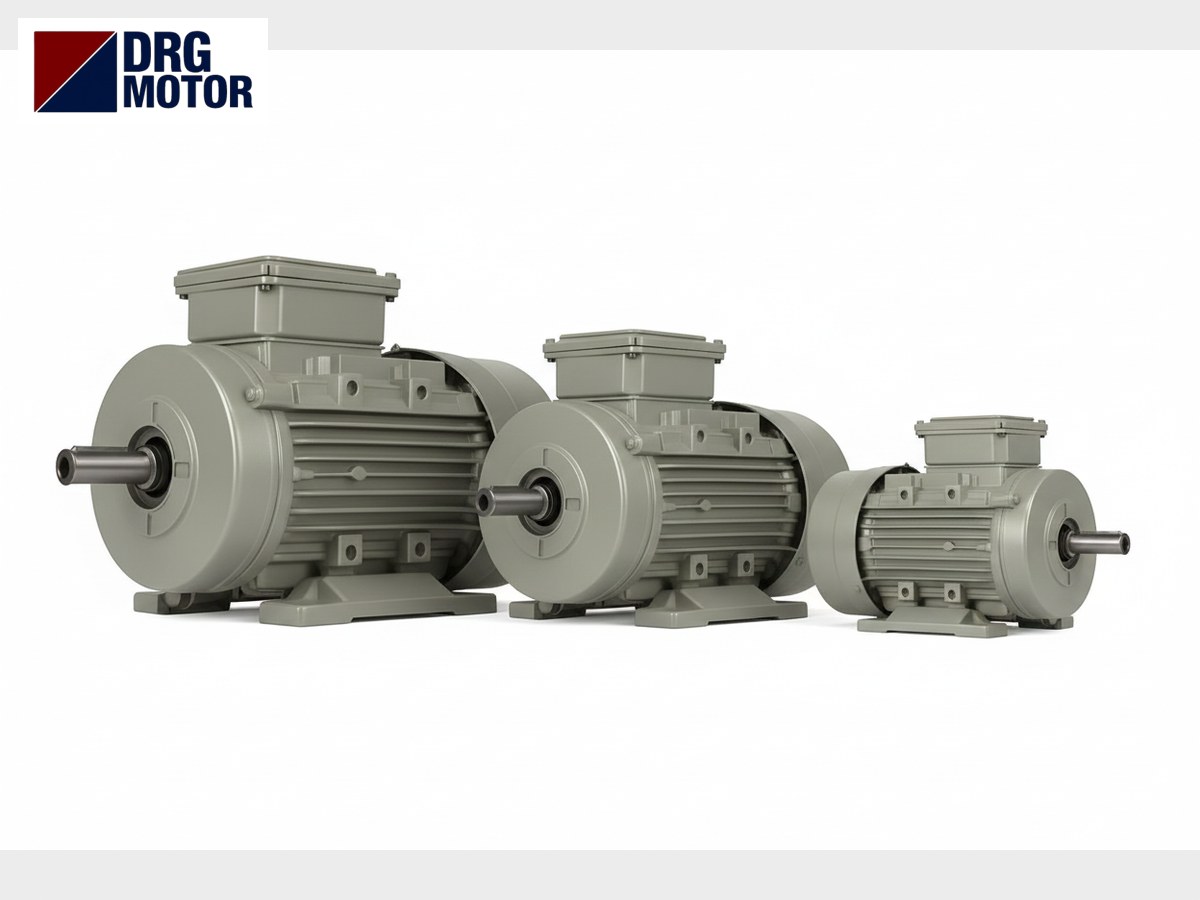
How many electric motors does a brick factory have, and which ones stop production when they fail? This page looks at the clay brick and roof tile production line from a motor inventory point of view: how many motors work at each station from clay intake to dryer entry, at what rating and with what drive, which ones count as critical, and how a spare motor plan is worked out. Ceramic tile and concrete block are not covered here; the main category describes them as separate flows.
DRG Motor is a manufacturer, supplier and seller of electric motors. We do not sell the line’s machines, gearboxes, hydraulic units, vacuum pump casings, fan wheels, inverters or press dies; we supply standard IEC motors to replace the electric motors in your inventory. Models are on Buy Electric Motors Online.
Motor inventory of a brick line
As an example we use a published plant quotation: a brick factory with wet preparation and a tunnel kiln, designed for 700 tonnes of fired product a day. The quotation lists each machine’s motors separately, which makes it a good template for building an inventory.
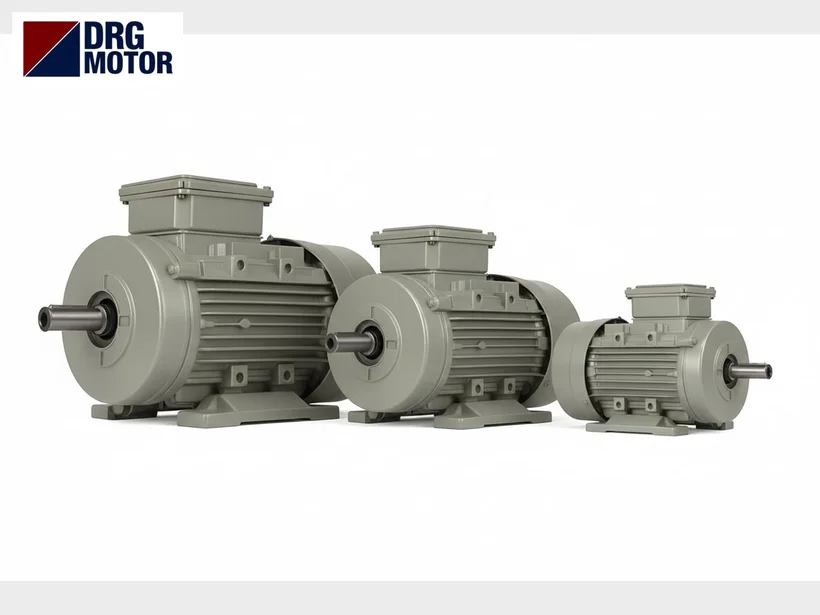
Motor list station by station
A) Motor ratings stated in the quotation (the machine maker’s values; the DRG column is our own matching):
| Station | Motors (qty × kW) | Drive | DRG equivalent |
|---|---|---|---|
| Box feeders (preparation, 2 units) | 2 × 4 | gearbox, 4-pole | DRG-112M-4 |
| Clod sizer | 2 × 9.2 | belts + planetary gearbox | not a standard rating, ask us |
| Rubber belt feeder | 2.2 + 4 | geared belt, belt-driven chipper | DRG-100L1-4, DRG-112M-4 |
| Toothed roll crusher | 30 + 22 | two rolls, belts | DRG-200L-4, DRG-180L-4 |
| Bar disintegrator | 55 + 18.5 | two rolls, belts | DRG-250M-4, DRG-180M-4 |
| Fine roller mill (two: preparation and production) | 90 + 75 each | B3, 4-pole, belts | DRG-280M-4, DRG-280S-4 |
| Mixer (two units) | 55 each | belts + gearbox | DRG-250M-4 |
| Box feeder (production) | 5.5 + 7.5 | geared apron, belt-driven chipper | DRG-132S-4, DRG-132M-4 |
| De-airing extruder | 200 main + 90 feeder-mixer | 6-pole, belts | DRG-355M2-6, DRG-315M-6 |
| Vacuum pump | 18.5 | flexible coupling | take the pole count from the plate |
| Cutting group | 0.75 + 1.5 + 0.75 | small geared motors | DRG-802-4, DRG-90L-4 |
| Dryer haulage unit | 18.5 | chain | DRG-180M-4 |
Counting the preparation, silo and production sections, this list holds 48 motors and roughly 990 kW of installed power. The smallest are the 0.18 kW traverse motors of the roll turning devices (below our 0.25 kW lower limit); the largest is the 200 kW main motor of the extruder. The transfer cars and pushers moving kiln cars run on hydraulic units and geared motors in the quotation; the setting machine and kiln fans are not in this count.
Silo and clay storage
The two spreader cars filling the clay ageing silo travel with two 2.2 kW motors each; the bucket excavator emptying it uses 18.5 kW for the bucket chain, 4 kW to raise the boom, 1.1 kW for bridge travel and 0.25 kW for carriage travel. Boom lifting works like a hoist; it needs a brake motor, and brake motors are not in our range.
How the table changes on a roof tile line
In a feasibility report for 25,000 roof tiles a day, the machines are smaller and more numerous:
| Roof tile line item | Motor | Qty | Total |
|---|---|---|---|
| De-airing extruder | 55 kW | 3 | 165 kW |
| Box feeder (before extruder) | 7.5 + 2.2 kW | 3 | 29.1 kW |
| Roof tile press | 6.6 + 7.5 kW | 2 | 28.2 kW |
| Belt conveyors | 5.5 kW | 10 | 55 kW |
| Installed power of the line | – | – | about 600 kW |
Instead of one large extruder, the tile line has three medium extruders, each with its own feeder. That changes the spare plan: one 55 kW spare can serve all three.
Click to see current electric motor prices and order nowSEE PRICES →
Which motors are critical?
A critical motor is one whose failure stops the whole line and which cannot be replaced quickly. A brick line runs in series, so a motor in preparation also stops the extruder; even so, criticality is not equal.
Group one: the heart of the line
The extruder main motor, the feeder-mixer motor and the vacuum pump motor belong here. A 200 kW 6-pole motor is an uncommon frame (355M) and the part that keeps you waiting longest after a failure. The two motors of the fine roller mill also belong here: without the mill there is no prepared clay.
Group two: medium ratings on a single path
Crushers, mixers and box feeders carry 4–90 kW motors. Some of them sit at a single point of the line (such as the bar disintegrator) and their spares need planning.
Group three: many small motors
Belts, cutter, travel drives and turning devices are small, numerous and mostly geared. None is critical on its own, but because many share the same rating, a few spares protect them all.
Heavy starting: starter data in the inventory
The quotation also states how the large motors are started: the extruder through a frequency converter, the mill, crushers and mixers through soft starters (some with reversing). The reason is starting current. A simple calculation with the equivalents in our range:
| Motor | Operation | Current (400 V) | Comment |
|---|---|---|---|
| DRG-355M2-6, 200 kW, direct-on-line | 346 × 6.8 | about 2,350 A | heavy shock on the supply |
| Same motor, star-delta | 2,353 / 3 | about 785 A | starting torque also drops to a third |
| DRG-280M-4, 90 kW, direct-on-line | 155 × 6.9 | about 1,070 A | fast roll of the mill |
| DRG-250M-4, 55 kW, direct-on-line | 97.6 × 7.4 | about 720 A | mixer |
Star-delta lowers the current but also the starting torque for a loaded mixer or a choked auger; that is the reason the quotation puts soft starters and a converter on its heaviest machines. For details and calculation see our star-delta tool.
How to build a spare motor plan
Once the inventory is in a table, decide on spares with three questions: does the line stop if this motor stops, how many days would a replacement take, and does the same motor sit at another station too?
Group identical frames
In the example both roller mills use the same 90 + 75 kW pair and both mixers the same 55 kW motor. If power, poles, mounting (B3, B35), shaft diameter and key match, one spare serves several machines. Where only the pulley differs, move or replace the pulley along with the motor.
Building the motor list from nameplates
For each motor, one spreadsheet row: station name, rated kW and rpm, voltage with Δ/Y link, IEC frame and mounting code, shaft end and key, any flange size, and what sits on the shaft (pulley or coupling). Where a plate is unreadable, measure shaft end and foot hole spacing; we compare them with our technical drawings.
When you send us the inventory, we write the matching model from our range next to each line. Items outside the range (non-standard ratings such as 9.2 kW, the 0.18 kW turning traverse motor, the brake motor for lifting) are flagged separately.
Outside our range
Some motors you will meet on a brick line are outside our range, and we prefer to say so up front:
- motors above 355 kW and medium voltage (possible on very large extruders)
- brake motors: silo excavator boom lifting, setting and stacking gear
- servo motors: robot setting axes and synchronised cutters
- single-phase motors and vibration motors (for vibrating feeders and screens see vibration motors)
- motors for use inside the kiln: on dryer and kiln fans the motor hangs on the outside wall, and we size it once you give us the air temperature at that spot
- Ex-approved motors: a coal dust or gas zone on site makes them mandatory, and our standard series comes without that approval
DRG motors for a brick factory
B) Where DRG fits: every standard rating between 0.25 and 200 kW in the inventory is in our range; the 0.18 kW turning traverse motor, non-standard ratings such as 9.2 kW and the brake motor for lifting stay outside. Equivalents (current at 400 V):
| Model | Power / speed | Frame · shaft D×E | Current 400 V |
|---|---|---|---|
| DRG-100L1-4 | 2.2 kW / 1450 rpm | 100L cast iron · 28×60 | 4.52 A |
| DRG-112M-4 | 4 kW / 1450 rpm | 112M cast iron · 28×60 | 7.95 A |
| DRG-180M-4 | 18.5 kW / 1470 rpm | 180M cast iron · 48×110 | 33.5 A |
| DRG-180L-4 | 22 kW / 1470 rpm | 180L cast iron · 48×110 | 39.7 A |
| DRG-200L-4 | 30 kW / 1475 rpm | 200L cast iron · 55×110 | 53.8 A |
| DRG-250M-4 | 55 kW / 1485 rpm | 250M cast iron · 65×140 | 97.6 A |
| DRG-280S-4 | 75 kW / 1486 rpm | 280S cast iron · 75×140 | 129 A |
| DRG-280M-4 | 90 kW / 1486 rpm | 280M cast iron · 75×140 | 155 A |
| DRG-315M-6 | 90 kW / 988 rpm | 315M cast iron · 85×170 | 161 A |
| DRG-355M2-6 | 200 kW / 990 rpm | 355M cast iron · 100×170 | 346 A |
Our range runs to 11 kW in aluminium and on to 355 kW in cast iron; every motor is a three-phase IEC induction motor with 2, 4 or 6 poles. Protection is IP55 for clay dust and damp. Belt drives use foot-mounted B3, belts coupled directly to a gearbox use flanged B5 or B14.
Live price table
Live shop prices of our models in the ratings that appear most often in the inventory:
| Model | Power / speed | Frame · current 400 V | Price |
|---|---|---|---|
| DRG-100L1-43 HP | 2.2 kW · 1500 rpm | Cast iron 100L · 4.52 A | $188.32 (€168.18) Details & buy → |
| DRG-132S-47.5 HP | 5.5 kW · 1500 rpm | Cast iron 132S · 10.7 A | $342.01 (€305.44) Details & buy → |
| DRG-180M-425 HP | 18.5 kW · 1500 rpm | Cast iron 180M · 33.5 A | $873.49 (€780.08) Details & buy → |
| DRG-200L-440 HP | 30 kW · 1500 rpm | Cast iron 200L · 53.8 A | $1,235.00 (€1,102.93) Details & buy → |
| DRG-250M-475 HP | 55 kW · 1500 rpm | Cast iron 250M · 97.6 A | $2,065.73 (€1,844.82) Details & buy → |
| DRG-280S-4100 HP | 75 kW · 1500 rpm | Cast iron 280S · 129 A | $2,916.93 (€2,605.00) Details & buy → |
| DRG-315M-6125 HP | 90 kW · 1000 rpm | Cast iron 315M · 161 A | $4,430.22 (€3,956.46) Details & buy → |
| DRG-280M-4125 HP | 90 kW · 1500 rpm | Cast iron 280M · 155 A | $3,268.56 (€2,919.03) Details & buy → |
DRG MOTOR motors are guaranteed against material and manufacturing defects for 2 years from the delivery date (warranty certificate).
Motors in this power range
- DRG-180M-4 – 18.5 kW – 1470 rpm – 180M cast iron
- DRG-250M-4 – 55 kW – 1485 rpm – 250M cast iron
- DRG-280S-4 – 75 kW – 1486 rpm – 280S cast iron
- DRG-280M-4 – 90 kW – 1486 rpm – 280M cast iron
- DRG-315M-6 – 90 kW – 988 rpm – 315M cast iron
Click to see current prices and order these motors nowSEE PRICES →
Browse the products, ask for a quote: send your line’s motor list (spreadsheet or plate photos) via WhatsApp; we prepare a spare proposal for the critical motors with matching models. Browse the models on Buy Electric Motors Online or call +90 (542) 666 11 11.
Frequently asked questions
Which brick factory electric motor should be the first spare?
The one that takes longest to replace and stops the whole line: in most plants the extruder main motor and the fine roller mill motors.
Is a roof tile machine motor different from those on a brick line?
The motor type is the same; the power split is different. Tile lines have more medium-sized presses and feeders, brick lines fewer but larger motors.
Questions: info@drgmotor.com · contact. General guidance for ceramic plants: motor selection in ceramic plants.


