 English
 Le français
 Türkçe

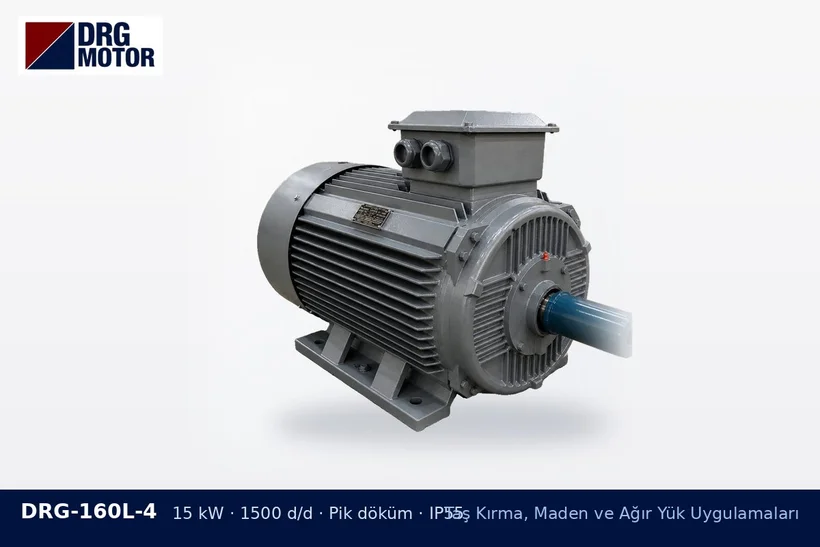
Each machine is selected according to its own load character: the crusher carries shock loads and high inertia, the screen moves an oscillating mass, and the feeder usually starts under load beneath a full hopper. So screen and feeder motors are not set as a fraction of the crusher motor, but individually, according to the drive data given by the machine manufacturer.
Comparison of load character
| Machine | Nature of the load | Key points in selection |
|---|---|---|
| Eccentric shaft screen | Oscillating mass, passing through resonance at start-up | Belt drive, speed, bearing load |
| Belt feeder | Starting beneath a full hopper | Starting torque, gearbox ratio |
| Apron feeder | Heavy, low-speed, impact loading | High-ratio gearbox, torque |
| Vibrating feeder | Vibration or eccentric drive | Separate assessment by drive type |
Points to watch on screens
On eccentric shaft screens, the motor is usually connected to the screen shaft by belts; since the screen speed determines amplitude and screening performance, the pulley ratio is set to the manufacturer's value. When starting and stopping, the screen passes through the resonance zone, causing brief high oscillation in the body and belts. On screens and feeders driven by vibration motors, selection is based on the centrifugal force and speed of that motor; this type is not chosen from an IEC foot-mounted motor catalogue.
Points to watch on feeders
Belt and apron feeders run at low speed and the motor is connected through a gearbox; DRG does not sell gearboxes, so you select the motor according to the gearbox manufacturer's input flange and speed data. Feeder speed is the main factor determining the crusher load; for this reason, if speed adjustment is needed, operation with a drive is planned.
One more reason for separate selection: run sequence
In a plant, machines are started against the direction of material flow: first the discharge conveyor, then the screen, then the crusher and finally the feeder. Stopping starts from the feeder. This interlocking prevents the machines upstream from piling up material when one motor stops; that is why each motor needs its own protection and its own definition. Control design is the job of qualified electrical personnel.
For machine-by-machine selection, see the vibrating screen motor and hopper feeder motor pages, and review power ratings in the three-phase motor store.