 English
 Le français
 Türkçe

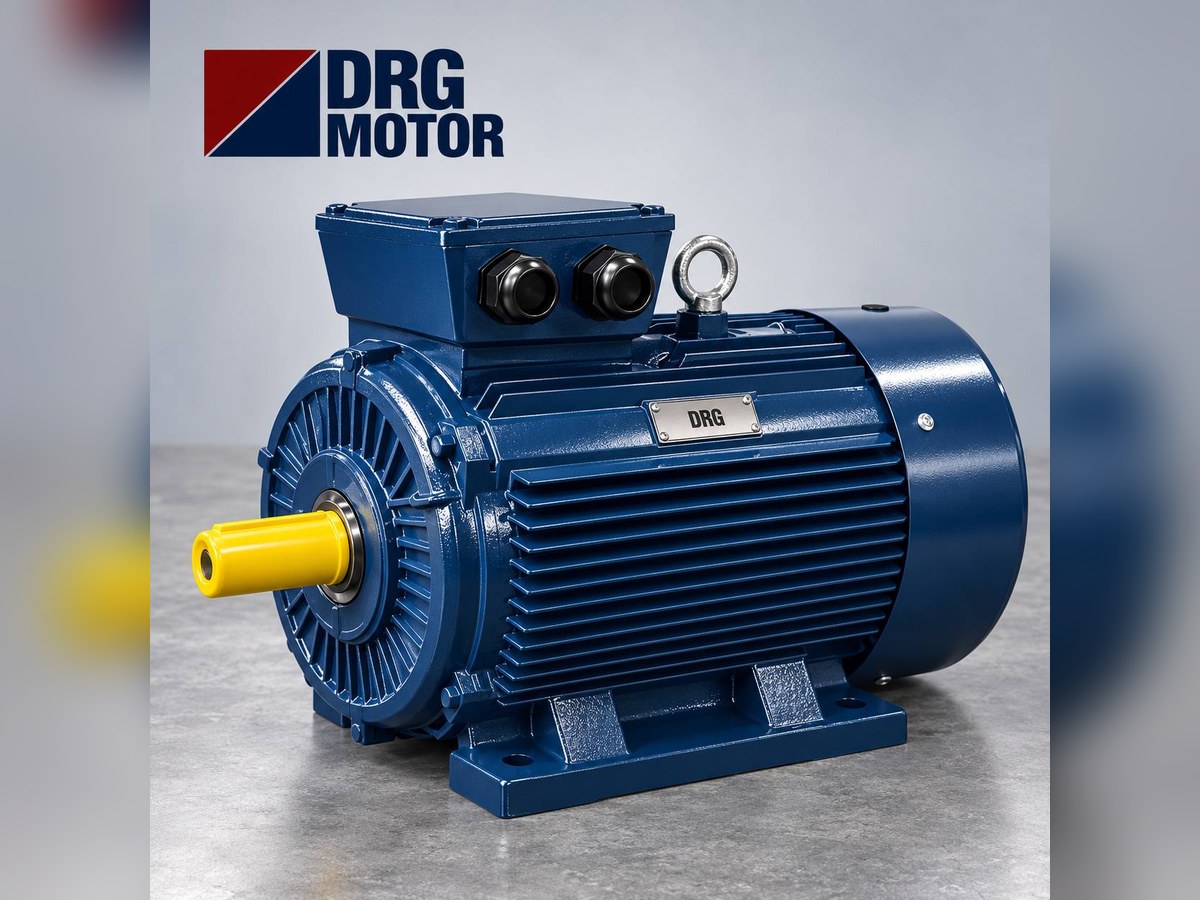
On a bridge saw the real work is done by the cutting head motor that turns the diamond blade; travel of the bridge along its rails, sliding of the carriage across the bridge and the plunge of the blade are handled by much smaller axis motors. Maker catalogues show blade motors between 15 kW and 31 kW, with the largest blade diameter and the depth of cut setting most of that figure. This page treats the two motor families separately.
DRG Motor is a manufacturer, supplier and seller of electric motors. We do not sell the bridge saw itself, gearboxes, servo motors, electrospindles or drives (inverters); what we supply is the standard three-phase IEC motor fitted to the cutting head or to a travel drive. Suitable frames for your slab cutting line are listed on Buy Electric Motors Online.
How is the cutting head (blade) motor connected?
Two layouts are common. In the first, belts and pulleys link a motor mounted above or next to the head to a blade spinning on its own bearing arbor. In the second, the blade is fastened straight onto the shaft of a flange motor, so the motor shaft is the blade arbor. Which one your machine uses changes the motor choice completely.
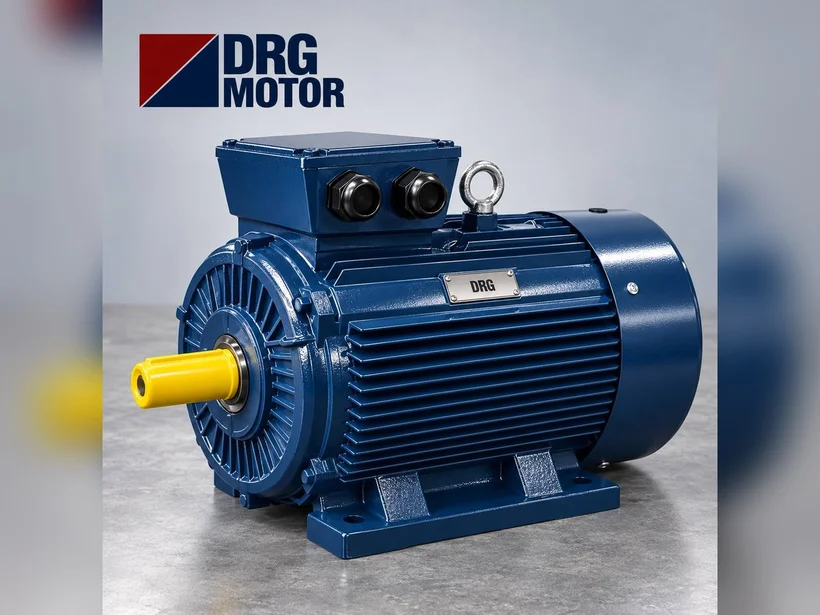
Belt-driven head: the route for a standard IEC motor
With belts the motor stays away from the blade, part of the shock during cutting is absorbed in the belt and blade speed is set by the pulley ratio. A standard foot-mounted (B3) or flange (B5, B35) motor can be used here. When replacing it, watch the shaft diameter and key size that carry the pulley and the frame size that matches the fixing holes on the head.
Blade on the motor shaft: special shaft and flange
Where the blade sits on the motor shaft, that shaft is lengthened and threaded for the blade flange and clamping nut, and the motor body is often recessed into the head to withstand spray. A special long shaft or special flange for this kind of head motor is not in our range. If you need to replace such a motor, we check its shaft length, thread and flange against the standard catalogue sizes; if they differ, we say so.
Electrospindles on 5-axis machines
On 5-axis bridges whose head tilts and rotates, the blade is usually mounted on a drive-fed electrospindle running from zero to several thousand rpm. Neither the electrospindle nor its drive is part of the DRG range; on these machines our part is limited to auxiliary pump or vacuum motors.
How does blade diameter affect motor power?
A larger blade changes two things at once. Depth of cut grows, so each pass removes more stone. To keep the same peripheral speed the blade must turn more slowly, and at equal power a slower arbor carries more torque. One maker catalogue lists a 22 kW blade motor for a 725 mm blade and 200 mm depth of cut, and 30 kW for a 1000 mm blade and 360 mm depth. Depth goes up 1.8 times while power rises about 1.36 times, because the feed rate is also lowered on the large-blade machine.
Example: arbor torque against blade diameter
The table assumes 35 m/s peripheral speed purely as an example (the real figure comes from the rpm allowed by the blade maker) and works out arbor torque with M = 9550 × P / n:
| Blade diameter | Blade speed for 35 m/s | Arbor torque at 22 kW | Reading |
|---|---|---|---|
| 600 mm | 1114 rpm | 189 Nm | small head, slim arbor is enough |
| 725 mm | 922 rpm | 228 Nm | same power, more torque |
| 1000 mm | 668 rpm | 314 Nm | 429 Nm if 30 kW is chosen |
| 1200 mm | 557 rpm | 377 Nm | bearings and pulley grow |
Motor power alone is clearly not enough: a 22 kW motor is comfortable on a 600 mm blade, but on a 1000 mm blade the torque that pulleys, belts and bearings must carry rises by about three quarters. A shop that wants to fit a bigger blade should first ask the machine builder whether the head is rated for that torque. Speed and pulley calculations are covered in our stone and marble cutting motor article.
Click to see current electric motor prices and order nowSEE PRICES →
Bridge and carriage travel axes
Bridge travel on its rails, carriage (head carrier) travel across the bridge and blade plunge are three separate axes. Their power comes from the moving mass, friction and required speed, not from cutting force, which is why axis motors are a small fraction of the blade motor. On one maker’s trolley-type side cutter the plunge and forward-back axes use 0.75 kW motors while the blade runs on 9.3 kW.
Geared motor or servo?
Conventional bridges move each axis with an asynchronous motor on a gearbox, with an inverter when speed must be varied. CNC machines with high positioning accuracy use servo motors with their own drives. Gearboxes, servos and drives are not in the DRG range. On a gearbox layout we can supply the asynchronous motor that bolts to the gearbox input flange; on servo axes a motor change belongs to the machine builder.
Brake and vertical axis
Because the plunge axis holds weight, many machines use a brake motor or a self-locking gearbox on it. Brake motors are not in our range; when replacing a motor on a vertical axis, do not fit a standard motor directly without solving the brake as a separate part.
Water, slurry and the cutting environment
The blade is cooled with water all the time; the water mixes with stone dust into slurry and splashes around the head. Our motors are IP55; that protects against water jets, not against running under water or in a pool of slurry. In practice:
- Position the terminal box with the cable entry facing down and keep the gland tight.
- If the cooling fins fill with slurry the motor overheats; include the motor in the regular wash-down.
- Earthing and residual current protection are vital on wet floors; wiring must be done by a qualified electrician.
Checks before replacement and DRG models
For a blade motor swap we need the kW, speed and voltage from the old plate, the way it is attached to the head (feet, flange, blade on shaft), the shaft diameter and key size, and the pulley size. Add the machine builder’s document if you have it; we do not promise a definite fit without comparing against these data.
A) Motor powers seen on bridge saws on the market:
| Machine / blade size | Motor power | Which motor | Note |
|---|---|---|---|
| Bridge saw, Ø350–600 mm blade | 15 kW | Blade motor (19 kW installed in total) | maker data sheet, workshop type |
| 5-axis bridge, Ø300–725 mm blade | 18.5 kW | Blade electrospindle, 0–6000 rpm | second maker, drive-fed |
| Bridge saw, largest blade Ø725 mm | 22 kW | Blade motor (30 kW in total) | third maker catalogue |
| Bridge saw, largest blade Ø1000 mm | 30 kW | Blade motor (38 kW in total) | same catalogue, large model |
| Large-format 5-axis, Ø400–1200 mm | 25.5 / 28.5 / 31.2 kW | Blade electrospindle, optional sizes | fourth maker, 0–5000 rpm |
| Trolley-type side cutter, Ø350–450 mm | 0.75 kW + 0.75 kW | Plunge and travel axis motors | fifth maker; blade motor 9.3 kW |
Across these machines the blade motor runs from about 15 to 31.2 kW depending on model and blade size, while axis motors stay below 1 kW. Installed power is higher than the blade motor alone because axis, pump and control loads are added.
B) Where DRG fits: 15, 18.5, 22 and 30 kW are all standard sizes in our cast iron range, both as 2-pole (3000 rpm) and as 4-pole (1500 rpm) motors, with a 0.75 kW model available for axis drives. Intermediate ratings between 25.5 and 31.2 kW and electrospindles running at 0–6000 rpm are outside our range.
| Model | Power / speed | Frame · shaft D×E | Current 400 V |
|---|---|---|---|
| DRG-160M2-2 | 15 kW / 2945 rpm | 160M cast iron · 42×110 | 26.5 A |
| DRG-160L-2 | 18.5 kW / 2940 rpm | 160L cast iron · 42×110 | 32.5 A |
| DRG-180M-2 | 22 kW / 2955 rpm | 180M cast iron · 48×110 | 38.5 A |
| DRG-200L1-2 | 30 kW / 2960 rpm | 200L cast iron · 55×110 | 52.1 A |
| DRG-180L-4 | 22 kW / 1470 rpm | 180L cast iron · 48×110 | 39.7 A |
| DRG-200L-4 | 30 kW / 1475 rpm | 200L cast iron · 55×110 | 53.8 A |
Dimensions for B5 flange heads
If the head motor is flange-mounted, these frames come from the B5 table of our catalogue (mm):
| Frame | Shaft D×E | Flange P / M / N | Hole S |
|---|---|---|---|
| 160M/160L | 42×110 | 350 / 300 / 250 | 18.5 |
| 180M/180L | 48×110 | 350 / 300 / 250 | 18.5 |
| 200L | 55×110 | 400 / 350 / 300 | 18.5 |
These are standard IEC shafts and flanges. If the old shaft is a long threaded blade arbor, the table does not replace it.
Live price table
Current shop prices for the ratings used on bridge saw blade and axis drives:
| Model | Power / speed | Frame · current 400 V | Price |
|---|---|---|---|
| DRG-802-41 HP | 0.75 kW · 1500 rpm | Cast iron 80 · 1.75 A | $101.93 (€91.03) Details & buy → |
| DRG-160L-420 HP | 15 kW · 1500 rpm | Cast iron 160L · 27.3 A | $678.13 (€605.61) Details & buy → |
| DRG-160M2-220 HP | 15 kW · 3000 rpm | Cast iron 160M · 26.5 A | $570.23 (€509.25) Details & buy → |
| DRG-160L-225 HP | 18.5 kW · 3000 rpm | Cast iron 160L · 32.5 A | $714.00 (€637.65) Details & buy → |
| DRG-180L-430 HP | 22 kW · 1500 rpm | Cast iron 180L · 39.7 A | $919.45 (€821.13) Details & buy → |
| DRG-180M-230 HP | 22 kW · 3000 rpm | Cast iron 180M · 38.5 A | $857.53 (€765.83) Details & buy → |
| DRG-200L-440 HP | 30 kW · 1500 rpm | Cast iron 200L · 53.8 A | $1,235.00 (€1,102.93) Details & buy → |
| DRG-200L1-240 HP | 30 kW · 3000 rpm | Cast iron 200L · 52.1 A | $1,273.02 (€1,136.88) Details & buy → |
DRG MOTOR motors are guaranteed against material and manufacturing defects for 2 years from the delivery date (warranty certificate).
Motors in this power range
- DRG-160M2-2 – 15 kW – 2945 rpm – 160M cast iron
- DRG-180M-2 – 22 kW – 2955 rpm – 180M cast iron
- DRG-200L1-2 – 30 kW – 2960 rpm – 200L cast iron
- DRG-180L-4 – 22 kW – 1470 rpm – 180L cast iron
- DRG-802-4 – 0.75 kW – 1420 rpm – 80 cast iron
Click to see current prices and order these motors nowSEE PRICES →
Browse the motors, request a quote: Compare the models on Buy Electric Motors Online. Send the blade motor nameplate and a photo of the head via WhatsApp, or call us on +90 (542) 666 11 11.
Frequently asked questions
2-pole or 4-pole: which motor goes on a bridge saw?
Both appear on belt-driven heads; blade speed and pulley ratio decide. The speed on the old nameplate is the safest starting point: swap a 2-pole for a 4-pole without new pulleys and the blade will run at half its speed.
Will a stronger marble cutting motor cut faster?
Only if the head, belts and blade can take the extra power. Frequent overload trips usually come from glazed segments, a slack belt or too much feed; check these before going up in power.
The travel motor of my stone saw has failed. Can I replace just the motor?
If it is an asynchronous motor on a gearbox, yes; the gearbox flange, shaft diameter and key must match. Servo-driven axes are a service matter for the machine builder.
Need help with another axis or head? Ring +90 (542) 666 11 11, write to info@drgmotor.com or use the contact page. Bridge saw motor options are under Buy Electric Motors Online.


