 English
 Le français
 Türkçe

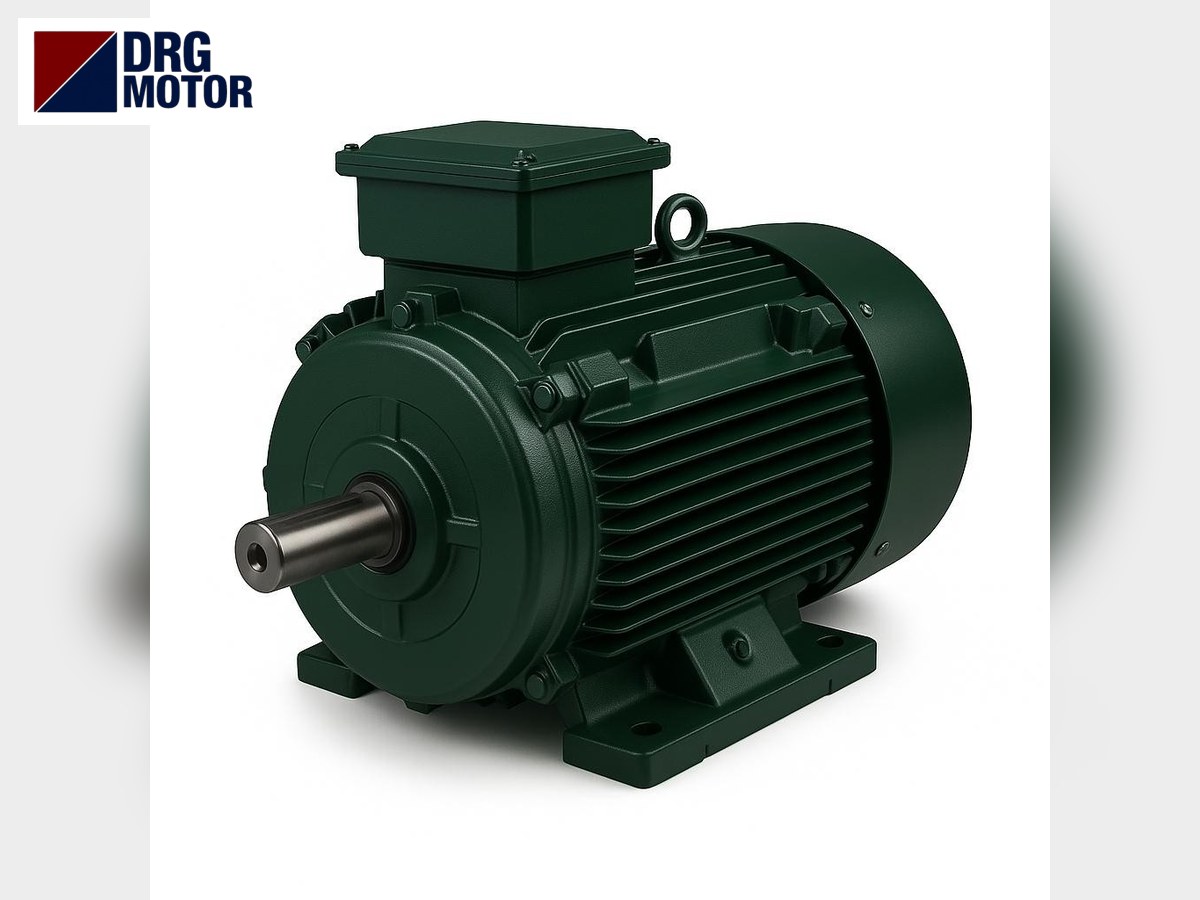
A clay and soil crusher takes the large, often wet and sticky clods arriving from the pit or the box feeder and tears them apart between two rolls turning at different speeds, so that the following machines can accept the material. The electric motor drives these rolls through belts and pulleys or a gearbox, and most models give each roll its own motor. Makers’ catalogues for brick and roof tile plants list clay crushers with 11–160 kW per motor. This page covers the first crushing step of raw material preparation; for machines that crush quarry stone and aggregate, see our roll crusher motor page.
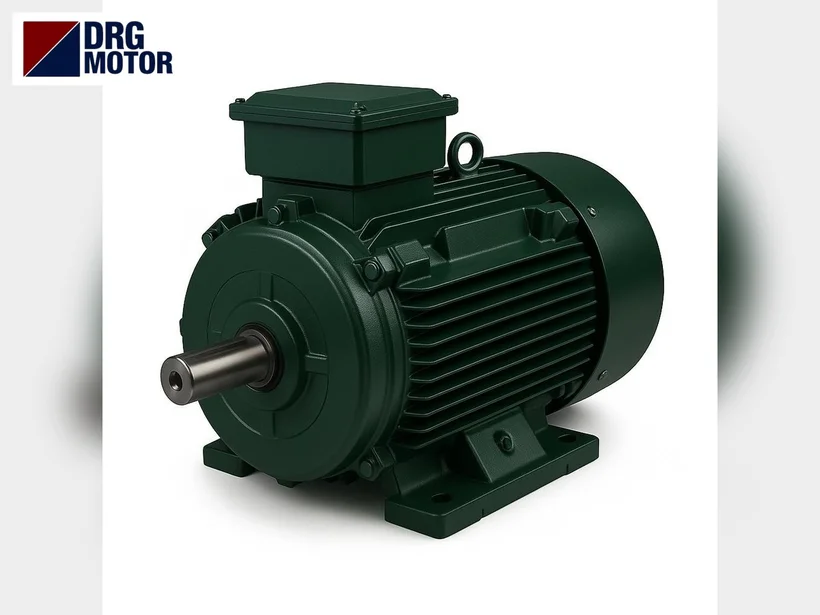
DRG Motor is a manufacturer, supplier and seller of electric motors. We do not sell the crusher itself, roll shells, toothed discs, gearboxes, hydraulic drive units or inverters; our part of the job is the three-phase asynchronous motor behind each roll. You can browse the models on the Buy Electric Motors Online page.
Where does the clay crusher sit in the preparation line?
Clay comes from the pit by truck, is tipped into a box feeder, and the feeder floor slowly pushes it into the crusher mouth. The crusher’s job is to make the clods dosable: one maker’s data sheet accepts pieces up to 600×500×400 mm and brings them down to about 100×60×30 mm. Next comes either a stone separating roller or, in dry lines, a hammer crusher, then fine rolling and mixing. When the crusher stops, the rest of the line runs empty, which is why plants keep this motor on their critical spares list.
Toothed roll clay crusher
One-piece toothed discs are stacked on two slow rolls; the rolls turn towards each other at different speeds and the clod breaks under pressure and shear as it passes between the teeth. One catalogue gives a roll gap adjustable between about 10 and 100 mm. In mechanical versions each roll is driven by its own motor and bevel-helical gearbox, with speed set by an inverter; in hydraulic versions the electric motor drives a hydraulic pump and a hydraulic motor turns the roll.
Knife-roll crusher (disintegrator)
Here a large smooth roll faces a small roll carrying replaceable steel knives. The knife roll runs much faster and slices the clay, while the slow smooth roll carries it through. Data sheets show the two rolls on separate motors of different power: at one maker, 11 kW and 30 kW for an 800 mm width, 15 kW and 37 kW for 1000 mm. The large roll sits in spring-loaded bearings, so the gap opens when an uncrushable stone arrives.
Geared primary clay crusher
If the pit delivers coarse dry or moist material with hard inclusions, a slow, heavy-rotor primary crusher comes first. One maker states that this machine is driven through a gearbox, motor and pulley, reduces pieces of up to 400 mm to 20–30 mm, and uses a single 45 or 55 kW motor. As the rotor turns only a few tens of revolutions per minute, the reduction between motor and rotor is large.
How does wet, sticky clay load the motor?
In dry stone crushing the load is impact; in a clay crusher it comes mostly from friction and smearing. Wet clay packs the gaps between teeth, sticks to the rolls and acts like an extra brake until the scrapers clear it. In the rainy season the same machine turns harder than in summer, and some makers stress that the roll gap can be changed to suit seasonal raw material. Not going below the rated power of the original motor avoids thermal trips in heavy-clay periods.
Belts, pulleys and the shear pin
On belt-driven clay crushers the large rotor pulley also behaves like a flywheel. A domestic maker explains that when a foreign body slips between the rotors, a shear pin on the pulley breaks and the pulley freewheels, while spring-loaded bearings open the gap as a second safeguard. Once the pin breaks the motor is unloaded, but the line waits until the pin and belts are replaced. If you want the motor to trip on current before the pin shears, set the relay together with the machine maker.
Matching the two motors
Because the two rolls run at different speeds, their pulleys differ even when the motors have the same rating. Toothed roll types usually carry two equal motors (for example 2 × 37 kW); knife-roll types give the fast and slow roll motors of different power. Keeping both motors at the same pole count on replacement preserves the pulley ratios and thus the speed difference between rolls. On inverter-controlled machines keep the drive within the limits set by the machine maker; drives are not part of our offer.
How many kW should a clay crusher motor be?
A) Crusher motor ratings given in makers’ catalogues for brick and tile raw material:
| Machine type / size | Motor power | Single / total | Note |
|---|---|---|---|
| Toothed roll crusher, 430×1200 mm | 2 × 37 kW | two motors, 74 kW total | first maker, mechanical drive |
| Toothed roll crusher, 920×1860 mm | 2 × 90 kW | two motors, 180 kW total | first maker, largest mechanical type |
| Toothed roll crusher, hydraulic drive | 75–200 kW | drive power per machine | first maker; motor turns a hydraulic pump |
| Knife-roll crusher, 800 mm wide | 11 kW + 30 kW | smooth and knife roll each with own motor | second maker, 60–80 t/h |
| Knife-roll crusher, 1000 mm wide | 15 kW + 37 kW | two motors, 52 kW total | second maker, 80–100 t/h |
| Disintegrator, fast roll | 30–56 kW | fast-roll motor | third maker, 457 and 610 mm wide |
| Geared primary clay crusher | 45 kW and 55 kW | single motor | second maker, 50–150 t/h |
| Clay-shale crusher, twin rotor 800×1400 mm | 2 × 160 kW | two motors, 320 kW total | fourth maker, 950 rpm motor |
In this machine group, depending on the maker’s model, roll width and clay hardness, options of about 11–160 kW per motor are seen; on twin-motor machines the total approaches twice that. On hydraulically driven types, 75–200 kW is the rating of the motor turning the pump, not the power per roll. The required power changes with capacity (t/h or m³/h), moisture and the share of hard inclusions.
B) Overlap with the DRG range: every rating from 11 to 160 kW has a 4- or 6-pole cast iron match with us; DRG-355M1-6 for 160 kW at 6 poles, 160L and 200L frames for the smaller knife-roll motors. Where data sheets show 950 rpm class motors, a 6-pole motor (about 970–990 rpm) needs only a small pulley correction. Special crushers requiring more than 355 kW, medium voltage or an 8-pole motor are outside our range.
Click to see current electric motor prices and order nowSEE PRICES →
Example: pulley and torque on a twin-rotor crusher
The fourth maker’s data sheet for a twin-rotor clay-shale crusher lists two 160 kW motors, a 1700 mm rotor pulley, 106 rpm on the fast rotor and 94 rpm on the slow one. With these values we can work out the pulley and shaft torque for a DRG-355M1-6 (990 rpm) of the same rating:
| Step | Calculation | Result | Comment |
|---|---|---|---|
| Ratio for the fast rotor | 990 / 106 | about 9.34 | DRG-355M1-6, 1700 mm rotor pulley from the data sheet |
| Motor pulley, fast rotor | 1700 × 106 / 990 | about 182 mm | around 190 mm with a 950 rpm motor |
| Motor pulley, slow rotor | 1700 × 94 / 990 | about 161 mm | the speed difference between rotors comes from the pulleys |
| Torque on the fast rotor shaft | 9550 × 160 / 106 | about 14,400 Nm | rough value, belt losses ignored |
| Torque on the slow rotor shaft | 9550 × 160 / 94 | about 16,250 Nm | the slow side carries more torque |
The table shows two things: when the motor speed is slightly different, the motor pulley is reduced by a few millimetres to keep the rotor speed, and the crushing torque appears on the rotor shaft, not the motor shaft; the motor sees it divided by the pulley ratio. You can try your own diameters with the pulley and belt calculator.
Effect of two large motors on the supply
| Case | Calculation | Current (400 V) | Note |
|---|---|---|---|
| One motor at rated load | 281 | 281 A | DRG-355M1-6 rated current |
| One motor direct-on-line start | 281 × 6.8 | about 1,911 A | Is/In = 6.8 |
| One motor in star stage | 1,911 / 3 | about 637 A | first stage of star-delta |
| Second motor in star while the first runs | 281 + 637 | about 918 A | staggered start |
Starting both motors direct-on-line at the same moment strains the transformer and panel. A clay crusher normally starts empty, yet pulley and rotor inertia lengthen the run-up; starting the motors a few seconds apart with star-delta or a soft starter is the usual route. Compare methods with our star-delta starting tool.
Information needed and items outside our range
- Old motor nameplate: kW, speed, voltage, connection (star/delta) and frame size.
- Per roll or machine total? List fast-roll and slow-roll motors separately.
- Pulley diameters and belt type, or gearbox input flange and shaft size.
- Foot (B3) or flange (B5/B35) mounting; motor slide rail dimensions.
- Starting method: direct, star-delta, soft starter or inverter.
- Clay moisture, hard inclusions and stones; whether the machine stands indoors or outdoors (our IP55 motors are protected against dust and water splashes).
Not in our range
On crushers whose rolls are turned by hydraulic motors, the part we can supply is the motor driving the hydraulic pump; pumps and power units are not in our range, and for sizing see our hydraulic pump motor article. Brake motors for lifting feed gates or hoists, single-phase motors used on small workshop machines, servo motors and motors above 355 kW are not part of our offer. If an explosive dust zone such as coal dust is defined next to the crusher, an Ex-rated motor with the matching documentation is required; our standard motor is not sold with it.
DRG motors for clay crushers
Cast iron models suited to everything from knife rolls to twin-rotor clay-shale crushers (current at 400 V):
| Model | Power / speed | Frame · shaft D×E | Current 400 V |
|---|---|---|---|
| DRG-160L-6 | 11 kW / 970 rpm | 160L cast iron · 42×110 | 22 A |
| DRG-200L-4 | 30 kW / 1475 rpm | 200L cast iron · 55×110 | 53.8 A |
| DRG-225M-6 | 30 kW / 980 rpm | 225M cast iron · 60×140 | 56.2 A |
| DRG-225S-4 | 37 kW / 1485 rpm | 225S cast iron · 60×140 | 66.1 A |
| DRG-250M-4 | 55 kW / 1485 rpm | 250M cast iron · 65×140 | 97.6 A |
| DRG-315S-6 | 75 kW / 985 rpm | 315S cast iron · 85×170 | 136 A |
| DRG-315M-6 | 90 kW / 988 rpm | 315M cast iron · 85×170 | 161 A |
| DRG-355M1-6 | 160 kW / 990 rpm | 355M cast iron · 100×170 | 281 A |
A clay crusher motor usually sits on feet (B3) on a slide rail used for belt tensioning. Our aluminium motors stop at 11 kW, while cast iron ones continue to 355 kW; all motors are 3-phase asynchronous IEC motors in 2, 4 and 6 poles. We check fit using the nameplate, shaft diameter and key, and foot hole spacing together; drawings are on the technical drawings page.
Live price table
Prices of models in clay crusher power ratings are pulled live from the shop:
| Model | Power / speed | Frame · current 400 V | Price |
|---|---|---|---|
| DRG-160L-615 HP | 11 kW · 1000 rpm | Cast iron 160L · 22 A | $668.92 (€597.39) Details & buy → |
| DRG-200L-440 HP | 30 kW · 1500 rpm | Cast iron 200L · 53.8 A | $1,235.00 (€1,102.93) Details & buy → |
| DRG-225S-450 HP | 37 kW · 1500 rpm | Cast iron 225S · 66.1 A | $1,527.18 (€1,363.87) Details & buy → |
| DRG-280S-660 HP | 45 kW · 1000 rpm | Cast iron 280S · 81.6 A | $2,568.23 (€2,293.59) Details & buy → |
| DRG-225M-460 HP | 45 kW · 1500 rpm | Cast iron 225M · 80.2 A | $1,688.50 (€1,507.94) Details & buy → |
| DRG-250M-475 HP | 55 kW · 1500 rpm | Cast iron 250M · 97.6 A | $2,065.73 (€1,844.82) Details & buy → |
| DRG-315S-6100 HP | 75 kW · 1000 rpm | Cast iron 315S · 136 A | $3,889.23 (€3,473.33) Details & buy → |
| DRG-315M-6125 HP | 90 kW · 1000 rpm | Cast iron 315M · 161 A | $4,430.22 (€3,956.46) Details & buy → |
| DRG-355M1-6200 HP | 160 kW · 1000 rpm | Cast iron 355M · 281 A | $6,285.89 (€5,613.69) Details & buy → |
DRG MOTOR motors are guaranteed against material and manufacturing defects for 2 years from the delivery date (warranty certificate).
Motors in this power range
- DRG-160L-6 – 11 kW – 970 rpm – 160L cast iron
- DRG-225S-4 – 37 kW – 1485 rpm – 225S cast iron
- DRG-250M-4 – 55 kW – 1485 rpm – 250M cast iron
- DRG-315M-6 – 90 kW – 988 rpm – 315M cast iron
- DRG-355M1-6 – 160 kW – 990 rpm – 355M cast iron
Click to see current prices and order these motors nowSEE PRICES →
Browse products, ask for a quote: motors for your crusher are on the Buy Electric Motors Online page. Send a photo of the nameplate and the pulley side via WhatsApp and we will check power per roll and pulley sizes with you. Phone: +90 (542) 666 11 11.
Frequently asked questions
Can the two motors of a clay crusher have different ratings?
Yes. On knife-roll types the fast knife roll and the slow smooth roll take motors of different power; on toothed roll types the two motors are usually equal. Keep the original pairing when replacing.
Should a clay crusher motor be 4-pole or 6-pole?
The pulleys were sized for the original motor speed. Staying at the same pole count is simplest; a different pole count means working out new pulley diameters.
Why does the motor draw more current on rainy days?
Wet clay sticks to rolls and teeth, so scraper load and friction rise. Check scrapers and roll gap; if the current stays above the nameplate value, review motor power with the machine maker.
What does the price of a clay crusher motor depend on?
Power, pole count and frame size; the table above shows current prices from the shop.
Questions: +90 (542) 666 11 11 · info@drgmotor.com · contact.


