 English
 Le français
 Türkçe

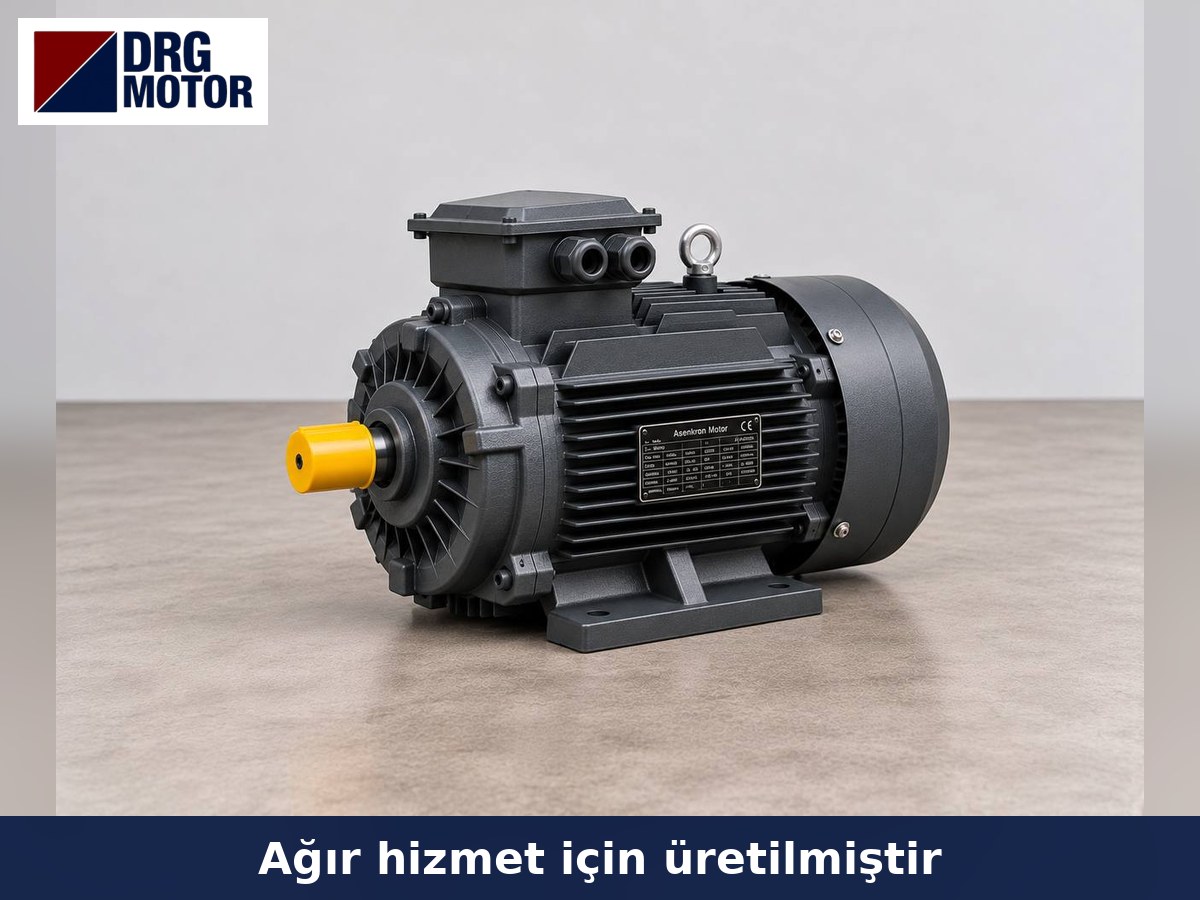
A vacuum pump draws gas out of a closed volume and discharges it to atmosphere, lowering the pressure; the electric motor turns the pump rotor, which is a slotted rotor with vanes in a vane pump, an impeller in a liquid ring pump, a pair of screws in a screw pump and two lobed rotors in a Roots pump. When the pump type changes, so do the motor speed, the way it is connected and its power. Manufacturer catalogues show motors of around 1 kW on small vane pumps and up to 132 kW on large liquid ring pumps. This page maps the vacuum pump family from the motor’s point of view; for replacing the motor of a single pump and its power curve, see our vacuum pump motor selection and replacement guide.
DRG Motor is a manufacturer, supplier and seller of electric motors. We do not sell the vacuum pump itself, seal and vane kits, separators or seal-water circuits; the vane, ring, screw or lobe drive is left to its maker, and we deliver the motor that spins it. All models are on the Buy Electric Motors Online page.
Pump types and the work the motor does
Four pump families are the ones met most often in industry. In each, the motor does the same job, turning the rotor, but speed and connection differ.
Vane pump (oil-lubricated and dry)
Vanes sitting in the slots of an eccentric rotor slide along the housing and compress the gas. In one maker’s oil-lubricated vane series the motors run at 1500 rpm; 1.0 kW is given for the 25 m³/h model and 8.3 kW for the 300 m³/h model. Packaging machines, CNC vacuum tables and drying ovens are typical users. A dry vane pump has no oil and self-lubricating vanes; the motor connection is the same.
Liquid ring pump
The impeller turning in the casing throws the seal water outward into a ring; the cells between the ring and the impeller draw in and compress the gas. It tolerates humid, vapour-laden or liquid-carrying gas and is used in plastics extrusion, filtration, drying and meat processing. One maker’s small systems use 2900 rpm motors and its larger ones 1450 rpm. Besides the gas, the motor also moves the water; running with too much water loads the motor.
Dry screw pump
Two screws turn without contact and there is no oil in the compression chamber. It is preferred in chemical, pharmaceutical and distillation processes. One maker’s 85 m³/h model has a 1.5 kW, 3000 rpm motor, and that motor is a canned design built into the pump.
Roots pump (booster)
Two lobed rotors turn without touching; on its own it does not discharge to atmosphere, and a backing pump (vane, liquid ring or screw) runs behind it. The booster multiplies the flow obtained from the same backing pump at low pressure. In one maker’s series with flange-mounted motors the motor ranges from 1.1 kW to 7.5 kW at 3000 rpm.
Close-coupled, flanged and coupled connections
The way the motor is joined to the pump decides whether a standard IEC motor can be used.
Flange motor and flexible coupling
On most vane and Roots pumps the motor is bolted by its B5 flange to the pump’s lantern (bell housing) and joined to the shaft by a flexible coupling. A Roots catalogue calls this layout a “flange-mounted motor”; oiled shaft seals keep the pump shaft tight against atmosphere. With this type the motor can be replaced by an IEC motor of the same frame and flange. B5 dimensions from our catalogue:
| Frame | Shaft D×E | Flange P / M / N | Hole S |
|---|---|---|---|
| 90S/90L | 24×50 | 200 / 165 / 130 | 12 |
| 100L/112M | 28×60 | 250 / 215 / 180 | 14.5 |
| 132S/132M | 38×80 | 300 / 265 / 230 | 14.5 |
| 160M/160L | 42×110 | 350 / 300 / 250 | 18.5 |
Coupled on a baseplate
Large liquid ring pumps are sold bare-shaft (as a block), placed on a common baseplate with a foot-mounted motor and joined by a coupling. One maker offers the same pump as a bare-shaft block, a motorised pack and a ready water-recovery module. A B3 foot motor is used here and coupling alignment is reset after replacement. On smaller liquid ring series a lantern flange gives the alignment by itself.
Canned and hermetic motors: not in our range
On some Roots and dry screw pumps the motor rotor turns inside the vacuum, with a non-magnetic can between it and the stator, and there is no shaft seal. In the hermetic type the whole motor is moved to the vacuum side. Such a motor belongs to the pump body itself; no catalogue IEC motor can take its place. Canned and hermetic motors are not in our range; if such a pump fails, contact the pump manufacturer.
Click to see current electric motor prices and order nowSEE PRICES →
How many kW is a vacuum pump motor? Catalogue values
A) What vacuum pump makers list as motor power in their data sheets:
| Pump type / model group | Motor power | Single / total | Note |
|---|---|---|---|
| Oil-lubricated vane, 25–40 m³/h | 1.0–1.4 kW | single motor, 1500 rpm | first maker, small models |
| Oil-lubricated vane, 160–300 m³/h | 5.5–8.3 kW | single motor, 1500 rpm | first maker, large models |
| Dry screw, 85 m³/h | 1.5 kW | single motor, 3000 rpm | first maker; canned motor built into the pump |
| Liquid ring system, small sizes | 1.1–1.5 kW | single motor, 2900 rpm | first maker |
| Liquid ring system, large sizes | 2.2–4.0 kW | single motor, 1450 rpm | first maker |
| Liquid ring, single stage, 165–400 m³/h | 4–11 kW | single motor | second maker, lantern flange mounting |
| Liquid ring, single stage, 170–5400 m³/h | 5.5–132 kW | single motor | second maker, widest series |
| Roots (booster), 253–2000 m³/h class | 1.1–7.5 kW | booster motor only, 3000 rpm | third maker; backing pump motor extra |
Depending on the maker’s model and suction capacity, motor options of roughly 1–132 kW are seen in this machine group. The same vane catalogue shows the 205 m³/h model fitted with a 5.5 kW motor while the pump draws 4.2 kW at 100 mbar and 3.3 kW at ultimate pressure; the motor’s plate rating is not the pump’s consumption at every operating point. Non-standard values such as 8.3 kW belong to the pump maker’s own motor winding; the next standard step up is chosen instead.
B) Overlap with the DRG range: every flange- or foot-mounted motor running at 3000 or 1500 rpm has a counterpart in our range. Outside it are pumps with canned or hermetic motors, small single-phase laboratory pumps and the Ex motors required on pumps handling explosive gas.
Example: a booster and backing pump set
Assume a drying line where a 2.2 kW Roots booster runs in front of a 5.5 kW oil-lubricated vane backing pump. The booster maker specifies the backing pump type; here we put motor values from two different catalogues side by side only to show the electrical side:
| Stage | Motor in catalogue | DRG counterpart | Current 400 V |
|---|---|---|---|
| Roots booster (3000 rpm) | 2.2 kW | DRG-90L-2 | 4.35 A |
| Backing pump: oil-lubricated vane (1500 rpm) | 5.5 kW | DRG-132S-4 | 10.7 A |
| Both motors together | 7.7 kW | — | 15.05 A |
The set consists of two separate motors at different speeds: the booster needs a 2-pole motor and the backing pump a 4-pole one. In the control panel the backing pump must start first and the booster only after the pressure has fallen to a set value; running the booster at atmospheric pressure overloads it. This sequence comes from the pump maker’s control diagram. Together the pair draws 15.05 A, a figure to carry into the contactor and overload sizing tool.
Keep the speed
A pump’s suction capacity is proportional to speed. Fitting a 3000 rpm motor to a 1500 rpm vane pump drives the vanes and bearings beyond the speed the maker allows; the reverse halves the capacity. Always keep the old motor’s pole count.
Surroundings, rotation and out-of-range cases
Liquid ring pumps stand in wet surroundings; an IP55 enclosure copes with splashes, yet a hose aimed at the motor or a leak dripping on it for hours is still to be avoided. Vane pump bodies get hot; the motor fan carries this heat away too, so a pump placed in a cabinet needs ventilation. Check rotation against the arrow on the pump; a vane pump running backwards can be damaged quickly.
A vacuum pump drive needs no brake; brake motors are not in our range. Single-phase motors on milking machines and laboratory pumps are not in our range either; for milking vacuum pumps see our milking machine motor article. Pumps working in explosive atmospheres need Ex motors, which are also not in our range. And do not confuse vacuum pumps with the liquid pumps in our Pump Motors category: one pushes liquid, the other draws gas.
Vacuum pumps with DRG motors
The table lists 2-pole models for Roots and dry screw pumps and 4-pole models for vane and large liquid ring pumps:
| Model | Power / speed | Frame · shaft D×E | Current 400 V |
|---|---|---|---|
| DRG-90S-2 | 1.5 kW / 2895 rpm | 90S cast iron · 24×50 | 3.06 A |
| DRG-90L-2 | 2.2 kW / 2895 rpm | 90L cast iron · 24×50 | 4.35 A |
| DRG-112M-2 | 4 kW / 2905 rpm | 112M cast iron · 28×60 | 7.45 A |
| DRG-90L-4 | 1.5 kW / 1445 rpm | 90L cast iron · 24×50 | 3.3 A |
| DRG-112M-4 | 4 kW / 1450 rpm | 112M cast iron · 28×60 | 7.95 A |
| DRG-132S-4 | 5.5 kW / 1460 rpm | 132S cast iron · 38×80 | 10.7 A |
| DRG-132M-4 | 7.5 kW / 1460 rpm | 132M cast iron · 38×80 | 14.3 A |
| DRG-160M-4 | 11 kW / 1465 rpm | 160M cast iron · 42×110 | 20.4 A |
| DRG-180M-4 | 18.5 kW / 1470 rpm | 180M cast iron · 48×110 | 33.5 A |
In the order, state the mounting (B5 for a flanged pump, B3 or B35 for a baseplate pump), the shaft D×E and the flange diameter. Flange and shaft sizes for every frame are in our drawing library, and we confirm the match only once the pump side has been measured.
Live price table
Prices of models in vacuum pump ratings come live from the shop:
| Model | Power / speed | Frame · current 400 V | Price |
|---|---|---|---|
| DRG-90L-42 HP | 1.5 kW · 1500 rpm | Cast iron 90L · 3.3 A | $144.14 (€128.73) Details & buy → |
| DRG-100L1-43 HP | 2.2 kW · 1500 rpm | Cast iron 100L · 4.52 A | $188.32 (€168.18) Details & buy → |
| DRG-90L-23 HP | 2.2 kW · 3000 rpm | Cast iron 90L · 4.35 A | $154.45 (€137.93) Details & buy → |
| DRG-112M-45.5 HP | 4 kW · 1500 rpm | Cast iron 112M · 7.95 A | $254.38 (€227.18) Details & buy → |
| DRG-132S-47.5 HP | 5.5 kW · 1500 rpm | Cast iron 132S · 10.7 A | $342.01 (€305.44) Details & buy → |
| DRG-132M-410 HP | 7.5 kW · 1500 rpm | Cast iron 132M · 14.3 A | $394.89 (€352.66) Details & buy → |
| DRG-160M-415 HP | 11 kW · 1500 rpm | Cast iron 160M · 20.4 A | $568.76 (€507.94) Details & buy → |
| DRG-160L-420 HP | 15 kW · 1500 rpm | Cast iron 160L · 27.3 A | $678.13 (€605.61) Details & buy → |
| DRG-180M-425 HP | 18.5 kW · 1500 rpm | Cast iron 180M · 33.5 A | $873.49 (€780.08) Details & buy → |
DRG MOTOR motors are guaranteed against material and manufacturing defects for 2 years from the delivery date (warranty certificate).
Motors in this power range
- DRG-90L-2 – 2.2 kW – 2895 rpm – 90L cast iron
- DRG-112M-2 – 4 kW – 2905 rpm – 112M cast iron
- DRG-132S-4 – 5.5 kW – 1460 rpm – 132S cast iron
- DRG-160M-4 – 11 kW – 1465 rpm – 160M cast iron
- DRG-180M-4 – 18.5 kW – 1470 rpm – 180M cast iron
Click to see current prices and order these motors nowSEE PRICES →
Have a look at the products and get a quote: send the pump’s type plate and the old motor plate via WhatsApp or reach us on +90 (542) 666 11 11. Matching motors are on the Buy Electric Motors Online page; the general introduction to industrial motors is on the General Purpose Industrial Electric Motors page.
Frequently asked questions
Should a vacuum pump motor be 2-pole or 4-pole?
It depends on the pump type. In the catalogues vane pumps and large liquid ring pumps come with 1500 rpm motors, Roots and dry screw pumps with 3000 rpm motors. The old motor plate or the pump label gives the right answer.
Can a standard motor be fitted to a pump with a canned motor?
No. In canned and hermetic motors the rotor sits on the pump shaft and turns inside the vacuum; there is no shaft end or flange to connect a standard motor to.
Why does the liquid ring pump motor draw too much current?
If the seal water flow is higher than needed, the impeller throws more water and the motor is loaded. First bring the water flow to the pump maker’s value, then measure the current again.
How do I find out the price of a vacuum pump motor?
The live table above shows current prices of 2- and 4-pole models in vacuum pump ratings.
Questions: +90 (542) 666 11 11 · info@drgmotor.com · contact.


